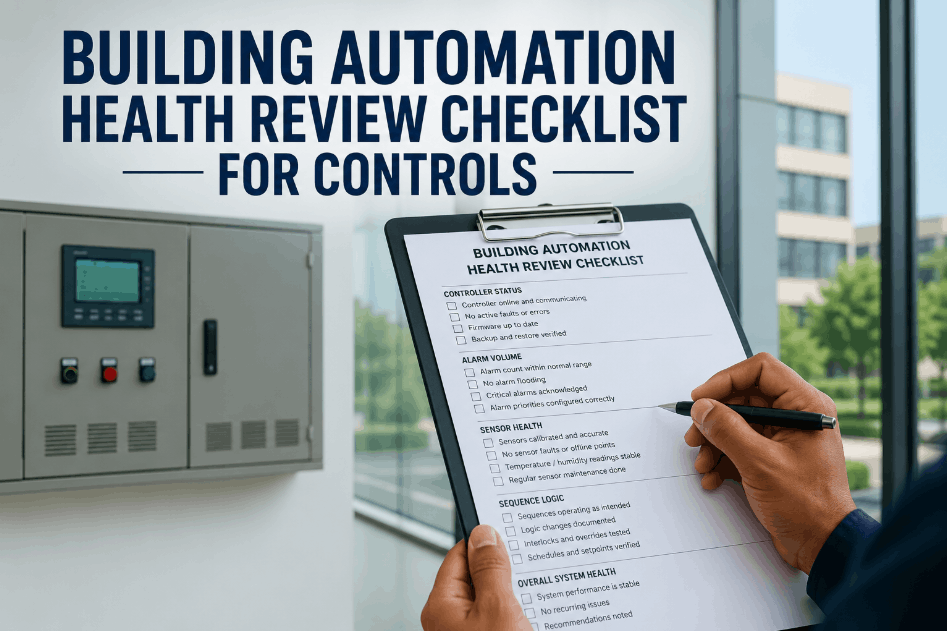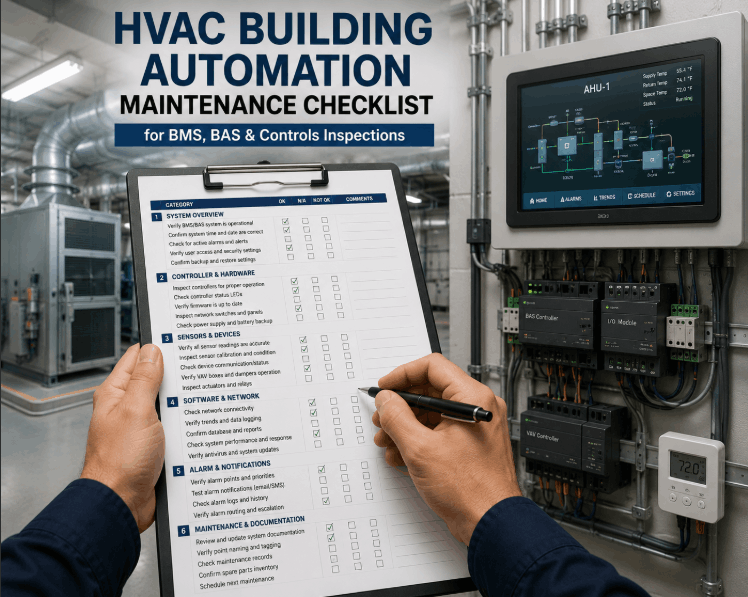
Your BMS/BAS system controls up to 70% of your building's total energy load — but an improperly configured or uncalibrated system silently costs 20% of that energy back through sensor drift, missed control sequences, and outdated firmware. Oxmaint's IoT integration platform connects directly to BACnet, Modbus, and LonWorks-based building automation systems, turning every sensor deviation and fault code into an automated maintenance work order before comfort or compliance is impacted. This checklist covers every layer of BMS/BAS verification — from hardware sensors to network protocols — with the frequency and documentation your team needs to keep smart building automation performing as designed.
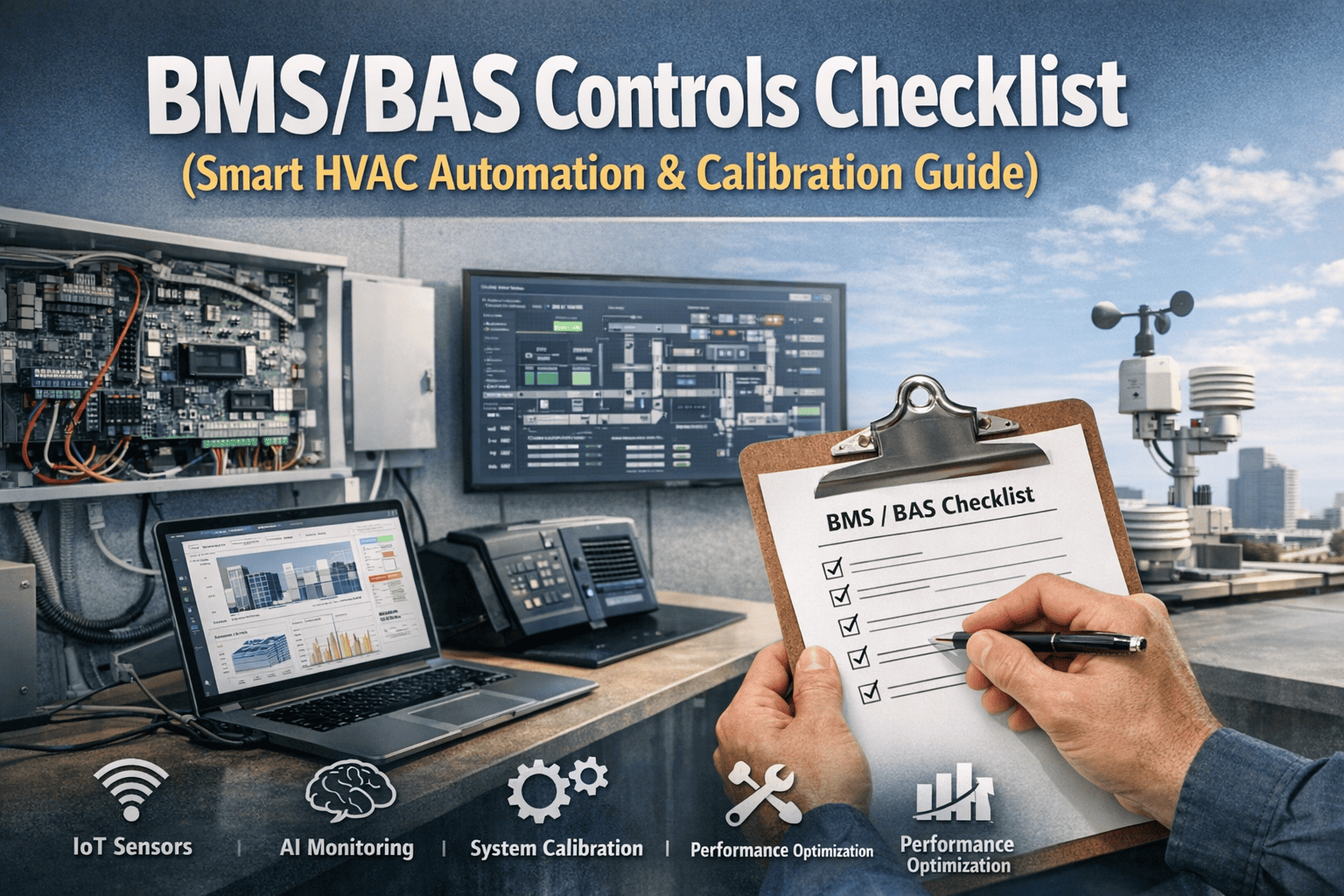
BMS/BAS Controls Checklist: Smart HVAC Automation & Calibration Guide
A structured verification framework for facility managers and controls engineers — covering sensor calibration, network protocols, control sequences, and AI-powered fault detection across BACnet, Modbus, and LonWorks systems.
Smart Building Control KPIs — Real-Time Monitoring
BMS/BAS Controls Verification Checklist
Each layer maps to a specific control system failure mode. Work through them in sequence — hardware integrity before software review, sensors before sequences.
| Verification Item | Method | Pass Criteria | Frequency |
|---|---|---|---|
| DDC controller power supply voltage | Multimeter test | 24VAC ±10% | Monthly |
| Controller enclosure temperature | Thermal probe | Below 40°C | Weekly |
| Status LEDs on all controllers | Visual inspection | No fault indicators | Weekly |
| Battery backup on memory modules | Battery tester | Charge above 90% | Quarterly |
| Physical wiring — loose terminals | Inspection + pull test | No movement at terminals | Semi-annual |
| Sensor Type | Calibration Tool | Acceptable Deviation | Action if Failed |
|---|---|---|---|
| Temperature sensors (AHU, zones) | Calibrated reference probe | ±1°F (±0.55°C) | Recalibrate or replace |
| Humidity sensors (RH%) | Calibrated hygrometer | ±3% RH | Factory recalibration |
| CO2 sensors | Reference gas cylinder | ±50 ppm | Zero-span calibration |
| Differential pressure sensors | Manometer reference | ±0.05 in. WG | Recalibrate transmitter |
| Occupancy/PIR sensors | Physical occupancy test | Response within 30 sec | Adjust sensitivity or replace |
| Flow meters (air/water) | Ultrasonic clamp meter | ±5% of design flow | Rebalance system |
| Protocol / System | Test Method | Pass Criteria | Frequency |
|---|---|---|---|
| BACnet/IP device discovery | Network scan tool | 100% device visibility | Monthly |
| Modbus RTU polling response | Packet analyzer | Response under 200ms | Monthly |
| LonWorks node communication | NL-220 analyzer | No communication errors | Monthly |
| IP addressing / subnet config | Network review | No conflicts / duplicates | Quarterly |
| BMS head-end server backup | Restore test | Successful restore under 2hr | Monthly |
| Control Sequence | Expected Response | Verified By | Frequency |
|---|---|---|---|
| Occupied/unoccupied scheduling | HVAC setback within 5 min of schedule | Time-stamp comparison | Quarterly |
| Economizer enable/disable | Damper opens when OAT below 60°F | Manual temp manipulation | Seasonal |
| Demand-controlled ventilation (DCV) | OA damper modulates with CO2 | CO2 spike test | Semi-annual |
| VAV box minimum airflow | Maintains design minimum at all loads | Flow hood measurement | Annual |
| Chilled water reset schedule | CHW setpoint rises as load drops | Load ramp test | Semi-annual |
| Heat/cool interlock prevention | No simultaneous heat + cool in same zone | Logic trace in BMS | Quarterly |
| Item | Action | Frequency |
|---|---|---|
| Controller firmware versions | Compare to vendor latest — patch if behind | Quarterly |
| BMS software license validity | Verify expiry dates — renew proactively | Annual |
| Unauthorized sequence changes | Compare to as-built documentation | Quarterly |
| Alarm configuration review | Verify priority levels and routing | Semi-annual |
| Cybersecurity patches | Apply vendor security updates | Monthly |
| Device | Test | Pass Criteria |
|---|---|---|
| Valve actuators (CHW, HHW) | Full stroke test via BMS command | Full travel under 90 sec |
| Damper actuators (OA, RA, SA) | 0–100% position command | Position within ±5% |
| VFD speed control response | 0–60 Hz ramp via BMS signal | Linear response, no hunting |
| Thermostat zone setpoints | Override and verify response | Zone reaches setpoint ±1°F |
| Relay / binary output verification | Force output — confirm device response | Correct device activates |
Automate BMS Fault Detection — Work Orders Before Comfort Is Impacted
Oxmaint connects to your BACnet/Modbus BAS and converts every fault code into a prioritized, auto-dispatched work order — linked to the asset, the control sequence, and the technician on duty.
What AI-Powered BMS Monitoring Delivers
AI-Powered Fault Prediction — Before Failure Occurs
The biggest operational gap I see across commercial facilities is not a lack of BMS data — it is a failure to act on it. A BACnet fault code logged at 2 AM on a Tuesday sits unread until Friday, by which point a recoverable sensor drift has become an occupant comfort complaint and an energy variance that won't show up in the utility bill until next month. Facilities that integrate BMS fault codes directly into a CMMS work order pipeline don't just respond faster — they catch degradation patterns that no human reviewer would ever notice in a sea of alarm logs. The 25–40% reduction in unplanned HVAC downtime that integrated BMS-CMMS platforms deliver is not from better technology — it is from finally closing the gap between data generation and maintenance action.
BMS/BAS Controls — Frequently Asked Questions
How often should BMS sensors be calibrated, and what tolerance is acceptable?
What is the difference between BMS and BAS, and does it affect maintenance approach?
How does Oxmaint integrate with BACnet and Modbus-based building automation systems?
What are the most common BMS calibration failures found during audits?
Connect Your BMS to a CMMS That Acts on Every Fault Code Automatically
Oxmaint's IoT integration layer reads BACnet and Modbus fault codes in real time, generates work orders automatically, and tracks every sensor calibration event and control sequence verification from a single platform — so your BMS investment delivers the energy savings and comfort outcomes it was designed to achieve.