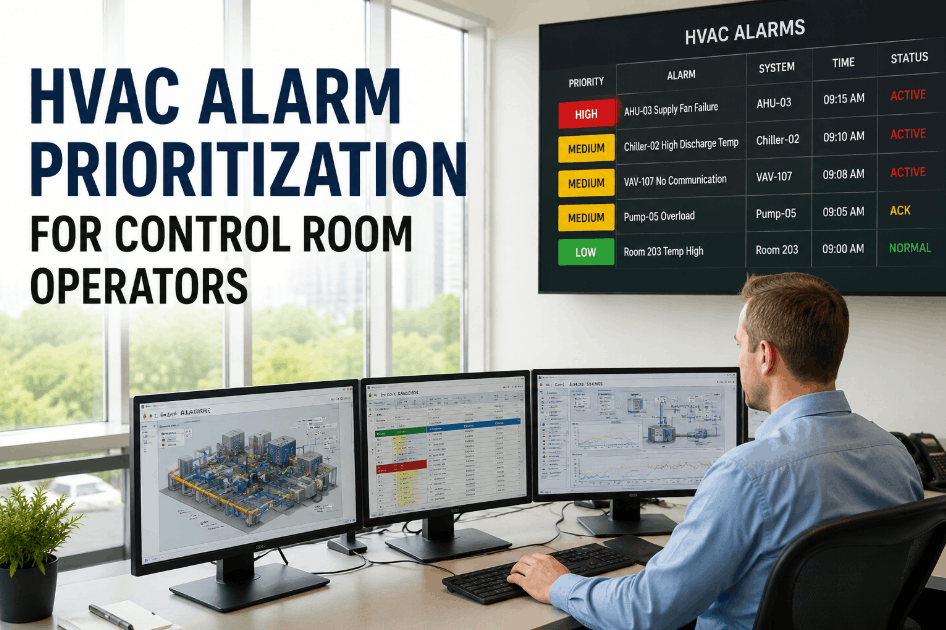
HVAC alarm prioritization is what separates a control room that catches real problems early from one that's buried in noise — when chillers, AHUs, and dozens of VAV terminals all feed the same alarm queue, urgent faults get lost next to routine setpoint deviations and reminder notices. Facility teams using Sign Up Free on OxMaint can categorize alarm severity on every work order, configure escalation rules for critical faults, and give control room operators a queue they can actually trust. Getting alarm prioritization right is what keeps response quality high when every alert competes for the same operator's attention.
Why Alarm Volume Overwhelms Control Room Operators
A building automation system covering chillers, AHUs, and a large VAV network can generate an enormous number of alarms in a single shift, and without consistent prioritization, operators end up triaging by instinct rather than by actual risk. Book a Demo to see how OxMaint links alarm history to asset records so control room teams can rank events by real impact.
Five Alarm Categories Every Control Room Should Prioritize
Consistent categorization is the foundation of effective alarm prioritization — without it, every alert competes equally for attention. Sign Up Free to start tagging alarm category and severity on every work order in OxMaint.
Critical Safety and Life-Safety Alarms
Smoke control interlocks, fire-mode dampers, and life-safety related faults require immediate operator response and should never be queued alongside routine events.
Equipment Protection and Trip Alarms
Chiller trips, compressor overloads, and high-pressure cutouts protect expensive equipment from damage and warrant fast escalation to avoid downtime.
Comfort and Setpoint Deviation Alarms
Zone temperature or humidity deviations matter to occupants but rarely require the same urgency as equipment protection events, and should be triaged accordingly.
Sensor and Communication Fault Alarms
Failed sensors and dropped communication points can mask real conditions behind them, so these deserve attention even though they're not always urgent on their own.
Maintenance Reminder and Informational Alarms
Filter change reminders and routine PM notices are useful for planning but shouldn't compete with operational alarms in the same priority queue.
Alarm Risk by HVAC System Type
Different systems carry different alarm risk profiles, and treating them identically wastes operator attention on low-impact systems. Book a Demo to see how OxMaint maps alarm sources to system type for smarter response routing.
| System | Dominant Alarm Type | Operator Impact | Risk Level | OxMaint Response Lever |
|---|---|---|---|---|
| Chiller Plant | Trip and protection alarms | Cooling capacity loss | Critical | Immediate escalation workflow |
| AHU & RTU Systems | Static pressure, fan fault alarms | Zone airflow disruption | High | Priority work order routing |
| VAV Terminal Network | Comfort and sensor drift alarms | Localized comfort complaints | Medium | Batched triage scheduling |
| Life-Safety Interlocks | Safety override alarms | Building safety risk | Critical | Dedicated alert channel |
| BAS Network Infrastructure | Communication fault alarms | Loss of system visibility | High | Linked controller asset records |
How Poor Alarm Prioritization Drives Operational Risk
When alarms aren't ranked by real urgency, the costs go beyond a single missed event. Sign Up Free to connect alarm history to asset and work order records in OxMaint and build the prioritization structure your control room needs.
Using OxMaint to Prioritize HVAC Alarms at Scale
A structured approach to alarm prioritization holds up far better across shifts and staff turnover than relying on individual operator judgment alone. Book a Demo to see this workflow mapped to your control room's alarm sources.
Register BAS Alarm Sources as Linked Assets
Create asset records in OxMaint for chillers, AHUs, and terminal units so every alarm can be traced back to a specific piece of equipment and its history.
Categorize Alarm Severity on Every Work Order
Tag each alarm-driven work order with a severity tier in OxMaint so operators and technicians work from a consistent priority standard.
Configure Escalation Workflows for Critical Faults
Set up automatic escalation paths in OxMaint for safety and equipment-protection alarms so they reach the right technician without delay.
Link Alarm History to Asset and PM Records
Connect recurring alarm patterns to preventive maintenance schedules in OxMaint to address root causes instead of repeatedly dismissing the same alert.
Generate Alarm Trend Reports for Staffing and Training
Use OxMaint reporting to identify which systems generate the most alarm volume, supporting staffing decisions and operator training priorities.
Frequently Asked Questions: HVAC Alarm Prioritization
What makes HVAC alarm prioritization difficult in large facilities?
High alarm volume across many connected systems makes it hard to separate genuinely urgent faults from routine or informational alerts without a consistent severity framework.
What alarm categories should get the fastest response?
Life-safety alarms and equipment protection trips should always receive the fastest response, ahead of comfort deviations or informational maintenance reminders.
How does OxMaint help with alarm prioritization?
OxMaint links alarm-driven work orders to asset records and severity tags, giving control room teams a consistent way to triage events and escalate critical faults.
What is alarm fatigue and why does it matter?
Alarm fatigue happens when operators are exposed to too many low-priority alerts, making it more likely that a genuinely critical event gets missed or delayed.
Can alarm history support long-term maintenance planning?
Yes — tracking which assets generate recurring alarms in OxMaint helps teams target preventive maintenance at root causes instead of repeatedly responding to the same fault.