Every minute a technician spends searching for equipment information costs your facility an average of $17,000 in hidden downtime. In the high-pressure world of HVAC maintenance, where a failed chiller can disrupt entire buildings and emergency repairs drain budgets, that search time is the silent killer of operational efficiency. Yet across thousands of facilities, technicians still waste 20-30 minutes per service call hunting through binders, calling control rooms, or scrolling through spreadsheets to identify which air handling unit serves a specific room or locate a manual for a rooftop unit installed fifteen years ago. QR code asset tagging changes everything. By linking physical HVAC equipment to digital intelligence through a simple smartphone scan, facilities are reducing diagnosis time by 40%, improving first-time fix rates by 35%, and transforming how technicians interact with complex mechanical systems. This is not future technology—this is the operational standard competitive facilities are implementing today.
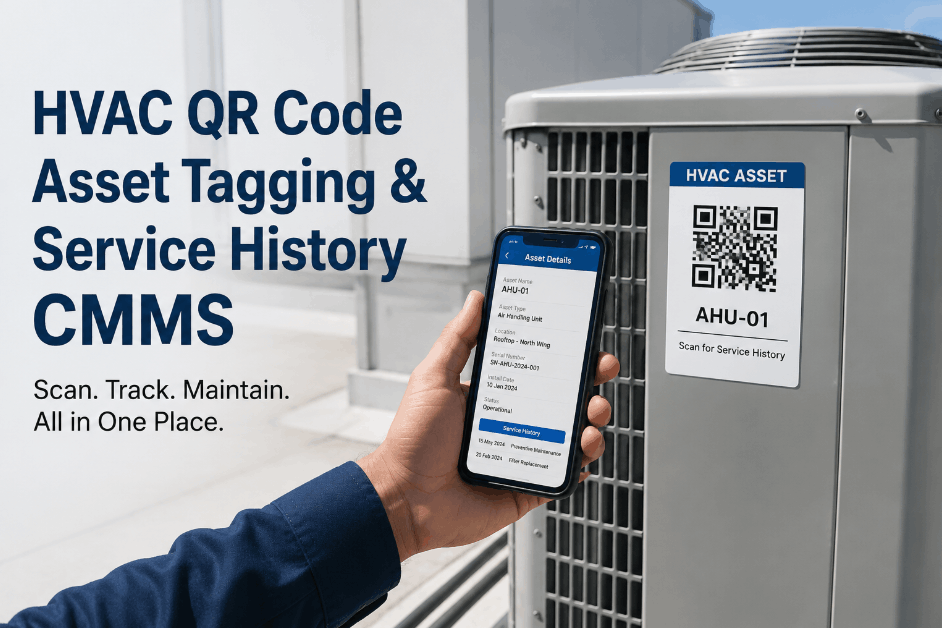
The transformation is immediate and measurable. When a technician approaches an HVAC unit with a QR code tag, they unlock instant access to complete equipment history, preventive maintenance schedules, manufacturer manuals, wiring diagrams, parts lists, and troubleshooting guides—all without typing a single character or making a phone call. No more guessing serial numbers. No more walking back to the shop for paperwork. No more servicing the wrong unit because three rooms share the same number but different air handlers. For facility managers looking to eliminate these inefficiencies, modern CMMS platforms now make QR code deployment faster than traditional labeling systems.
The QR Code Advantage: From Physical Asset to Digital Intelligence
Instant Equipment Identification
Scan any tagged HVAC unit to immediately view asset name, location, model number, serial number, installation date, and warranty status. Eliminate misidentification errors that lead to wrong parts and repeat service calls.
Complete Maintenance History
Access full service records, previous repairs, recurring issues, technician notes, and performance trends. Understand what was fixed last month before touching a single screw.
PM Schedules & Checklists
View upcoming preventive maintenance tasks, step-by-step inspection checklists, required tools, and estimated completion times. Ensure consistent service execution across all shifts.
Technical Documentation
Instant access to manufacturer manuals, wiring diagrams, troubleshooting guides, specification sheets, and safety procedures. No more carrying binders or searching file cabinets.
How QR Code Asset Tagging Transforms HVAC Workflows
The traditional HVAC service workflow is fraught with friction. A technician receives a work order for "Room 1004—no cooling." They arrive at the room, discover the thermostat is unresponsive, and then begins the investigation: Which air handling unit serves this room? Which variable air volume box controls this zone? Where is the equipment located? What is its service history? In large facilities with thousands of rooms and complex duct networks, this detective work can consume 30-45 minutes before actual repair work begins.
QR code tagging eliminates this friction entirely. When the American University in Cairo implemented QR codes across their 2,000-room campus with 150 air handling units, technicians no longer needed to call the control room to identify which AHU served a specific room. A simple scan above the thermostat revealed the room number, connected AHU, VAV box details, and responsible staff—reducing response times by over 60% and eliminating errors from rooms with identical numbers served by different equipment.
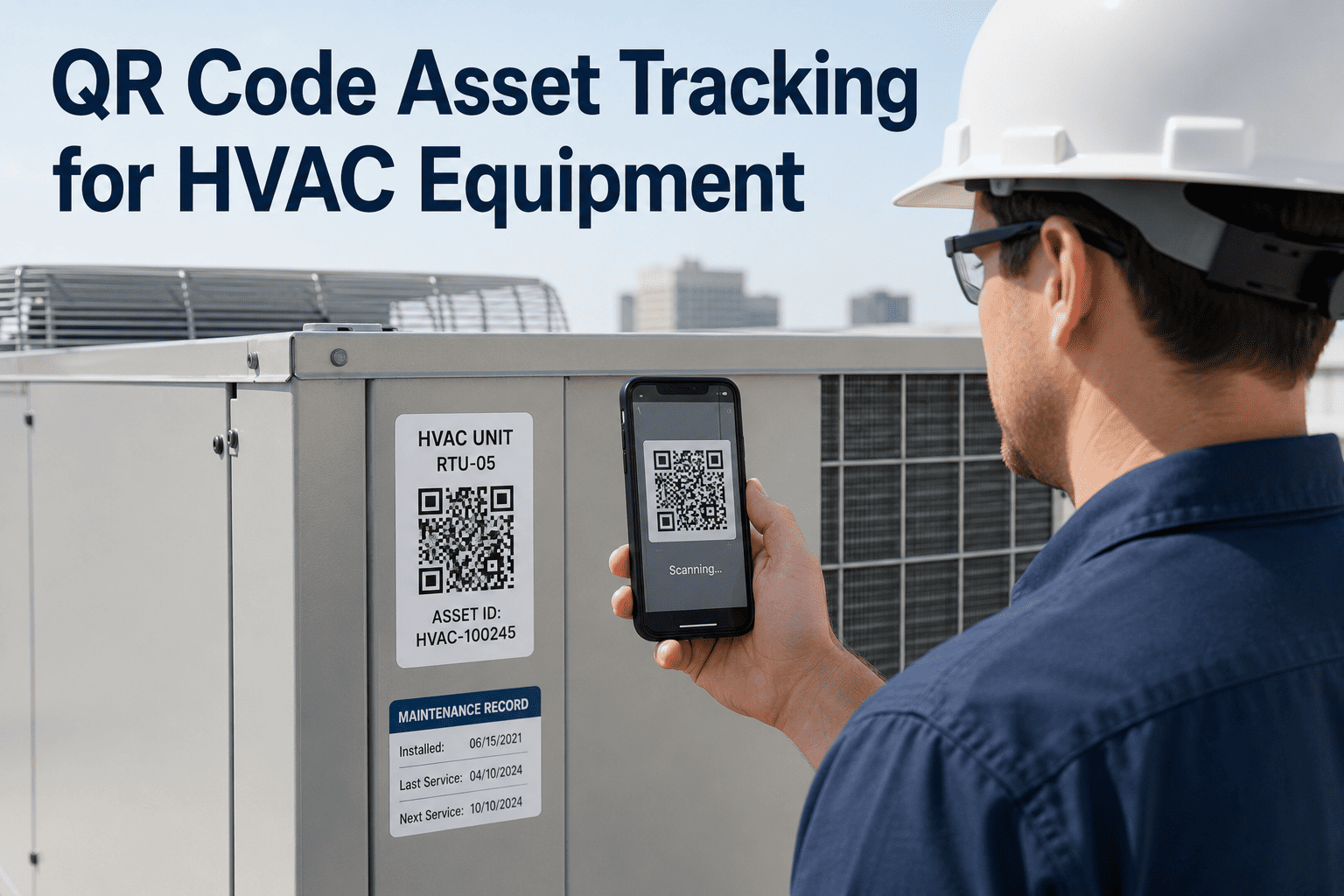
The workflow transformation extends across every maintenance activity. For routine preventive maintenance, technicians scan the QR code on a rooftop unit to instantly access the PM checklist specific to that model, view the last service date, and log completion with photos—all from their smartphone. For emergency repairs, scanning provides immediate access to troubleshooting trees, common failure modes for that specific model, and parts availability. Schedule a demo to see how this workflow eliminates the diagnostic delays that extend downtime.
Real-World Impact: Measurable Efficiency Gains
Reduction in diagnosis time through instant information access
Improvement in first-time fix rates with right parts and knowledge
Faster issue reporting compared to paper-based systems
Reduction in paperwork and administrative data entry
Implementation Strategy: From First Tag to Full Deployment
Deploying a QR code asset tagging system requires strategic planning, but modern CMMS platforms have streamlined the process significantly. The key is balancing comprehensive coverage with practical rollout phases that deliver immediate value while building toward complete asset visibility.
Phase 1: Critical Equipment First (Weeks 1-4): Begin with your most critical HVAC assets—central chillers, boilers, cooling towers, and major air handling units. These systems have the highest impact when they fail and the most complex service requirements. Generate QR codes that link to comprehensive asset profiles including equipment specifications, warranty information, maintenance histories, and critical spare parts lists. Sign up to generate your first batch of asset tags in minutes.
Phase 2: Distributed Systems (Weeks 5-8): Expand to rooftop units, split systems, and variable air volume boxes. For these distributed assets, location accuracy becomes critical. Ensure each tag includes precise location data—building, floor, mechanical room, and specific position within the room. Consider color-coding tags by building or system type for visual identification at a distance.
Phase 3: Endpoint Coverage (Weeks 9-12): Complete the network by tagging thermostats, VAV boxes, and other endpoints. This enables the room-level identification that transformed the American University in Cairo's operations. When a comfort complaint comes in, technicians scan the thermostat to immediately identify the serving equipment and access its complete profile.
Beyond QR Codes: NFC and RFID for Specialized Applications
While QR codes provide the optimal balance of cost, durability, and accessibility for most HVAC applications, certain scenarios benefit from alternative tagging technologies. Understanding when to deploy each type maximizes your asset identification investment.
NFC (Near Field Communication) Tags: These passive tags communicate via smartphone tap rather than camera scan, offering advantages in environments where QR codes might become obscured by dirt or grease. NFC tags work through thin layers of dust and don't require line-of-sight, making them ideal for boiler rooms, kitchen exhaust systems, and industrial environments. However, they cost 3-5x more than QR codes and require closer proximity (typically 1-2 inches).
Passive RFID: For high-security environments or facilities where hands-free scanning is essential, passive RFID enables reading multiple tags simultaneously from several feet away. This technology suits data centers, clean rooms, and facilities where technicians wear gloves that make phone handling difficult. Book a consultation to determine the optimal tagging mix for your facility's specific conditions.
Active RFID & IoT Sensors: The most sophisticated implementations combine asset identification with condition monitoring. Active tags transmit temperature, vibration, or pressure data continuously, enabling true predictive maintenance. While these represent higher investment, they deliver ROI through failure prevention rather than just efficiency gains.
Ready to Transform Your HVAC Maintenance Efficiency?
Join facilities reducing diagnosis time by 40% and improving first-time fix rates with Oxmaint's integrated QR code asset management. Deploy your first 100 tags free and see immediate workflow transformation.
Integration with Mobile CMMS: The Complete Solution
QR codes alone provide identification, but their true power emerges when integrated with a mobile-enabled CMMS platform. This integration creates a seamless flow from physical asset to digital workflow that transforms how technicians execute maintenance.
When a technician scans a QR code in an integrated system, they don't just view static information—they enter a dynamic workflow environment. The scan can automatically generate a work order pre-populated with asset details, location, and maintenance history. Technicians can access step-by-step digital checklists, capture photos of conditions, order parts directly from the equipment profile, and log time and materials with minimal typing. Sign up today to experience how integrated mobile CMMS eliminates the paperwork that consumes 30% of technician time.
The integration also enables powerful analytics. Facility managers can track scan frequency to identify which assets require excessive attention, analyze time-to-resolution by equipment type, and identify training needs based on recurring issues. This data-driven approach shifts maintenance from reactive firefighting to strategic asset management.
FAQ: HVAC Asset Tagging and QR Code Systems
How durable are QR code tags in harsh HVAC environments?
Industrial-grade QR code tags are specifically engineered for HVAC environments. Polyester and anodized aluminum tags withstand temperatures from -40°F to 250°F, UV exposure, moisture, and chemical exposure. For extreme conditions like boiler rooms or outdoor rooftop units, specify tags with protective laminates or metal construction. Properly specified tags maintain scannability for 10+ years. Avoid paper labels or standard office stickers—they degrade within months in mechanical environments.
What information should be encoded in HVAC asset QR codes?
Best practice is encoding a unique asset URL rather than static data. This links to a dynamic database containing: equipment specifications (model, serial, capacity), installation date and warranty info, maintenance history and PM schedules, manufacturer manuals and diagrams, troubleshooting guides, parts lists with inventory status, and responsible technician contacts. Static encoding limits future flexibility, while URL-based tags allow information updates without re-tagging equipment.
How much time do technicians actually save with QR code asset tagging?
Documented time savings average 20-30 minutes per service call. This includes elimination of: equipment identification searches (5-10 min), manual data entry (5-8 min), trips to retrieve manuals or specs (10-15 min), and callbacks for wrong parts or incomplete information (varies). For a technician handling 6-8 calls daily, this translates to 2-4 hours of recovered productive time—enabling either higher work order completion or deeper preventive maintenance focus. Facilities typically see 40% reduction in mean time to repair.
Can QR codes work without internet connectivity in mechanical rooms?
Yes, with proper platform design. Modern mobile CMMS apps like Oxmaint cache asset data locally on the technician's smartphone, enabling full functionality without connectivity. When the device reconnects, data syncs automatically. For deep basement mechanical rooms or remote rooftop units, this offline capability is essential. Alternatively, NFC tags can store limited data locally (typically 500+ bytes) readable without any network connection, though with less information than cloud-linked QR systems.
What is the cost comparison between QR codes and traditional asset labeling?
QR code tags cost $0.50-$3.00 each depending on material and durability—comparable to engraved metal tags or laminated labels. However, the total cost of ownership is significantly lower because: (1) QR codes link to unlimited digital information versus static printed data, (2) updates require database changes not re-tagging, (3) integration with CMMS eliminates separate data entry labor costs, and (4) time savings per service call deliver ROI within weeks. A 500-tag deployment typically pays for itself within 60 days through efficiency gains alone.
How do I get started with QR code asset tagging for my HVAC systems?
Start with a pilot program: (1) Select 20-50 critical assets representing different equipment types, (2) Audit and standardize asset data in your CMMS, (3) Generate and print weatherproof QR code tags, (4) Train technicians on scanning and mobile workflow, (5) Measure time savings and accuracy improvements over 30 days. Successful pilots typically expand organically as technicians demand tags for remaining equipment. Book a demo to see how Oxmaint streamlines tag generation and deployment.
Transform Your Technician Productivity Today
Stop letting information hunts consume 30% of your technician time. Oxmaint's QR code asset management system delivers instant equipment intelligence to any smartphone, reducing diagnosis time by 40% and eliminating the paperwork that delays first-time fixes.
Join 10,000+ technicians accessing instant equipment intelligence with Oxmaint