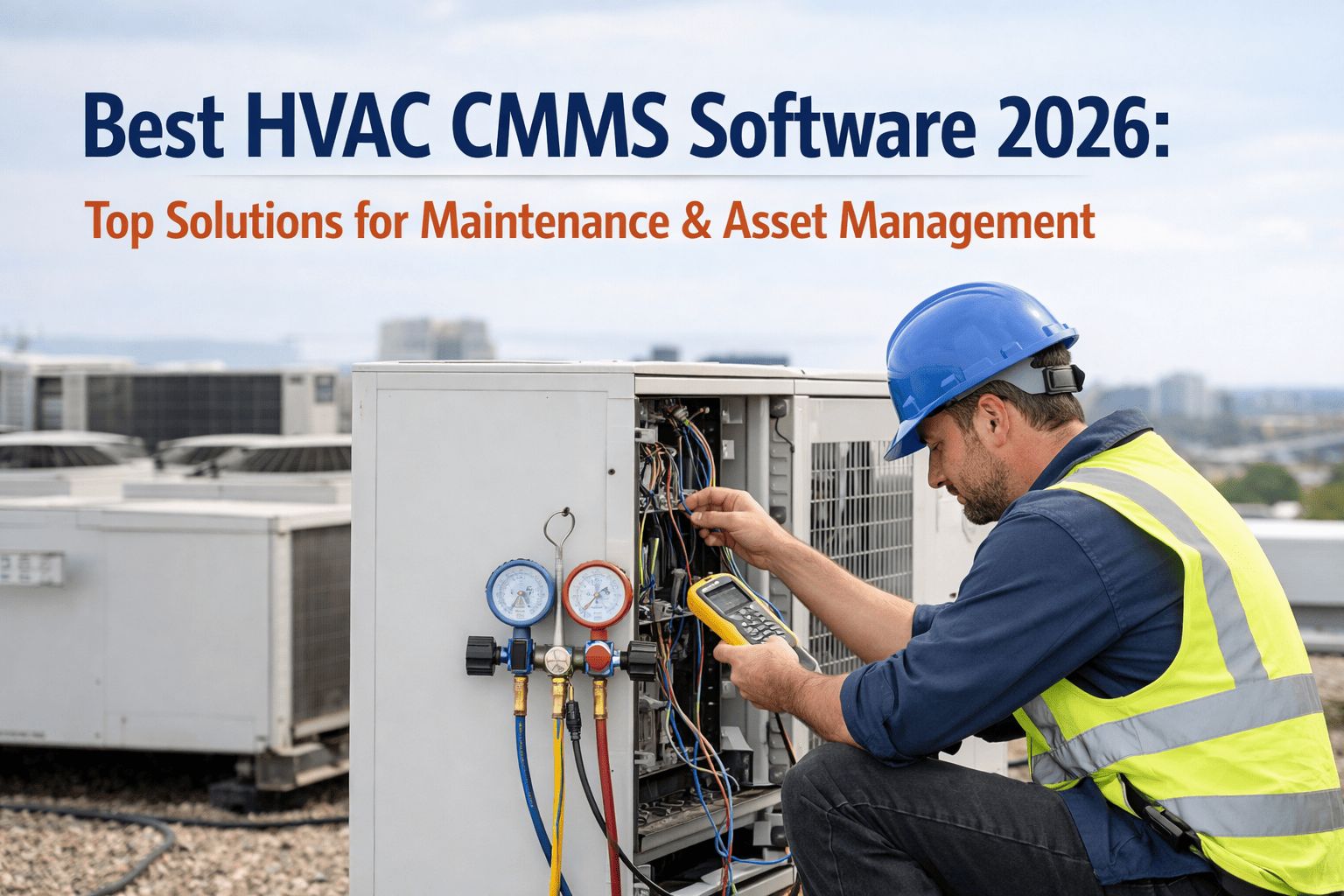
Selecting the right CMMS for HVAC operations in 2026 is no longer a feature-checklist exercise — it is a strategic decision that determines technician productivity, refrigerant compliance exposure, and total cost of ownership across your entire facility portfolio. For HVAC contractors, facility managers, and operations leads evaluating Sign Up Free platforms, this comparison breaks down Oxmaint, UpKeep, Limble, and MaintainX across the dimensions that actually drive ROI: mobile field UX, preventive maintenance automation, refrigerant compliance workflows, third-party integrations, and pricing transparency. Whether you manage 50 rooftop units or a 500-site commercial portfolio, the right HVAC CMMS pays for itself in reduced emergency callouts, tighter compliance records, and faster work order cycle times. Book a Demo to see how Oxmaint's purpose-built maintenance platform compares in your operational context.
HVAC CMMS · Software Comparison · 2026
Oxmaint vs UpKeep vs Limble vs MaintainX — Find the Right HVAC CMMS for 2026
Compare mobile UX, preventive maintenance automation, refrigerant compliance, integrations, and TCO across the four most-shortlisted HVAC CMMS platforms in 2026.
Why HVAC Teams Are Re-Evaluating Their CMMS in 2026
Refrigerant transition mandates, rising energy audit requirements, and mobile-first technician workforces have rendered first-generation CMMS platforms inadequate for modern HVAC operations. Teams using Book a Demo conversations routinely cite the same pain points: work orders that don't capture refrigerant usage by unit, PM schedules disconnected from actual runtime hours, and compliance documentation that lives in spreadsheets outside the CMMS. The four platforms in this comparison represent the current shortlist for HVAC maintenance managers — each with distinct strengths and real trade-offs that matter at scale.
Refrigerant Compliance Tracking
EPA Section 608 and evolving HFC phase-down rules require per-unit refrigerant logs, leak test records, and certified technician documentation. Compliance gaps create audit liability that a general-purpose CMMS won't catch.
Mobile-First Field Execution
HVAC technicians work in equipment rooms, on rooftops, and across multi-site portfolios. A CMMS that requires back-office connectivity or complex navigation kills adoption on day one.
Preventive Maintenance Automation
Filter replacements, coil cleanings, and belt inspections on fixed-interval schedules are table stakes. The differentiator in 2026 is condition-based PM triggering from runtime meters and sensor data.
Multi-Site Asset Visibility
Commercial HVAC portfolios span dozens of buildings with heterogeneous equipment. Cross-site asset health dashboards, not siloed building views, determine whether leadership can act on fleet-level data.
ERP and BMS Integration
Maintenance costs that don't flow to finance systems and sensor data that doesn't inform scheduling create duplicate work. Native API connectivity to BAS, BMS, and ERP platforms eliminates the data gap.
Total Cost of Ownership
Per-seat pricing, implementation fees, and integration costs diverge significantly across platforms at 50+ user deployments. Licensing sticker price is rarely the true cost of a three-year CMMS commitment.
Head-to-Head: Oxmaint vs UpKeep vs Limble vs MaintainX
The comparison below evaluates each platform across the criteria HVAC operations leaders weight most heavily. Ratings reflect published capability and documented user outcomes as of 2026. Sign Up Free to validate Oxmaint's positioning against your specific operational requirements.
| Evaluation Criteria |
Oxmaint |
UpKeep |
Limble CMMS |
MaintainX |
| Mobile Field UX |
Offline-capable, QR scan, guided task flows |
Strong consumer-grade mobile app |
Clean UI, moderate offline support |
Excellent mobile-first design |
| Preventive Maintenance |
Runtime-triggered + calendar PM + AI recommendations |
Calendar and meter-based PM |
Robust PM scheduling with templates |
Solid recurring WO scheduling |
| Refrigerant Compliance |
Per-unit refrigerant logs, leak test records, EPA-aligned fields |
Custom fields only; no native compliance module |
Custom fields; limited native HVAC compliance |
Procedure checklists; no dedicated refrigerant module |
| Predictive Maintenance / AI |
Sensor + telematics ingestion, degradation trend alerts |
Limited AI features at standard tiers |
Analytics dashboard; limited predictive capability |
Minimal predictive; strong reactive WO |
| ERP / BMS Integration |
Bidirectional API — SAP, Oracle, BAS/BMS connectors |
Native integrations + Zapier |
API available; select native integrations |
API + select ERP integrations |
| Multi-Site Asset Management |
Portfolio-level dashboard, cross-site asset health |
Multi-location support; strong for SMB scale |
Strong multi-site hierarchy |
Good multi-location; enterprise tier required |
| Pricing Transparency |
Modular; no hidden per-seat overage |
Per-user pricing; adds up at scale |
Transparent per-user tiers |
Per-user; enterprise pricing on request |
| Implementation Timeline |
2–4 weeks line operations; 8–10 weeks full deployment |
Days to weeks for standard deployment |
Weeks; guided onboarding available |
Fast setup; days for small teams |
| Best Fit |
Mid-market to enterprise HVAC, compliance-heavy portfolios |
SMB facilities, simple multi-trade operations |
Manufacturing + mixed facilities |
Field service teams, multi-trade contractors |
Where Each Platform Wins — and Where It Falls Short
No CMMS is universally best. The right platform depends on fleet size, compliance obligations, integration architecture, and the ratio of reactive to preventive work in your operation. Book a Demo with Oxmaint's team to map your specific requirements against platform capabilities before committing to a deployment.
Oxmaint — Best for Compliance-Driven HVAC and Multi-Site Commercial Portfolios
Oxmaint's strength is the combination of HVAC-specific compliance workflows — refrigerant logs, leak test records, technician certification tracking — with AI-driven predictive maintenance and bidirectional ERP integration. For facility managers running 100+ HVAC assets across multiple buildings, the portfolio-level asset health dashboard and automated PM triggers from runtime and sensor data deliver measurably lower AOG event rates and faster audit preparation. The trade-off: implementation depth means a 2–4 week onboarding window vs. same-day setup on simpler platforms.
UpKeep — Best for SMB Facilities with Simple Multi-Trade Needs
UpKeep built its reputation on consumer-grade mobile UX and rapid deployment. For small HVAC contractors or single-site facility teams that need work order management and basic PM scheduling without complex compliance requirements, UpKeep delivers fast time-to-value. The limitation appears at scale: per-user pricing escalates significantly above 25 seats, native refrigerant compliance fields are absent, and predictive maintenance capability is limited to higher-cost enterprise tiers.
Limble CMMS — Best for Mixed-Use Facilities with Manufacturing in the Portfolio
Limble excels in manufacturing and mixed-asset environments where HVAC is one of several equipment categories under management. Its PM template library is extensive, onboarding is well-guided, and the analytics dashboard provides solid reporting for operations managers. For pure HVAC operations with EPA compliance requirements, Limble requires custom field configuration to approximate what purpose-built HVAC CMMS platforms deliver natively — adding setup time and compliance risk if fields are misconfigured.
MaintainX — Best for Field Service Contractors and Multi-Trade Crews
MaintainX wins on mobile-first work order execution and procedure-driven checklists, making it popular with HVAC contractors whose technicians complete high volumes of dispatched jobs daily. The platform's reactive maintenance and communication features are industry-leading for field service. For operations leads who need refrigerant compliance documentation, condition-based PM from BMS sensor feeds, or ERP-level cost data integration, MaintainX requires enterprise tier access and third-party middleware to close the gap.
HVAC CMMS TCO: What the Per-Seat Price Doesn't Show You
Procurement teams evaluating HVAC CMMS on monthly per-seat cost systematically underestimate three-year TCO. Sign Up Free and use Oxmaint's TCO calculator to model true deployment cost against your headcount and integration requirements.
01
Implementation and Data Migration
Migrating asset registers, PM schedules, and historical work orders from legacy systems or spreadsheets adds $5,000–$40,000 in professional services cost that sticker-price comparisons omit entirely.
02
Integration Middleware
Platforms without native ERP or BMS connectors require third-party middleware (iPaaS tools, custom API development) that adds $3,000–$15,000 annually to the operational cost of the deployment.
03
Compliance Gap Remediation
HVAC operations that configure custom fields to approximate native refrigerant compliance modules face recurring configuration maintenance cost and elevated audit risk from field mapping errors.
04
Per-Seat Scaling Penalties
Platforms with strict per-user licensing create budget friction as technician headcount grows. At 50+ users, the differential between per-seat and modular pricing models can exceed $20,000 annually.
05
Retraining After Platform Churn
Organizations that switch CMMS platforms after 18–24 months due to capability gaps absorb 40–80 hours of technician retraining per site — a cost that dwarfs any first-year licensing savings from the cheaper platform.
06
Audit Preparation Labor
Platforms that require manual report compilation for EPA or internal audits add 8–20 hours of supervisor time per audit cycle. Oxmaint's automated audit-ready export eliminates this overhead entirely.
Oxmaint's HVAC-Specific Capabilities: What Sets It Apart in 2026
General-purpose CMMS platforms force HVAC operations to fit their compliance and scheduling requirements into generic work order frameworks. Book a Demo to see how Oxmaint's HVAC-aligned capability set eliminates the configuration overhead that drains administrator time on competing platforms.
Native Refrigerant Usage and Leak Test Logging
Oxmaint captures refrigerant type, quantity added, recovery amount, and leak test results at the work order level — linked to the specific asset and technician certification. EPA Section 608 documentation is generated automatically, not assembled manually at audit time.
Runtime-Hour Triggered Preventive Maintenance
Calendar-based PM misses equipment that runs harder in peak cooling and heating seasons. Oxmaint ingests runtime meter data from BMS and IoT sensors to trigger filter changes, coil cleanings, and belt inspections based on actual operating hours — reducing both over-maintenance and premature failures.
Multi-Site Portfolio Asset Health Dashboard
Operations leads managing commercial HVAC across 10 or 100 buildings see a consolidated asset health view — overdue PMs, open defects, refrigerant consumption anomalies, and upcoming major service milestones — across the entire portfolio in a single dashboard without toggling between building records.
AI-Driven Component Degradation Alerts
Oxmaint's AI engine surfaces compressor efficiency degradation, condenser pressure anomalies, and motor amp trends before they escalate to emergency calls or equipment failure — shifting HVAC maintenance from reactive dispatching to condition-based scheduling that reduces unplanned downtime costs.
HVAC CMMS · Preventive Maintenance · Refrigerant Compliance
Ready to Replace Your HVAC CMMS Shortlist with a Live Deployment?
Oxmaint's HVAC-aligned CMMS delivers native refrigerant compliance, AI-driven PM triggers, and multi-site asset visibility — with a deployment playbook that goes live in weeks, not months.
Frequently Asked Questions — HVAC CMMS Comparison 2026
What is the best CMMS for HVAC contractors in 2026?
The best HVAC CMMS depends on fleet size and compliance requirements. Oxmaint leads for compliance-heavy commercial portfolios; MaintainX suits high-volume field service dispatching; UpKeep fits small multi-trade teams; Limble works well in mixed-asset facility environments.
Does Oxmaint support EPA refrigerant compliance documentation?
Yes. Oxmaint captures refrigerant type, quantity, recovery records, and leak test results at the work order level, linked to asset and technician certification records — supporting EPA Section 608 documentation requirements natively.
How does Oxmaint compare to UpKeep for large HVAC portfolios?
Oxmaint scales more cost-effectively above 25 users due to modular pricing, and delivers native HVAC compliance workflows and AI-driven predictive maintenance that UpKeep requires enterprise tier upgrades or custom configuration to approximate.
Can Oxmaint integrate with Building Management Systems (BMS)?
Yes. Oxmaint provides API-based integration with BAS/BMS platforms to ingest runtime data, sensor alerts, and equipment status — enabling runtime-hour triggered PM and condition-based maintenance scheduling.
What is the typical HVAC CMMS implementation timeline for Oxmaint?
Standard HVAC line operations go live within 2–4 weeks. Full multi-site deployment with ERP integration and complete asset library migration typically completes in 8–10 weeks.
Is Limble CMMS suitable for dedicated HVAC operations?
Limble is well-suited for mixed-asset facilities where HVAC is one of several equipment types managed. For pure HVAC operations with refrigerant compliance obligations, native HVAC-specific fields require additional configuration time versus purpose-built platforms.
How does predictive maintenance in Oxmaint benefit HVAC teams?
Oxmaint ingests sensor and BMS data to surface compressor degradation trends, pressure anomalies, and motor performance shifts before failure — reducing emergency callout costs and extending equipment life through timely condition-based interventions.
HVAC CMMS · Asset Management · Maintenance Automation
Stop Comparing — Start Deploying the HVAC CMMS Built for 2026 Compliance and Scale
Oxmaint gives HVAC operations leaders native refrigerant compliance, runtime-triggered preventive maintenance, and multi-site portfolio visibility — with a phased deployment that goes live in weeks without disrupting ongoing operations.