The HVAC industry is undergoing its most significant refrigerant transition since the R-22 phaseout — and unlike that transition, the pace this time is driven simultaneously by regulation, economics, and OEM product strategy. The EU F-Gas Regulation revision, US EPA AIM Act HFC phasedown, and the Kigali Amendment schedule are converging to make high-GWP refrigerants including R-410A economically and legally untenable within this decade. For HVAC engineers, facility managers, and maintenance teams, the question is not whether to transition — it is which low-GWP refrigerant to specify, whether your existing equipment and service tooling are ready, and how to manage the compliance records that regulators in every jurisdiction are increasingly requiring. This guide compares the four refrigerants defining HVAC in 2026 — R-32, R-454B, R-290, and R-1234yf — across GWP, safety classification, efficiency, equipment compatibility, and what each means for your maintenance and compliance programme.
Keep Your Refrigerant Compliance Records Audit-Ready — Automatically
OxMaint tracks refrigerant type, charge weight, safety classification, service history, and leak check records for every HVAC asset in your portfolio — so F-Gas and EPA audit preparation takes minutes, not days.
Why the Transition Is Happening Now — and Why It Cannot Wait
The practical consequence for HVAC operations teams is not abstract — it is cost. Refrigerant prices for high-GWP HFCs including R-410A have risen 40–70% since 2022 as HFC quotas tighten under the AIM Act, and further price increases are structurally locked in regardless of supply chain conditions. In the EU, the revised F-Gas Regulation bans new equipment charged with refrigerants above GWP 750 for stationary split AC systems under 3kW from 2024 — with thresholds extending to larger equipment categories through 2030. The transition to low-GWP alternatives is no longer purely an environmental obligation. It is simultaneously a maintenance cost management decision, a capital planning decision, and a regulatory compliance decision. Facilities still operating large R-410A fleets are already paying the reactive maintenance tax on every service event — rising refrigerant costs that proactive transition planning eliminates.
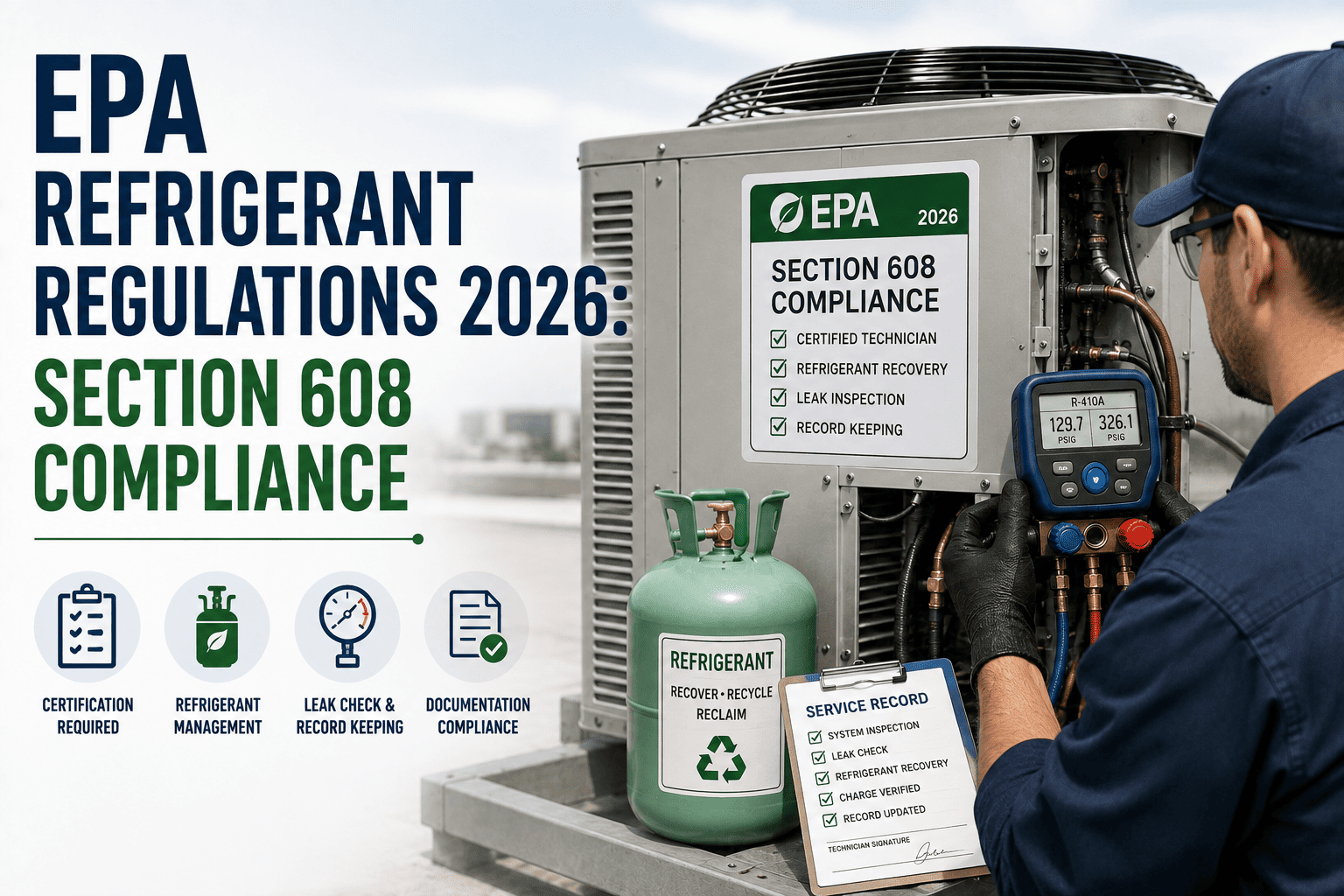
HVAC maintenance teams managing the transition also face a new compliance layer that did not exist with R-410A — A2L refrigerant handling documentation, technician certification verification, and leak detection infrastructure requirements that must be in place before the first service event on the new equipment. Tracking these requirements manually across a mixed fleet creates exactly the documentation gap that F-Gas and EPA auditors are increasingly targeting. Book a demo to see how OxMaint manages refrigerant compliance records for transitioning HVAC fleets.
The Four Low-GWP Refrigerants: What Each One Is and Where It Fits
Four refrigerants account for virtually all new HVAC equipment installations in 2026 across the residential, commercial, and industrial segments. Understanding their characteristics, constraints, and application envelope is the prerequisite for sound specification decisions, maintenance programme updates, and compliance planning in the current transition environment. Sign up free to track refrigerant type, safety class, and compliance records for every asset in your CMMS.
GWP 675 · A2L · Dominant Low-GWP Choice for Residential and Light Commercial
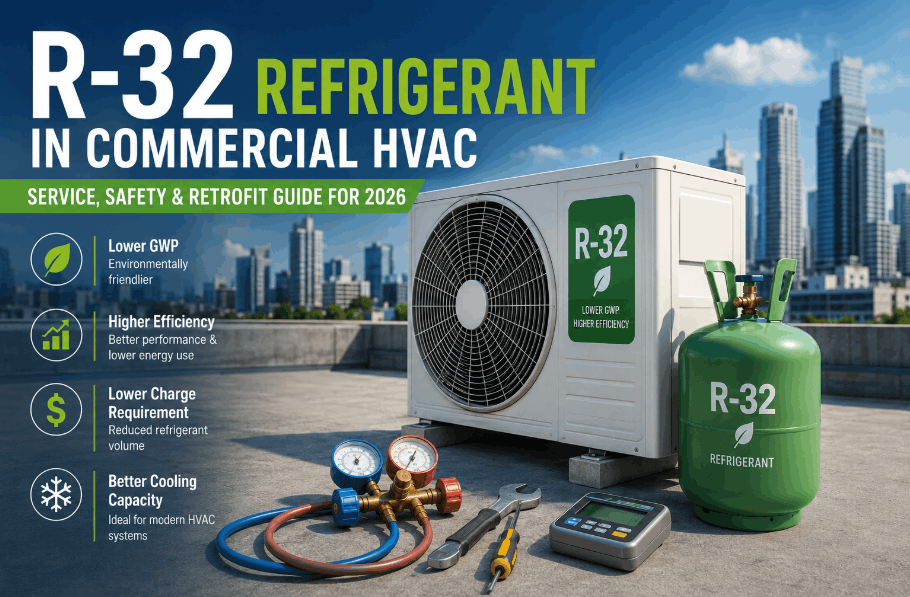
R-32 (difluoromethane) is the most widely deployed low-GWP refrigerant in new HVAC equipment globally in 2026. Its GWP of 675 is 68% lower than R-410A's 2,088. Virtually all major OEMs — Daikin, Mitsubishi, LG, Panasonic, Midea — now ship residential and light commercial split systems and VRF equipment with R-32 as the factory charge. R-32 requires equipment specifically designed for it: different POE lubricant specification, adjusted expansion valves, and compressors rated for discharge temperatures 12–18°C higher than equivalent R-410A operation. It cannot be substituted into existing R-410A systems.
- 5–8% better COP than R-410A in optimally designed equipment
- ~70% of R-410A charge weight required for the same cooling capacity
- Higher discharge temperatures require correct suction superheat setting — primary failure mode if poorly serviced
- A2L-rated recovery equipment and certified technicians required for all service events
GWP 466 · A2L · Commercial R-410A Successor at Near-Identical Operating Pressures
R-454B is a zeotropic blend of R-32 and R-1234yf, commercially branded as Puron Advance by Carrier. Its GWP of 466 is lower than R-32, and — critically — its operating pressures are near-identical to R-410A. This pressure compatibility makes it the preferred transition choice for commercial equipment manufacturers who need to redesign R-410A product lines without a complete pressure envelope rearchitecture. Carrier, Daikin, Lennox, and Trane are transitioning their commercial rooftop unit, large split, and VRF product lines to R-454B for equipment above approximately 20kW. R-454B is not a field retrofit for existing R-410A systems — it requires new OEM-specified equipment designed for R-454B.
- GWP 466 — 78% lower than R-410A
- Near-identical operating pressures to R-410A — simplifies commercial equipment transition design
- Zeotropic blend — always charge as liquid from cylinder to prevent fractionation and composition shift
- Preferred commercial specification for RTUs, large VRF, and packaged equipment replacing R-410A fleets
GWP 3 · A3 — Highly Flammable · Maximum Efficiency, Minimum Climate Impact, Maximum Safety Constraints
R-290 is propane — the same compound used in domestic heating and cooking. Its GWP of 3 is effectively negligible for climate purposes, and its thermodynamic properties deliver 10–15% better COP than R-410A in optimally designed equipment — the highest efficiency figure of any commercially deployed refrigerant. The constraint is entirely the A3 safety classification and the 150g maximum charge weight per circuit in occupied spaces prescribed by IEC 60335-2-89. This charge limit restricts R-290 to applications where small charges are sufficient: commercial plug-in refrigeration, display cabinets, bottle coolers, and small dedicated heat pumps designed within the limit.
- GWP 3 — effectively zero climate impact
- 10–15% better COP than R-410A — the highest efficiency available in any low-GWP refrigerant
- 150g maximum charge per circuit in occupied spaces — limits capacity to approximately 800–1,500W per circuit
- A3 classification requires explosion-proof electrical components, ATEX-rated tools, and specialist technician certification
GWP 4 · A2L · Automotive Standard and Large Centrifugal Chiller R-134a Replacement
R-1234yf is an HFO (hydrofluoroolefin) with near-zero GWP of 4. It has been mandated in all new passenger vehicle air conditioning systems in the EU since 2017 and is standard in automotive AC globally. In commercial HVAC, its primary application is in large centrifugal chillers replacing R-134a — where its lower operating pressures are compatible with the centrifugal compressor architecture that R-32 or R-454B's much higher pressures would require completely redesigning. Carrier AquaEdge, Trane CenTraVac, and York YZ centrifugal chiller series offer R-1234yf configurations. Its significantly higher per-kilo cost — typically 3–5× the cost of R-32 — makes it non-competitive for smaller commercial equipment despite the superior GWP figure.
- GWP 4 — near-zero climate impact, comparable to R-290
- Mandated standard in automotive AC globally since 2017
- Much lower operating pressures than R-410A — compatible with centrifugal compressor architectures for large chiller plant
- Higher refrigerant cost limits economic case versus R-32 or R-454B for all but the largest cooling applications
Head-to-Head Comparison: Key Parameters for Engineering Decisions
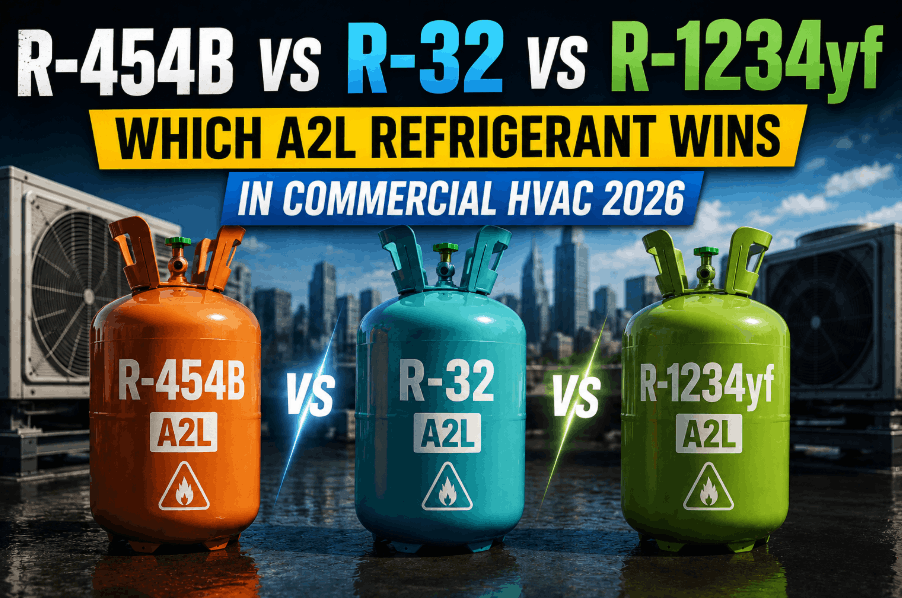
The comparison below covers the parameters that matter most to HVAC engineers, facility managers, and maintenance teams. No single refrigerant wins across every category — the correct choice depends on application capacity, building occupancy classification, local regulatory requirements, and existing equipment fleet management constraints.
| Parameter | R-32 | R-454B | R-290 | R-1234yf |
|---|---|---|---|---|
| GWP (AR6, 100-year) | 675 | 466 | 3 | 4 |
| ASHRAE 34 Safety Class | A2L — Mildly Flammable | A2L — Mildly Flammable | A3 — Highly Flammable | A2L — Mildly Flammable |
| Lower Flammable Limit | 14.4% vol/vol | ~13.5% vol/vol | 2.1% vol/vol | 6.2% vol/vol |
| COP vs R-410A (new equipment) | +5 to +8% better | Comparable (±2%) | +10 to +15% better | Comparable to R-134a |
| Charge weight vs R-410A | ~70% of R-410A charge | ~90% of R-410A charge | 150g maximum per circuit | Similar to R-134a |
| Operating pressure vs R-410A | ~25% lower | Near-identical | Lower | Much lower |
| Discharge temperature | 12–18°C higher than R-410A | Moderate — comparable | Lower | Lower |
| R-410A field retrofit possible | No — new equipment only | No — designed as successor | Not applicable | Not applicable |
| Refrigerant cost (2026) | Low | Moderate | Very low | High — 3–5× R-32 |
| Primary HVAC application | Residential / light commercial splits and VRF | Commercial RTU / large VRF / commercial chillers | Plug-in refrigeration / small heat pumps under 150g limit | Automotive / centrifugal chillers replacing R-134a |
A2L vs A3: What Safety Classification Means in Practice for Service Teams
The ASHRAE 34 safety classification is the most operationally significant specification for maintenance teams managing the refrigerant transition. Understanding what A2L and A3 mean in practice determines what training, tooling, and installation standards your team must meet before the first service event on the new equipment. Sign up free to track safety classification and technician certification status for every refrigerant type in your CMMS.
Mildly Flammable — Manageable with Correct Equipment and Training
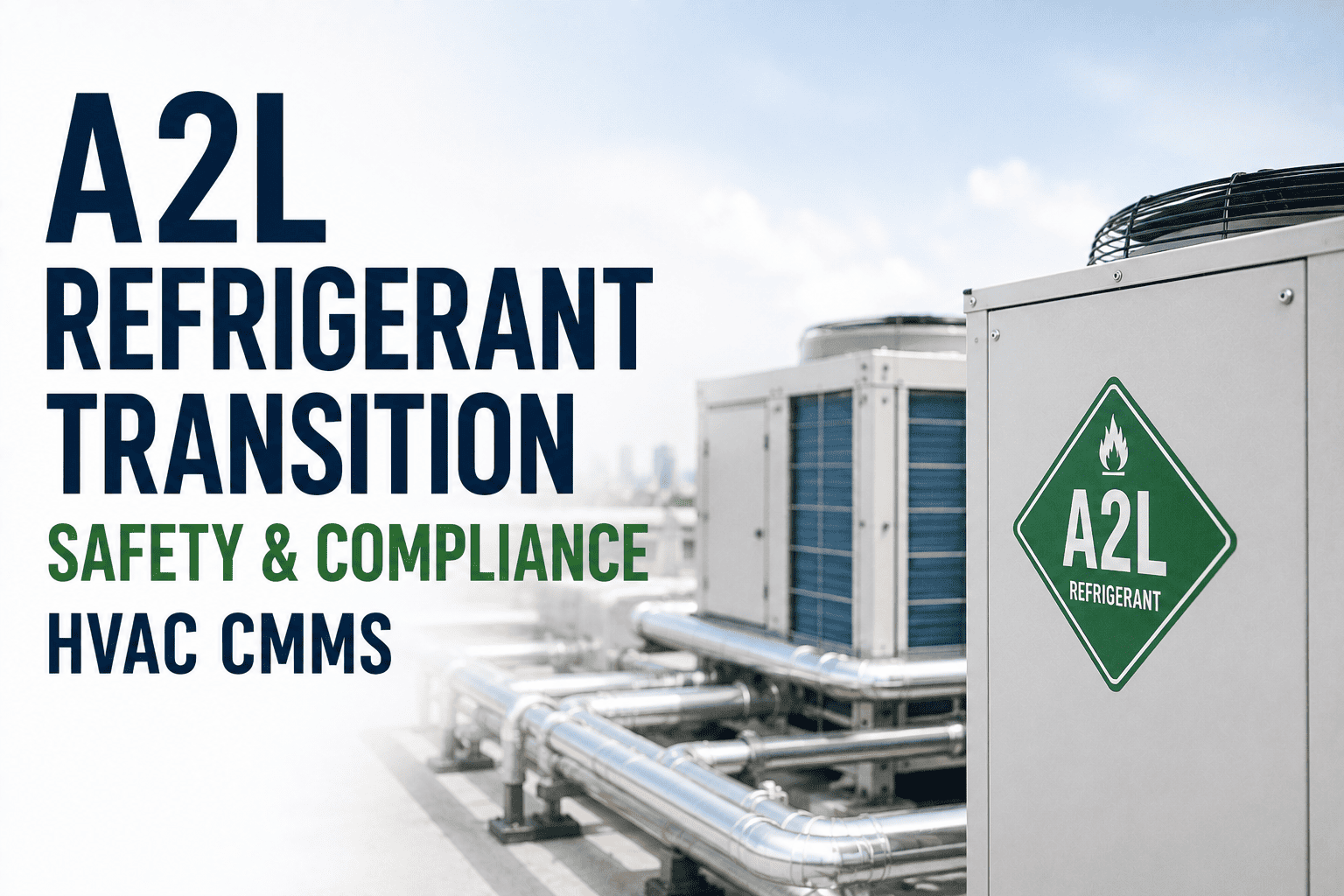
A2L refrigerants will burn under specific conditions but require higher minimum ignition energy than propane and have a narrow flammable concentration range. For trained HVAC teams, the service and installation requirements are manageable:
- No naked flames or ignition sources during service in enclosed spaces
- Fixed leak detection sensors mandatory in mechanical rooms
- A2L-rated recovery equipment — standard R-410A machines are not certified for A2L use
- A2L-compatible manifold gauges, hoses, and portable leak detector required
- Minimum ventilation standards apply to all plant rooms with A2L equipment
- Technician A2L handling certification — confirm current certificates cover A2L with your certification body
- IEC 60335-2-40 compliant equipment design mandatory for new A2L installations
Highly Flammable — Substantially More Demanding Service Requirements
A3 refrigerants are highly flammable with a low lower flammable limit of 2.1% volume in air. R-290's behaviour is well understood because it is propane, but its application in HVAC equipment carries much more demanding operational requirements:
- Maximum 150g charge per circuit in occupied spaces — IEC 60335-2-89
- Explosion-proof electrical components required in the refrigerant zone
- ATEX-rated tools required for service in enclosed and potentially explosive atmospheres
- Significantly higher technician training and certification requirement than A2L
- All R-290 equipment must be factory-hermetically sealed — no field-charged A3 systems in occupied spaces
- Not suitable for large-capacity air conditioning at commercially useful capacities
What Must Be in Place Before Your First A2L Service Event
For each of these elements, verify and document completion before any team member services the first A2L-charged equipment in your portfolio:
- Technician F-Gas / EPA certification confirmed to cover A2L — do not assume existing certificates are sufficient
- A2L-rated recovery machine purchased and on site
- A2L-compatible manifold gauges, hoses, and portable leak detector on site
- Fixed refrigerant leak detection sensors installed in all mechanical rooms with A2L equipment
- Ventilation assessment completed and documented for all affected plant rooms
- CMMS asset records updated with refrigerant type, safety class, and charge weight per unit
- COSHH / SDS files updated for each A2L refrigerant type in use at the facility
Equipment Compatibility: What Your Fleet Can and Cannot Use
The most common source of costly decisions in refrigerant transition planning is assuming that a lower-GWP refrigerant can be substituted into existing equipment. Lubricating oil compatibility, compressor design pressure envelope, heat exchanger sizing, and expansion valve calibration all differ between refrigerant families. The guidance below applies to both new equipment specification and existing fleet replacement planning. Book a demo to see how OxMaint tracks refrigerant type, compatibility status, and service history across your full HVAC asset register.
New Equipment Only — Not a Drop-In for R-410A Systems
R-32 requires equipment specifically designed and certified for it — different POE lubricant specification, higher-rated pressure components, adjusted TXV calibration, and a compressor capable of handling 12–18°C higher discharge temperatures than R-410A operation. It cannot be substituted in existing R-410A systems. All new residential and light commercial HVAC from major OEMs now ships with R-32 as the factory charge. Specify R-32 equipment for all new installations in these categories going forward.
Designed as Commercial R-410A Successor — Near-Identical Pressures
R-454B's near-identical operating pressures to R-410A allow equipment manufacturers to transition commercial product lines without complete compressor and heat exchanger redesign. It is not a field retrofit for existing R-410A equipment — it requires new OEM-specified equipment. For facilities planning commercial equipment replacement cycles, R-454B is the reference specification for equipment above 20kW replacing R-410A rooftop units, large splits, and commercial VRF systems.
Factory-Sealed Only — 150g Limit Constrains to Small Commercial Applications
R-290 equipment must be hermetically factory-sealed. Field-charged R-290 systems are not permitted in occupied spaces. Applications are restricted to commercial plug-in refrigeration, display cabinets, and small dedicated heat pumps designed within the 150g charge limit — which provides approximately 800–1,500W of cooling capacity. Not suitable for general air conditioning at commercial building scale regardless of the efficiency and GWP advantages.
Automotive Standard and Large Centrifugal Chillers Replacing R-134a
R-1234yf's lower operating pressures are compatible with the centrifugal compressor architecture used in large campus cooling plants and data centre chillers. Carrier, Trane, and York offer R-1234yf centrifugal chiller configurations. Higher refrigerant cost versus R-32 and R-454B makes it non-competitive for smaller commercial equipment. For facilities replacing large centrifugal chillers on R-134a, R-1234yf or R-515B are the correct reference specifications in 2026.
Regulatory Timeline: What Changes When and in Which Markets
EU F-Gas Regulation — GWP 750 Limit for Small AC Equipment
The revised EU F-Gas Regulation prohibits new hermetically sealed equipment charged with refrigerants above GWP 750 for stationary split AC systems below 3kW. This threshold captures R-410A (GWP 2,088) in this capacity category. New equipment sold into EU member states in this range must use R-32, R-290, or equivalent. Existing equipment continues to operate but faces rising refrigerant costs as HFC quota restrictions tighten. EU F-Gas equipment logbook requirements apply to all fluorinated refrigerant systems above 5 tCO₂e equivalent charge — documentation failure is the most commonly cited audit finding across European HVAC portfolios.
US EPA AIM Act — HFC Phasedown Milestone and R-410A Cost Acceleration
The AIM Act HFC phasedown reaches its 60% of baseline milestone, driving R-410A bulk refrigerant prices 50–80% above 2022 levels. New R-410A equipment manufacture remains legal until EPA SNAP rules covering specific product categories take full effect — but the operational economics of R-410A systems are deteriorating with every service event. The EPA has finalised listings of R-32, R-454B, and R-454C as acceptable substitutes for R-410A in specific end uses. Facilities managing large R-410A fleets should model the cost trajectory of continued operation against the capital cost of transition in their current planning cycle rather than waiting for regulatory compulsion.
EU Commercial Equipment Thresholds Extended and US State-Level Rules
EU F-Gas GWP equipment limits extend to systems above 12kW from 2027 across most commercial air conditioning categories — covering the majority of commercial rooftop units and large split systems currently on R-410A. EU facilities with commercial HVAC equipment in this range should include refrigerant transition in their 2025–2027 capital budgets. California Title 20 and Title 24 are tracking EU timelines — facilities in California should plan commercial HVAC transitions around the 2026–2028 window for systems above 40kW. Canada follows a comparable 2028–2032 phasedown trajectory.
Kigali Amendment — 85% HFC Phasedown in Developed Countries
The Kigali Amendment requires developed countries to reduce HFC consumption to 15% of baseline by 2036 and 85% reduction by 2047. HVAC equipment purchased today on a 15-year expected lifespan may reach end of useful life before the full phasedown endpoint — but equipment with longer expected useful life, including large centrifugal chillers, heat pump systems integrated into building fabric, and district cooling infrastructure, should be specified for low-GWP refrigerants now to avoid mid-life regulatory stranding and the capital cost of premature replacement.
Compliance Tracking: What HVAC Teams Must Document for Each Refrigerant Type
The transition to low-GWP refrigerants increases the compliance documentation burden in most jurisdictions — A2L refrigerants bring additional handling requirements and equipment certification records alongside existing F-Gas and EPA reporting obligations. Managing these records manually across a mixed fleet creates exactly the documentation gap that compliance auditors target. Book a demo to see how OxMaint automates refrigerant compliance record-keeping across every refrigerant type in your portfolio.
| Compliance Requirement | Applies To | Documentation Required | OxMaint Coverage |
|---|---|---|---|
| F-Gas Equipment Logbook (EU) | All fluorinated refrigerant systems above 5 tCO₂e equivalent charge | Installation date, refrigerant type and GWP, charge amount, leak checks, service records, technician certification details | Auto-generated per asset — exportable for F-Gas authority submission on demand |
| EPA Section 608 Records (US) | All appliances with 5+ lbs refrigerant charge | Leak inspection dates and findings, refrigerant added and recovered per service event, technician EPA certification number, disposal documentation | Work order linked records — quantity, leak test result, and certification tracked per service event |
| A2L Technician Certification | Any technician servicing A2L-charged equipment | Certification number, training provider, issue date, expiry date, refrigerant categories covered | Technician qualification records — alert when certification approaching expiry |
| Charge Weight Records — R-290 | All A3-charged equipment | OEM maximum rated charge per circuit, actual installed charge, verification at each service event confirming no overcharge | Asset record field — rated and actual charge tracked, service record flags if overcharge indicated |
| Periodic Leak Check Records | Systems above jurisdiction-specific leak check threshold | Test method, test date, pass/fail result, follow-up corrective actions, technician sign-off | PM work order with mandatory completion fields — result stored against permanent asset history |
| Equipment Installation Certificate | New A2L and A3 equipment installations | IEC 60335-2-40 compliance declaration, ventilation assessment record, installer certification | Asset document attachment — certificates uploaded and accessible at asset level for audit |
One CMMS for Every Refrigerant in Your HVAC Portfolio
OxMaint tracks refrigerant type, GWP, safety classification, charge weight, service history, and technician certification expiry for every HVAC asset — keeping your team audit-ready for F-Gas, EPA Section 608, and A2L handling requirements without manual record assembly before every inspection.
Frequently Asked Questions: Low-GWP Refrigerants for HVAC in 2026
Can I recharge an existing R-410A system with R-32 or R-454B to reduce GWP?
No. R-32 and R-454B are not drop-in substitutes for R-410A. Both require equipment specifically designed for the target refrigerant — different lubricant specification, adjusted expansion valve calibration, and in the case of R-32, a compressor designed for discharge temperatures 12–18°C higher than R-410A operation. Substituting either refrigerant into an R-410A system without OEM authorisation will void warranties, likely cause premature compressor failure from lubricant incompatibility, and may create a safety situation that an A2L-capable recovery machine is then required to address. The correct approach is equipment replacement at end of life with new OEM-specified equipment designed for the target refrigerant.
What special tools and certifications does my team need before servicing A2L equipment?
Servicing A2L refrigerant systems requires both updated tooling and confirmed certification. Tooling requirements include an A2L-rated refrigerant recovery machine (standard R-410A recovery equipment is not certified for A2L use), A2L-compatible manifold gauges and hoses, and a portable refrigerant leak detector capable of identifying A2L refrigerants. On certification, the EU F-Gas Regulation requires technicians to hold a Category I or Category II F-Gas certificate — many existing certificates cover A2L refrigerants, but operators must confirm explicitly with their certification body rather than assuming. In the US, EPA 608 certification requirements are being updated to address A2L — facilities should check the current status of technician certifications against the latest EPA guidance. Documentation of certification status and expiry dates per technician should be maintained in your CMMS.
What does the 150g charge limit for R-290 mean in practice for facility decisions?
The 150g per circuit limit for R-290 in occupied spaces derives from IEC 60335-2-89 and is set to keep the worst-case refrigerant release below the lower flammable limit in the smallest room type likely to contain the equipment. In practical terms, 150g of R-290 provides approximately 800W to 1,500W of cooling capacity depending on operating conditions — sufficient for commercial plug-in refrigeration, display cabinets, and wine coolers, but not for the multi-kW cooling capacities required by commercial air conditioning systems. The 150g limit effectively prevents R-290 from being used as a general HVAC refrigerant in occupied buildings at commercially useful capacities, regardless of its significant efficiency and GWP advantages. Its role in the HVAC industry is therefore specific to plug-in commercial refrigeration, not space conditioning.
How should facility managers prioritise their HVAC fleet for refrigerant transition?
The most effective prioritisation framework uses three variables: equipment age, refrigerant type, and regulatory jurisdiction. Equipment using R-22 — already illegal to recharge with virgin refrigerant in most developed markets — and R-404A (GWP 3,922) should be the first replacement candidates regardless of remaining mechanical life. R-410A equipment over 8 years old in EU or California jurisdictions should be assessed for replacement in the current capital planning cycle, with R-32 or R-454B as the replacement specification depending on capacity. R-410A equipment under 5 years old in less-regulated jurisdictions may remain economical to operate through its designed lifespan, though the rising refrigerant cost trajectory should be built into the OpEx model rather than treated as stable. Maintaining a refrigerant inventory by asset in your CMMS is the fastest way to answer transition planning questions when raised by regulators, auditors, or asset owners.
How does a CMMS help manage refrigerant compliance across a mixed fleet during transition?
A mixed fleet — some assets on R-32, some on legacy R-410A, some on R-454B — is the most common situation for commercial FM teams in 2026, and it creates the highest compliance complexity because different documentation requirements apply to each refrigerant type. A CMMS with asset-level refrigerant records enables the compliance team to produce a refrigerant inventory by type, GWP, and jurisdiction in minutes rather than auditing paper service records. Each service event updates the per-asset refrigerant log automatically — leak check results, refrigerant quantity added, and technician certification reference. F-Gas authority requests, EPA audit enquiries, and ESG reporting requests can all be answered from the same structured data without additional manual compilation. OxMaint stores refrigerant type, safety class, charge weight, and complete service history at asset level and exports audit-ready compliance packages on demand for any regulatory framework.
Is R-1234yf a better option than R-32 for commercial HVAC applications?
For most commercial HVAC applications in the split and VRF capacity range, R-1234yf offers no meaningful advantage over R-32 and carries a substantially higher refrigerant cost — typically 3 to 5 times the per-kilo cost of R-32 in 2026. Both carry A2L safety classifications and both require equipment specifically designed for the target refrigerant. R-1234yf's near-zero GWP of 4 versus R-32's 675 is relevant in jurisdictions implementing very aggressive future GWP thresholds, but in 2026 this difference does not change regulatory treatment for most commercial HVAC applications in any major market. R-1234yf's primary advantage is its compatibility with centrifugal compressor architectures used in large cooling plant — where R-32's higher operating pressures would require fundamental chiller redesign. Outside of that specific large-chiller application, R-32 or R-454B are the economically superior choices for commercial HVAC specification in 2026.