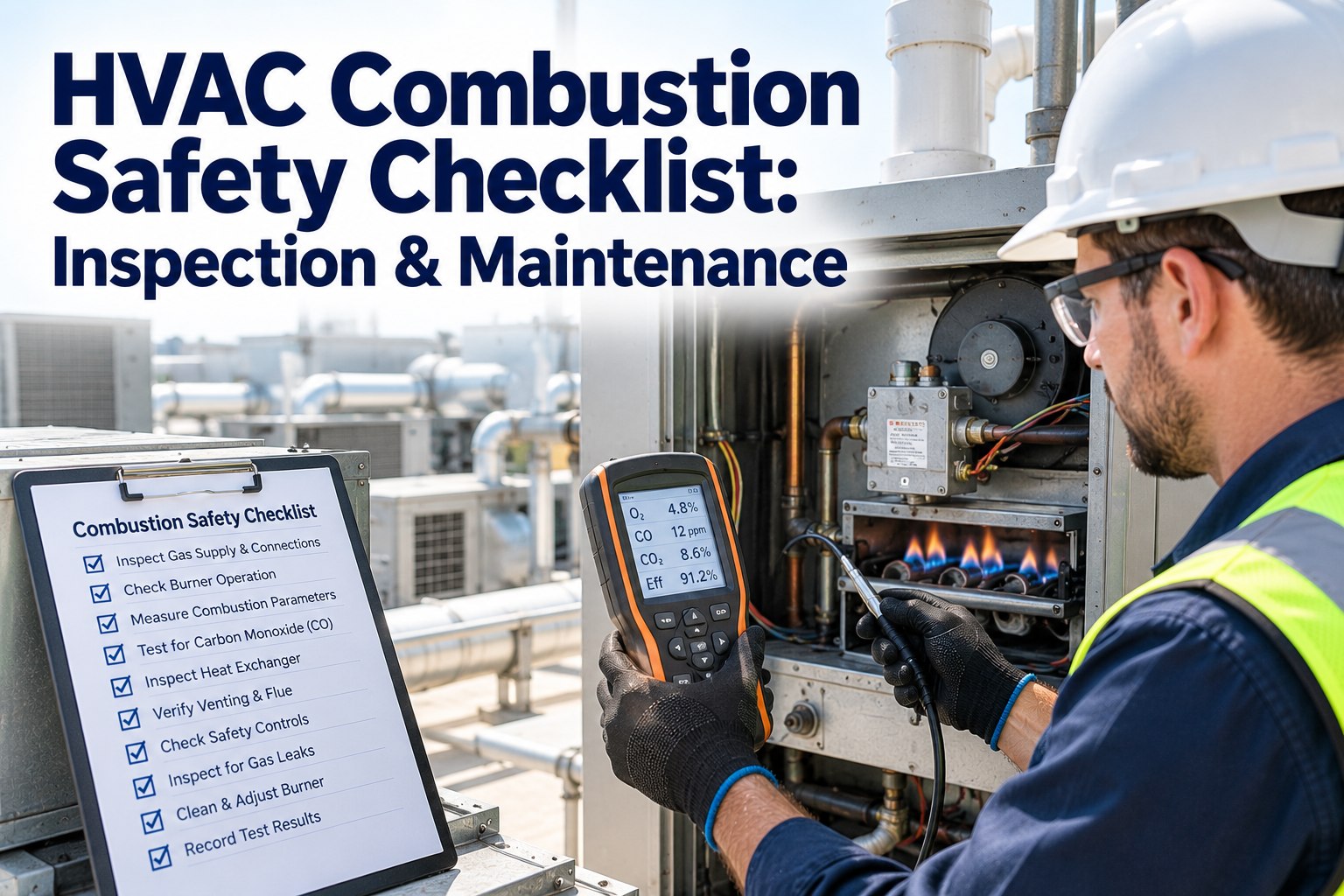
A gas burner that's a little out of tune wastes fuel. A burner that's badly out of tune, or venting into a cracked heat exchanger, makes carbon monoxide — and puts it into the air people breathe. The only way to know which you have is to measure the combustion, not eyeball the flame. This HVAC combustion safety checklist walks the burner, the gas supply, the flue-gas analysis, the venting and the safety controls, and logs every reading and finding as a tracked record in OXMAINT AI — or book a demo of combustion safety tracking in OXMAINT AI.
HVAC COMBUSTION SAFETY · BURNER · FLUE-GAS ANALYSIS · CHECKLIST · 2026
HVAC Combustion Safety Checklist: Inspection & Maintenance
Incomplete combustion is invisible, silent and dangerous — wasted fuel at best, carbon monoxide at worst. OXMAINT AI is the AI-powered CMMS that schedules the combustion inspections, logs the analyzer readings against target, and raises a work order the moment a value falls out of range — so a drifting burner becomes a documented tune, not a CO call.
1 · Inspect
2 · Analyze
3 · Verify venting
4 · Document
<100
ppm air-free CO — a tuned furnace runs well under this find-and-fix level
400
ppm air-free CO — a commonly cited shut-down threshold
7–9%
oxygen is the typical tuned window for an atmospheric gas burner
NFPA 54
National Fuel Gas Code, alongside the maker's data and the local AHJ
The Combustion Analysis: What the Numbers Say
Combustion safety is measured, not guessed. An analyzer in the flue reads these values, and together they tell you whether the burner is clean, efficient and safe. These are commonly cited reference ranges for residential gas — confirm against the appliance rating plate. Start free and log analyzer readings by asset in OXMAINT AI.
Reading
What it tells you
Typical target
Oxygen (O₂)
Excess air — too much wastes heat, too little makes CO
~7–9%
Carbon Dioxide (CO₂)
Combustion completeness — rises as the burn tightens
~6.5–8%
Carbon Monoxide (air-free)
The safety number — incomplete combustion
Well under 100 ppm
Stack Temperature
Heat going up the flue — too high wastes energy
~325–500°F*
Draft
Flue pulling properly — no spillage into the space
~−0.02 to −0.04 in w.c.
Combustion Efficiency
How much fuel energy becomes useful heat
~75–80% field
*Non-condensing; a condensing furnace runs far cooler (roughly 100–140°F). Air-free CO of around 400 ppm is a commonly cited shut-down point.
The Flame Tells the Story
Before the analyzer confirms it, the flame gives the first read. A clean burn looks one way; incomplete combustion looks another. Learn the three states.
Crisp Blue
Sharp, steady, mostly blue cones — complete, efficient combustion. This is the target.
Yellow & Lazy
Soft yellow, flickering or sooting — incomplete combustion, a classic CO producer. Investigate.
Lifting or Rolling
Flame that lifts off, floats or leans — can signal over-aeration or a heat-exchanger fault.
The Combustion Safety Checklist
Work the five domains in order — gas supply, burner, the flue-gas analysis, venting, then the safety controls and CO check. Tick each item as you go; the whole row toggles. Book a demo and run this checklist from a phone in OXMAINT AI.
Signature RuleCO Is the Risk You Can't See or Smell
Every other reading is about efficiency. Carbon monoxide is about safety — it's colorless, odorless, and a cracked heat exchanger can route it straight into the supply air. A combustion inspection isn't finished until the CO picture is clear.
✓
Find and fix near 100 ppm — air-free CO at this level is a signal to investigate and correct.
✓
Shut down near 400 ppm — a commonly cited air-free CO point to take the appliance offline.
✓
Watch the blower effect — CO or O₂ that shifts when the blower runs suggests a cracked exchanger.
✓
Elevated ambient CO — evacuate and call the fire department or gas utility; the lowest applicable limit governs.
What a Combustion Inspection Catches
These are the faults a proper combustion check turns up — each one a reason to measure rather than assume the burner is fine.
×
Cracked Heat Exchanger
The serious one — a path for combustion gases, including CO, into the circulated air.
×
Blocked or Leaking Flue
Corrosion, debris or disconnection that stops the appliance venting safely.
×
Dirty Burners
Soot and debris that distort the flame and drive incomplete combustion.
×
Wrong Gas Pressure
Over- or under-firing from manifold pressure off the maker's setpoint.
×
Insufficient Combustion Air
A sealed or starved equipment room that chokes the burn and raises CO.
×
Backdrafting
Exhaust appliances depressurizing the space and pulling flue gas back inside.
How OXMAINT AI Keeps Combustion Safe on the Record
OXMAINT AI is the AI-powered maintenance management software that carries a combustion inspection from the schedule to the documented result — the appliance register, the PM routine, the analyzer readings and the safety findings on one platform. Put your gas appliances on it when you start free and schedule combustion inspections in OXMAINT AI.
Appliance Register
Every furnace, boiler and burner as an asset with its targets and inspection history on file.
Scheduled Inspections
Recurring combustion checks generated on cadence so no appliance misses its safety inspection.
Readings vs Target
O₂, CO, stack temp and efficiency logged against target, so drift shows up as a number.
Fault → Work Order
An out-of-range reading or a failed control raises a prioritised repair with the data attached.
CO Safety Flag
High-CO findings flagged distinctly so a safety issue is never buried in a routine report.
Document Trail
Signed, dated combustion records retained as proof of a safely maintained gas fleet.
You Can't Tune What You Don't Measure.
A combustion analyzer turns an invisible process into numbers you can act on — and a cracked heat exchanger into a finding instead of a tragedy. OXMAINT AI makes the inspection repeatable, the readings comparable and the safety findings impossible to miss.
EXPERT REVIEW
Written for HVAC, facilities and building-operations teams. Combustion work on gas appliances is safety-critical and regulated — it should be performed by qualified, licensed gas technicians following the National Fuel Gas Code (NFPA 54), the appliance manufacturer's instructions, and the authority having jurisdiction, which govern the acceptable values. The combustion figures, CO thresholds and draft ranges cited here are commonly referenced values that vary by appliance, altitude and standard — the lowest applicable limit governs, and the rating plate and maker's data take precedence. OXMAINT AI is a maintenance management platform that schedules the inspections, logs the readings and tracks the findings — it is not a combustion analyzer, a CO detector, or a substitute for a qualified technician's judgement.
Frequently Asked Questions
Why do a combustion analysis instead of just a visual check?
A flame can look acceptable while the burner produces dangerous carbon monoxide or runs well below efficiency. Only an analyzer reading O₂, CO, stack temperature and draft tells you what's actually happening in the combustion — and whether the appliance is safe. The visual flame check is the first clue, not the verdict.
Start free and log combustion readings in OXMAINT AI.
What CO level is dangerous in a furnace?
For air-free CO in the flue, a tuned furnace runs well under 100 ppm; around 100 ppm is a find-and-fix signal and roughly 400 ppm is a commonly cited shut-down point. Ambient CO in the living space is a separate, more urgent concern — elevated readings mean evacuate and call the fire department or gas utility. The lowest applicable standard governs.
How can I tell if the heat exchanger is cracked?
Watch the combustion readings as the circulating blower cycles on and off — CO or O₂ that shifts with the blower suggests air moving through a crack. A flame that lifts, rolls or leans when the blower starts is another sign. A cracked exchanger is serious because it can route combustion gases into the air people breathe, and usually means the furnace is taken out of service.
What is a spillage or backdraft test?
It checks that the appliance vents its flue gas instead of spilling it into the room. Smoke is held at the draft hood under worst-case conditions — exhaust fans, dryer and range hood running to depressurize the space — and it should be drawn up the flue. An appliance still spilling after about a minute fails and needs correction.
How often should combustion safety be checked?
Gas heating appliances are typically inspected before each heating season and on a regular preventive schedule, with the exact cadence set by the appliance, its duty and your facility policy. The point is a repeatable inspection with recorded readings, so a slow drift toward unsafe combustion is caught early.
Book a demo of combustion PM scheduling in OXMAINT AI.
Measure the Burn, Prove It's Safe.
Run combustion safety on OXMAINT AI: every gas appliance with its targets on file, inspections scheduled before the season, analyzer readings logged against target, CO findings flagged, and a work order raised the moment a value or a control falls out of range — so every burner is provably tuned and provably safe.