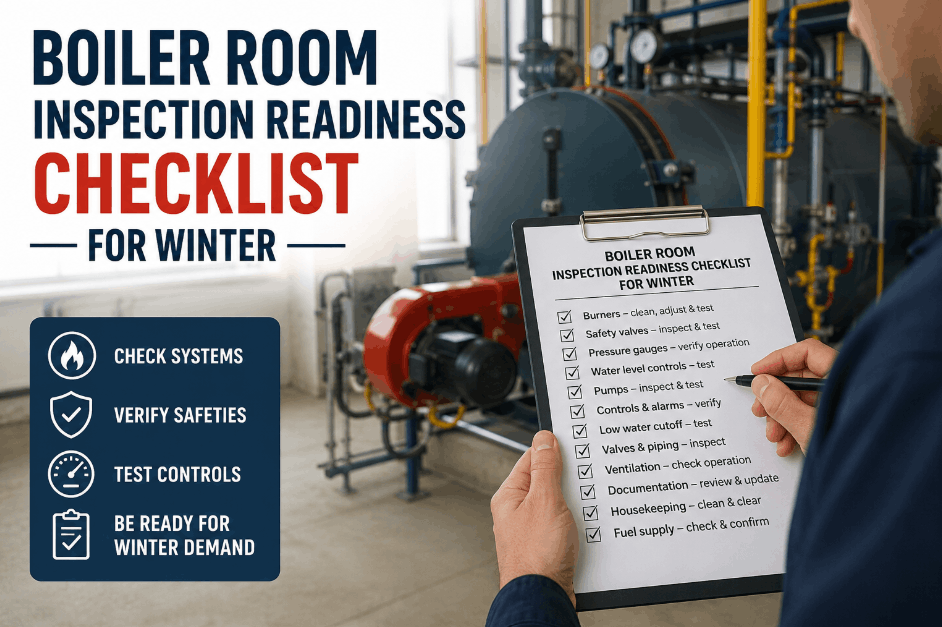
A boiler failure in a commercial or industrial facility is never just an inconvenience — it is a safety event, a compliance risk, and a costly operational disruption simultaneously. Boilers operate under high pressure and extreme temperatures where the margin for error is essentially zero. Low-water condition is consistently cited as the leading cause of catastrophic boiler failure: when water drops below the safe level and the burner continues firing, the heat exchanger overheats and can rupture under pressure. Facilities that follow structured preventive maintenance programs catch corroding tubes, fouled burners, and drifting safety controls weeks before they become incidents. This checklist covers every critical area — safety device testing, combustion analysis, water treatment, and compliance documentation — built for commercial and industrial heating systems operating under ASME, NFPA 85, and local boiler authority requirements. Sign up free to digitize every boiler PM task with automated work orders and compliance-ready records, or book a demo to see Oxmaint configured for your boiler plant.
#1Cause of catastrophic boiler failure: low-water condition
15%Fuel savings achievable from combustion tuning and PM
$80KAnnual savings from 1.5% efficiency improvement on a large boiler
AnnualMinimum jurisdictional inspection required for most steam boilers
Regulatory Compliance Framework
Commercial boiler operations are governed by a layered framework of standards. Non-compliance is not only a regulatory risk — it is a liability exposure that insurance carriers audit separately from government inspection. Book a demo to see how Oxmaint maps your PM tasks directly against these standards and generates audit-ready compliance reports on demand.
ASME Section I
Power Boiler Code
Power boiler design, construction, and pressure vessel code — governs safety valve ratings and maximum allowable working pressure (MAWP)
Design & Pressure
ASME CSD-1
Controls & Safety Devices
Controls and safety devices for automatically fired boilers — covers flame safeguard, burner management, and low-water cutoff requirements
Safety Controls
NFPA 85
Boiler & Combustion Hazards
Boiler and combustion systems hazards code — covers flame safeguard, burner management, and interlock requirements for fired equipment
Combustion Safety
NBIC
National Board Inspection Code
Governs in-service inspection, repair, and alteration of pressure-retaining equipment across jurisdictions — required for insurance and licensing
In-Service Inspection
OSHA 1910
General Industry Standards
OSHA general industry standards applicable to boiler room safety — covers operator training, LOTO procedures, and boiler room access requirements
Workplace Safety
State Codes
Jurisdictional Boiler Laws
Most jurisdictions require annual external inspection and biennial internal inspection for steam boilers above 15 psi — verify local requirements with your state boiler board
Jurisdiction-Specific
Priority:Critical Safety-critical, must not be skippedHigh Impacts equipment or complianceMedium Required before phase completion
Est. 15–20 minutesBoiler operator at shift startComplete every shift before operation
1.1 Pressure, Water Level & Flame Checks
#
Task
Acceptance Criteria
Priority
Sign-Off
1.1.1
Water level gauge glass — verify water level is visible in the middle third of the gauge glass. A reading below the lowest safe water level requires immediate burner shutdown before any other action is taken. This is the single most safety-critical daily check on any boiler.
Water level visible in middle third of gauge glass. Burner shutdown initiated immediately if below minimum safe level.
Critical
________
1.1.2
Operating pressure gauge — verify steam or hot water pressure is within operating range and below the MAWP stamped on the boiler nameplate. Note any pressure reading that requires the safety valve to lift under normal operating conditions.
Pressure within operating range and below MAWP on nameplate. Safety valve lift not required under normal operation. Reading logged with timestamp.
Critical
________
1.1.3
Burner flame observation — check flame shape, color, and stability through sight glass. A yellow or orange flame, sooting, or pulsating combustion indicates air-fuel ratio deviation requiring burner adjustment. Document any abnormal flame condition before next firing.
Flame blue and stable with no sooting or pulsation. Any abnormal condition documented before next firing cycle.
Critical
________
1.2 Controls, Feedwater & Visual Inspection
#
Task
Acceptance Criteria
Priority
Sign-Off
1.2.1
Control panel fault codes — check for active alarms, lockout codes, or warning indicators. Never silence a lockout alarm without identifying the root cause. Repeated safety shutdowns indicate a developing fault that must be investigated before returning to service.
No active alarms or lockout codes on panel. Any shutdown root cause identified and logged before reset.
High
________
1.2.2
Boiler room visual inspection — check for water, steam, or fuel leaks at all joints, valves, and fittings. Inspect boiler casing and insulation for damage. Verify combustion air openings are unobstructed and boiler room is free from flammable materials.
No leaks at joints, valves, or fittings. Combustion air openings unobstructed. Boiler room clear of flammable materials.
High
________
1.2.3
Feedwater pump operation — verify feedwater pump is running, make-up water valve is open, and chemical dosing pump is operating. Feedwater flow interruption while burner fires is the sequence of events leading to low-water damage. Log feedwater flow rate.
Feedwater pump running. Make-up water valve open. Chemical dosing pump operating. Flow rate logged.
High
________
1.2.4
Stack flue gas temperature — record stack temperature. Rising flue gas temperature over successive days indicates tube fouling or soot buildup. A 40°F increase in stack temperature represents approximately 1% loss in combustion efficiency.
Stack temperature recorded and compared against prior reading. Increase of 40°F or more triggers tube inspection work order. Recorded: ______°F
Medium
________
GATE 1All Phase 1 tasks signed off by boiler operator at shift start. Boiler must not remain in service if any Critical item is unresolved.
Est. 30–45 minutesCertified boiler operatorComplete once per week
Safety device tests must be performed and documented on a recurring schedule per ASME CSD-1. Never perform blowdown on an unattended boiler. Verify boiler room drain can accept full blowdown flow before opening any blowdown valve.
2.1 Safety Device Testing
#
Task
Acceptance Criteria & Recorded Result
Priority
Sign-Off
2.1.1
Low-water cutoff test — manually simulate low-water condition by blowing down the float chamber or testing probe response. Verify burner shuts down before water reaches the minimum safe level. ASME CSD-1 requires this test be documented on a recurring schedule.
Burner confirmed shutdown before water reaches minimum safe level. Test result and timestamp logged against work order. Pass / Fail: ______
Critical
________
2.1.2
Safety valve manual lift test (where permitted) — manually lift the safety valve test lever to verify the valve opens and reseats cleanly. A valve that fails to reseat is a safety device failure requiring immediate replacement, not recalibration. Some jurisdictions prohibit field testing; defer to local code.
Valve opens and reseats cleanly with no leakage after test. Valve requiring replacement tagged out immediately. Jurisdiction code confirmed. Pass / Fail: ______
High
________
2.2 Blowdown, Water Treatment & Gauge Glass
#
Task
Acceptance Criteria & Recorded Result
Priority
Sign-Off
2.2.1
Bottom blowdown — open the bottom blowdown valve fully for the duration specified by the boiler manufacturer to remove accumulated sludge and dissolved solids from the boiler mud drum. Never blowdown an unattended boiler. Verify boiler room drain can accept full blowdown flow.
Blowdown performed per manufacturer duration. Operator present for full duration. Drain capacity confirmed. Result logged.
Critical
________
2.2.2
Water treatment test — measure pH, total dissolved solids (TDS), alkalinity, and hardness of boiler water sample. Compare to ASME water quality limits for the operating pressure. Untreated or out-of-spec water accelerates tube corrosion and scale buildup. Adjust chemical dosing accordingly.
pH 10.5–11.5. TDS within ASME limits for operating pressure. Chemical dosing adjusted if any parameter out of range. Recorded: pH ______ TDS ______
High
________
2.2.3
Gauge glass blowdown — blow down the water column and gauge glass connections to clear sludge and verify accurate water level reading. A plugged gauge glass connection shows a false high-water reading that masks a dangerous low-water condition.
Gauge glass connections clear and water level reading confirmed accurate after blowdown. No false reading observed.
High
________
2.2.4
Steam trap inspection — check steam traps for blow-through (passing steam) or flooding (stuck closed). A failed open steam trap wastes steam continuously and inflates fuel cost. A failed closed trap floods the steam distribution system with condensate.
All steam traps confirmed functional. No blow-through or flooding detected. Failed traps tagged for replacement. Result logged.
Medium
________
GATE 2Low-water cutoff test documented. Blowdown completed. Water chemistry within ASME limits. Phase 3 monthly tasks cannot be skipped if any Weekly item remains unresolved.
ASME CSD-1 Compliance
Weekly safety device test records, blowdown logs, and water treatment results stored automatically against your boiler asset — feeding the next inspection scope without paper records or verbal handoffs. See weekly boiler task data in Oxmaint.
Certified technician required for combustion and controls tasksMonthly and quarterly cadenceBegin after Gate 2 clearance
Combustion analysis and safety control calibration require a certified technician. A high-limit control that has drifted above its set point means the boiler is operating without primary overpressure protection — do not return to service until recalibrated and verified.
3.1 Combustion Analysis & Safety Control Calibration
#
Task
Acceptance Criteria & Recorded Value
Priority
Sign-Off
3.1.1
Combustion analysis — use flue gas analyzer to measure O2, CO2, CO, and stack temperature. Target 82–85% combustion efficiency for gas-fired boilers. Excess O2 above 4–5% indicates too much excess air and direct fuel waste. CO above 100 ppm in flue gas requires immediate burner adjustment.
O2: 2–4%. CO2: 10–12%. CO below 100 ppm. Efficiency 82–85% minimum. Recorded: O2 ______ CO2 ______ CO ______ ppm Eff ______%
Critical
________
3.1.2
Safety control calibration — test and calibrate operating pressure control, high-limit pressure control, and operating temperature controls. A high-limit control that has drifted above its set point is a failed safety device — the boiler is operating without primary overpressure protection.
All controls calibrated and verified at set points per manufacturer specification. High-limit confirmed within tolerance. Results logged against work order.
Critical
________
3.2 Burner Assembly, Water Chemistry & Flue Inspection
#
Task
Acceptance Criteria & Recorded Value
Priority
Sign-Off
3.2.1
Burner assembly inspection — clean flame sensor, ignitor electrode, and burner orifices. Verify electrode gap against manufacturer specification. Inspect burner head for carbon deposits and deterioration. A fouled flame sensor causes nuisance shutdowns; a failed ignitor causes unlit fuel accumulation.
Flame sensor clean. Electrode gap within manufacturer specification. Burner head free of carbon deposits and deterioration. Gap recorded: ______ mm
High
________
3.2.2
Water treatment lab analysis — submit boiler water and feedwater samples to laboratory for full chemistry analysis including dissolved oxygen, iron, copper, and silica. Log results against ASME recommended limits for the operating pressure. Adjust chemical treatment program based on results.
All parameters within ASME limits for operating pressure. Chemical treatment program adjusted based on lab results. Lab report filed against work order.
High
________
3.2.3
Flue and venting inspection — inspect flue gas passages, breeching, and stack for corrosion, blockages, and joint integrity. Check draft. Flue gas recirculation from a compromised vent is a life-safety hazard. Measure CO levels at boiler room air outlets when heating season begins.
Flue passages clear with no corrosion, blockage, or joint failure. Draft within operating specification. CO at air outlets below 35 ppm. Recorded: CO ______ ppm
High
________
3.2.4
Scale inspection — 1 mm of scale on boiler heat transfer surfaces increases fuel consumption by approximately 7%. Inspect accessible tube surfaces for scale and corrosion quarterly. Elevated approach temperature or rising fuel consumption per unit of steam output indicates fouling requiring chemical treatment.
No visible scale above 1 mm on accessible tube surfaces. Fuel consumption per unit output within baseline. Scale treatment work order raised if fouling observed.
Medium
________
GATE 3Combustion analysis complete and within targets. Safety controls calibrated and verified. Burner assembly inspected. Water chemistry within ASME limits. Phase 4 annual tasks cannot begin until all monthly and quarterly items are signed off by a certified technician.
15% Fuel Savings
Combustion efficiency trends, burner inspection records, and water chemistry lab results stored against your boiler asset record — feeding the next annual inspection scope automatically. Book a demo to see combustion analysis data in Oxmaint.
Planned shutdown requiredCertified boiler inspectorBegin after Gate 3 clearance
Annual inspection requires a planned shutdown and a commissioned boiler inspector in most jurisdictions. A 20% wall thickness reduction in any tube requires replacement before returning to service. File all required reports with the state boiler authority and insurance carrier by the jurisdiction deadline.
Pressure vessel internal inspection — open boiler for full internal inspection of drum, tubes, headers, and welds. Inspect for corrosion, pitting, cracking, and scale. Most jurisdictions require this inspection by a commissioned boiler inspector. File inspection report with state boiler authority within required timeframe.
No active corrosion, pitting, cracking, or scale beyond acceptable limits. Inspection report filed with state boiler authority within required timeframe. Inspector: ______
Critical
________
4.1.2
Safety valve certification — have all safety valves tested and certified at rated lift pressure by an accredited valve testing facility. Replace any valve that fails to lift at set pressure, fails to reseat, or has exceeded the manufacturer's recommended service interval. File certification with insurance carrier.
All safety valves tested at rated lift pressure and certified. Failed valves replaced before return to service. Certification filed with insurance carrier. Cert #: ______
Critical
________
4.1.3
Low-water cutoff rebuild — disassemble, clean, and rebuild the low-water cutoff annually. Replace float mechanisms, probe sensors, or electronic elements per OEM interval. The low-water cutoff is the last line of defense against catastrophic heat exchanger failure — it must be in verified functional condition.
Low-water cutoff fully disassembled, cleaned, and rebuilt per OEM specification. Functional test passed after reassembly. OEM parts log attached to work order.
Critical
________
4.2 Heat Exchanger, Refractory & Feedwater System
#
Task
Acceptance Criteria & Recorded Value
Priority
Sign-Off
4.2.1
Refractory and insulation inspection — inspect combustion chamber refractory for cracks, spalling, and deterioration. Damaged refractory exposes pressure vessel metal to direct flame impingement. Check boiler body insulation for moisture infiltration and thermal bridging.
No cracks, spalling, or deterioration in combustion chamber refractory. Insulation free of moisture infiltration and thermal bridging. Repair work order raised for any defect found.
High
________
4.2.2
Heat exchanger tube inspection — brush or hydroblast fireside tube surfaces. Inspect tube sheets for leaks, pitting, and corrosion. Measure tube thickness in accessible areas. A 20% wall thickness reduction in any tube requires replacement before returning to service.
Tubes clean and free of pitting, leaks, and corrosion. Wall thickness above 80% of nominal in all measured areas. Recorded minimum wall: ______ mm
High
________
4.2.3
Feedwater and condensate system overhaul — overhaul feedwater pumps, clean condensate receiver, inspect make-up water treatment system, and rebuild feedwater control valve. Feedwater system integrity directly determines boiler water quality for the entire operating year ahead.
Feedwater pumps overhauled. Condensate receiver cleaned. Make-up water treatment system inspected. Control valve rebuilt per OEM specification. All findings logged.
High
________
4.3 Documentation & Compliance Filing
#
Authorisation Milestone
Required Before / Authorised By
Priority
Sign-Off
4.3.1
Compile annual inspection report, safety valve certification records, water treatment logs, and operator testing records. File all required reports with the state boiler authority and insurance carrier by the jurisdiction deadline. Retain records for a minimum of 3 years.
Required before boiler returns to service after annual shutdown. Records retained minimum 3 years. Filing deadline confirmed with state authority. Auth: ________
Medium
________
COMPLETEAll four phases signed off. Internal inspection complete. Safety valves certified. Low-water cutoff rebuilt. Compliance records filed. Boiler authorised for return to full service.
Deploy This Checklist Digitally
Your Boiler. Every Check. Always Audit-Ready.
Oxmaint digitizes every safety check, compliance record, and PM task on this checklist — mapped against ASME and NFPA 85 requirements, with timestamped records ready for your next inspector visit. Book a 30-minute demo with your boiler plant team and see the full checklist workflow configured for your equipment profile.