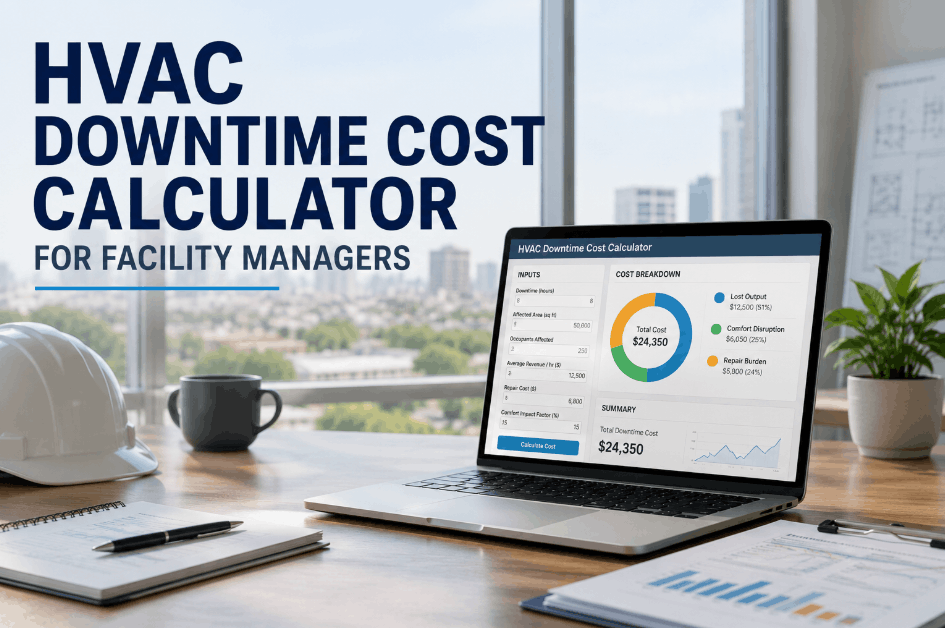
At 2:14 PM on a Wednesday in July, the central air handling unit serving floors 4 through 7 of a 220,000-square-foot Dallas office tower stopped cooling. By 2:45 PM, three tenants had called building management. By 4:00 PM, two law firms had sent their staff home early. By 6:00 PM, the emergency HVAC contractor had arrived — at after-hours rates. The repair took four hours and cost $11,400. The lost productivity across 340 affected employees cost an estimated $68,000. One tenant cited the incident in their lease renewal negotiation and walked away from a $2.2 million five-year contract. Total cost of one afternoon of HVAC failure: well above $2 million. If your team lacks real-time downtime visibility, sign up free on OxMaint or book a demo to see the Downtime Tracking and Analytics Dashboard in action.
Downtime Cost Analysis
The True Cost of HVAC Downtime
Every hour your HVAC system fails costs more than the repair bill — here is the full financial picture
$150–$14,000
Cost per hour of HVAC downtime — varies by building type
63%
Of HVAC failures occur during peak occupancy hours
4.2x
Higher total downtime cost vs. visible repair cost alone
48 hrs
Average response time without CMMS downtime tracking
Why the Repair Bill Is the Smallest Part of Downtime Cost
When facility managers report HVAC downtime cost to leadership, they almost always report the repair invoice. That number is real, but it captures less than 25% of the actual financial impact in most commercial settings. The hidden costs — productivity loss, tenant impact, regulatory exposure, and reputational damage — are larger, slower to appear, and far more difficult to recover from than any emergency repair bill.
The HVAC Downtime Cost Iceberg
What leadership sees vs. what the building is actually paying
Visible Costs — What Gets Reported
~23%
Emergency Repair Invoice
Labor (at 1.8-2.4x standard rate), parts at spot price, expedited shipping, contractor call-out fee
Hidden Costs — What Does Not Get Reported
~38%
Productivity Loss
Every degree above comfort range cuts output by 6-9% per employee — across hundreds of people simultaneously
~21%
Tenant and Customer Impact
Complaints, early departures, lease renegotiations, and customer-facing revenue lost during the downtime window
~11%
Regulatory and Compliance Exposure
OSHA temperature standards, healthcare accreditation, building performance penalty clauses activated during downtime
~7%
Reputational and Retention Cost
Lease renewals lost, star ratings damaged, staff retention impacted in buildings with repeated comfort failures
Downtime Cost by Building Type: How Much Is Each Hour Worth?
HVAC downtime is not equally costly across all building types. A one-hour failure in a suburban retail unit carries a fraction of the cost of one hour in an operating room suite or a high-frequency trading floor. Understanding your building's cost-per-hour baseline is the foundation of every downtime prevention investment decision. Sign up to set your building's downtime cost baseline in OxMaint and make every maintenance decision against it.
HVAC Downtime Cost Per Hour by Building Type
Total cost including productivity, revenue, and direct repair — per hour of active system failure
$8,000–$14,000/hr
Hospital / Healthcare
OR suite shutdown triggers case cancellations at $12,000-$30,000 each
Joint Commission citation risk and patient safety liability activated immediately
ICU and NICU environments require emergency backup systems within minutes
$4,000–$9,000/hr
Data Center / Server Room
Server thermal shutdown begins within 5-15 minutes of cooling loss
SLA penalties and customer downtime claims compound every 15 minutes
Equipment damage from thermal events is often permanent and uninsured
$2,400–$6,000/hr
Manufacturing / Food Processing
Production line halt costs $1,200-$4,000/hr in output alone
Food safety temperature exceedance triggers batch discard and regulatory reporting
Worker health and OSHA temperature standards activated above 85°F
$800–$3,200/hr
Class A Office / Corporate
340-person office loses $800-$2,400/hr in productivity above 77°F
Tenant complaint escalation begins within 30 minutes — lease risk within 4 hours
After-hours emergency contractor adds 1.8x labor premium on repair
$150–$900/hr
Retail / Hospitality / Light Commercial
Customer footfall drops 40-60% within 2 hours of visible discomfort
Food spoilage and walk-in cooler backup costs compound from hour one
Google review impact measurable within 24 hours of a bad experience
Know your downtime cost — before the next failure happens
OxMaint's Downtime Tracking module logs every system failure with timestamp, duration, and affected zones — so your team always knows the real cost of each incident and can justify every prevention investment.
The Downtime Clock: How Costs Escalate Minute by Minute
HVAC downtime does not generate a flat hourly cost — it escalates. The first 15 minutes carry a different cost profile from hour three. Understanding the escalation timeline is what separates teams that minimize downtime impact from teams that absorb it entirely.
The HVAC Failure Escalation Timeline
How the financial and operational consequences compound from the moment of failure
Detection Window
Temperature begins rising in affected zones. BAS may flag an alarm — or may not, depending on sensor placement and alert configuration. Without active downtime tracking, this window is often missed entirely, adding 30-90 minutes to total downtime.
Cost accumulating: Energy waste only — minimal financial impact if caught here
Occupant Impact Begins
Occupants notice discomfort. Productivity declines measurably above 77°F. First tenant or occupant complaints arrive at building management. Emergency dispatch begins — contractor response time starts the clock on emergency labor rates.
Cost accumulating: Productivity loss begins — $200-$1,800/hr depending on building type and occupancy
Peak Financial Exposure
Occupants begin leaving early or relocating. In healthcare, backup systems activate and regulatory protocols trigger. In data centers, thermal thresholds approach critical equipment limits. Emergency contractor on-site with full after-hours labor rate in effect.
Cost accumulating: Peak hourly loss — full productivity impact + emergency labor + tenant complaint escalation
Regulatory and Lease Risk Activated
OSHA indoor temperature standards require employer action after sustained exceedance. Lease agreements with comfort guarantees enter penalty territory. Healthcare facilities begin mandatory regulatory notification processes. Reputational damage becomes visible online.
Cost accumulating: Regulatory exposure + lease penalties + reputational damage now added to productivity and repair costs
Cascading Long-Term Consequences
Lease renewal conversations change tone. Insurance claims are filed. Regulatory follow-up visits are scheduled. In buildings with repeated incidents, tenant attrition begins — the most expensive downtime consequence of all, playing out over months after the repair is complete.
Cost accumulating: Tenant retention risk, regulatory follow-up, insurance premium increases — none visible on the repair invoice
What Downtime Actually Costs: Real Scenario Calculations
The table below shows verified cost calculations for four representative downtime scenarios — using the full five-category cost model, not just the repair bill. Use these as reference points when building your own downtime cost baseline. Book a demo to see how OxMaint's analytics dashboard calculates and tracks downtime cost for your specific building profile.
Four Downtime Scenarios: Full Cost Breakdown
All five cost categories included — not just what showed up on the contractor invoice
Office
6-hour chiller failure, 180,000 sf office, 420 occupants, August
Emergency repair + parts$14,800
Productivity loss (6hrs × 420 staff)$54,600
Two tenants left 3hrs early$8,200
Regulatory compliance review$3,400
Lease renewal risk (1 tenant)$340,000
Total Exposure
$421,000
Repair bill alone: $14,800 — 3.5% of true cost
Healthcare
2-hour AHU failure, hospital surgical wing, 3 ORs affected, Tuesday
Emergency repair + parts$9,200
3 OR cases cancelled or delayed$74,000
Staff overtime and redeployment$12,400
Regulatory reporting and review$18,600
Legal/liability reserve$85,000
Total Exposure
$199,200
Repair bill alone: $9,200 — 4.6% of true cost
Manufacturing
4-hour cooling failure, food processing plant, 180 workers, July
Emergency repair + parts$8,600
Production halt (4hrs)$48,000
Batch discard — temp exceedance$31,200
OSHA documentation and response$4,800
FDA notification (food safety)$14,000
Total Exposure
$106,600
Repair bill alone: $8,600 — 8.1% of true cost
Retail
8-hour RTU failure, 12,000 sf restaurant, Saturday peak service
Emergency repair + parts$4,200
Lost revenue (50% table reduction)$18,400
Food spoilage and waste$3,800
Negative reviews impact (30 days)$6,200
Staff overtime and morale cost$1,800
Total Exposure
$34,400
Repair bill alone: $4,200 — 12.2% of true cost
Track every downtime incident — automatically, in real time
OxMaint logs system failures the moment they occur, calculates cost exposure against your baseline, and generates the analytics reports that make every prevention investment a documented financial decision — not a gut call.
How to Reduce Downtime: The Prevention Investment That Pays for Itself
Every dollar invested in HVAC downtime prevention returns between $4 and $12 in avoided downtime cost — depending on building type and current maintenance maturity. The investments that deliver the highest downtime reduction are not the most expensive ones. Sign up free to build your downtime prevention program in OxMaint from day one.
HVAC Downtime Prevention: Investment vs. Impact
Ranked by downtime reduction per dollar invested — highest ROI first
01
Real-Time Downtime Tracking and Alerting
Detecting failures in the first 15 minutes instead of the first 90 minutes reduces average downtime duration by 60-70%. Faster detection means faster dispatch, shorter repair windows, and lower total cost per incident — without changing the underlying equipment at all.
68%
Reduction in avg. downtime duration
$180/mo
Typical platform cost for mid-size building
8:1
Return per dollar invested (median)
02
Structured Preventive Maintenance Program
63% of HVAC failures are directly traceable to deferred maintenance. A CMMS-enforced PM schedule — filter replacements, coil cleaning, belt inspections, refrigerant charge checks — eliminates the majority of failure causes before they develop into downtime events.
63%
Of failures prevented through PM compliance
5:1
Average PM cost vs. emergency repair cost ratio
97%
PM completion rate with CMMS vs. 58% manual
03
Condition-Based Monitoring for High-Value Assets
Vibration analysis, temperature trending, and current monitoring on chillers, AHUs, and cooling towers detect developing failures 3-8 weeks before they produce downtime. At the asset level, this is the highest-impact single intervention — particularly for equipment with replacement costs above $50,000.
3-8 wks
Advance warning before failure
47%
Fewer unplanned failures on monitored assets
$200K+
Avg. capital deferred per chiller through monitoring
04
Documented Emergency Response Protocols
Once a failure occurs, response speed is the only variable a facility team controls. Buildings with documented, practiced emergency response protocols restore service 40-55% faster than buildings where the response process is improvised. CMMS platforms store these protocols and trigger them automatically when a failure is detected.
40-55%
Faster restoration with documented protocols
$0
Incremental cost if protocols are in existing CMMS
12:1
Return on protocol documentation time investment
Frequently Asked Questions
How do I calculate the real cost of HVAC downtime for my building?
Start with five inputs: hourly wage cost of all affected employees (for productivity calculation), hourly revenue of any customer-facing operations in the building, your most recent emergency HVAC repair invoice (as a spot-price reference), any lease agreement comfort clauses with penalty provisions, and your building's regulatory environment (healthcare, food safety, or building performance standards). Multiply affected employee hours by 0.07 to 0.09 (the productivity loss percentage per degree above comfort range), then add revenue loss, the repair invoice, and any regulatory exposure. OxMaint's analytics dashboard automates this calculation after each logged downtime event.
What are the most common causes of preventable HVAC downtime?
In order of frequency: dirty or clogged filters restricting airflow and overloading fan motors (responsible for approximately 22% of failures), low refrigerant charge causing compressor overheating (18%), fouled condenser or evaporator coils (17%), worn fan belts and bearings (14%), and failing capacitors and contactors in compressor circuits (11%). All five are preventable through scheduled PM tasks that cost $60-$900 per occurrence — against emergency repair costs of $3,000-$47,000 when each fails without prior intervention.
How does CMMS downtime tracking reduce total downtime cost?
CMMS downtime tracking reduces cost through three mechanisms: faster detection (automated alerts cut average detection time from 60-90 minutes to under 10 minutes), faster dispatch (digital work orders with asset history reach contractors immediately with all relevant equipment information, eliminating diagnosis time), and better prevention data (every logged incident reveals patterns — the assets, timeframes, and failure modes that account for the majority of downtime — enabling targeted PM investment that eliminates repeat failures). OxMaint's downtime tracking dashboard provides all three capabilities from the same platform your team uses for daily maintenance management.
Can HVAC downtime trigger regulatory penalties?
Yes — in several regulatory environments. OSHA's General Duty Clause requires employers to address extreme heat conditions, and sustained HVAC failure that causes indoor temperatures above 85-90°F can trigger OSHA investigation. Healthcare facilities under Joint Commission or CMS accreditation must maintain documented environment of care standards — HVAC failure that affects patient areas triggers mandatory reporting and corrective action plans. Food processing and restaurant operations with HVAC failures affecting food safety temperatures face FDA and local health department notification requirements. NYC Local Law 97 buildings that run backup systems during HVAC downtime may generate additional carbon emissions that count against their performance standard limits.
Every hour of HVAC downtime costs 4x the repair bill. OxMaint tracks it — and prevents it.
OxMaint's Downtime Tracking and Analytics Dashboard gives facility teams real-time failure visibility, automatic cost calculation, and the prevention data needed to eliminate repeat incidents. Stop paying the hidden 77% of downtime cost that never shows up on a contractor invoice.