HVAC failures don't just disrupt comfort — they generate cascading financial losses that most facility managers can't quantify until weeks after the event. Lost productivity, emergency repair premiums, tenant complaints, and energy spikes compound silently into costs that dwarf the original repair invoice. Sign Up Free to start tracking your HVAC asset health before the next unplanned failure. Facility managers operating without downtime cost visibility consistently underestimate failure impact by 40–60%, delaying maintenance investment that would have cost a fraction of the resulting disruption. Book a Demo to see how Oxmaint's CMMS quantifies downtime cost per asset across your portfolio. Understanding the true financial exposure of HVAC downtime is the first step to justifying faster action, predictive maintenance investment, and smarter capital planning at scale.
Stop Underestimating HVAC Downtime Costs
Oxmaint helps facility managers estimate lost output, comfort disruption, and repair burden — so every maintenance decision is backed by financial data.
What HVAC Downtime Actually Costs: Beyond the Repair Invoice
Facility managers who calculate HVAC downtime cost using only the repair invoice are measuring less than 30% of the true financial impact. The remaining 70% sits in categories that don't appear on a single work order: lost occupant productivity, emergency contractor premiums, energy inefficiency from partial operation, compliance exposure from temperature-sensitive spaces, and the reputational cost of tenant escalations. A structured downtime cost model — built into a CMMS like Oxmaint — captures all cost categories per failure event, giving facility managers the financial data to justify preventive maintenance investment before the next failure occurs. Sign Up Free to deploy Oxmaint's asset-level downtime tracking across your facility portfolio.
Downtime Cost Calculator: How Facility Managers Should Structure the Model
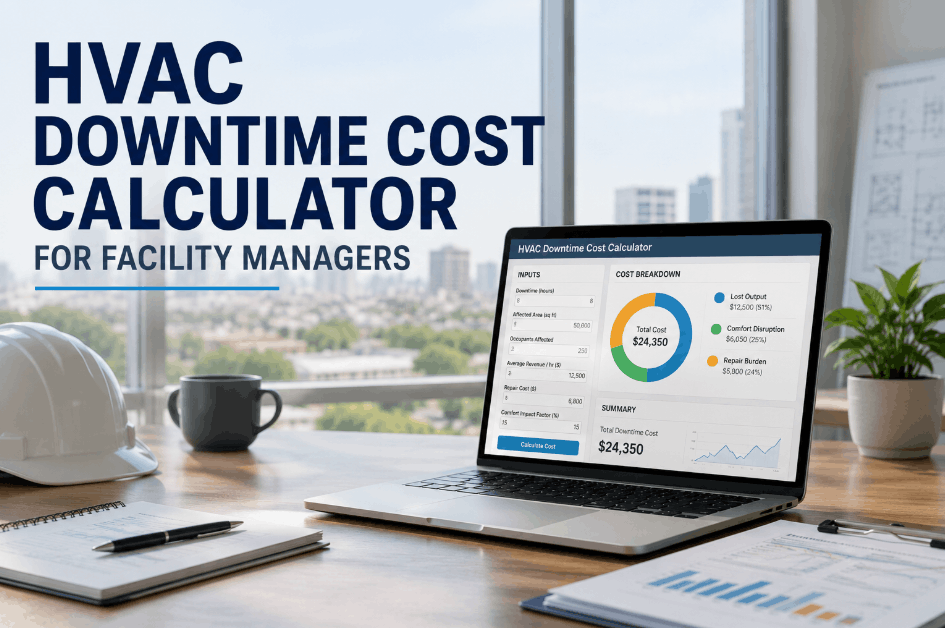
An effective HVAC downtime cost calculator requires four input variables: hourly downtime duration, affected square footage, occupancy density, and asset criticality tier. Output should generate three cost estimates: direct repair cost, indirect productivity cost, and long-term reliability risk cost. Oxmaint's work order system captures all three automatically per asset — so the cost model builds itself from real maintenance data rather than manual estimation. Book a Demo to see how Oxmaint calculates per-asset downtime cost across multi-site portfolios.
Comfort Disruption as a Measurable Cost Driver
Thermal comfort directly correlates with occupant productivity — research consistently shows a 2–4% productivity decline for every degree Celsius of deviation from the 21–23°C comfort band. For a 200-person office at $50/hour average labor cost, a 4-hour HVAC failure generating a 5°C deviation produces $8,000–$16,000 in lost productive output — entirely invisible in the work order. Oxmaint's asset criticality tagging and downtime logging allows facility managers to attach productivity cost coefficients to each HVAC unit, generating a true cost-per-failure metric that drives faster maintenance authorization. Book a Demo to configure comfort-linked downtime cost tracking in Oxmaint.
Repair Burden: Why Emergency HVAC Costs 3–5× Planned Maintenance
Emergency HVAC repair carries a structural cost premium that planned maintenance eliminates. After-hours labor rates, parts expedite shipping, contractor availability markups, and diagnostic time on unfamiliar fault histories compound the base repair cost by 3–5×. A compressor replacement scheduled during planned downtime costs $4,200; the same replacement as an emergency callout at 11pm costs $14,000–$18,000 before productivity loss is factored in. Oxmaint's PM scheduling and work order management eliminates reactive premium costs by converting reactive events to planned tasks — with documented cost savings per asset available for capital justification reporting. Sign Up Free to start converting your reactive HVAC spend to planned maintenance savings.
Using Downtime Cost Data to Justify Faster Maintenance Action
Maintenance authorization delays are the most preventable cost driver in facility HVAC management. When a facility manager requests a $3,500 compressor replacement without a downtime cost model, approval cycles average 8–12 days. When the same request includes a documented downtime cost of $1,800/day and a 4-day estimated failure window, approval cycles compress to 24–48 hours. Oxmaint generates this justification automatically from asset history, generating a cost-of-delay estimate that maintenance requestors can attach to approval workflows — eliminating the authorization friction that turns preventable failures into costly emergencies. Sign Up Free to start generating cost-of-delay justifications for your HVAC maintenance requests.
Quantify Your HVAC Downtime Cost — Before the Next Failure
Oxmaint tracks asset criticality, downtime duration, repair cost, and productivity impact — generating the financial data facility managers need to justify faster maintenance action.
Frequently Asked Questions
Estimate Downtime Cost. Justify Faster Action. Reduce Delay Costs at Scale.
Oxmaint's HVAC downtime cost module combines asset criticality tracking, repair cost logging, productivity impact modeling, and PM compliance analytics — giving facility managers the financial intelligence to act before failure, not after.