A 12-story office building in Dallas lost its primary chiller on the hottest week of the year. Root cause: a condenser coil that had not been cleaned in nine months. The restriction forced the compressor to run at 138% capacity until it burned out. Emergency replacement: $14,200. Tenant complaints, lost productivity, and service credits: $23,000. The coil cleaning that would have prevented all of it: $350 during a scheduled quarterly visit. This is not an unusual story — it is the predictable outcome of calendar-based HVAC maintenance that ignores real operating conditions. Commercial HVAC systems consume 40% of total building energy, and well-maintained systems use 20–40% less energy than neglected equivalents running the same building. The savings are not hypothetical. They are documented performance losses that compound on every utility bill. Sign in to OxMaint to build runtime-triggered HVAC maintenance schedules that target the five highest-ROI efficiency levers — or book a demo to see HVAC energy tracking configured for your building portfolio.
Energy & ESG / HVAC Efficiency 2026
How to Reduce HVAC Energy Costs by 20–30% with CMMS-Driven Maintenance
Coil cleaning, filter management, economizer optimisation, VFD tuning, and BAS calibration — the five maintenance-driven efficiency levers that deliver 20–35% energy reduction within 12 months, tracked and automated through a CMMS.
Energy Savings by Maintenance Action
Condenser coil cleaning
10–30%
Economizer restoration
up to 37%
Controls calibration
12–18%
Combined maintenance programme: 20–35% reduction within 12 months
Why Calendars Fail
Calendar-Based Maintenance Is the Problem — Runtime-Based Scheduling Is the Fix
A rooftop unit running 14 hours daily in a humid, high-particulate environment degrades three times faster than the same unit operating 8 hours in a dry climate — yet both receive identical quarterly maintenance schedules under calendar-based programmes. This mismatch between schedule and reality is the primary driver of HVAC energy waste in commercial buildings. Sign in to OxMaint to configure runtime-triggered HVAC maintenance that adjusts to actual operating conditions, not fixed calendar dates.
$127,500
Annual energy savings for a 300,000 sq ft building transitioning from calendar-based to runtime-triggered HVAC maintenance — recovering 30–40% of energy waste within the first 12 months through economizer repair, condenser cleaning, VFD tuning, and BAS override resolution.
The 5 Energy Levers
The Five Maintenance Actions That Drive 20–30% Energy Reduction
These five actions account for the majority of achievable HVAC energy savings through maintenance — no capital replacement required. Each has a quantified energy penalty when neglected and a documented savings range when maintained correctly. Book a demo to see how OxMaint schedules all five on runtime-triggered work orders per asset.
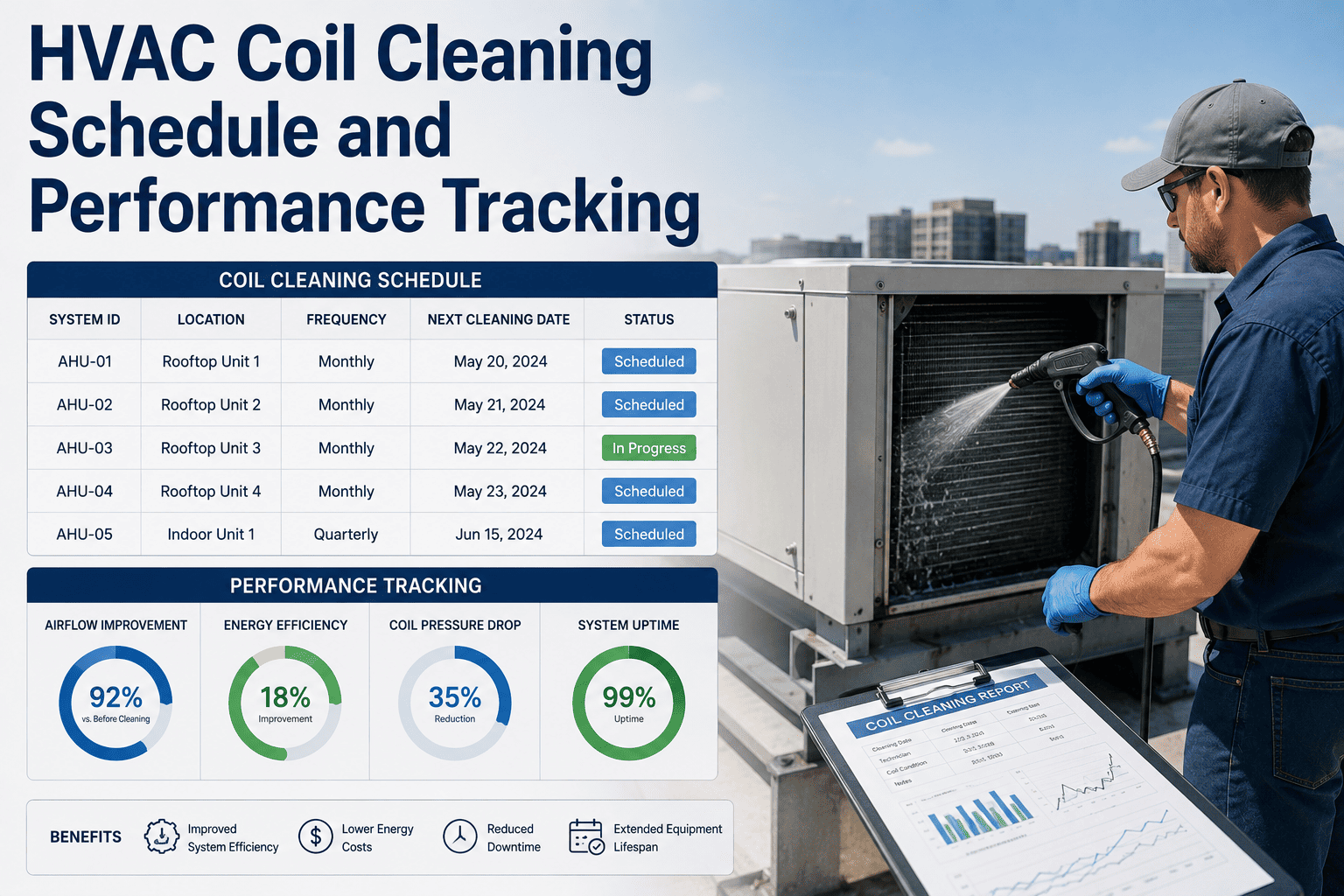
Coil fouling is the single largest cause of HVAC energy waste. A condenser coil with 0.042 inches of fouling increases energy consumption by 21%. A dirty condenser alone can increase compressor energy consumption by 10–30% as the system works harder to reject heat through a contaminated surface. Post-cleaning systems deliver 10–46% more airflow with 41–60% reductions in fan energy.
CMMS Scheduling Trigger
Urban rooftops and loading dock zones: every 2,000 runtime hours (not calendar quarter)
Standard environments: every 4,000 runtime hours — capture pressure drop reading at each clean
High-fouling environments (manufacturing, food processing): monthly evaporator coil inspection
Energy penalty if skipped
A functioning economiser provides free cooling whenever outdoor conditions allow — eliminating mechanical refrigeration for hours at a time in moderate climates. A stuck-open damper forces mechanical cooling even during free-cooling conditions, increasing cooling energy by up to 37%. A stuck-closed damper eliminates the free-cooling opportunity entirely, costing $3,000–$8,000 annually per unit in avoidable mechanical cooling. In large commercial buildings, economiser faults are consistently the highest-value single maintenance finding.
CMMS Scheduling Trigger
Quarterly: full damper stroke test, linkage check, actuator response verification
Semi-annual: enthalpy sensor calibration against reference instrument
Immediate work order: BAS reports economiser in manual override — auto-escalate as energy alert
Energy penalty if skipped
A MERV 13 filter two weeks overdue for replacement increases static pressure by 0.3 inches, driving fan motors to draw 18% more current. Clogged filters restrict airflow and force blower motors to work significantly harder, increasing energy consumption by 5–15% per unit. Monthly replacement in high-occupancy environments delivers the highest ROI of any single HVAC maintenance task: $4 saved per $1 spent on filter costs alone.
CMMS Scheduling Trigger
MERV 8 pre-filters, standard office: every 60–90 days
MERV 13 final filters: every 120–180 days — shorter in healthcare, food processing, high-occupancy retail
Runtime trigger option: replace when pressure differential across filter exceeds design threshold
Energy penalty if skipped
Variable Frequency Drives that drift from their calibration reduce fan and pump efficiency by 20–25%. Misaligned fan belts waste 5–15% of motor energy and accelerate bearing failure. A $12 belt replaced during a scheduled PM prevents a $600+ emergency motor replacement. Fan energy accounts for 30–40% of total HVAC energy in large commercial buildings — making drive and belt maintenance one of the highest-leverage electrical efficiency actions available.
CMMS Scheduling Trigger
Belt tension and alignment: every 2,000 runtime hours on all AHU fans and exhaust systems
VFD calibration check: semi-annual — compare actual speed to commanded speed at multiple setpoints
Bearing lubrication: every 1,000–2,000 runtime hours depending on motor size and speed
Energy penalty if skipped
Drifted temperature, humidity, and CO2 sensors cause the BAS to make incorrect control decisions — often resulting in simultaneous heating and cooling of the same space, one of the most wasteful HVAC faults possible. BAS override resolution — identifying equipment running in manual override that bypasses automated efficiency controls — delivers $15,000+ in annual utility savings in a building where only 10% of units are stuck in override. Controls calibration drift that goes undetected consumes 12–18% excess energy silently, month after month.
CMMS Scheduling Trigger
Sensor calibration: annually — temperature, humidity, CO2 sensors verified against reference instruments
BAS override audit: monthly — flag any HVAC unit in permanent manual override for investigation
Night setback verification: quarterly — confirm unoccupied setpoints are active and equipment is cycling off
Energy penalty if skipped
When a unit's energy consumption rises 10% above its seasonal baseline, something has changed — a fouled coil, a refrigerant leak, a stuck damper, a failed economiser. Per-unit energy tracking turns the utility bill into an early warning system. Without unit-level tracking, energy waste accumulates invisibly across the portfolio until it appears as a building-wide utility overage that cannot be attributed to a specific cause or corrected with a specific maintenance action.
CMMS Tracking Setup
Establish energy baseline per unit at commissioning or after each PM — record consumption at standard operating conditions
Track runtime hours per unit — consumption normalised to runtime eliminates seasonal variation from trend data
Threshold alert: auto-generate investigation work order when consumption exceeds baseline by more than 10%
Tracking reveals
Which specific units are driving building-wide energy overages. Maintenance actions with measurable before/after energy impact. ESG and ASHRAE 90.1 compliance data generated automatically.
Book a demo to see per-unit energy tracking.
Stop Losing 20–30% of Your HVAC Energy Budget to Preventable Maintenance Gaps
OxMaint schedules coil cleaning, economiser tests, filter changes, VFD checks, and BAS audits on runtime-triggered work orders — automatically. Energy savings tracked per unit. Compliance documentation generated at every close. Free trial, no implementation fees.
What Commercial HVAC Energy Specialists Say
"
The facilities I audit that are overspending on HVAC energy by 25–35% almost always have the same characteristic: they are maintaining on calendars, not on condition. The coil cleaning happens in March because it has always happened in March — regardless of whether the coil is dirty. The economiser gets checked at the annual PM, regardless of whether the BAS has been logging an override fault for six months. The fundamental shift I recommend is to measure first and maintain second. Establish a baseline energy consumption figure for each unit at the point of a known-good condition — immediately after a full coil clean, calibration, and economiser test. Then track consumption against that baseline. When consumption drifts 10% above baseline, investigate and correct before it becomes 25%. In my experience, the single highest-value thing a facility manager can do before purchasing new equipment is audit their economisers. I have walked buildings where 40% of rooftop units had stuck or failed economisers — every one of them was a $4,000–$8,000 annual energy loss sitting in a box on the roof, waiting to be found. A CMMS that logs BAS override status as part of routine PM completion creates a record that makes these faults visible before the next utility bill.
OxMaint Capabilities
How OxMaint Delivers HVAC Energy Savings
Runtime
Runtime-Triggered Scheduling
HVAC PM work orders generated by runtime hours, not calendar dates. A high-use rooftop unit in a humid climate gets maintenance when its condition warrants it — not when the calendar says so. Interval types: calendar, runtime hours, production cycles, or condition-based thresholds from BAS integration.
Sign in to configure runtime scheduling.
Energy
Per-Unit Energy Baseline Tracking
Baseline energy consumption per HVAC unit recorded at PM completion. Ongoing readings tracked against baseline with automatic alert when drift exceeds threshold. Before/after energy comparison quantifies the impact of each maintenance action — building the business case for the PM programme in utility savings terms.
Book a demo to see energy tracking.
Override
BAS Override and Fault Monitoring
Monthly BAS override audit work order auto-generated per building. Any unit in manual override logged as an energy-priority finding, triggering investigation. Economiser fault conditions from BAS integration generate immediate corrective work orders — catching $4,000–$8,000 annual losses per unit before they appear on the utility bill.
ESG
Energy and ESG Reporting
HVAC energy consumption data, PM completion rates, and efficiency improvement trends rolled into ESG and ASHRAE 90.1 compliance reports — generated from maintenance records automatically, not assembled from spreadsheets. Portfolio-level energy dashboard across all buildings and all HVAC assets.
Sign in to activate ESG energy reporting.
Mobile
Mobile Checklists with Meter Readings
Technicians complete HVAC PM checklists on mobile with mandatory meter reading fields — supply/return temperatures, static pressure, amperage draw, refrigerant pressures. Readings stored in the asset record and charted against historical values. Abnormal readings auto-generate follow-up investigation work orders.
Book a demo to see mobile PM completion.
Portfolio
Multi-Building Energy Dashboard
HVAC energy performance across every building and every asset in the portfolio — energy per sq ft, PM compliance rate, highest-consumption units, and savings-versus-baseline trend. Facility managers identify which buildings and which units are underperforming before energy waste compounds quarter over quarter.
Sign in to see the portfolio energy dashboard.
20–35% Energy Reduction. Tracked. Documented. Proven.
Runtime-triggered PM scheduling, per-unit energy baseline tracking, BAS override auditing, and ESG reporting — all from OxMaint. Free trial, no implementation fees. Most facilities see measurable energy improvement within 90 days.
Common Questions
Facility Managers Ask These About HVAC Energy Savings
What is the single highest-ROI HVAC maintenance action for energy savings?
Condenser coil cleaning consistently delivers the largest energy savings of any single maintenance action — post-cleaning systems show 10–46% more airflow and 41–60% reductions in fan energy. However, the highest-ROI action in facilities that have not recently audited their systems is almost always economiser inspection: a single stuck or failed economiser typically costs $3,000–$8,000 annually in avoidable mechanical cooling and can be corrected in a single maintenance visit. In buildings with 10 or more rooftop units, an economiser audit should be the first step of any HVAC energy optimisation programme.
Sign in to schedule an economiser audit work order for your entire HVAC fleet in OxMaint.
Why does runtime-based scheduling outperform calendar-based HVAC maintenance for energy efficiency?
Calendar-based schedules apply identical maintenance intervals to equipment regardless of how hard it has been working. A rooftop unit running 14 hours daily in a high-particulate urban environment will have a fouled coil and worn belt long before the quarterly calendar PM fires — accumulating energy waste throughout that interval. Runtime-triggered scheduling in a CMMS fires maintenance work orders when the equipment has actually accumulated enough operating hours to warrant service, not when a date arrives. For high-use assets, this means more frequent maintenance than the calendar would prescribe; for lightly used assets, it avoids unnecessary service visits. The result is maintenance matched to actual degradation rate — which is the condition that produces energy savings.
Book a demo to see runtime-triggered scheduling configured in OxMaint.
How does a CMMS help track and prove HVAC energy savings?
A CMMS creates the before/after energy record that proves maintenance-driven savings. By recording energy consumption readings (amperage draw, supply temperatures, pressure differentials) as mandatory fields on PM completion work orders, the CMMS builds a per-unit energy baseline and tracks deviation from it over time. When a coil is cleaned and energy consumption drops 18% on that specific unit, the CMMS captures both the maintenance event and the consumption change in the same asset record. This data is the evidence that justifies the PM programme budget to finance and leadership — turning energy savings from an estimate into a documented number.
Sign in to activate per-unit energy tracking in OxMaint.