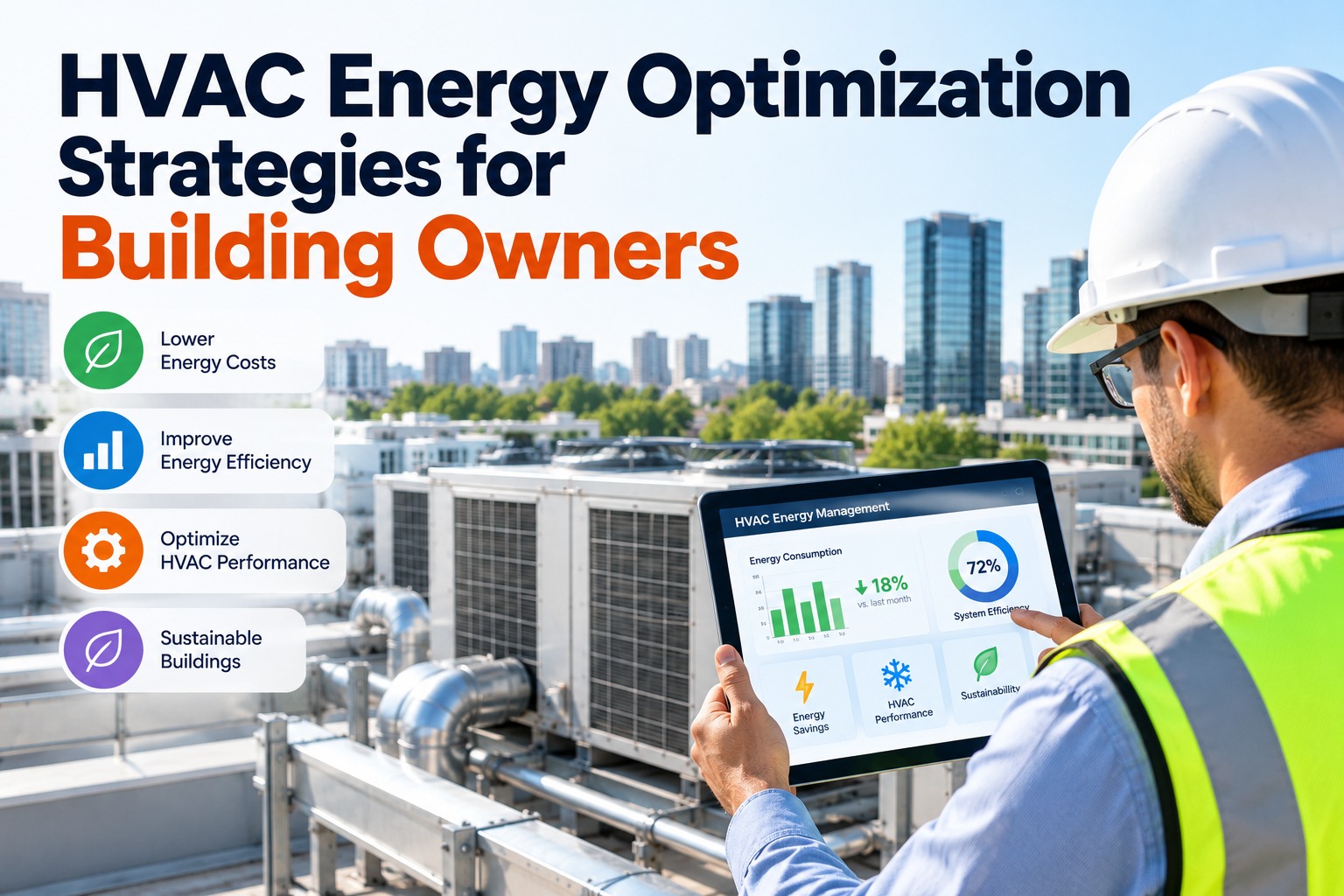
The facility manager at a 280,000-square-foot Class A office building in Dallas opened his July utility bill and stopped reading at the total: $127,400—up 31% from the same month the previous year. The HVAC system was running exactly as designed. Every chiller, every AHU, every VAV box was operational. Nothing was broken. The problem was simpler and more expensive than a breakdown: the building's HVAC system had been running the same fixed schedules and setpoints for four years, blind to occupancy patterns that had shifted dramatically since hybrid work became the norm. Forty-two percent of the conditioned floor space was empty on any given Tuesday, yet every zone received full cooling. The AI-based optimization system installed three months later identified $41,200 in monthly savings by dynamically adjusting cooling loads to actual occupancy, weather forecasts, and utility rate structures. The sensors cost $28,000. The software subscription cost $1,400 per month. The building had been overspending $494,000 annually on energy—not because anything was malfunctioning, but because nobody was asking the system to think.
Estimated annual HVAC energy waste across U.S. commercial buildings running on fixed schedules and static setpoints—systems that heat, cool, and ventilate based on assumptions rather than real-time conditions
Of total HVAC energy consumed in U.S. commercial buildings is wasted on conditioning unoccupied spaces, overcooling/overheating, and running equipment at suboptimal load points
Average annual HVAC energy cost per square foot for U.S. commercial office buildings—the single largest controllable operating expense for most building owners and property managers
The Pattern Energy Auditors See Every Week
Energy auditors don't find buildings with broken HVAC systems—they find buildings with perfectly functional systems running perfectly wrong schedules. Chillers staged for peak load at 7 AM when the building doesn't reach 60% occupancy until 9:30 AM. VAV boxes driving full airflow to conference rooms that have been empty since Monday. Economizer dampers locked in minimum position because nobody recalibrated the outdoor air sensor after last year's BAS upgrade. The equipment works. The intelligence doesn't. AI optimization fixes the intelligence—without replacing a single piece of equipment.
HVAC systems account for 40-60% of total energy consumption in U.S. commercial buildings—more than lighting, plug loads, and water heating combined. For decades, the industry accepted this as a fixed cost, manageable only through equipment upgrades and manual schedule adjustments. AI-based HVAC optimization has changed that equation fundamentally. By analyzing real-time occupancy data, weather forecasts, utility rate structures, equipment performance curves, and thermal mass characteristics, AI systems continuously adjust HVAC operations to deliver comfort at minimum energy cost. Buildings that start implementing AI-driven HVAC optimization aren't replacing their existing systems—they're making those systems intelligent for the first time.
Why AI-Based HVAC Optimization Is the Highest-ROI Building Investment in 2025
Building owners and facility managers face a convergence of pressures: energy costs that have risen 22% since 2020, ESG reporting requirements from tenants and investors, local building performance standards with escalating penalties, and tenant expectations for comfort and sustainability. Traditional approaches—equipment upgrades, LED retrofits, manual BAS reprogramming—deliver incremental improvements at high capital cost. AI-based HVAC optimization delivers 20-35% energy reduction with minimal capital expenditure, typically paying for itself within 6-18 months. It's the rare building investment that simultaneously reduces operating costs, improves tenant comfort, advances ESG goals, and requires no construction.
Average HVAC Energy Reduction Across AI-Optimized U.S. Buildings
Buildings deploying AI-based HVAC optimization achieve 20-35% energy reduction on average, with some facilities reaching 40%+ savings depending on baseline inefficiency, climate zone, and occupancy variability. These savings come without equipment replacement—pure operational intelligence applied to existing systems.
6-18 mo
Typical payback period for AI HVAC optimization—faster than any equipment retrofit or capital improvement
$0.55-0.85
Average annual savings per square foot for office buildings in Climate Zones 3-5 (covering most major U.S. metros)
73%
Of commercial tenants now include energy efficiency in lease evaluation criteria, making optimization a retention tool
$154K
average annual savings for a 200,000 sf Class A office building
340+
hours of facility staff time saved annually on manual BAS adjustments
15-22%
improvement in tenant comfort scores from AI-driven zone optimization
How AI HVAC Optimization Actually Works: The Technology Behind the Savings
AI HVAC optimization isn't a thermostat upgrade or a BAS software patch. It's a continuous learning system that ingests data from dozens of sources—occupancy sensors, weather APIs, utility rate feeds, BAS trend logs, equipment runtime data—and generates optimal control strategies every 5-15 minutes. The system learns the building's thermal characteristics, predicts cooling and heating loads before they develop, and adjusts setpoints, staging, and airflow to meet comfort targets at minimum energy cost. When building operations teams see how AI optimization integrates with their existing BAS, the implementation timeline becomes clear—most buildings go live within 4-8 weeks.
| Optimization Layer |
What AI Does |
Traditional Approach |
Typical Energy Impact |
| Occupancy-Based Conditioning |
Reads real-time occupancy from sensors, WiFi, badge data, and calendar systems to condition only occupied zones at appropriate levels; pre-conditions based on predicted arrivals |
Fixed schedules: full conditioning from 6 AM to 7 PM regardless of actual occupancy |
8-15% total HVAC energy reduction |
| Predictive Load Management |
Forecasts thermal loads 2-24 hours ahead using weather data, solar gain predictions, and historical patterns; pre-cools/heats using thermal mass to avoid peak energy use |
Reactive: equipment responds to current conditions, always playing catch-up during load swings |
5-12% energy reduction + peak demand savings |
| Optimal Equipment Staging |
Selects which chillers, boilers, pumps, and AHUs run at any moment based on real-time efficiency curves and current load; avoids running equipment at inefficient low-load points |
Lead-lag sequencing based on fixed thresholds, often running more equipment than needed |
6-10% energy reduction on central plant |
| Dynamic Setpoint Optimization |
Continuously adjusts supply air temperature, chilled water temperature, static pressure, and zone setpoints based on real-time conditions—not fixed design-day values |
Static setpoints based on worst-case design conditions, maintained year-round |
4-8% energy reduction system-wide |
| Demand Response & Rate Optimization |
Shifts energy consumption away from peak rate periods using pre-conditioning, load shedding sequences, and thermal storage strategies—automated based on utility rate signals |
Manual demand response participation; most buildings miss events or respond slowly |
$0.10-0.30/sf in annual demand charge reduction |
Swipe to see full table
AI optimization layers are cumulative—buildings implementing all five layers achieve the full 20-35% reduction, while even single-layer implementations deliver measurable ROI within months
How Much Is Your Building Overspending on HVAC Energy Right Now?
Most building owners discover 20-35% savings hiding in plain sight—not from broken equipment, but from systems running on fixed schedules in a dynamic world. See how AI optimization finds and captures those savings without replacing a single chiller.
Where the Savings Come From: The Six Waste Patterns AI Eliminates
AI HVAC optimization doesn't create savings from thin air. It identifies and eliminates six specific waste patterns that exist in virtually every commercial building in the U.S.—patterns that are invisible to traditional BAS systems because they require predictive analytics, cross-system correlation, and continuous learning that rule-based controls can't provide. Understanding these patterns explains why the savings are so consistent across building types and climate zones.
01
Ghost Conditioning
8-12%
Fully conditioning spaces with zero or minimal occupancy. Conference rooms cooled all day for one 2-hour meeting. Entire floors at full cooling when only 35% of workstations are occupied. Lobbies and common areas at daytime setpoints until 10 PM because the schedule says so.
AI Solution: Real-time occupancy sensing linked to zone-level control. AI learns occupancy patterns by day of week and time of day, pre-conditions for predicted arrivals, and reduces conditioning within minutes of space vacancy.
02
Thermal Momentum Waste
5-9%
Running chillers and AHUs at full capacity until occupancy ends, ignoring the building's thermal mass. A concrete-frame building that takes 3 hours to warm up by 2°F doesn't need active cooling until the last person leaves—but traditional controls don't know that.
AI Solution: Thermal mass modeling allows the AI to stop active cooling 30-90 minutes before occupancy ends while maintaining comfort. Pre-cooling during off-peak hours exploits lower energy rates and reduces peak demand charges.
03
Simultaneous Heating & Cooling
3-7%
Perimeter zones heating while interior zones cool—sometimes on the same floor, sometimes in the same AHU system. Reheat coils adding heat to air that was just mechanically cooled. A classic energy waste pattern that traditional BAS accepts as normal.
AI Solution: Cross-zone optimization that coordinates heating and cooling across the building envelope. Wider deadbands during mild weather. Intelligent reheat minimization that prevents comfort complaints while eliminating the most wasteful HVAC pattern.
04
Suboptimal Equipment Loading
4-8%
Running two chillers at 40% load (poor efficiency) when one chiller at 80% load (peak efficiency) would serve the building. Oversized AHUs running at minimum speed with VFDs, wasting fan energy. Pumps and cooling towers staged for design-day conditions on a mild October afternoon.
AI Solution: Real-time equipment efficiency mapping. AI selects optimal staging combinations for current conditions, runs each piece of equipment at its most efficient operating point, and re-evaluates every 5-15 minutes as loads change.
05
Static Setpoint Overdesign
3-6%
Chilled water at 42°F year-round when 48°F would satisfy loads 80% of the year. Supply air at 55°F in January when 62°F would provide adequate cooling. Static pressure setpoints based on design airflow when actual demand is 60% of design. Every degree and every PSI of unnecessary capacity wastes energy.
AI Solution: Dynamic setpoint reset based on real-time zone demands. AI finds the highest chilled water temperature, warmest supply air, and lowest static pressure that satisfies all zones—continuously adjusting as conditions change throughout the day.
06
Missed Economizer & Free Cooling Hours
2-5%
Economizer dampers stuck at minimum position due to failed sensors, incorrect calibration, or conservative high-limit lockout settings. Buildings running mechanical cooling when outdoor conditions would provide free cooling—hundreds of hours per year of missed savings in most U.S. climates.
AI Solution: Enthalpy-based economizer optimization with sensor fault detection. AI identifies optimal free cooling windows, detects sensor drift that would lock out economizer mode, and maximizes natural cooling hours across all AHUs simultaneously.
Traditional BAS vs. AI Optimization: The Performance Gap Building Owners Can't Ignore
Modern building automation systems are powerful tools—but they're rule-based controllers, not learning systems. A BAS executes the logic its programmers wrote, regardless of whether conditions have changed. An AI optimization layer learns from every hour of operation, discovers patterns no programmer anticipated, and continuously improves its strategies. The performance gap between buildings running traditional BAS logic and those enhanced with AI optimization is measurable, consistent, and growing. Building owners ready to close that gap can start with a free energy baseline assessment and see where their savings opportunities are.
Traditional BAS Only
Occupancy response:
Fixed schedules
Load prediction:
Reactive only
Optimization cycle:
Manual/seasonal
AI-Optimized BAS
Occupancy response:
Real-time + predictive
Load prediction:
2-24 hour forecasting
Optimization cycle:
Every 5-15 minutes
27%
average HVAC energy reduction without equipment replacement
15-22%
improvement in tenant comfort satisfaction scores
6-18 mo
typical payback period from implementation to net positive ROI
Expert Perspective: What Top-Performing Building Operators Are Doing Differently
"I've audited over 400 commercial buildings across the U.S. in the last decade. The ones achieving ENERGY STAR scores above 85 almost all share one characteristic: they've layered AI optimization on top of their existing BAS. They didn't rip out their chillers or install new ductwork. They gave their existing systems intelligence. The AI finds savings patterns that no human operator could identify—micro-adjustments across hundreds of zones, thousands of times per day, responding to conditions that change faster than any manual process can track. The buildings that resist AI optimization aren't saving money by waiting. They're losing 20-35% of their HVAC budget every month they delay."
— Commercial Building Energy Performance Consultant, ASHRAE Fellow
Non-Invasive Integration
AI optimization layers on top of existing BAS platforms—Tridium Niagara, Siemens, Honeywell, Johnson Controls, Schneider—without replacing controllers or rewiring. Most buildings go live in 4-8 weeks with zero disruption to operations or tenant comfort.
Continuous Commissioning
Unlike one-time retro-commissioning that degrades within 18 months, AI optimization continuously adjusts to changing conditions—seasonal shifts, occupancy changes, equipment aging, and tenant turnover. Savings don't degrade. They improve as the system learns.
Compliance & ESG Reporting
Automated energy performance tracking for ENERGY STAR benchmarking, Local Law 97 (NYC), BERDO (Boston), Building Performance Standards nationwide, and tenant ESG reporting. The data flows automatically—no manual meter reads or spreadsheet gymnastics.
The economics of HVAC energy waste have reached a tipping point. Energy prices are rising. Building performance regulations are tightening. Tenants are demanding sustainability credentials. And the technology to capture 20-35% savings from existing HVAC systems—without capital construction—is proven, deployed across thousands of buildings, and available at a fraction of the cost of traditional energy retrofits. Owners who schedule an energy optimization assessment discover that their buildings have been subsidizing waste for years—and that the AI system that stops that waste pays for itself before the first annual review.
Your Building Is Already Wasting Energy. The Only Question Is How Much.
Every commercial building in the U.S. running HVAC on fixed schedules and static setpoints is overspending by 20-35%. That's not a projection—it's the consistent, measured result across thousands of AI optimization deployments in every climate zone, every building type, and every major BAS platform. The buildings that capture those savings aren't larger, newer, or better funded than the ones that don't. They made one decision: to stop accepting energy waste as a fixed cost and start treating it as a solvable data problem. That decision starts with understanding exactly how much your building is overspending—and seeing the specific, guaranteed-savings plan that AI optimization produces for your exact building, your exact equipment, and your exact operating profile.
Cut Your HVAC Energy Costs 20-35%. No Equipment Replacement Required.
Oxmaint's AI HVAC optimization platform layers onto your existing BAS to deliver measurable energy savings from day one—occupancy-based conditioning, predictive load management, dynamic setpoint optimization, and automated demand response. See your building's specific savings potential with a free energy assessment.
Frequently Asked Questions
How much can AI HVAC optimization actually save on energy costs?
Measured results across thousands of U.S. commercial buildings show 20-35% HVAC energy reduction as the consistent range, with an average of 27%. For a 200,000-square-foot office building, this typically translates to $110,000-$190,000 in annual energy savings. Savings vary by climate zone (hotter and colder climates offer more optimization opportunity), building type (offices with variable occupancy save more than hospitals with 24/7 loads), existing BAS sophistication (buildings with basic controls have more untapped savings), and utility rate structure (buildings on demand-based rates benefit from peak load management). The savings come from operational optimization of existing equipment—no chiller replacements, no ductwork modifications, no major construction.
Does AI optimization work with my existing BAS platform?
Yes. Modern AI HVAC optimization platforms are designed as a non-invasive layer that integrates with all major BAS platforms—Tridium Niagara, Siemens Desigo/Apogee, Honeywell Tridium/EBI, Johnson Controls Metasys, Schneider EcoStruxure, Carrier i-Vu, and others. Integration uses standard protocols (BACnet, Modbus, MQTT, API) to read sensor data and write optimal setpoints. The existing BAS retains full safety controls and override capability. No controllers are replaced. No wiring is modified. Typical integration takes 2-4 weeks for data connectivity and 2-4 additional weeks for optimization model training before savings begin. Buildings with older pneumatic or non-networked controls may need targeted BACnet gateway upgrades for key equipment before AI optimization can be applied.
Will AI optimization affect tenant comfort?
AI-optimized buildings consistently show 15-22% improvement in tenant comfort satisfaction scores compared to traditional BAS operation. This seems counterintuitive—how can using less energy improve comfort? The answer is that traditional BAS systems over-cool some zones and under-cool others because they use fixed setpoints and static airflow schedules. AI optimization reads actual zone conditions every few minutes and adjusts dynamically, eliminating the hot spots and cold spots that generate tenant complaints. Additionally, AI systems detect and flag comfort-impacting equipment faults (stuck dampers, failed sensors, valve hunting) that traditional BAS ignores, enabling proactive correction before tenants notice. Energy savings and comfort improvement aren't competing goals—they're both products of better control intelligence.
What is the typical payback period for AI HVAC optimization?
Typical payback ranges from 6-18 months depending on building size, current energy spend, and implementation scope. A 200,000-square-foot office building spending $434,000 annually on HVAC energy (at $2.17/sf) that achieves 27% savings recovers approximately $117,000 per year. Implementation costs—including sensors, integration, software, and commissioning—typically range from $50,000-$150,000 depending on existing infrastructure. Many implementations achieve payback within 12 months. Unlike capital equipment upgrades that depreciate, AI optimization maintains and improves its savings over time as the system learns. Several utility incentive programs and federal tax provisions (including Section 179D) can further reduce effective implementation cost by 30-50%.
How does AI optimization help with building performance regulations?
Local building performance standards are accelerating across U.S. cities—New York's Local Law 97, Boston's BERDO, Washington DC's BEPS, Denver's Energize Denver, and similar regulations in over 40 jurisdictions. These laws impose escalating penalties for buildings exceeding carbon emission thresholds, with fines reaching $268 per ton of CO2 over the limit in NYC starting in 2024. AI HVAC optimization delivers immediate carbon reduction (20-35% HVAC energy reduction translates directly to emissions reduction) while providing automated tracking and reporting for compliance documentation. For many buildings, AI optimization alone can achieve compliance without the capital-intensive envelope or equipment upgrades that would otherwise be required. The optimization platform also generates the measurement and verification data needed to demonstrate compliance to regulators.
What data and sensors does AI HVAC optimization require?
At minimum, AI optimization requires access to BAS trend data (zone temperatures, equipment status, setpoints) and building-level or main meter energy data. This baseline enables meaningful optimization through better setpoint management and equipment staging. For maximum savings, additional data layers improve results: occupancy sensors (people-counting or motion-based) enable demand-controlled conditioning, weather data feeds (accessed via API—no hardware needed) enable predictive load management, and sub-metering enables equipment-level efficiency tracking. Many buildings already have 60-80% of the required data available in their existing BAS—it's just not being analyzed. The AI platform identifies data gaps during assessment and recommends targeted sensor additions only where the incremental savings justify the cost, typically $15,000-$40,000 for a mid-size building.