Your facility's HVAC system just failed during the hottest week of summer. Production lines shut down. Employees are sent home. The emergency repair technician quotes $4,200 for rush service—plus another $8,000 in lost productivity. The diagnosis? A clogged condensate drain that could have been cleared during routine maintenance for less than $50. This scenario plays out thousands of times across U.S. commercial and industrial facilities each year, costing businesses approximately $50 billion in unplanned downtime. The frustrating reality: 95% of these HVAC failures are preventable through systematic preventive maintenance programs that catch small issues before they cascade into expensive emergencies.
The True Cost of Skipping HVAC Maintenance
What facilities lose when preventive maintenance isn't prioritized
$50B
Annual U.S. cost from unplanned HVAC downtime
95%
HVAC failures preventable with regular maintenance
545%
ROI from implementing preventive maintenance programs
20-40%
Equipment lifespan extension with proper maintenance
Why HVAC Preventive Maintenance Is Non-Negotiable for Commercial Operations
Research from multiple peer-reviewed studies confirms what facility managers already suspect: reactive HVAC maintenance is far more expensive than preventive strategies. A comprehensive analysis tracking over 100,000 rental units found that preventive maintenance programs reduced HVAC service requests by 31-50%. More significantly, facilities implementing condition-based maintenance saw Mean Time Between Failures increase by 90-175 hours, while breakdown duration decreased by 35-45%. The Department of Energy estimates organizations achieve 5-20% annual energy savings through proper HVAC operations and maintenance—savings that directly impact your facility's operating budget every single month.
Commercial HVAC systems represent significant capital investments, typically lasting 10-25 years depending on maintenance quality. Without systematic preventive care, dirt accumulation forces systems to work harder, refrigerant leaks go undetected, electrical connections loosen, and minor component wear accelerates into major failures. Each month of deferred maintenance shortens equipment life and increases the probability of catastrophic breakdown during peak demand periods when you can least afford downtime.
The Complete HVAC Preventive Maintenance Checklist
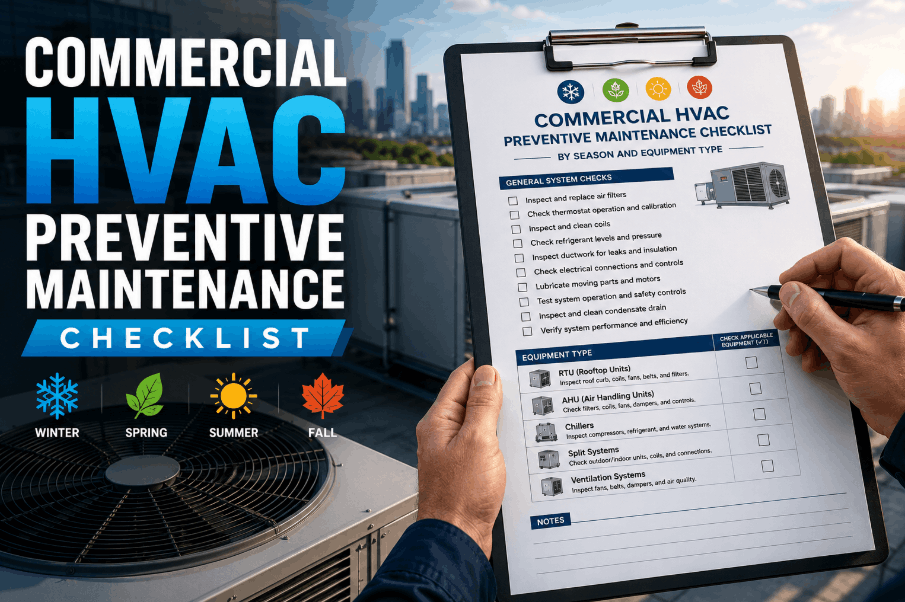
Effective HVAC maintenance follows a structured schedule aligned with system demands and seasonal requirements. This comprehensive checklist covers monthly, quarterly, seasonal, and annual tasks that maintain optimal performance and prevent unexpected failures. Facilities using CMMS platforms to automate these schedules report 44% reduction in overall downtime and 87% fewer equipment defects compared to manual tracking methods.
Monthly HVAC Maintenance Tasks
Perform these tasks every 30 days
Quarterly HVAC Maintenance Tasks
Perform these tasks every 90 days
Seasonal HVAC Maintenance Requirements
Prepare your system for peak demand periods
Cooling Season Prep
Perform in early spring
Clean outdoor condenser coils and fins
Test cooling capacity under load
Verify refrigerant charge and check for leaks
Clean condensate drain pans and lines
Calibrate thermostats for cooling accuracy
Inspect and clean air handlers and blowers
Heating Season Prep
Perform in early fall
Inspect heat exchanger for cracks or corrosion
Test ignition system and burner assembly
Check gas pressure and connections for leaks
Clean or replace heating elements
Test emergency heat and backup systems
Inspect flue pipes and ventilation
Automate Your HVAC Maintenance Schedule
Stop missing critical maintenance tasks. Oxmaint's CMMS automatically schedules inspections, assigns technicians, and tracks completion—ensuring every task gets done on time, every time.
Not all HVAC systems require identical maintenance approaches. Rooftop units, chillers, heat pumps, and dedicated outdoor air systems each have unique requirements that must be addressed for optimal performance.
Rooftop Units (RTUs)
Check roof membrane integrity around unit base
Inspect economizer dampers for proper operation
Verify roof drainage doesn't pool near units
Clean outdoor air intake screens quarterly
Chillers
Monitor refrigerant charge and oil levels monthly
Clean condenser tubes annually using approved methods
Test water treatment chemistry weekly
Verify compressor oil analysis quarterly
Heat Pumps
Test both heating and cooling modes seasonally
Check defrost cycle operation in heating season
Inspect reversing valve functionality
Monitor compressor wear in dual-mode operation
DOAS Units
Replace outdoor air filters monthly minimum
Clean energy recovery wheels quarterly
Verify damper actuator operation
Test demand-controlled ventilation sensors
The ROI of Systematic HVAC Preventive Maintenance
Maintenance represents 15-60% of total facility operating costs, making it one of the largest controllable expenses. Facilities that shift from reactive to preventive HVAC maintenance see measurable financial returns within the first year. A single prevented breakdown—avoiding the $4,000-$8,000 combination of emergency repairs and lost productivity—can justify an entire year's preventive maintenance investment. Additional savings accumulate through reduced energy consumption, extended equipment life, and more efficient allocation of maintenance labor.
Preventive vs. Reactive Maintenance: The Numbers
Annual cost comparison for a typical 50,000 sq ft commercial facility
Reactive Approach
Fix it when it breaks
Emergency Repairs
$18,500
Lost Productivity
$24,000
Higher Energy Costs
$8,200
Expedited Parts
$4,300
Total Annual Cost
$55,000
Preventive Approach
Maintain before failure
Scheduled Maintenance
$12,000
Planned Repairs
$6,500
Energy Costs (Optimized)
$6,400
Standard Parts
$1,800
Total Annual Cost
$26,700
Annual Savings with Preventive Maintenance
$28,300
51% cost reduction
How CMMS Transforms HVAC Maintenance from Burden to Strategic Asset
Manual HVAC maintenance tracking through spreadsheets, paper logs, and email reminders creates gaps where critical tasks get overlooked. A computerized maintenance management system eliminates these gaps by automating scheduling, assigning tasks to qualified technicians, tracking completion with digital forms, and maintaining complete equipment history accessible from any device. Facilities using CMMS platforms report that 59% achieve better operational efficiency and 44% reduction in unplanned downtime compared to manual systems.
What CMMS Does for HVAC Maintenance
Automated Scheduling
Generate work orders automatically based on equipment runtime, calendar intervals, or meter readings—ensuring tasks never get forgotten.
Digital Checklists
Technicians follow standardized procedures on mobile devices, attach photos, record measurements, and submit completed work instantly.
Equipment History Tracking
Access complete maintenance records, failure patterns, and cost data for every HVAC asset—identifying chronic problems and optimizing replacement timing.
Parts Inventory Integration
Track filter stock, refrigerant levels, and critical spare parts—receiving low-stock alerts and ordering before shortages delay maintenance.
Technician Assignment
Route tasks to qualified technicians based on skills, certifications, and availability—optimizing labor efficiency and ensuring proper expertise.
Compliance Documentation
Maintain audit-ready records of all maintenance activities, refrigerant handling, and safety inspections—demonstrating regulatory compliance instantly.
The facilities that succeed with HVAC preventive maintenance aren't the ones with the most resources—they're the ones with the best systems. Manual tracking creates gaps. Forgotten tasks. Missed inspections. CMMS platforms eliminate these gaps by automating everything from scheduling to completion verification. The result is consistent maintenance execution that prevents 95% of equipment failures before they disrupt operations.
Prevents Task Omission
Automated scheduling ensures critical quarterly and seasonal tasks occur on schedule, not when someone remembers to do them.
Improves Labor Efficiency
Technicians spend time maintaining equipment, not searching for manuals, logging paper forms, or tracking down parts—increasing productive hours by 15-25%.
Enables Predictive Strategies
Equipment history reveals patterns that allow facilities to predict failures weeks in advance, transitioning from calendar-based to condition-based maintenance.
Getting Started: Implementing Your HVAC Preventive Maintenance Program
Building an effective HVAC preventive maintenance program begins with asset inventory and prioritization. Identify all HVAC equipment, document manufacturer specifications, establish baseline performance metrics, and prioritize critical systems where failure creates the most operational impact. Start with high-priority equipment—your primary air handlers, chillers, and rooftop units—before expanding to secondary systems. Facilities ready to move from reactive to preventive HVAC maintenance can schedule a consultation to map their implementation strategy and see how CMMS automation accelerates the transition.
Your 90-Day HVAC Preventive Maintenance Roadmap
Days 1-30
Foundation & Inventory
Complete equipment inventory with models, locations, and serial numbers
Gather manufacturer maintenance specifications and manuals
Document current maintenance practices and identify gaps
Select CMMS platform and begin configuration
Establish baseline performance metrics for critical assets
Days 31-60
Setup & Training
Build preventive maintenance schedules in CMMS
Create digital checklists for monthly, quarterly, seasonal tasks
Train technicians on mobile app usage and procedures
Establish parts inventory for filters and critical components
Begin executing scheduled maintenance on priority equipment
Days 61-90
Optimization & Expansion
Review first 60 days data and refine schedules
Expand program to secondary HVAC equipment
Establish KPIs: completion rate, downtime, energy usage
Integrate vendor management for specialized services
Begin trending equipment performance for predictive insights
Transform HVAC Maintenance from Reactive to Predictive
Join thousands of facilities using Oxmaint CMMS to eliminate unexpected HVAC breakdowns, reduce energy costs, and extend equipment life. See how automated scheduling and digital checklists keep your systems running at peak efficiency.
How often should commercial HVAC systems receive preventive maintenance?
Commercial HVAC systems require monthly filter inspections, quarterly component checks, seasonal preparation before peak heating and cooling periods, and comprehensive annual professional inspections. High-use facilities or those in dusty environments may need more frequent filter changes and coil cleaning. The Department of Energy recommends at minimum semi-annual professional maintenance—once before cooling season and once before heating season—to maintain efficiency and prevent unexpected breakdowns.
What's the typical ROI timeline for implementing preventive HVAC maintenance?
Most facilities see positive ROI within 6-12 months through a combination of avoided emergency repairs, reduced energy consumption, and extended equipment life. Research shows preventive maintenance delivers 545% ROI, with facilities achieving 5-20% annual energy savings, 44% reduction in downtime, and 20-40% longer equipment lifespan. A single prevented major breakdown—saving $4,000-$8,000 in repairs and lost productivity—can justify an entire year's preventive maintenance investment.
Can facility staff perform HVAC preventive maintenance, or is professional service required?
HVAC maintenance divides into tasks facilities can handle internally and those requiring certified professionals. Staff can change filters, clear outdoor unit perimeters, inspect drain lines, listen for unusual noises, and verify thermostat settings. However, tasks involving refrigerant handling, electrical system testing, gas connections, safety control calibration, and comprehensive performance testing require EPA-certified HVAC technicians with proper tools and training. The optimal approach combines routine internal tasks with scheduled professional inspections.
How does CMMS software improve HVAC maintenance compared to manual tracking?
CMMS eliminates the gaps inherent in manual tracking by automating work order generation, ensuring tasks occur on schedule regardless of staffing changes or workload fluctuations. Digital checklists standardize procedures across all technicians, mobile apps enable real-time completion documentation with photos and measurements, and complete equipment history reveals failure patterns that manual logs miss. Facilities using CMMS report 59% better operational efficiency, 44% less downtime, and significantly improved regulatory compliance documentation compared to spreadsheet and paper-based systems.
What are the most critical HVAC maintenance tasks that prevent expensive failures?
The highest-impact preventive tasks are regular filter changes (preventing 15-20% energy waste and airflow restrictions), coil cleaning (maintaining heat transfer efficiency), refrigerant level monitoring (detecting leaks before compressor damage occurs), electrical connection tightening (preventing failures and fire hazards), and condensate drain clearing (avoiding water damage and emergency shutdowns). Annual comprehensive inspections that measure system performance against baseline metrics catch gradual degradation before it causes complete failure, typically providing 4-8 weeks advance warning of impending problems.