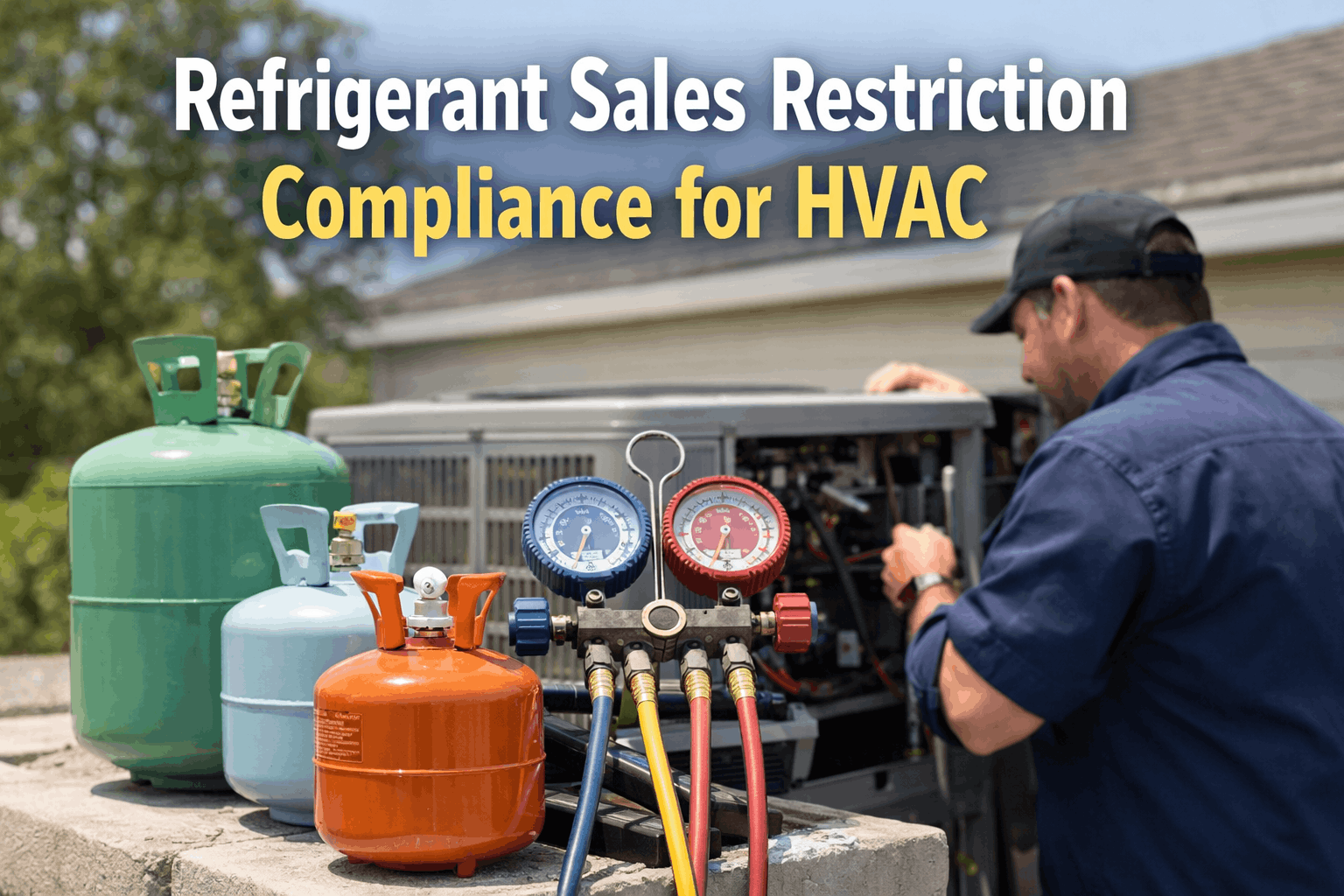
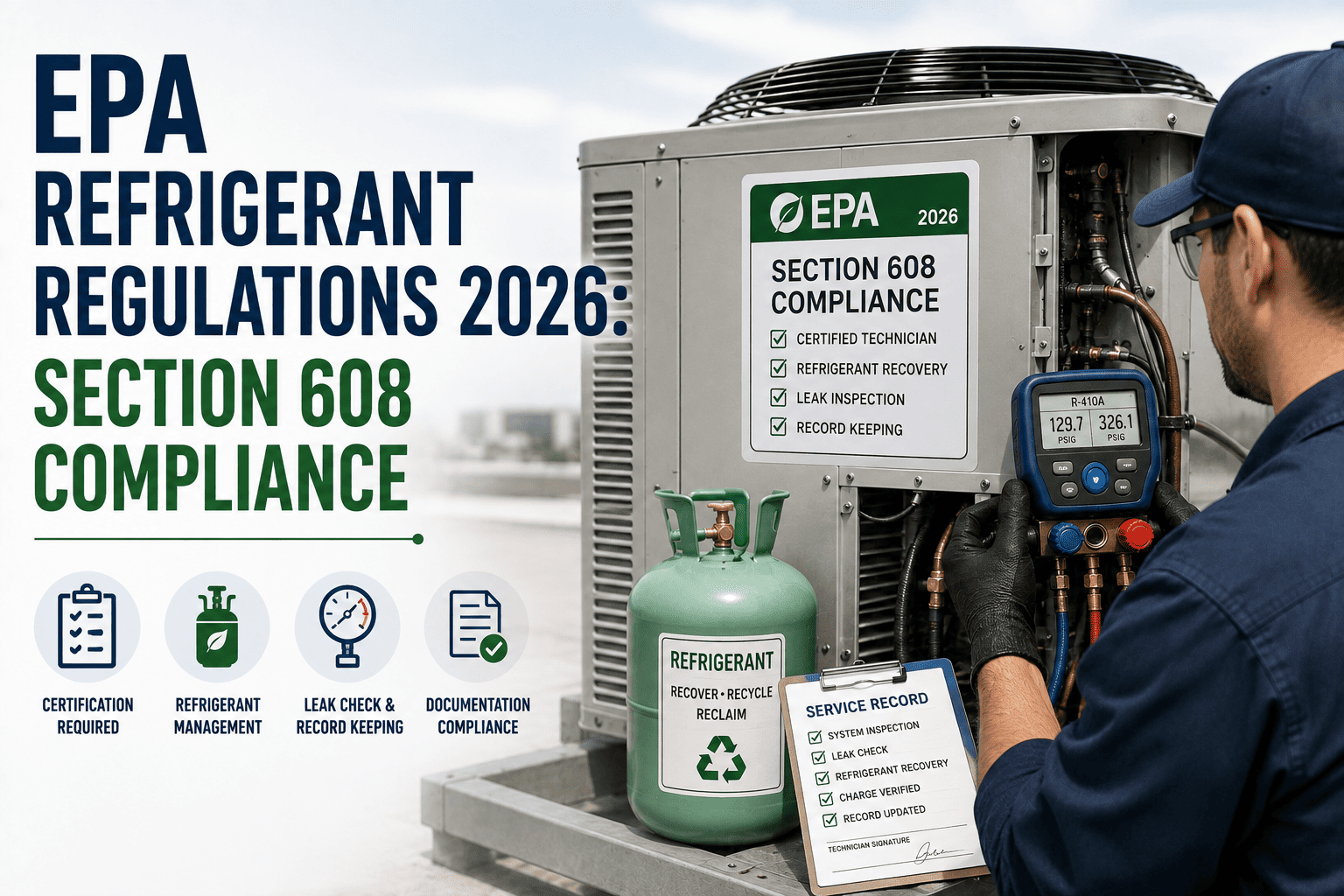
Your supply house just got a call from a property manager asking to buy two 25-pound cylinders of R-410A for his maintenance guy to "top off some units." The property manager doesn't have an EPA 608 certification. His maintenance guy might, but he's not the one making the purchase. Can you sell it? Should you sell it? What happens if you do? As of January 1, 2025, the EPA's refrigerant sales restriction rules have expanded under the AIM Act and updated Section 608 regulations—tightening who can buy, who can sell, and what documentation must exist at every transaction. Yet a 2024 compliance survey found that 43% of HVAC distributors and contractors could not accurately describe the current sales restriction requirements. That's not a knowledge gap—it's an enforcement gap waiting to become a penalty. Refrigerant sales restrictions exist for one reason: to prevent unqualified individuals from handling regulated substances that damage the ozone layer and contribute to climate change. For HVAC businesses on both sides of the transaction—selling and buying—non-compliance carries fines of up to $44,539 per violation, potential loss of EPA certification, and criminal liability for knowing violations. The rules aren't complicated. But they are specific, and they've changed recently enough that what you knew two years ago may no longer be accurate.
Compliance Alert
Refrigerant Sales Rules Have Changed
Updated EPA restrictions under the AIM Act now apply to HFC refrigerants in addition to ODS. Every sale requires verified buyer certification.
43%
of distributors can't accurately describe current sales rules
$44,539
maximum fine per violation for non-compliant refrigerant sales
Jan 2025
effective date of expanded HFC sales restrictions under AIM Act
What the Sales Restriction Rules Actually Require
The EPA's refrigerant sales restrictions operate on a simple principle: regulated refrigerants can only be sold to certified buyers, and every sale must be documented. But the details matter—who qualifies as a certified buyer, which refrigerants are covered, what constitutes a "sale," and what records must be kept have all been updated in recent rulemaking cycles. Contractors and distributors that sign up for automated compliance tracking can verify buyer eligibility in real time and generate audit-ready transaction records without manual certification checks or paper-based verification.
ODS Refrigerant Sales (R-22, R-12, R-502, etc.)
Who can buyEPA 608-certified technicians only
Certification requiredType I, II, III, or Universal matching equipment class
VerificationSeller must verify certification before sale
Container limitNo sales to uncertified buyers in any quantity
Effective sinceNovember 14, 1994
HFC Refrigerant Sales (R-410A, R-134a, R-404A, etc.)
Who can buyEPA 608-certified technicians or authorized purchasers
Certification requiredSection 608 certification matching equipment class
VerificationSeller must verify and document certification
Container limitContainers over 2 lbs require certified buyer
Effective sinceJanuary 1, 2025
Next-Gen Refrigerants (R-454B, R-32, R-1234yf, etc.)
Who can buyEPA 608-certified technicians (evolving requirements)
Certification required608 certification + potential A2L safety training
VerificationSeller should verify certification and safety training
Container limitSubject to same restrictions as HFC sales
Effective sincePhasing in 2025–2027
Who Can Buy Refrigerant: The Eligibility Matrix
The most common compliance mistake in refrigerant sales isn't failing to check certification—it's checking the wrong certification type for the purchase. EPA 608 has four certification types, and each authorizes handling specific equipment classes. Selling to a technician whose certification doesn't match the equipment class they're servicing creates a violation for both the buyer and the seller.
Small Appliances
(<5 lbs charge)
High-Pressure
(AC, heat pumps)
Low-Pressure
(centrifugal chillers)
Bulk Purchase
(wholesale/resale)
Common Violations: Real Scenarios, Real Penalties
Refrigerant sales violations don't require intent. They don't require a large quantity. A single transaction to an unverified buyer—or a single missing record—triggers enforcement. Here are the violation scenarios that EPA inspectors encounter most frequently, along with their typical consequences.
Scenario: Distributor sells two cylinders of R-410A to a property management company. The purchaser is a facilities coordinator—not a certified technician. No certification was requested or verified at time of sale.
Result: Both the seller (for failing to verify) and the buyer's company (for purchasing without certification) face enforcement action. Each cylinder counts as a separate violation.
Scenario: Contractor with Type I certification (small appliances only) purchases R-410A for use in rooftop units—which require Type II or Universal certification. Supplier checks for 608 cert but not the specific type.
Result: The sale technically occurred to a "certified" technician, but the certification doesn't authorize handling the equipment class. Both parties exposed to enforcement.
Scenario: Distributor sells to certified buyers but doesn't record the buyer's certification number, expiration date, or the specific refrigerant quantities on each transaction. Sales log shows only company name and "R-410A."
Result: Even though the sale was legitimate, the lack of documentation means the seller cannot prove compliance during audit. Each undocumented sale is a separate finding.
Scenario: HVAC supply company sells refrigerant through online marketplace. Buyers self-certify via checkbox: "I confirm I hold EPA 608 certification." No actual cert number collected or verified.
Result: Self-certification checkboxes do not satisfy EPA verification requirements. The seller must obtain and record the buyer's actual certification number and type before completing the transaction.
Every one of these scenarios plays out hundreds of times daily across the HVAC supply chain. The enforcement risk concentrates on sellers—distributors, supply houses, and contractors who resell—because the EPA holds the seller responsible for verifying buyer eligibility before completing the transaction. Companies that sign up for digital buyer verification can validate certifications against EPA databases in real time, eliminating the guesswork and creating an automatic compliance record for every sale.
Verify Every Buyer. Document Every Sale. Automatically.
OxMaint validates buyer certifications in real time, matches cert types to purchase categories, and generates EPA-ready sales records for every refrigerant transaction—eliminating manual verification and audit risk.
Seller Compliance Checklist: What You Must Do for Every Transaction
Whether you're a supply house, distributor, or contractor selling refrigerant to another business, every transaction requires the same verification and documentation steps. This isn't a best-practice recommendation—it's a regulatory requirement. Missing any single step creates a violation that's discoverable during audit.
Required
Verify Buyer's EPA 608 Certification
Request and examine the buyer's certification card or documentation. Confirm the certificate is current and the name matches the purchaser. A photocopy or digital scan must be retained.
Required
Match Certification Type to Purchase
Confirm the buyer's certification type (I, II, III, or Universal) authorizes handling the refrigerant and equipment class for which it's being purchased. Type II covers high-pressure AC/heat pumps. Type III covers low-pressure chillers.
Required
Record Transaction Details
Document: buyer name, company, EPA cert number and type, refrigerant type sold, quantity (pounds), date of sale, and seller representative. This record must be retained for a minimum of 3 years.
Required
Retain Certification Documentation
Keep a copy of the buyer's EPA 608 certification card or number on file, linked to the specific transaction record. Must be producible on demand during EPA inspection.
Recommended
Verify Against EPA Certification Database
Cross-reference the buyer's cert number against the EPA's certification database when available. This provides an additional layer of verification beyond visual inspection of the certification card.
Recommended
Flag Repeat Buyers for Periodic Re-Verification
For regular customers, establish a re-verification schedule (annually minimum) to ensure certifications haven't expired. A one-time check at first purchase is insufficient for ongoing compliance.
The Seller's Documentation Requirements: What Records to Keep
EPA inspectors don't audit your intentions—they audit your records. The documentation burden for refrigerant sales falls primarily on the seller, who must be able to demonstrate that every transaction involved a verified, properly certified buyer. Here's what your records must contain and how long they must be retained.
Per-Transaction Sales Record
Buyer name, company, EPA cert # and type, refrigerant type and quantity, date, and seller name
Retention: 3 years minimum
Buyer Certification Copy
Photocopy, scan, or digital record of buyer's EPA 608 certification card linked to transaction
Retention: 3 years minimum (linked to sales records)
Inventory Reconciliation Log
Running inventory of all refrigerant types—purchases in, sales out, current stock—reconciled to transaction records
Retention: 3 years minimum
Verification Audit Trail
Evidence that certification was verified before sale—timestamp, verification method, and any database cross-reference results
Retention: 3 years minimum (best practice: perpetual)
AIM Act Impact: What's Changed for HFC Sales
Before the AIM Act, HFC refrigerants like R-410A could be purchased by anyone—no certification required. That changed on January 1, 2025. The expanded sales restrictions now apply the same buyer verification requirements to HFCs that have existed for ODS refrigerants since 1994. For HVAC businesses that have been selling R-410A over the counter without verifying certification, this represents a fundamental compliance shift that requires immediate process changes.
Pre-2024
HFCs sold without buyer certification. Only ODS (R-22 etc.) restricted under Section 608.
Dec 2020
AIM Act signed—authorizes EPA to phase down HFC production and extend sales restrictions.
Jan 2025
HFC sales restrictions take effect. Buyers must hold EPA 608 certification for containers >2 lbs.
2025–2027
Next-gen A2L refrigerant (R-454B, R-32) sales requirements phasing in with additional safety training.
2029+
Further HFC phasedown quotas reduce supply. Proper sales documentation becomes essential for allocation tracking.
The operational impact is significant: distributors and contractors that previously sold R-410A without verification must now implement the same buyer-check processes they use for R-22. For businesses managing high transaction volumes, manual verification creates bottlenecks. Teams that schedule a demo to see automated certification verification can see how buyer eligibility is validated instantly at point of sale—with compliance records generated automatically for every transaction.
Expert Perspective: Building Sales Compliance into Your Workflow
"The businesses that struggle with sales restriction compliance are the ones that treat it as a point-of-sale problem. It's not. It's a systems problem. If your sales process doesn't require certification input before completing a refrigerant transaction—if a cashier or order entry person can process the sale without a cert number field being populated—your system is broken by design. I tell every distributor the same thing: make it impossible to sell without verification, and compliance becomes automatic. The technology exists. It's a 30-minute implementation. The businesses that don't do it aren't saving time—they're accumulating violations they haven't been caught for yet."
Block at point of sale — make certification a mandatory field in your order system
Train every employee — anyone who touches a refrigerant transaction must understand the rules
Audit quarterly — spot-check 10% of transactions for complete documentation compliance
Re-verify annually — certifications expire; one-time checks become compliance gaps over time
Building sales compliance into your workflow starts with the right tooling. If your business processes more than a few refrigerant transactions per week, book a free demo to see how automated buyer verification and sales documentation works at point-of-sale and across multi-location operations.
Every Sale Verified. Every Record Complete. Zero Exposure.
OxMaint automates buyer certification verification, matches cert types to purchase categories, generates audit-ready transaction records, and flags expired certifications—so every refrigerant sale is compliant before it's completed.
Frequently Asked Questions
Who is allowed to purchase refrigerant under current EPA rules?
Under current EPA regulations, any person purchasing regulated refrigerant in containers larger than 2 pounds must hold a valid EPA Section 608 certification. This applies to both ODS refrigerants (R-22, R-12) and, as of January 1, 2025, HFC refrigerants (R-410A, R-134a, R-404A) under the AIM Act. The buyer's certification type must match the equipment class they service: Type I for small appliances, Type II for high-pressure systems (AC and heat pumps), Type III for low-pressure systems (centrifugal chillers), or Universal for all equipment types. Businesses purchasing on behalf of certified technicians must have the certified technician's credentials on file and linked to the purchase.
What are the penalties for selling refrigerant to an uncertified buyer?
EPA penalties for selling refrigerant to an uncertified buyer can reach $44,539 per violation. Each individual sale to an uncertified buyer constitutes a separate violation—meaning multiple transactions can result in penalties exceeding $100,000. Both the seller and the uncertified buyer face enforcement action. The seller is held responsible for failing to verify certification before completing the sale, regardless of whether the buyer claimed to be certified. In cases of knowing violations—deliberately selling without verification—criminal penalties including fines and imprisonment are possible. Additionally, companies found in repeated violation may face enhanced scrutiny, increased inspection frequency, and reputational damage in their market.
What records must sellers keep for refrigerant sales?
Sellers must maintain per-transaction records including: buyer's full name and company, EPA 608 certification number and type, refrigerant type and quantity sold (in pounds), date of sale, and name of the seller representative who processed the transaction. Additionally, sellers must retain a copy of the buyer's certification card or documentation linked to the transaction record. All records must be retained for a minimum of three years and produced on demand during EPA inspections. Sellers should also maintain a running inventory reconciliation log that matches refrigerant purchased (inbound) against refrigerant sold (outbound) to demonstrate that all product movement is accounted for and documented.
How did the AIM Act change refrigerant sales restrictions?
Before the AIM Act, only ODS refrigerants (like R-22) were subject to EPA sales restrictions requiring buyer certification. HFC refrigerants like R-410A, R-134a, and R-404A could be purchased by anyone without certification. The AIM Act, signed in December 2020 with enforcement effective January 1, 2025, extended the same buyer verification requirements to HFC refrigerants—the most commonly used refrigerants in modern HVAC systems. This means distributors, supply houses, and contractors who previously sold R-410A over the counter without checking certification must now verify EPA 608 credentials for every sale of containers exceeding 2 pounds. The act also established HFC production and import phasedown quotas, making accurate sales documentation essential for tracking allocation compliance.
Do online refrigerant sales require the same certification verification?
Yes—online refrigerant sales are subject to identical EPA certification verification requirements as in-person transactions. A self-certification checkbox where the buyer confirms they hold EPA 608 certification does not satisfy the verification requirement. Online sellers must collect the buyer's actual EPA certification number and type, verify it against the claimed identity, retain a copy of the certification documentation, and link it to the specific transaction record. Many online sellers accomplish this by requiring buyers to upload a certification card image during account registration and re-verify annually. Sellers who process online transactions without collecting actual certification numbers and types are accumulating violations with every sale—regardless of whether the buyer actually holds a valid certification.