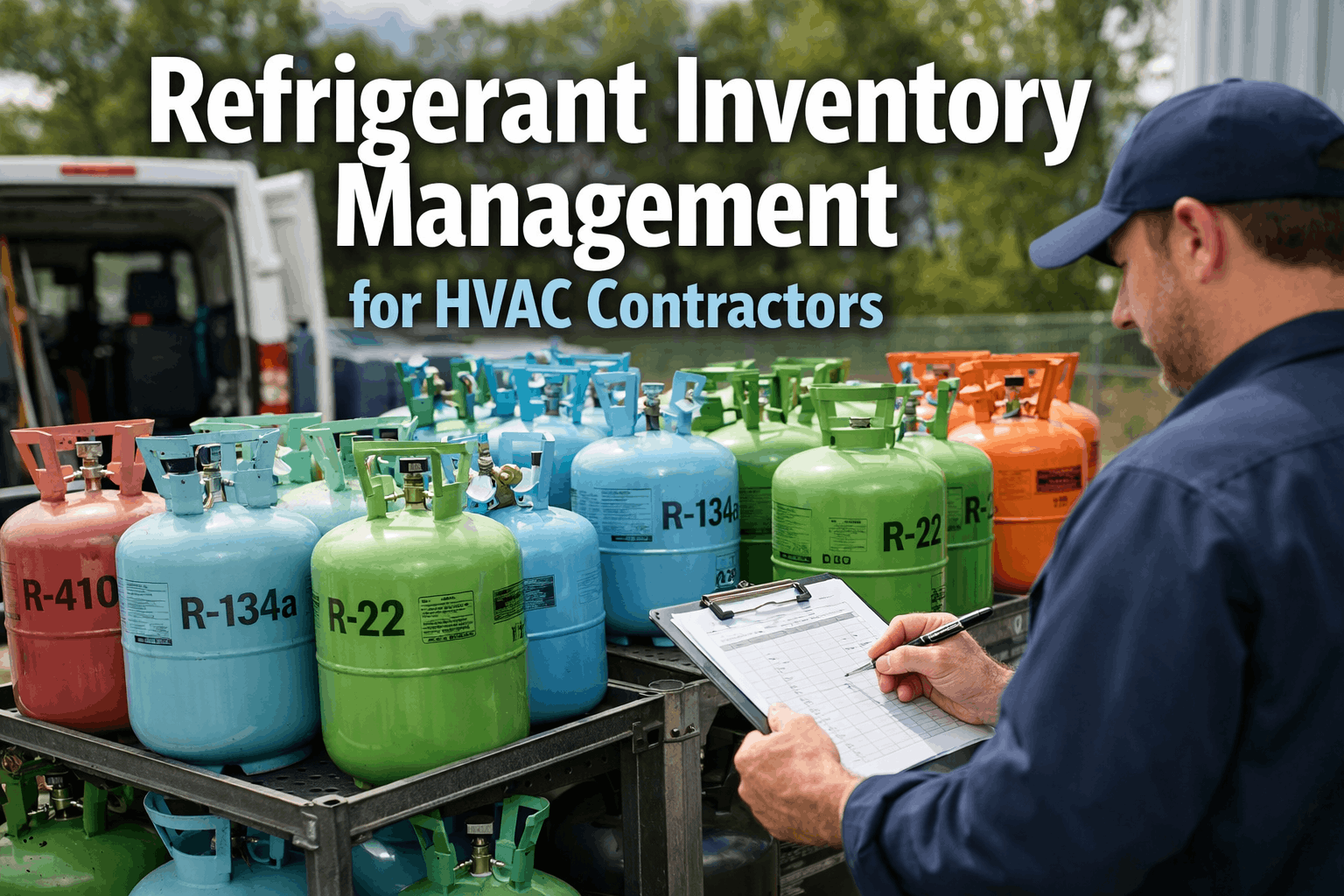
Refrigerant Inventory Management for HVAC Contractors
By John Mark on February 20, 2026
You've got 14 technicians across three service vans, each carrying a mix of R-410A, R-22, and R-454B. One tech just used 8 pounds of R-410A on a residential recharge and logged it on a sticky note. Another has two cylinders in his van that haven't been weighed since last Tuesday. A third recovered 12 pounds of R-22 from a decommission job and it's sitting in a recovery tank with no documentation on where it came from or where it's going. Right now—this moment—can you tell a regulator exactly how many pounds of each refrigerant type your company owns, where every cylinder is located, and produce purchase-to-disposal chain-of-custody records? If the answer is no, you're operating with a liability, not an inventory. Refrigerant is the second-most expensive consumable for HVAC contractors after labor, averaging $18,000–$45,000 annually for mid-size operations. Yet most contractors manage it with spreadsheets, clipboard logs, or nothing at all. The EPA doesn't care about your system—they care about your records. And the records most contractors produce wouldn't survive a five-minute audit.
The Inventory Problem
What Contractors Lose Without Refrigerant Tracking
70%
of contractors can't account for all refrigerant in their fleet
30%
average inventory shrinkage from poor tracking and cylinder mismanagement
$45K
annual refrigerant spend for mid-size contractors—largely unaudited
Why Inventory Management Is a Business-Critical Function
Refrigerant inventory management isn't a warehouse problem—it's a financial, regulatory, and operational problem that touches every service call your company runs. When a technician can't confirm what's in his van, you're guessing at job costs. When recovered refrigerant sits in unlabeled tanks, you're creating a compliance liability. When you reorder R-410A because nobody knows you have 40 pounds already in the shop, you're burning cash on redundant purchases. And when the EPA asks for chain-of-custody documentation and all you have is a half-filled spreadsheet from six months ago, you're facing penalties that can reach $44,539 per day per violation.
Contractors that sign up for digital refrigerant inventory tracking eliminate these blind spots by connecting every purchase, every charge, every recovery, and every disposal into a single, auditable record—accessible from the office, the shop, or the service van.
The Refrigerant Lifecycle: From Purchase to Disposal
Every pound of refrigerant your company touches follows a lifecycle that the EPA expects you to document. Most contractors track the purchase. Some track the charge. Almost none track the full cycle from procurement through recovery, reclamation, and final disposal. Here's what complete lifecycle management looks like.
Purchase
Procure from certified supplier with type, quantity, lot number, and date recorded against PO
Warehouse
Log into central inventory with cylinder ID, weight, and storage location—assign to shelf or staging area
Van Assignment
Transfer to technician vehicle with recorded weight, tech name, and assignment date—van becomes a mobile inventory
Field Usage
Log charge amount per job—asset ID, pounds added, pre/post pressures, customer work order linked
Recovery
Capture recovered pounds by type, source asset, recovery tank ID, and technician EPA cert number
Reclaim / Dispose
Ship to EPA-certified reclaimer or destruction facility with manifests, weights, and chain-of-custody docs
What You're Really Losing: Inventory Shrinkage Breakdown
Refrigerant "shrinkage" isn't theft in most cases—it's systemic loss from poor measurement, sloppy transfers, undocumented usage, and the assumption that small discrepancies don't matter. But at $50–$150 per pound for common blends and $400–$700+ for phasedown HFCs, a 10-pound monthly discrepancy across your fleet adds up to $6,000–$18,000 per year in unaccounted inventory. Here's where the losses actually occur.
35%
Undocumented Field Usage
Techs add refrigerant but don't log exact pounds—"about 3 lbs" loses accuracy fast
25%
Transfer Measurement Errors
Cylinder-to-van transfers without weighing create running discrepancies that compound monthly
20%
Untracked Recovery
Recovered refrigerant not weighed or typed—mixed tanks become unclaimable and undocumentable
12%
Cylinder Handling Loss
Valve leaks, hose residual, and connection purge losses that nobody measures or accounts for
8%
Misidentified Refrigerant
Wrong type logged—R-407C recorded as R-410A—corrupts inventory counts for both types
The first step to controlling shrinkage is measuring it. And you can't measure what you're not tracking. Contractors that sign up to digitize their refrigerant inventory typically discover 15–30% more loss than they estimated—which means they also discover 15–30% more savings once the tracking system is in place.
Know Where Every Pound Is. Always.
Track refrigerant from purchase through recovery across your entire fleet—every cylinder, every van, every job. Digital chain-of-custody documentation generated automatically for EPA compliance.
Scenario Comparison: A Day With vs. Without Inventory Tracking
The difference between a contractor with structured refrigerant tracking and one without isn't theoretical—it plays out every day in lost time, lost money, and accumulated compliance risk. Here's what a typical Wednesday looks like under both models.
Without Tracking
7:30 AMTech checks van—guesses he has "enough" R-410A. No scale check.
9:15 AMFirst job: adds ~4 lbs to a split system. Writes "R-410A added" on paper invoice.
11:00 AMSecond job needs 8 lbs. Cylinder runs dry at 5. Returns to shop mid-route for new cylinder.
12:30 PMShop inventory shows 2 full R-410A cylinders—but one is actually R-407C mislabeled.
2:00 PMRecovery job: 10 lbs pulled. Tank goes in van. No label, no weight log, no source asset recorded.
4:30 PMEnd of day: no accurate inventory count possible. Paper logs have gaps. $400+ in untracked refrigerant.
With Digital Tracking
7:30 AMApp shows van has 18.2 lbs R-410A and 6.5 lbs R-407C. Sufficient for today's route.
9:15 AMFirst job: 4.3 lbs logged digitally—linked to asset ID, work order, pre/post pressures.
11:00 AMApp shows 13.9 lbs remaining—enough for next job. No wasted trip to shop.
12:30 PMShop inventory dashboard shows real-time counts by type with last-weighed timestamps.
2:00 PMRecovery: 10.2 lbs logged with source asset, refrigerant type, recovery tank ID, tech cert.
4:30 PMFull reconciliation automatic. Every pound accounted for. EPA-ready records generated.
Fleet-Wide Inventory Visibility: What to Track at Each Level
Refrigerant inventory for a multi-van contractor operation has three layers: central warehouse, service vehicles, and field usage. Most contractors have partial visibility at the warehouse level and almost none at the van and field levels. Complete inventory management requires tracking at all three tiers simultaneously—with real-time reconciliation between them.
Tier 1
Central Warehouse / Shop
Total pounds by refrigerant type (virgin, recovered, reclaimed)
Cylinder count with individual IDs and last-weighed dates
Reorder thresholds with automatic alerts when stock hits minimum
Purchase order history linked to supplier, lot number, and cost per pound
Tier 2
Service Vehicles / Vans
Per-van refrigerant inventory with type, weight, and assigned technician
Transfer logs showing what moved from shop to van, when, and by whom
Recovery tank status—type, source, weight, and available capacity
Automatic low-stock alerts based on upcoming job requirements
Tier 3
Field / Job Site
Exact pounds charged per work order with asset ID and customer record
Exact pounds recovered per job with source asset and tank assignment
Technician EPA cert verification at time of service
Real-time van inventory deduction—no end-of-day reconciliation needed
When all three tiers feed a single inventory system, you get real-time fleet-wide visibility: how many pounds of each type you own, where every pound is physically located, and the complete transaction history for any cylinder or charge. Contractors that schedule a demo to see fleet-wide refrigerant tracking can walk through exactly how multi-van, multi-type inventory works across their operation—including the mobile interface technicians use in the field.
Compliance Requirements Every Contractor Must Meet
EPA enforcement of refrigerant management regulations has intensified significantly since the AIM Act amendments. Contractors are both the most frequent handlers of refrigerant and the most frequently audited—making robust inventory records not just good practice but a legal requirement. Here are the non-negotiable compliance obligations and what your records must demonstrate.
EPA Section 608: Recordkeeping Requirements
All contractors servicing appliances with 50+ lbs of refrigerant must maintain records of: refrigerant type and quantity purchased, quantity added to each appliance, quantity recovered from each appliance, and disposition of recovered refrigerant (reclamation or destruction). Records must be retained for a minimum of 3 years and produced on demand during inspections.
AIM Act: HFC Phasedown Tracking
Contractors handling HFC refrigerants (R-410A, R-134a, R-404A, etc.) must track allowance allocations, purchase quantities, and usage volumes as phasedown quotas reduce supply. Proper inventory prevents purchasing above allocation limits.
Technician Certification
Every technician handling refrigerant must hold current EPA 608 certification (Type I, II, III, or Universal). Certification records must be on file and verifiable. Uncertified handling is a standalone violation regardless of recordkeeping quality.
Recovery Equipment Certification
Recovery machines must be certified to meet EPA evacuation requirements. Certification records, maintenance logs, and calibration dates should be linked to the specific recovery events where each machine was used.
Disposal & Reclamation Chain-of-Custody
Recovered refrigerant must be sent to an EPA-certified reclaimer or destroyed at an approved facility. Shipping manifests, weights, and receiving confirmations must document the complete chain from recovery to final disposition.
Expert Perspective: Running Refrigerant Like a Financial Asset
"
The contractors who are profitable in a phasedown market treat refrigerant the way a pharmacy treats controlled substances—every gram accounted for, every transaction documented, every discrepancy investigated. When R-410A costs $75 per pound and R-454B costs $120, a 30-pound discrepancy isn't a rounding error—it's a $2,250–$3,600 write-off. I advise every contracting company to assign a refrigerant inventory manager the same way they assign a fleet manager. Someone has to own the numbers. The technology exists to track every cylinder from purchase to recovery on a mobile device. The question is whether your operation is disciplined enough to use it. The ones that are save 20–35% on annual refrigerant spend and pass every audit without breaking a sweat.
Assign a dedicated refrigerant inventory owner—accountability drives accuracy
Weigh every cylinder at every transfer—estimates are where losses hide
Reconcile van inventory weekly—monthly is too late to catch compounding errors
Never mix recovered refrigerant types—contaminated tanks are a total loss
OxMaint gives HVAC contractors real-time refrigerant inventory across warehouse, vans, and field—with automatic EPA documentation, low-stock alerts, and chain-of-custody records for every cylinder in your fleet.
What records must HVAC contractors keep for refrigerant inventory?
Under EPA Section 608, HVAC contractors must maintain records of all refrigerant purchased (type, quantity, date, supplier), all refrigerant added to appliances containing 50+ pounds (quantity, appliance identification, date, technician), all refrigerant recovered (quantity, type, source appliance, date), and the final disposition of recovered refrigerant (reclamation facility, destruction facility, shipping manifests). All technicians must have EPA 608 certification on file, and recovery equipment must be properly certified. These records must be retained for a minimum of three years and produced on demand during EPA inspections. Penalties for inadequate recordkeeping can reach $44,539 per day per violation.
How do HVAC contractors track refrigerant across multiple vans?
Fleet-wide refrigerant tracking requires a three-tier system: central warehouse inventory tracking total pounds by type with cylinder IDs and reorder alerts, per-van inventory showing what each technician is carrying with transfer logs documenting every shop-to-van movement, and field-level logging capturing exact pounds charged and recovered per job with work order linkage. Digital platforms with mobile apps allow technicians to log usage in real time from the job site, automatically deducting from van inventory and linking every transaction to a customer work order. Weekly van reconciliation—comparing system records to actual cylinder weights—catches discrepancies before they compound into significant losses.
How much refrigerant shrinkage is normal for HVAC contractors?
Industry data suggests that contractors without structured inventory tracking experience 15–30% annual refrigerant shrinkage—meaning they can't account for 15–30% of the refrigerant they purchased. The primary causes are undocumented field usage (35% of losses), transfer measurement errors between shop and vans (25%), untracked recovery (20%), cylinder handling losses (12%), and misidentified refrigerant types (8%). Contractors with digital tracking systems typically reduce shrinkage to 3–5% through precise logging, mandatory weigh-ins at transfers, and real-time reconciliation. For a contractor spending $30,000 annually on refrigerant, reducing shrinkage from 25% to 5% saves approximately $6,000 per year in recovered inventory value alone.
How does the HFC phasedown affect refrigerant inventory management?
The AIM Act's HFC phasedown is reducing the available supply of common refrigerants like R-410A, R-134a, and R-404A through production and import quotas, driving prices significantly higher. This makes precise inventory management more critical than ever: contractors can no longer afford 20–30% shrinkage rates when refrigerant costs $75–$150+ per pound. Tracking inventory by type also becomes essential as contractors begin handling transition refrigerants like R-454B alongside legacy blends. Proper inventory management prevents cross-contamination (which destroys entire tank volumes), ensures you don't over-purchase against tightening supply, and documents your handling practices for potential phasedown compliance audits.
What's the ROI of digital refrigerant inventory management for contractors?
The ROI of digital refrigerant inventory management typically breaks down into four categories: reduced shrinkage (saving 15–25% of annual refrigerant spend), eliminated redundant purchases (saving 5–10% by knowing actual stock before reordering), avoided compliance penalties (preventing fines up to $44,539 per day), and recovered labor efficiency (saving 30–60 minutes per technician per day on documentation and shop trips). For a mid-size contractor spending $30,000–$45,000 annually on refrigerant with 8–14 technicians, digital tracking typically delivers $12,000–$25,000 in direct annual savings while reducing audit preparation time from days to minutes. Most contractors achieve full ROI within the first 3–6 months of implementation.