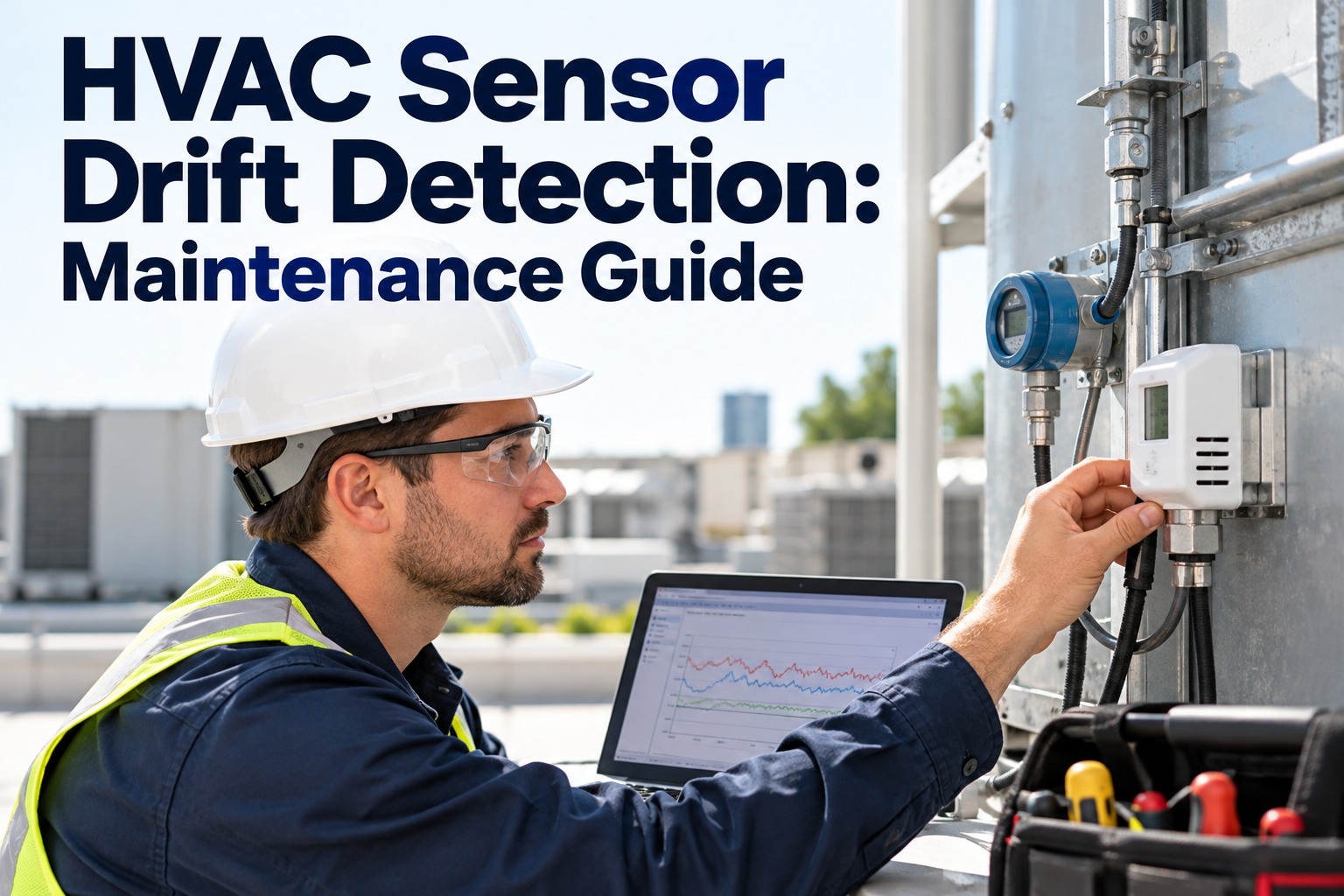
A failed sensor trips an alarm. A drifting sensor does something worse — it keeps reporting a believable number that is slowly becoming wrong, and nothing flags it. The thermostat still reads 72, the system still runs, every check still passes, and all the while the space is really at 69 and the plant is burning energy to chase a number that does not exist. Drift is the quiet fault, and you cannot spot it by staring at one reading. You spot it by comparing that reading against something you trust. The OXMAINT AI — the AI-powered maintenance management software — watches those comparisons continuously so drift surfaces as a work order, not a complaint.
How to catch a sensor that is lying before it costs comfort, energy and false control decisions — the detection methods, the sensor-by-sensor tells, and the response when a reading no longer adds up.
Drift is gradual. The reading pulls away from the true value a fraction at a time, staying well inside the alarm band the whole way, so the system never objects. By the time anyone notices, it is through a comfort complaint or an energy bill — not a fault code; start free and let OXMAINT AI watch the gap before it widens.
Reading vs reality over time — the alarm band is never crossed
The sensor is not broken — it is wrong. Detection is about finding the growing gap while every alarm still reads normal.
Drift Is Not the Only Way a Reading Goes Wrong
Before you chase drift, know which of three problems you are looking at — the fix is different for each. A sudden erratic reading is a fault to repair; a constant error is an offset to zero out; a slow creep is true drift that needs recalibration. Telling them apart is the first move; book a demo to see how OXMAINT AI classifies a bad reading.
Constant
Offset
The reading is wrong by the same amount all the time — reads 2° high from day one. Often a placement or wiring issue; corrected with a one-time offset.
Gradual
Drift
The error grows slowly over weeks or months as the element ages or fouls. This is the quiet one — no alarm, no single bad reading, just a widening gap. Needs recalibration.
Sudden
Fault
The reading jumps, freezes, spikes or goes erratic. This one usually does trip an alarm or look obviously wrong — a failed element or broken connection to repair or replace.
Four Ways to Detect Drift — Each Needs a Reference
You can never see drift from one reading alone, because the reading looks fine. Every detection method works by comparing the sensor against something you trust more — another sensor, physical reality, its own history, or a calibrated instrument. These are the four, from the cheapest to run continuously to the most definitive; start free and run the first three automatically in OXMAINT AI.
01
Redundancy cross-check
Compare sensors that should agree. Two sensors in the same airstream, a supply reading against a return, several zone sensors on a mild day — when one pulls away from the pack while conditions have not changed, it is the suspect. The reference is its neighbours.
02
Physical-reality sanity check
Hold the reading against what must be true. Mixed air cannot read colder than both outdoor and return; a space at setpoint with no load should sit near setpoint; humidity cannot read above 100%. A reading that breaks physics is drifting or faulted. The reference is the laws the number has to obey.
03
Trend & statistical analysis
Watch each sensor against its own history. A reading that slowly diverges from its long-run baseline under the same conditions, or whose relationship to a paired sensor steadily widens, is the signature of drift. The reference is the sensor's own past — which is exactly what a maintenance platform keeps.
04
Field verification against a calibrated instrument
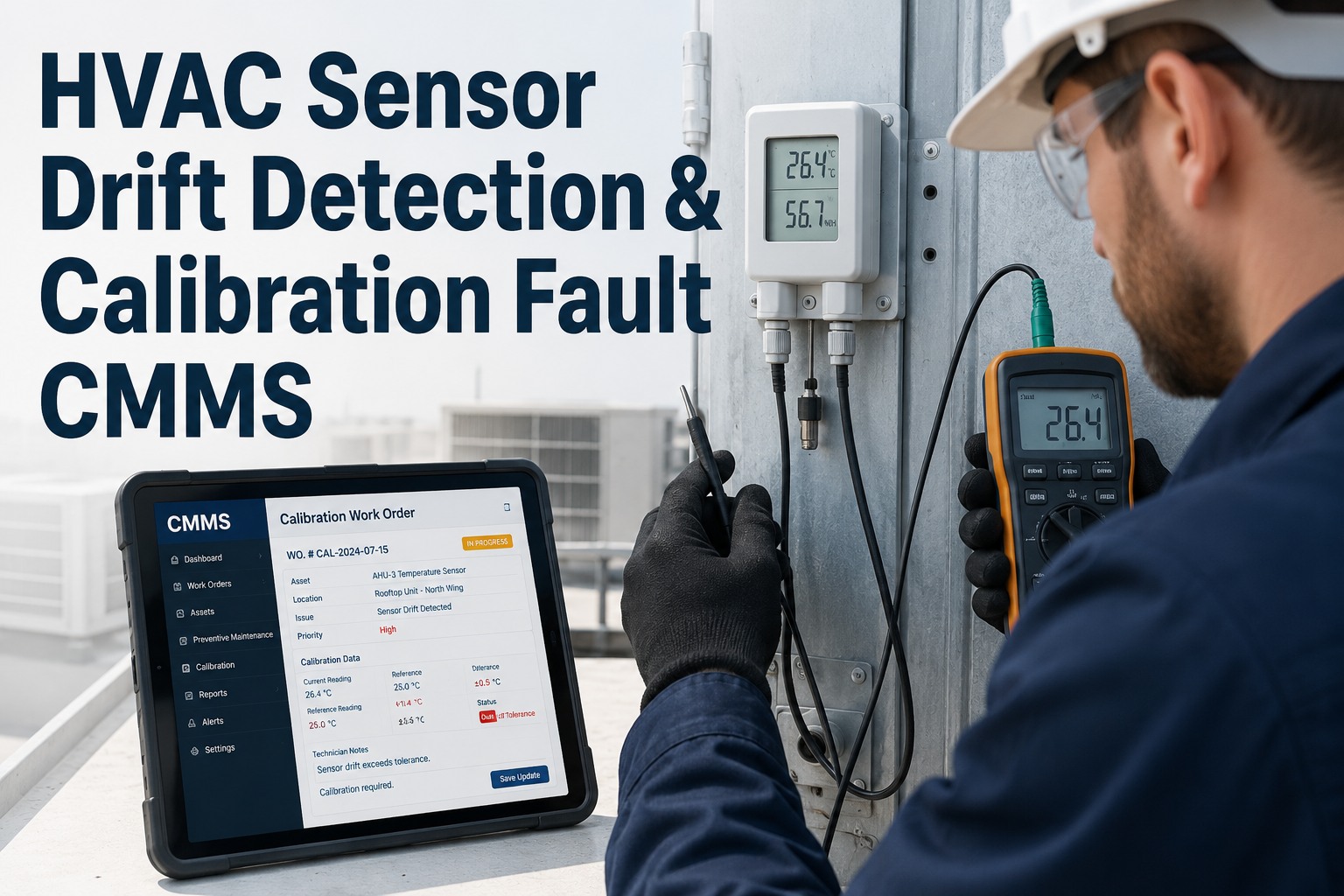
The definitive check — put a traceable, recently calibrated reference meter at the sensor and read both at the same point. This confirms drift the first three only suspected, and tells you the exact correction. The reference is a known-good instrument; the others tell you which sensors are worth this trip.
Where Each Sensor Drifts — and the Tell
Different sensors drift for different reasons and at different rates, and each leaves a different tell. This reference shows what to watch per sensor type; it scrolls sideways on a phone so every column stays readable. Book a demo to hold this reference against your own points in OXMAINT AI.
Sensor
Common drift cause
Typical rate
The tell
Temperature
Element ageing, self-heating, poor contact
Slow, small
Pulls away from paired zone or airstream sensors
Pressure
Diaphragm fatigue, zero shift, port fouling
Moderate
Static pressure holds while fan behaviour changes
Humidity
Polymer ageing, dust, condensation
Fast
Reads over 100%, or far off a reference hygrometer
CO2
Baseline shift between calibrations
Moderate
Empty space does not settle near outdoor baseline
Airflow
Probe fouling, duct buildup, placement
Gradual
Box commands do not match delivered flow
The Cheapest Fault in the Building Is the One You Never See.
A two-degree drift throws no code and breaks nothing — it just quietly overcools, overheats and overspends, month after month, until it shows up as a complaint or a bill nobody can explain. The OXMAINT AI maintenance management software compares every sensor against its history and its neighbours continuously, so a drifting point becomes a work order the week it starts pulling away.
Suspecting drift and confirming it are two steps — and recalibrating a sensor that was fine wastes a trip, while ignoring a real one wastes energy. This is the response once a reading looks wrong; start free and run it as a tracked workflow in OXMAINT AI.
1
Confirm against a reference
Cross-check neighbours, sanity-check against physics, then verify with a calibrated instrument before touching anything.
2
Separate drift from a fault
A slow steady gap is drift to recalibrate; a jump, freeze or erratic signal is a fault to repair or swap.
3
Recalibrate or replace
Apply the correction, or fit a new sensor where the element is past recovery. Record the as-found and as-left values.
4
Log it and reset the clock
Record the reading, the correction and the date, and set the next verification so the sensor is checked before it drifts again.
The space feels wrong while the reading says it is fine — the classic sign the reading is the problem.
Energy creeping up
Plant works harder to hit a target that is off, so consumption rises with no change in load or weather.
Bad control decisions
A drifted outdoor or mixed-air sensor makes the economizer and reset logic choose wrongly all day.
Short cycling or hunting
Equipment chases a moving, untrue number, cycling more and wearing faster than the schedule expects.
How OXMAINT AI Detects Drift
The first three detection methods only work if something is always watching and always remembering — which is the job a maintenance platform does. Here is how the OXMAINT AI maintenance management software turns drift detection into a running program; start free and put every sensor under watch in OXMAINT AI.
Continuous trend watch
Every sensor tracked against its own baseline, so a slow divergence surfaces long before a complaint does.
Cross-sensor deviation alerts
Paired and grouped points compared automatically; when one pulls away from the rest, it is flagged.
Calibration-due scheduling
Verification intervals set per sensor and raised automatically, so no point goes unchecked past its due date.
Deviation becomes a work order
A flagged sensor opens a job with its trend attached, so a technician goes out to the right point, not a guess.
As-found / as-left record
Every verification logs the reading before and the correction after, building a traceable calibration history.
Drift history & repeat offenders
Sensors that drift often rise to the top over time, so chronic points get a shorter interval or a replacement.
Frequently Asked Questions
What is HVAC sensor drift?
It is the slow loss of accuracy in a sensor over time — the reading moves away from the true value a little at a time as the element ages, fouls or shifts. Unlike a failure, it throws no alarm, which is what makes it hard to catch.
How do you detect drift if the reading looks normal?
By comparing the sensor against a reference it should agree with: neighbouring sensors, physical reality, its own historical trend, or a calibrated instrument in the field. Drift shows up as a growing gap against that reference, never in the single reading itself.
How often should HVAC sensors be verified?
It depends on the sensor and its duty — humidity sensors tend to drift fastest, temperature sensors slowest. A common approach is a periodic field check with the interval tuned per sensor from its drift history, tightened for points that have drifted before.
What is the difference between drift and an offset?
An offset is a constant error — wrong by the same amount all the time, corrected once. Drift grows over time and needs recalibration to bring the sensor back, then monitoring so you catch it when it starts again.
How does a CMMS help with sensor drift?
It keeps the history and the comparisons that drift detection depends on — trending each sensor, flagging points that pull away from their group, scheduling verification and turning a deviation into a work order; OXMAINT AI runs the whole drift-detection program.
Catch the Sensor That Is Lying — Before It Costs You.
Run sensor drift detection inside the OXMAINT AI maintenance management software — continuous trend watch, cross-sensor deviation alerts, per-sensor calibration scheduling, deviation-driven work orders and a full as-found / as-left history — so a drifting reading becomes a job you close, not a bill you cannot explain.