Every HVAC system’s intelligence depends on the accuracy of its sensors and controls. A drifting temperature sensor or miscalibrated pressure transmitter doesn’t just cause comfort complaints — it silently degrades energy efficiency, accelerates equipment wear, and creates compliance risks that expose facility managers to audit findings and lease disputes. Traditional building maintenance tracks these critical components inconsistently, leaving calibration gaps that spread across building automation networks before anyone detects the root cause. Sign Up Free to see how OxMaint converts every sensor, thermostat, and controller into a tracked, schedule-driven asset with automated calibration work orders and audit-ready documentation.
Replace Calibration Blind Spots With Automated Compliance Tracking
OxMaint centralizes HVAC calibration management — tracking due dates, storing certificates, assigning tasks by asset zone, and generating audit trails across every sensor, transmitter, and controller in your building portfolio.
Why HVAC Calibration Management Breaks Down in Manual Building Operations
Most commercial buildings treat sensor calibration as an afterthought — tacked onto annual PM checklists or addressed only when a comfort complaint escalates. The result is a fragmented, unreliable calibration program that fails when it matters most.
Scattered Calibration Records
Calibration certificates live in email attachments, technician notebooks, or paper binders — impossible to locate during an audit or when a sensor starts reading out of spec.
Missed Calibration Deadlines
Without automated scheduling, calibration windows slip by unnoticed — allowing drifting sensors to corrupt BMS decisions for months before anyone realizes equipment is running outside design parameters.
No Asset-to-Sensor Traceability
Which pressure transmitter serves which AHU? What thermostat controls what zone? Facilities teams lose hours tracing control loops when calibration records aren't linked directly to HVAC assets.
Manual Work Order Generation
Coordinators manually create calibration tasks, introducing delays between due date and technician dispatch — and increasing the risk that critical sensors operate past their certified accuracy window.
Inconsistent Calibration Procedures
Without standardized checklists, each technician follows a different verification process — creating variation in calibration quality and making it impossible to validate that work was performed correctly.
No Drift Pattern Detection
Repeated calibration adjustments on the same sensor go unnoticed without analytics — preventing teams from identifying failing sensors before they cause system-wide efficiency losses or comfort failures.
6 Calibration Workflows OxMaint Automates Across Your HVAC Asset Register
Each workflow below addresses a specific failure point in manual calibration management. OxMaint converts these into structured, date-driven calibration work orders with mobile technician access and complete documentation. Sign Up Free to activate these workflows across your HVAC sensor fleet in OxMaint.
What Is Captured
- Sensor type, manufacturer, model, and serial number
- Installation date and last calibration date
- Required calibration interval and tolerance range
- Associated HVAC asset and building zone
OxMaint Action
OxMaint creates a complete instrument registry where every sensor, thermostat, pressure transmitter, and airflow meter becomes a tracked asset with its own calibration schedule, certificate history, and direct link to the HVAC equipment it serves — eliminating search time during audits and failure investigations.
What Is Managed
- Time-based intervals (months, quarters, years)
- Meter-based triggers (operating hours, cycles)
- Regulatory requirement alignment (ISO, GMP, FDA)
- Multi-building calibration calendars
OxMaint Action
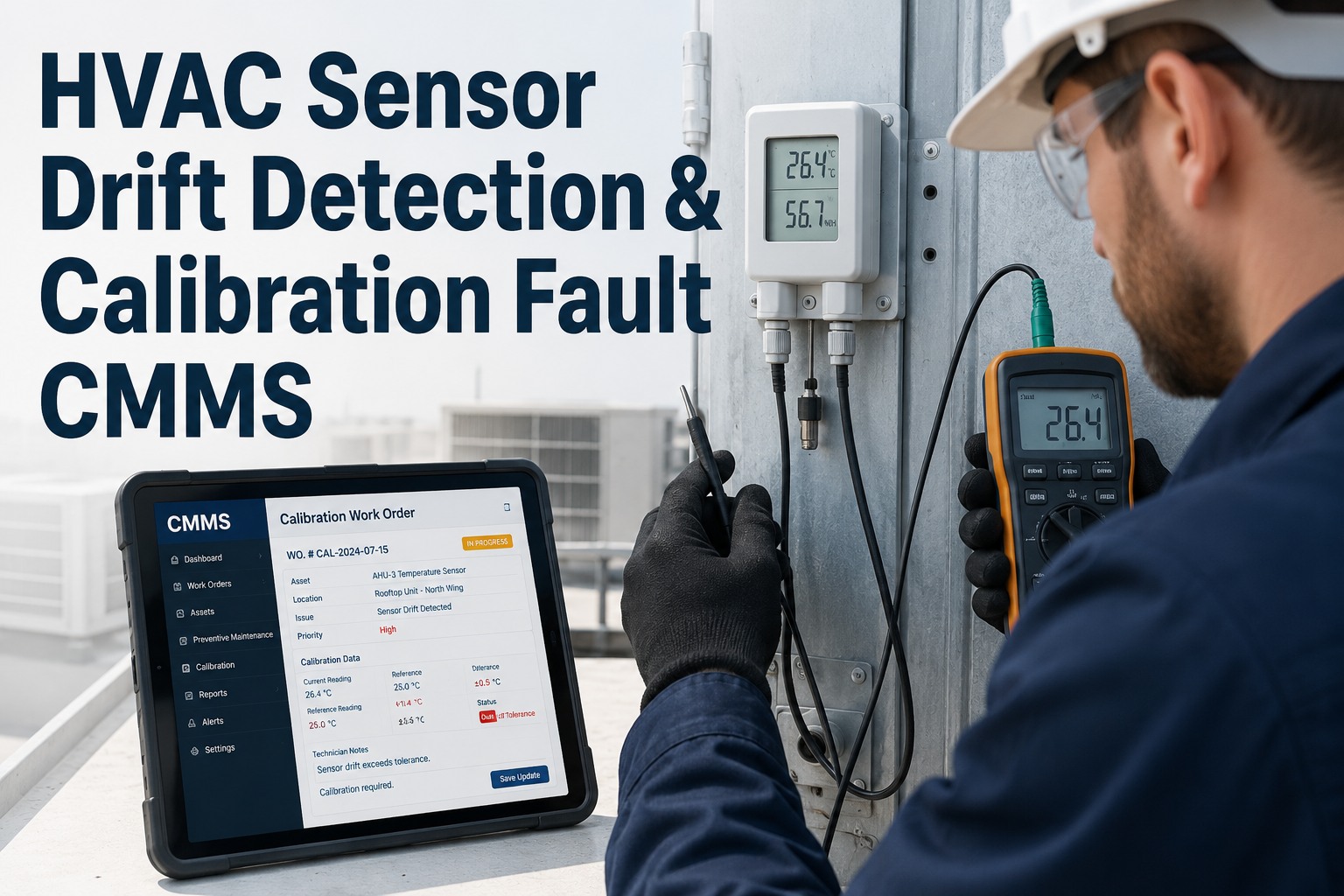
OxMaint automatically generates calibration work orders on configurable schedules — daily sensor verification, weekly thermostat checks, monthly pressure transmitter validation — before accuracy degradation reaches threshold. Overdue tasks escalate automatically to supervisors.
Book a Demo to explore OxMaint's calibration scheduling engine.
What Is Standardized
- Pre-calibration verification steps
- Reference standard traceability
- As-found and as-left readings
- Adjustment records and pass/fail determination
OxMaint Action
OxMaint delivers structured digital checklists for every calibration task — pre-populated with instrument specifications, tolerance ranges, and required reference standards. Technicians complete checklists on mobile devices, ensuring consistent procedure execution regardless of which technician performs the work.
What Is Stored
- Calibration certificates as timestamped PDFs
- Technician signatures and credentials
- Reference standard traceability numbers
- Environmental conditions during calibration
OxMaint Action
OxMaint stores every calibration certificate as a timestamped, immutable digital record attached directly to the instrument's asset profile. Auditors get instant access to complete calibration history without digging through email archives or paper binders — reducing audit preparation time from weeks to minutes.
What Is Tracked
- 30-, 14-, and 7-day advance alerts
- Overdue instrument dashboards
- Supervisor escalation for missed deadlines
- Regulatory non-compliance risk flags
OxMaint Action
OxMaint sends automated reminders before each calibration due date and flags overdue instruments immediately after deadline passes. Supervisors receive escalation alerts when critical sensors miss their calibration window — preventing compliance lapses and ensuring continuous control accuracy.
Book a Demo to see OxMaint's compliance dashboard in action.
What Is Analyzed
- As-found vs. as-left reading deviations
- Calibration frequency trends by instrument type
- Sensors requiring repeated adjustments
- Correlation between drift patterns and environmental conditions
OxMaint Action
OxMaint's analytics layer identifies instruments showing drift patterns — flagging sensors that consistently need adjustment before they fail entirely. Facilities teams convert these patterns into replacement programs or adjusted calibration intervals, eliminating the root cause of recurring comfort complaints and energy waste.
Connect Your BMS to Automated Calibration Workflows
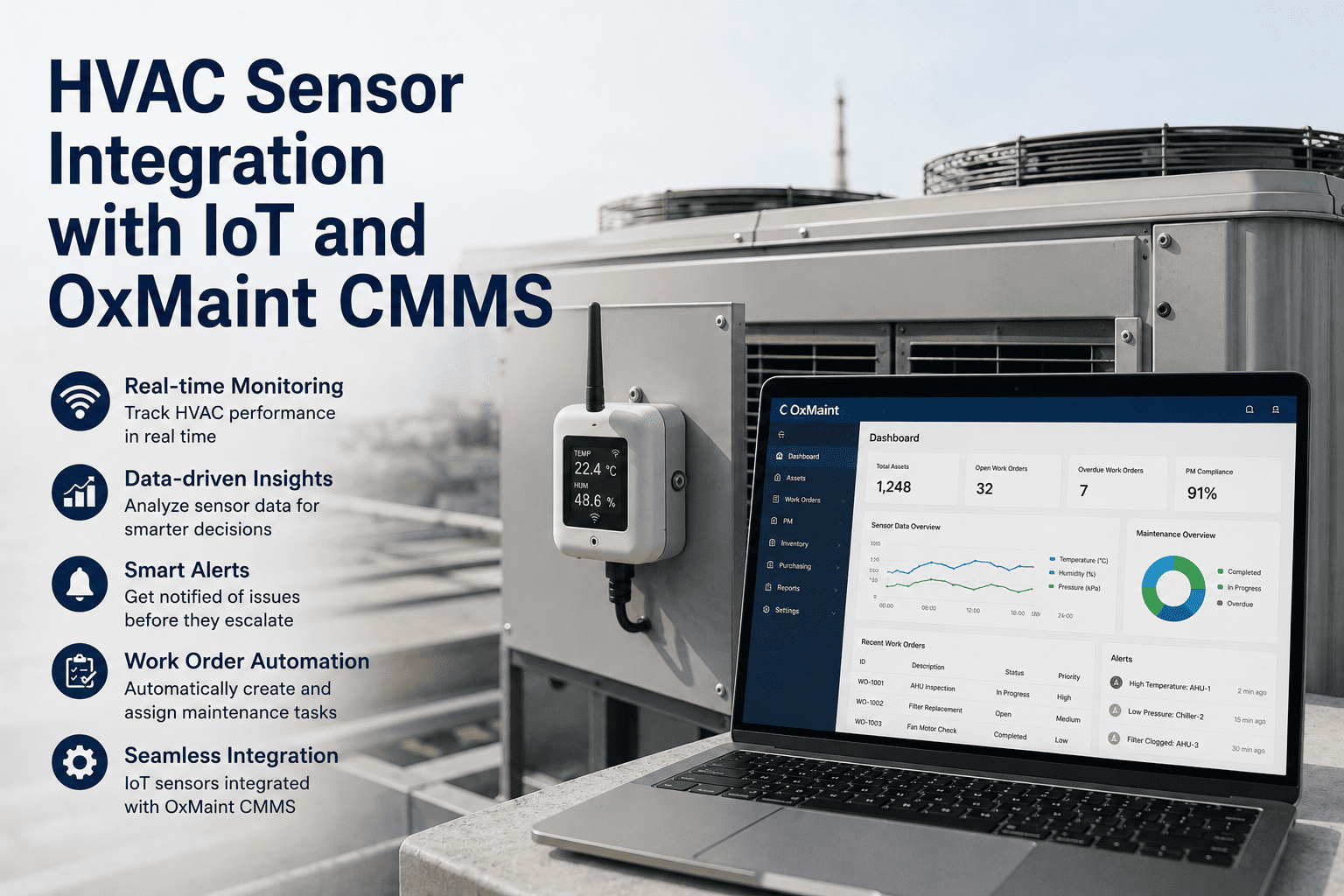
OxMaint integrates directly with BACnet, Modbus, and REST API-enabled building automation systems — turning sensor data drift into structured calibration work orders without manual data entry or control system modifications.
HVAC Calibration Requirements by Sensor Type — What OxMaint Tracks
Calibration frequencies, tolerances, and regulatory requirements vary significantly across HVAC sensor categories. The table below maps each sensor type to its typical calibration interval, critical application, and OxMaint tracking configuration. Book a Demo to configure sensor-specific calibration rules for your building's instrument register.
| Sensor / Control Type |
Typical Calibration Interval |
Critical Application |
OxMaint Work Order Type |
Compliance Flag |
| Temperature Sensor (Room / Duct) |
12 months |
Comfort control, energy optimization |
Preventive — Calibration |
Comfort SLA |
| Humidity Sensor |
12 months |
Indoor air quality, process critical |
Preventive — Calibration |
IAQ compliance |
| Pressure Transmitter (Differential / Static) |
6–12 months |
Airflow control, VAV box operation |
Preventive — Critical Calibration |
System performance |
| CO₂ Sensor |
12 months |
Demand-controlled ventilation |
Preventive — Calibration |
IAQ compliance |
| Thermostat / Room Controller |
24 months |
Zone temperature regulation |
Preventive — Verification |
Tenant satisfaction |
| Airflow Measuring Station |
12 months |
Outside air tracking, CFM verification |
Preventive — Critical Calibration |
Energy code compliance |
| Chilled Water / Hot Water Temperature Sensor |
12 months |
HVAC plant efficiency, setpoint accuracy |
Preventive — Calibration |
Energy optimization |
How OxMaint Structures HVAC Calibration Management for Smart Buildings
01
Instrument Registry With Asset Linking
Every sensor, thermostat, and transmitter is registered as a tracked asset with manufacturer specs, calibration history, and direct linkage to the HVAC equipment and building zone it serves.
02
Automated Calibration Work Order Generation
OxMaint creates calibration work orders on configurable schedules — time-based or meter-based — with pre-populated checklists and required reference standards attached to each task.
03
Mobile Technician Execution With Digital Signatures
Technicians receive calibration tasks on mobile devices, complete structured checklists, record as-found and as-left readings, and attach certificates with timestamped signatures — all without returning to a desktop.
04
Audit-Ready Certificate Storage
OxMaint stores every calibration certificate as an immutable digital record attached to the instrument's asset profile — with full traceability, technician credentials, and reference standard documentation.
05
BMS Integration for Automated Triggering
OxMaint integrates with BACnet, Modbus, and REST API-enabled BMS platforms — reading sensor values and alarm states to trigger calibration work orders when drift exceeds configured thresholds.
06
Drift Analytics & Preventive Action
OxMaint's analytics layer identifies instruments showing recurring drift patterns — enabling facilities teams to replace failing sensors or adjust calibration intervals before control accuracy compromises comfort or efficiency.
Sign Up Free to explore OxMaint's calibration analytics dashboard.
Frequently Asked Questions — HVAC Calibration Management
What is HVAC calibration management?
It is the systematic process of scheduling, executing, and documenting calibration for HVAC sensors, thermostats, pressure transmitters, airflow meters, and BMS controls to ensure control accuracy and regulatory compliance.
How often should HVAC sensors be calibrated?
Calibration intervals vary by sensor type and application — temperature sensors typically every 12 months, pressure transmitters every 6–12 months, and CO₂ sensors annually. Regulatory requirements may mandate shorter intervals for critical applications.
Can OxMaint integrate with my existing BMS for calibration management?
Yes. OxMaint connects directly to BACnet, Modbus, and REST API-enabled BMS platforms — reading sensor values and alarm states to automatically trigger calibration work orders when drift or faults are detected.
How does OxMaint help with regulatory compliance for calibration tracking?
OxMaint automates calibration scheduling by date or meter reading, stores digital certificates with technician signatures, sends advance alerts before due dates, and generates audit-ready compliance reports — meeting ISO 9001, GMP, FDA, and other regulatory standards.
What happens if a calibration deadline is missed in OxMaint?
OxMaint flags overdue instruments on real-time dashboards and sends escalation alerts to supervisors when critical sensors miss their calibration window — preventing compliance lapses and enabling immediate corrective action.
What types of buildings benefit most from automated HVAC calibration management?
Multi-tenant office buildings, healthcare facilities, pharmaceutical plants, data centers, educational campuses, and any commercial property where sensor accuracy directly impacts occupant comfort, energy costs, or regulatory compliance.
Take Control of Your HVAC Calibration Program With OxMaint
Automated calibration scheduling. Digital certificate storage. BMS integration. Drift analytics. One CMMS platform built for facility teams managing HVAC sensors and controls at scale — from single buildings to multi-site portfolios.