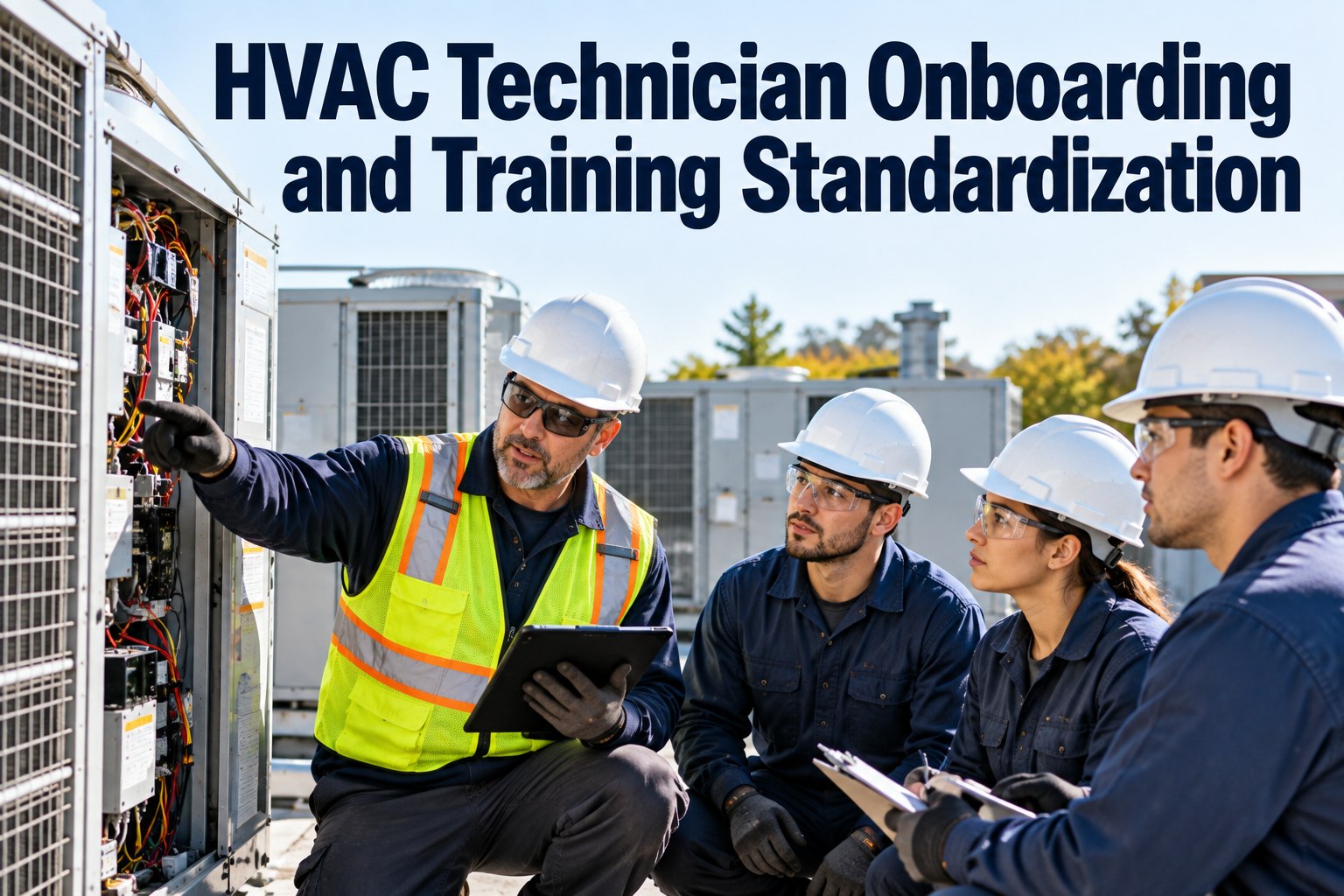
HVAC Technician Onboarding and Training Standardization

By William Jerry on September 30, 2026

hvac-technician-onboarding-training-standardization

Two techs, same job, two different results — because they were trained by two different people, one thorough and one rushed. That's the hidden cost of unstandardized onboarding: a new hire who takes a year to work independently, service that varies by who taught them, and senior knowledge that walks out the door at retirement undocumented. Standardized onboarding fixes all three. OXMAINT AI, the AI-powered HVAC CMMS, turns onboarding into a tracked curriculum, verifies competency before a tech works solo, and matches every assignment to proven skill.

HVAC Workforce · Technician Onboarding · Training Standardization · 2026

HVAC Technician Onboarding & Training Standardization

New hires who take a year to ramp. Service that varies by who trained them. Senior expertise that leaves at retirement. OXMAINT AI, the AI-powered CMMS and maintenance management software, runs onboarding on one platform: a structured curriculum every hire works through, competency verified and signed off before solo work, a live skills matrix, and assignments matched to proven ability — so techs get productive faster and every one works the same way.

1Hire → 2Curriculum → 3Verify Competency → 4Assign by Skill
SKILLS MATRIX · NEW HIRE
Safety & LOTOL4
Refrigerant / EPA 608L3
Boiler & combustionL2
Controls / BASL1
Chiller serviceL2
Gaps flagged → L1/L2 skills queued for supervised reps
12–18 mo
typical ramp from entry-level to independent competency
75% vs 10%
knowledge retention: hands-on work vs classroom lecture
4 levels
competency scale from Awareness to Can Train Others
2+
independently qualified techs to hold per critical asset

Inconsistent Training Breeds Inconsistent Service

When onboarding is "shadow whoever's free," every new tech learns a slightly different way to do the same job — and the gaps show up later as callbacks, safety misses and repeat failures. Standardization means every hire gets the same curriculum, the same checks and the same sign-offs, no matter who supervises them. OXMAINT AI holds that curriculum and tracks each hire's progress through it. Start free and standardize your onboarding in OXMAINT AI.

The Onboarding Journey, in Phases

Ramp time drops when onboarding is a sequence, not a scramble. A structured program moves a hire from safety and fundamentals into supervised repairs and finally independent work — each phase building on the last. OXMAINT AI runs the phases as tracked tasks so nobody skips ahead of their competency. Book a demo to see the onboarding path in OXMAINT AI.

Weeks 1–2
Safety Immersion & Orientation
Safety-first foundation with a 100% pass requirement, plus systems and site orientation before touching equipment.
Weeks 3–6
Craft Skills Foundation
Mechanical, electrical and instrumentation fundamentals — roughly 70% hands-on workshop, not lecture.
Weeks 7–12
Equipment-Specific & Ride-Alongs
Supervised repairs on real HVAC assets — dozens of guided jobs paired with an experienced tech.
Months 4–6
PM & Predictive Systems
Preventive and predictive maintenance workflows, reading condition data, and closing work orders cleanly.
Months 7–9
Diagnostics & Reliability
Root-cause analysis and reliability thinking — moving from fixing symptoms to preventing recurrence.
Months 10–12
Independent & Mentoring
Autonomous work verified, then learning to mentor the next hire — closing the loop on the skills pipeline.

Full ramp to independent competency typically runs 12–18 months. The point of standardizing isn't to rush it — it's to make sure every hire actually reaches it, the same way, with the gaps closed instead of hidden.

Competency Is a Level, Not a Yes/No

"Trained" is too blunt to schedule against. A four-level scale says whether a tech can do a task alone, needs supervision, or can teach it — and that's what a dispatcher actually needs to know. OXMAINT AI rates every tech on every skill against these levels. Start free and level your team's skills in OXMAINT AI.

L1 · AWARENESS
Knows the task exists and the basics, but can't yet perform it. Learning and observing.
L2 · ASSISTED
Can perform the task with supervision or help. Ready for guided, supervised reps.
L3 · INDEPENDENT
Performs the task solo, correctly and safely. Cleared for unsupervised assignment.
L4 · CAN TRAIN OTHERS
Mastery — performs and teaches the task. The bench that onboards the next hire.

Levels are earned, not claimed: verify with practical demonstration, written check and supervisor evaluation — never self-assessment alone. Best practice is to hold at least two independently qualified (L3+) techs for every critical asset category, so a single absence never leaves a gap.

The Skills Matrix at a Glance

Put every tech against every skill and the whole team's readiness becomes one picture — who can cover what, where the gaps are, and which training closes the most risk. A simplified view: Book a demo to see your live skills matrix in OXMAINT AI.

TechnicianSafety / LOTOEPA 608Boiler / combustionControls / BASChillers
Senior tech L4 L4 L3 L3 L4
Mid-level tech L4 L3 L3 L2 L3
New hire L4 L3 L2 L1 L2

The gaps read at a glance: Controls/BAS has only one L3+ tech — a coverage risk on a critical system, and the obvious next training priority.

You Can’t Schedule Against “Trained.”

A yes/no training flag tells a dispatcher nothing about who can safely work a chiller alone. OXMAINT AI ties verified competency levels to work-order assignment, so the right-qualified tech gets the job and the gaps become a training plan, not a surprise.

From New Hire to Independent Tech

Standardized onboarding is a loop that runs the same for every hire and feeds the next one. OXMAINT AI carries a tech from day-one curriculum to verified independence to mentoring the person behind them. Here's the flow. Start free and run this onboarding loop in OXMAINT AI.

01
Assign the Curriculum
A new hire gets the standardized onboarding path as tracked tasks — same content, same order, regardless of who supervises.
↓
02
Learn by Doing
Hands-on workshops and supervised ride-alongs, with digital SOPs and procedure videos embedded in the work orders.
↓
03
Verify & Sign Off
Practical demo, written check and supervisor evaluation move each skill up a level — competency proven, not assumed.
↓
04
Assign by Verified Skill
Once a skill hits L3, the tech is cleared for solo work on it — and the platform routes matching jobs their way.
↓
05
Mentor the Next Hire
L4 techs onboard the next cohort and capture their knowledge into SOPs — the pipeline sustains itself.

What the CMMS Brings to Training

A training binder can't schedule work or flag a gap. In OXMAINT AI onboarding, competency and assignment live in the same system your team already runs the work in. Book a demo to see the training tools in OXMAINT AI.

CURRICULUM
Standardized Onboarding Path
One tracked curriculum every hire works through, so instruction is identical no matter who supervises.
MATRIX
Live Skills Matrix
Every tech rated on every skill at four levels, with the last assessment date — coverage and gaps at a glance.
VERIFY
Competency Sign-Off
Levels advance on verified demonstration and supervisor evaluation, not self-assessment.
SOP
SOPs in the Work Order
Digital procedures and video libraries sit inside the task, so the right method travels with the job.
MATCH
Skill-Matched Assignment
Work orders route to techs qualified for them, and unqualified solo assignment is flagged before it happens.
CAPTURE
Knowledge Capture
Senior expertise recorded into SOPs and case archives before retirement, so it outlasts any one person.
“

Onboarding used to mean handing a new tech to whoever had a light week, and you could tell six months later who'd trained them. We built one curriculum in the system and put every skill on a four-level matrix. Now a new hire follows the same path every time, we don't clear anyone for solo work on a chiller until it's signed off, and I can see on one screen that we're thin on controls coverage before it bites us. Ramp time came down and the callbacks that trace to 'they were never really shown' basically stopped.

Training & Operations Lead · Commercial HVAC Contractor

Frequently Asked Questions

How long does it take to onboard an HVAC technician?
Reaching independent competency typically takes 12–18 months through a structured program that moves from safety and fundamentals into supervised repairs and then autonomous work. Standardizing the path doesn't rush it — it makes sure every hire actually gets there. OXMAINT AI tracks each phase. Start free and map your onboarding path.
Why standardize training instead of pairing new hires with a senior tech?
Pairing is valuable, but on its own it makes every hire's training depend on who taught them — so service varies and gaps hide. A standardized curriculum plus mentorship gives identical instruction and verifiable competency. OXMAINT AI holds both. Book a demo to see standardized onboarding.
What is a skills matrix and why use one?
It rates every technician on every skill using a four-level scale — Awareness, Assisted, Independent, Can Train Others — so you can see instantly who can cover which assets and where coverage is thin. OXMAINT AI keeps it live and ties it to assignments. Start free and build your matrix.
How is competency actually verified?
Through practical demonstration, a written check and a supervisor evaluation — never self-assessment alone. A skill only advances a level when observed performance backs it, and best practice is at least two independently qualified techs per critical asset. Book a demo to see competency sign-off.
How does this help before a senior tech retires?
By capturing their expertise into digital SOPs, procedure videos and mentorship pairings while they're still on the team — so the knowledge lives in the system and in the next tech, not just in one person's head. OXMAINT AI stores it in the work orders. Start free and capture senior knowledge.

Train Every Tech the Same Way. Prove It Before They Work Solo.

Standardize HVAC technician onboarding on the OXMAINT AI maintenance management software — one tracked curriculum, a four-level skills matrix, verified competency sign-off, SOPs in every work order, and skill-matched assignment. Get new hires productive faster without letting quality or safety drift.
Share This Story, Choose Your Platform!