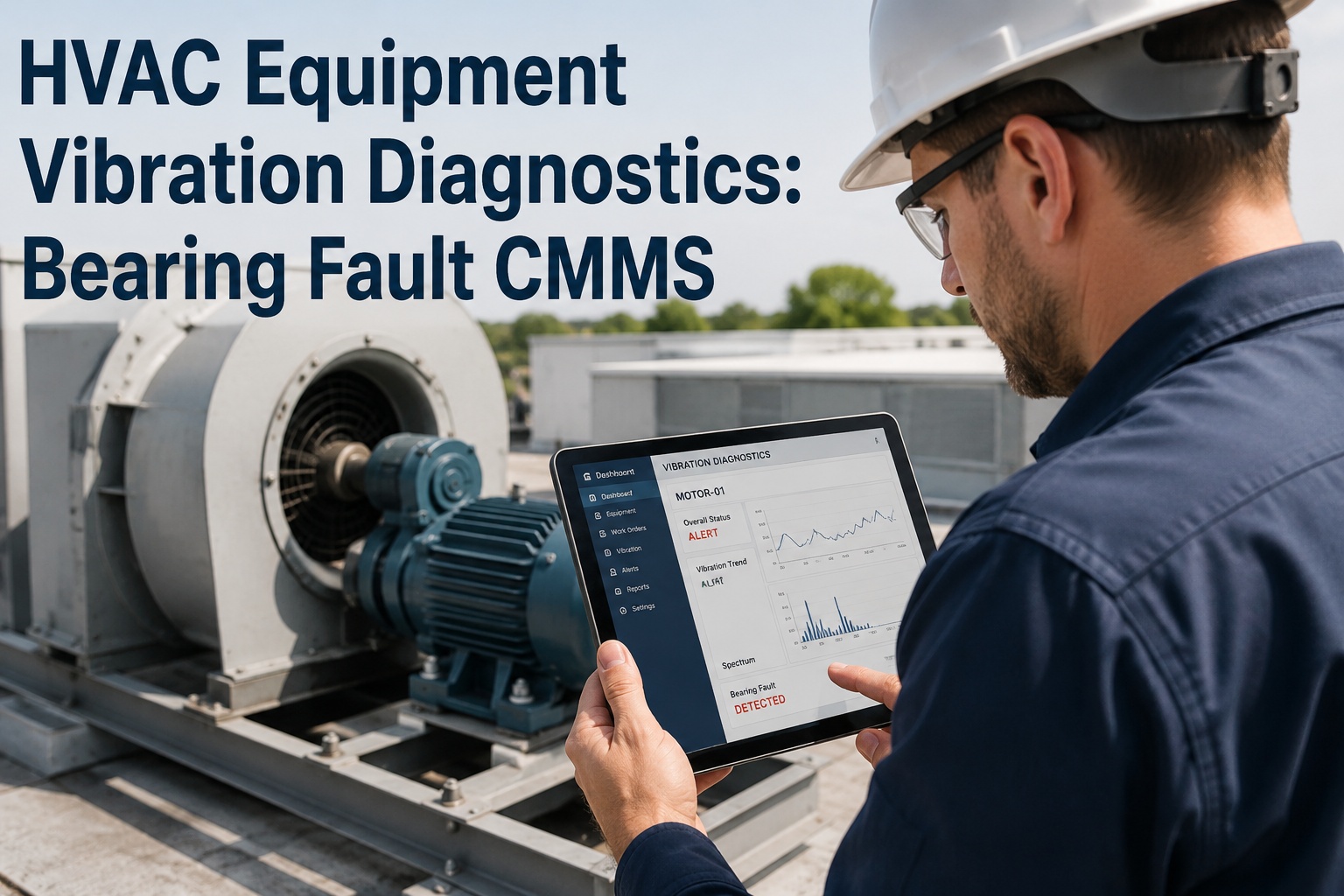
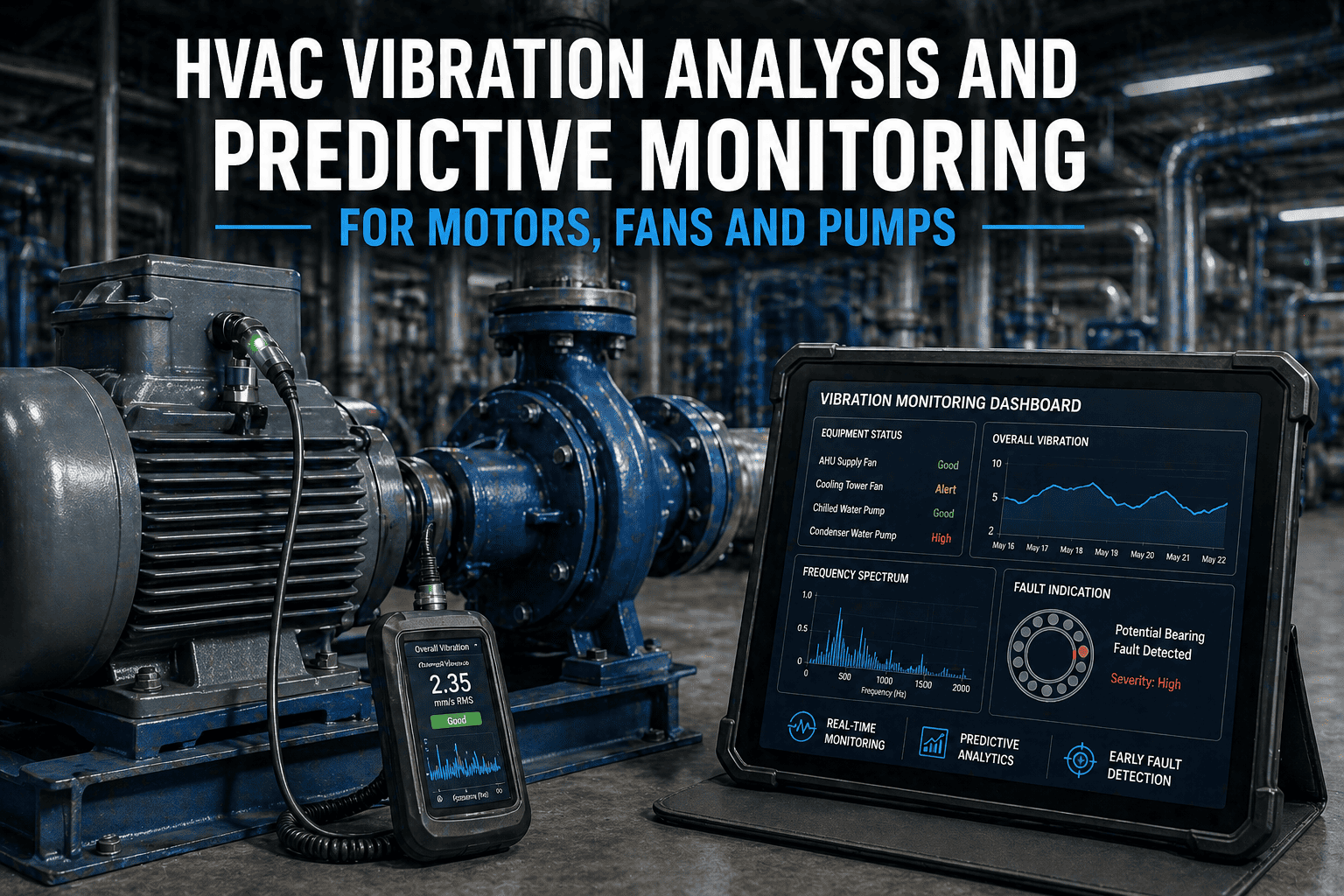
A fan bearing doesn't fail overnight — it sings at an ultrasonic pitch for months, then shows a defect frequency, then harmonics, then it seizes. Vibration monitoring reads that story early, while there's still time to plan the repair. This article covers HVAC vibration monitoring for fans and motors — the fault signatures, the ISO zones, the warning window — and how OXMAINT AI, the AI-powered predictive-maintenance CMMS, turns a rising trend into a diagnostic work order.
Predictive Maintenance · HVAC · Fan & Motor Vibration · 2026
HVAC Vibration Monitoring: Fans, Motors & Predictive Maintenance
A rising 1× peak, a bearing frequency creeping up, an overall level drifting toward the ISO limit — each is a fault announcing itself months before failure. OXMAINT AI, the AI-powered CMMS and maintenance management software, trends every reading against the asset's baseline, reads the fault from the spectrum, and raises a diagnostic work order while there's still a window to plan.
1Measure
→
2Diagnose signature
→
3Trend to zone
→
4Work order
ISO 10816-3 SEVERITY (mm/s RMS)
A<1.8
B<4.5
C<7.1
D>7.1
Group 2, 15–75 kW — verify against the standard
1× & 2×
imbalance and misalignment signatures
4 freqs
BPFO / BPFI / BSF / FTF bearing defects
2–6 mo
warning window at the intervention stage
4 zones
ISO 10816-3 severity, A through D
Reading The Spectrum: What Each Fault Looks Like
Vibration is diagnostic because each fault lands at a predictable place in the frequency spectrum. The peak's location, its harmonics and its phase tell you which problem you have — not just that something is wrong. You can book a demo to see fault-signature identification in OXMAINT AI.
1× RPM
Imbalance
Dominant 1× peak, radial. From fan-blade fouling, erosion, ice build-up or uneven impeller deposits.
2× RPM
Misalignment
Dominant 2× peak, axial over half of radial, 180° phase shift across the coupling. From coupling misalignment or thermal growth.
1×,2×,3×…
Looseness
Many harmonics with erratic amplitude, sometimes ½× or ⅓× sub-harmonics. From loose mounts, soft foot or a worn housing bore.
Non-sync
Bearing defect
Non-synchronous peaks at BPFO/BPFI/BSF/FTF. BPFI carries ±1× sidebands; BSF is often 2× dominant.
Belt freq
Belt / sheave
Peak at the belt frequency with harmonics when the belt is worn or loaded. From wear, tension loss or sheave wear.
Blade×RPM
Blade pass
Peak at blade count × RPM. An elevated blade-pass frequency points to uneven blade loading or a flow restriction.
How Severe Is It? The ISO Zones
Once you know the fault, overall velocity in mm/s RMS tells you how urgent it is. ISO 10816-3 sorts readings into four zones from new-condition to shut-down, and the zone sets the response. The bands below are for a common motor group — always confirm against the standard for your machine — and you can start free and set zone alarms in OXMAINT AI.
Zone A
< 1.8 mm/s
New or freshly commissioned — the baseline you want to hold.
Zone B
< 4.5 mm/s
Acceptable for unrestricted long-term operation.
Zone C
< 7.1 mm/s
Investigate — not suitable for continuous operation; plan the repair.
Zone D
> 7.1 mm/s
Immediate action — vibration severe enough to damage the machine.
Decoding A Bearing Fault
Bearings are the most common and most diagnosable fan-and-motor failure, because each defect rings at a frequency set by the bearing's geometry. Match the spectrum peak to the calculated frequency and you know which race or element is going.
| Defect | Signature | Likely cause | Typical action |
| BPFO — outer race |
Peak at the outer-race defect frequency, no sidebands |
Misalignment, overloading, shaft deflection |
Schedule repair within a few weeks |
| BPFI — inner race |
Inner-race frequency with ±1× RPM sidebands |
Fretting from a loose fit, electrical discharge |
Plan replacement; advancing fault |
| BSF — rolling element |
Ball-spin peak, often modulated by cage frequency |
Contamination, inadequate lubrication |
Re-lubricate, re-scan, plan replacement |
| FTF — cage |
Sidebands around defect peaks at the cage frequency |
Impact loading, improper mounting |
Increase monitoring to weekly |
Confirm each peak against the bearing's calculated geometry to rule out looseness or electrical noise. Scroll sideways on mobile.
The Bearing Warned For Months. The Spectrum Was Listening.
A failing bearing passes through ultrasonic emission, then low-amplitude defect frequencies, then clear harmonics — a window of months, not hours. Trend the spectrum and that window becomes a planned swap; ignore it and it becomes a 2 a.m. fan failure.
The Four Stages Of Bearing Failure
A bearing degrades through recognizable stages, and the whole point of monitoring is to act in the window where there's still warning — Stage III — rather than at Stage IV, when the only option is shutdown.
I
Ultrasonic
Emission at ~30–50 kHz, not yet visible in a standard spectrum. The earliest whisper.
→
II
Defect appears
Defect frequencies emerge at low amplitude. Fault now identifiable in the FFT.
→
III
Clear harmonics
Strong fault frequencies with harmonics; overall level in Zone B/C. The intervention window — about 2–6 months.
→
IV
Broadband
Discrete peaks dissolve into a broadband floor. Immediate shutdown — failure is imminent.
Why Trend Beats A Fixed Threshold
A single reading under the limit looks fine; four readings climbing toward it are a failure in progress. The power of monitoring is the trend against the asset's own baseline — which is why separate, unlinked readings hide exactly the signal you need, and you can book a demo to see baseline trending in OXMAINT AI.
OVERALL VIBRATION, FOUR MONTHLY READINGS (mm/s RMS)
1.2M1
1.9M2
2.8M3
3.8M4
Zone B limit 4.5
Still "within limits" at 3.8 — but the slope says it crosses soon. Four separate work orders would never show this; one trended asset does.
From Reading To Diagnostic Work Order
Monitoring pays off only when the signal becomes an action with a diagnosis attached. OXMAINT AI stores each reading against the asset, compares it to the baseline, and raises a work order that names the fault, not just the number, and you can start free and connect your fans and motors in OXMAINT AI.
◉
Per-Asset Baselines
Each reading stored against the asset with timestamp, RPM and analyst, trended on its own baseline.
◉
FFT Signature ID
The spectrum is matched to a fault — imbalance, misalignment, looseness, bearing — not just an overall level.
◉
Trend-Based Alerts
Work orders fire on the rate of change into Stage II or III, not only when a fixed threshold is crossed.
◉
Diagnostic Work Orders
Each order carries the fault type, a recommendation and the parts to bring — and can reserve the spare.
◉
Route & Sensor Data
Handheld routes or wireless sensors on drive-end and non-drive-end housings, in a consistent point and direction.
◉
Airside Asset History
Vibration sits with bearing, belt and alignment PMs on one fan or motor record for the full picture.
“
We ran fans to failure because our vibration readings lived in disconnected spot checks — each one looked fine on its own. Trending every reading on the asset's baseline and letting the rate of change raise the order changed the game: a supply fan bearing showed clear inner-race sidebands climbing through Zone B, we planned the swap on a weekend, and never took the unplanned hit. We fix on the trend now, not the breakdown.
Reliability Lead · Commercial HVAC Operations
Frequently Asked Questions
What faults can HVAC vibration monitoring detect?
The common fan and motor faults all have distinct signatures: imbalance (dominant 1× RPM), misalignment (2× RPM, high axial, 180° phase shift), mechanical looseness (many harmonics, sometimes sub-harmonics), bearing defects (non-synchronous BPFO/BPFI/BSF/FTF peaks), and belt or blade-pass issues. The spectrum identifies which, not just that something is wrong.
Book a demo to see fault identification in OXMAINT AI.
What are the ISO 10816 vibration severity zones?
Overall velocity in mm/s RMS sorts into four zones: A (roughly under 1.8) is new condition, B (under 4.5) is acceptable for long-term running, C (under 7.1) means investigate and plan a repair, and D (above 7.1) calls for immediate action. Exact bands depend on machine group and size, so confirm against the standard for your equipment.
How early can a bearing fault be caught?
Quite early. A bearing passes through four stages — ultrasonic emission around 30–50 kHz, then low-amplitude defect frequencies, then clear fault frequencies with harmonics (the intervention window, about 2–6 months of warning), then a broadband floor that demands shutdown. Monitoring aims to act in the third stage, with time to plan.
Why trend readings instead of using a fixed alarm?
Because a reading below the limit can still be a failure in progress. Four monthly readings of 1.2, 1.9, 2.8 and 3.8 mm/s are all under a 4.5 Zone B limit, yet the slope says it crosses soon. Trending against the asset's baseline catches that; separate, unlinked readings hide it.
How does a CMMS use vibration data?
It stores each reading against the asset with RPM and timestamp, compares it to the baseline, and when the rate of change indicates an advancing fault it raises a prioritized work order naming the fault type, a recommendation and the parts to bring — and can reserve the spare and notify the technician. The reading becomes a diagnosis, not just a number.
Start free and automate vibration PdM in OXMAINT AI.
Hear The Fault Months Before The Failure.
Run HVAC vibration monitoring on the OXMAINT AI maintenance management software — FFT fault-signature identification, ISO 10816 zone alarms, per-asset baselines and trend-based alerts, and diagnostic work orders that name the fault and reserve the part. Catch imbalance, misalignment and bearing wear while there's still a window to plan.