HVAC BAS Trend Analysis for Predictive Maintenance
By Willam Jerry on October 10, 2026
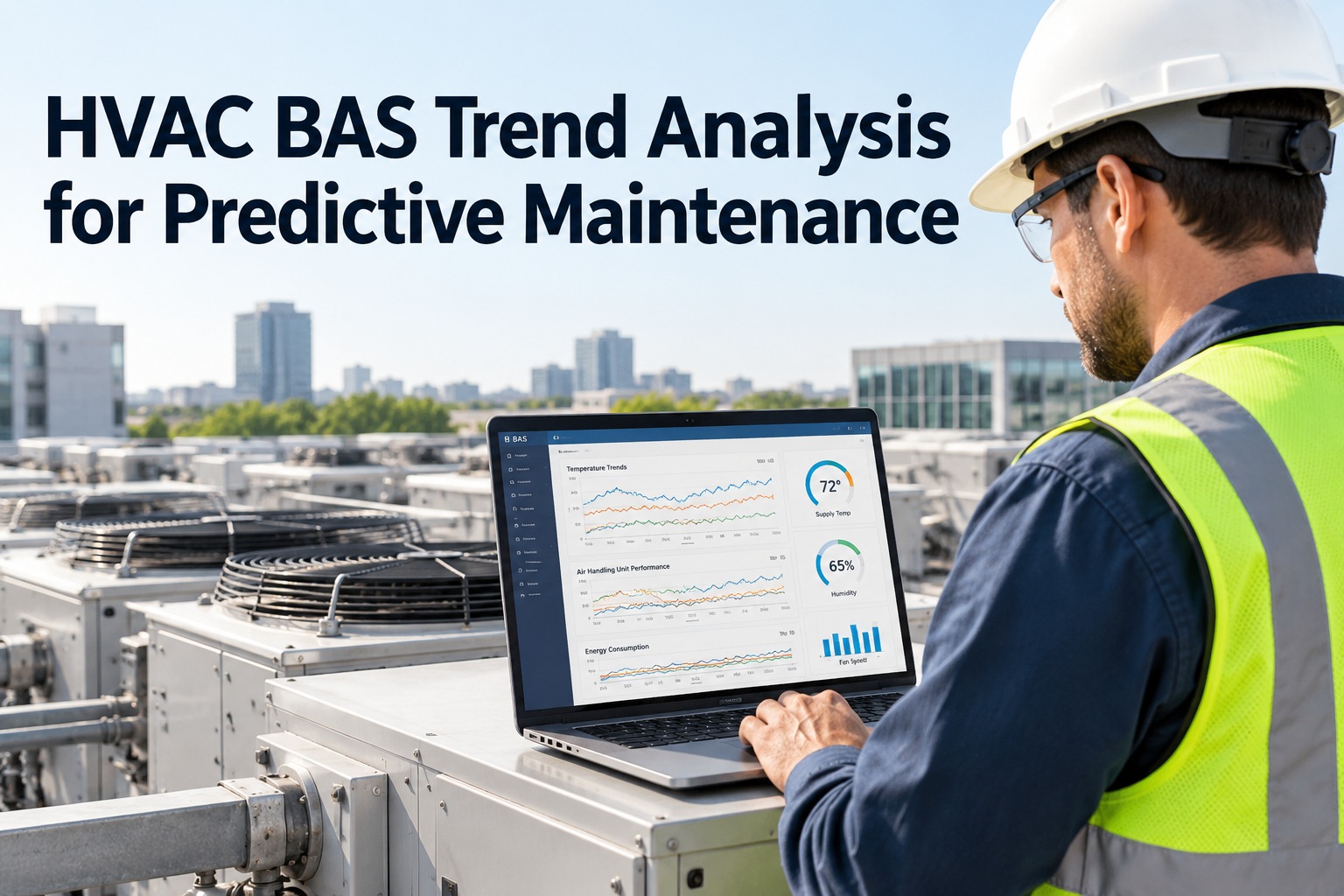
A building automation system (BAS) records thousands of data points every day: supply air temperatures, valve positions, fan speeds, pressures, runtimes. Most of it is stored and never looked at again. Alarms catch the obvious failures. Trends catch the slow ones: the valve that works a little harder each month, the sensor that drifts, the compressor that starts and stops too often. HVAC BAS trend analysis turns that stored data into early warnings, and a maintenance workflow turns the warnings into work. This guide shows six trend patterns worth recognising, which points to trend, how to trust the data and how to act on what you see, using OXMAINT AI, the AI-powered CMMS for facility and HVAC maintenance teams.
HVAC · BAS Trend Analysis · Predictive Maintenance
HVAC BAS Trend Analysis for Predictive Maintenance.
A trend nobody reviews is just stored data. OXMAINT AI connects the workflow in one CMMS: BAS trends, inspections and comfort requests raise issues, issues become work orders on the right asset, repairs are recorded in its history, and preventive and predictive maintenance are planned from what the data keeps showing.
A limit was crossed. Occupants may already be uncomfortable. The question is how fast to respond.
vs
THE TREND VIEW
"Valve command up, temperature barely moving."
Performance is slipping before any limit is crossed. The question is what to check, and when.
Six Trend Shapes Worth Recognising
Learn to spot these six shapes and most of your BAS trends start to tell a story. Each shape suggests where to look first. It does not prove a cause, so confirm on site before you repair. Book a demo to see trend-driven work orders.
1 · Slow drift
Can mean: sensor drift, fouling coils, a valve or damper losing authority.
Look first: compare with a reference reading and inspect the actuator.
2 · Hunting
Can mean: poor loop tuning, a sticky or oversized valve or damper, unstable control.
Look first: actuator movement, control settings and mechanical play.
3 · Flatline
Can mean: a failed or disconnected sensor, a frozen point or lost communication.
Look first: the point's status, wiring and network connection.
4 · Sudden step
Can mean: a component failure, a changed setpoint, a replaced sensor or a manual override.
Look first: what changed on that date: work orders, overrides, schedules.
5 · Short cycling
Can mean: oversized equipment, control issues, low load or protection trips.
Look first: start counts, runtimes and safety or limit controls.
6 · Rising effort
Can mean: more fan speed, pump power or valve travel needed for the same result.
Look first: filters, coils, strainers, belts and bearings.
Illustrative shapes. They are not real data, and real trends need context such as weather and occupancy.
Which Points to Trend on Common HVAC Equipment
You do not need to trend everything. Pick a few points per asset that show whether the equipment is doing its job. These are examples, so adjust them to your system and design. Start free and register the assets behind your points.
Equipment
Points worth trending
What the trend can show
Air handling unit
Supply and return air temperature, valve and damper positions, fan speed, filter pressure drop
Coil fouling, valve or damper faults, filter loading
Chiller
Chilled water supply and return temperature, runtime, load, start count
Capacity loss, short cycling, rising effort
Boiler
Supply and return water temperature, firing rate, cycling
Poor modulation, scaling, short cycling
VAV box
Zone temperature, damper position, airflow against setpoint
Stuck dampers, sensor faults, unbalanced zones
Pump
Speed, differential pressure, runtime, motor current if available
Wear, blockage, control instability
Give Every Trend an Owner and a Next Step.
Connect BAS data to assets, work orders and PM in OXMAINT AI, so a drifting valve becomes a planned job, not a surprise.
A trend is only as good as the data behind it. Four checks catch most problems before they send a technician on a false trip. Book a demo to review your data readiness.
1
Sampling interval
Fast enough to catch the behaviour you care about. Slow logging can hide short cycling.
2
Sensor health
Confirm key sensors against a reference reading before acting on small drifts.
3
Naming & units
Points are mapped to the right asset, with consistent names and units.
4
Time & context
Clocks agree, and trends are read alongside weather, occupancy and schedules.
A trend departs from its baseline or from similar equipment.
→
2
Rule out data
Check sensor, schedule, override and season before blaming equipment.
→
3
Raise the job
Create a work order with the trend attached and a clear priority.
→
4
Fix & record
Repair, note the cause and attach photos and parts used.
→
5
Verify
Check that the trend returns to normal, then update PM tasks.
Set Baselines That Respect Seasons and Occupancy
A chiller working hard in July is not a fault. The same behaviour in January might be. Compare like with like, and let the context shape the threshold. Book a demo to discuss baselines for your sites.
Compare to itself
Today against the same asset on a similar day or season.
Compare to peers
One VAV box or AHU against similar units serving similar spaces.
Compare to design
Actual values against commissioning data or the design intent.
Filter out noise
Use a sustained-duration rule so brief spikes do not create jobs.
How OXMAINT AI Turns BAS Trends Into Maintenance Action
OXMAINT AI reads building data over standard protocols such as BACnet and Modbus, and connects it to assets, work orders and PM in one mobile-first CMMS. Have your controls and IT teams review access and security before connecting. Start free and add your first HVAC assets.
BACnet & Modbus Connectivity
Read points from BAS and controllers over standard building protocols and APIs.
Rules & Thresholds
Use thresholds with sustained-duration filters so fewer false alerts become jobs.
Work Order Management
Create asset-tagged jobs with history and context ready for the technician.
Preventive Maintenance
Schedule recurring checks and tune them from what trends keep revealing.
Predictive & AI Tools
Use AI-assisted detection and the AI Assistant to surface developing issues for review.
Asset History & Reporting
Compare trends with repair history and spot repeat faults across the portfolio.
HVAC equipment is in an asset register with clear IDs
Each critical asset has an owner or responsible team
Common fault responses have task templates
Someone reviews trends on a regular schedule
BAS & Data Governance
Priority points are listed and mapped to assets
Sampling intervals suit the faults you want to catch
Controls and IT teams approve access and security
Someone owns rule tuning after go-live
Frequently Asked Questions
What is HVAC BAS trend analysis?
It is the review of logged building automation data over time, such as temperatures, valve positions and runtimes, to spot developing problems before they become failures. Sign up free and explore OXMAINT AI.
How is trend analysis different from BAS alarms?
Alarms report that a limit has been crossed. Trends show the movement toward a limit, which can give maintenance more time to plan. They work best together. Book a demo to see both in one workflow.
Do we need new sensors to start?
Not necessarily. Many buildings already log useful points. Start with what exists, check its quality and add sensors only where a critical asset has no useful data. Start free and map your existing points.
Will connecting a CMMS change our BAS programming?
The goal is to read data and route it into maintenance without altering control logic, but your controls team should confirm the approach, access and security for your site. Book a demo to discuss it.
How do we avoid too many false alerts?
Trend only meaningful points, compare against season and peers, use sustained-duration rules and review the first alerts with the people who will act on them. Sign up free and design your rules.
Read the Trend Early. Fix It Planned.
Bring BAS data, inspections, work orders and PM scheduling together in OXMAINT AI, and give every HVAC asset a clear next step.