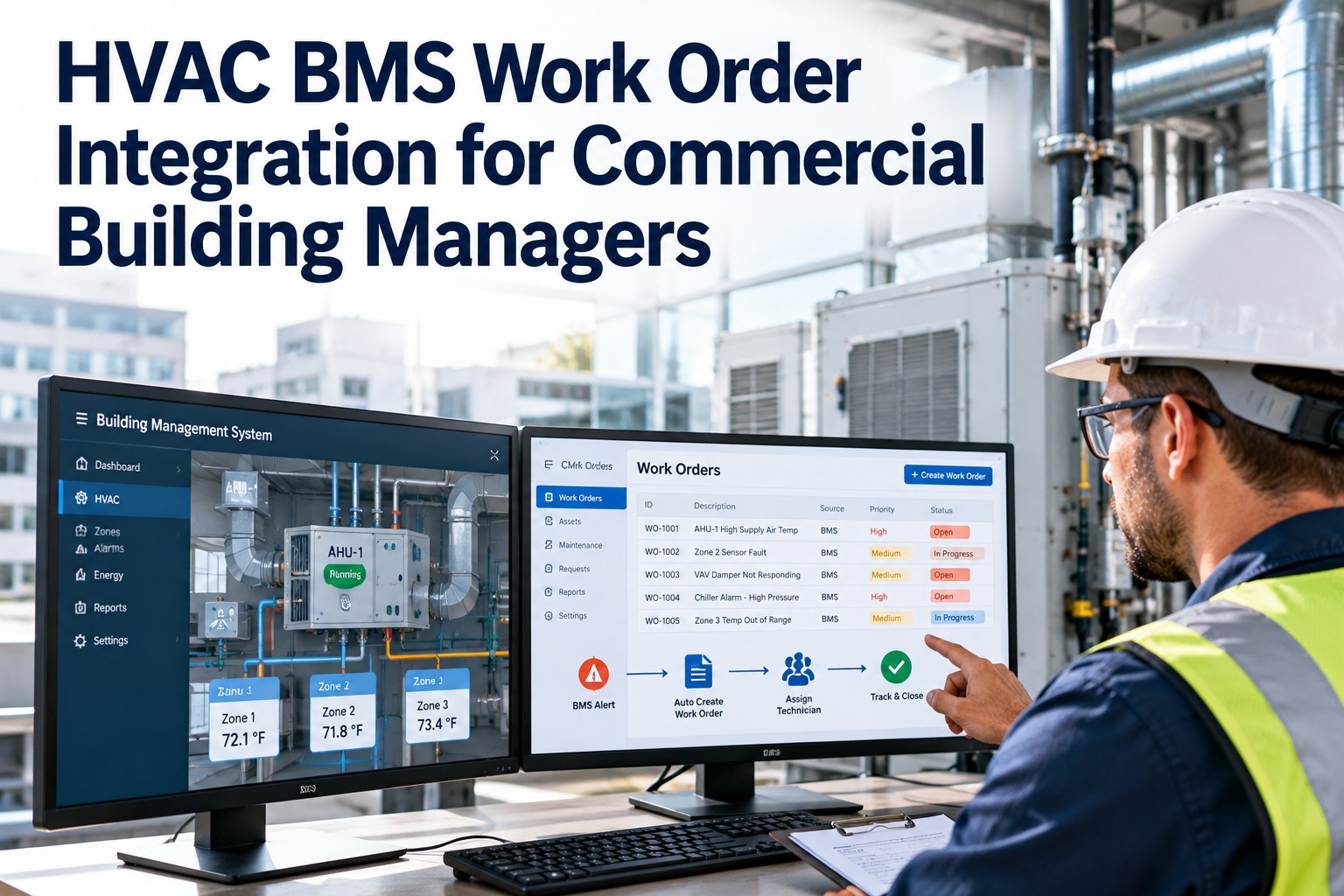
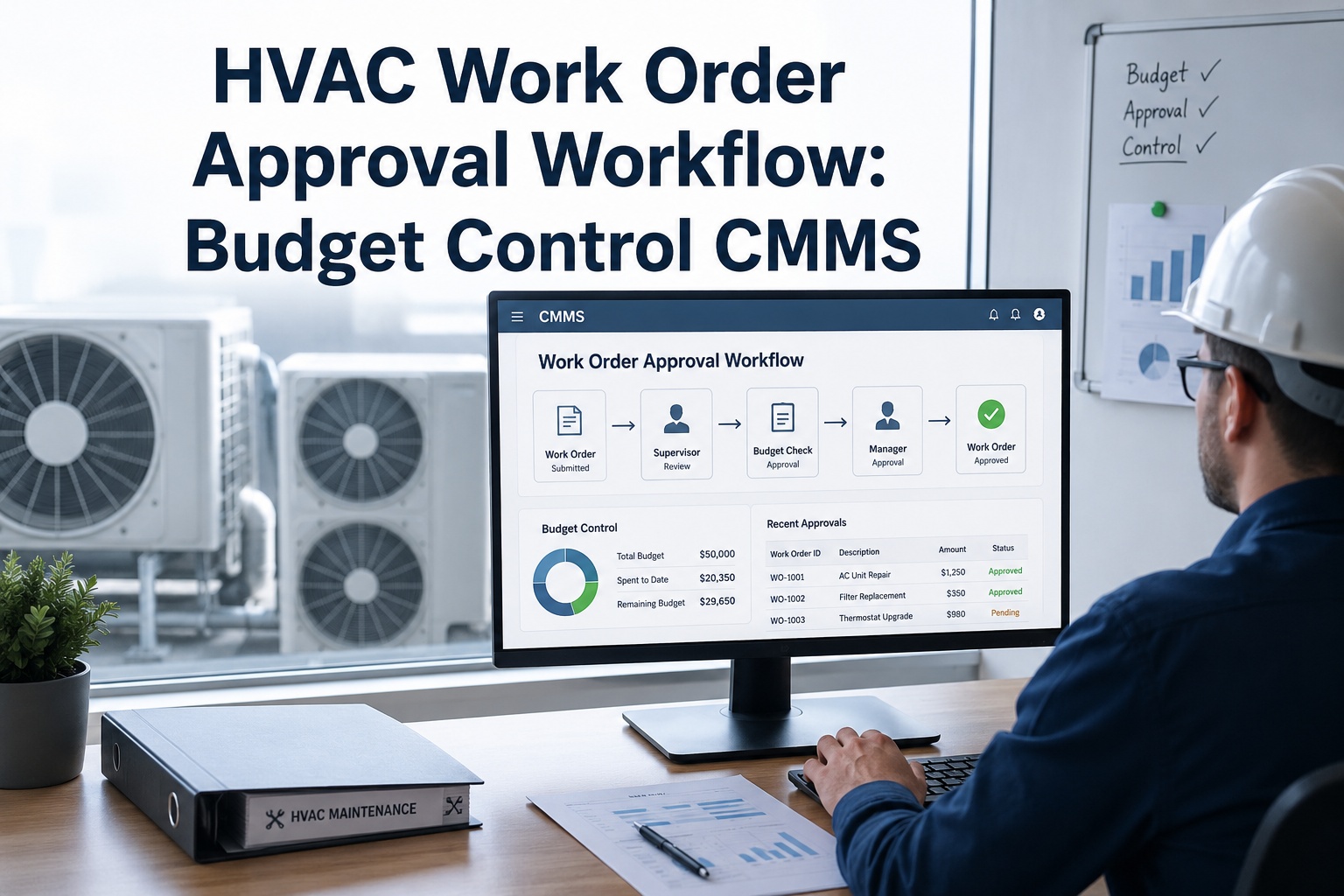
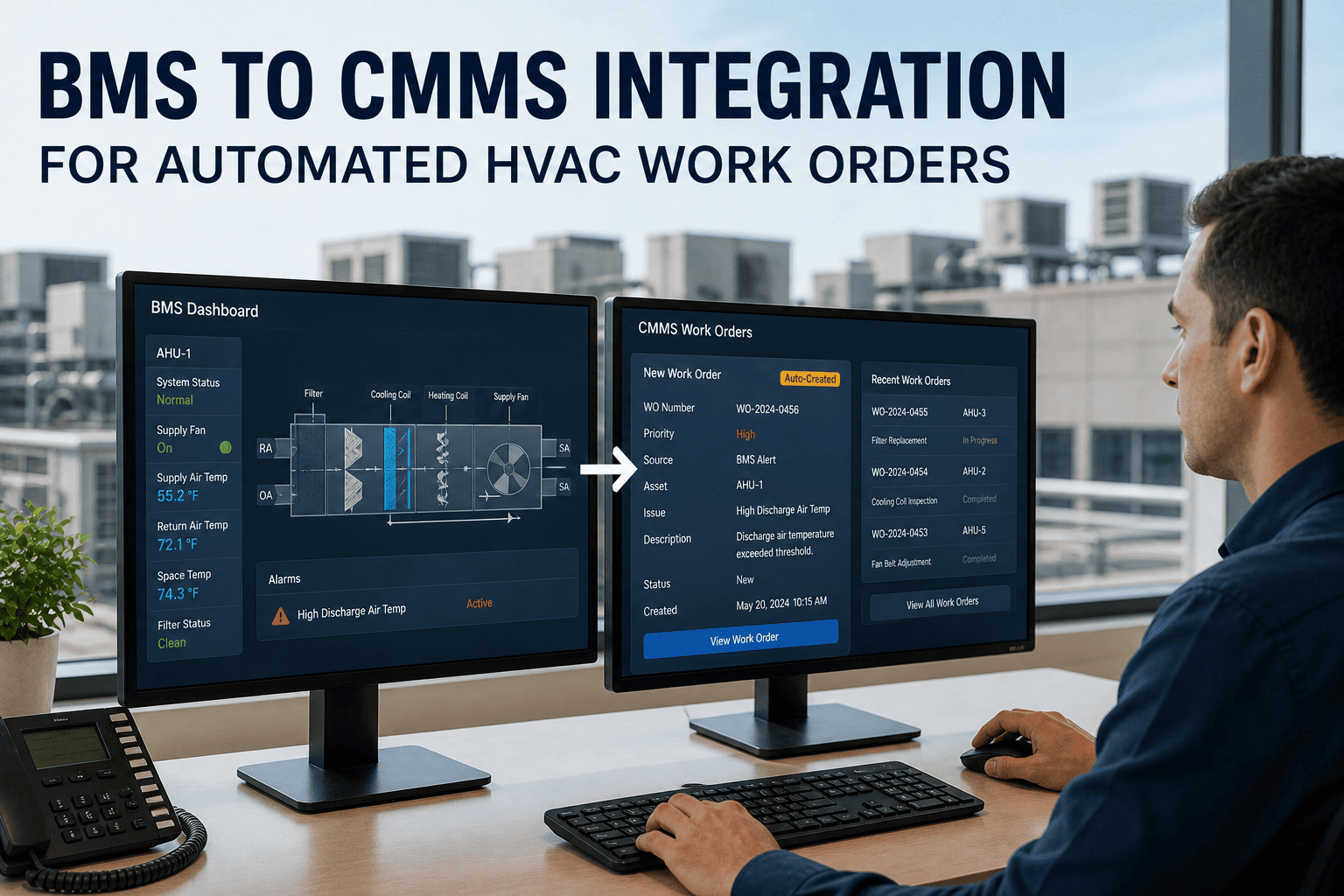
Your maintenance team just received three HVAC work orders at 9 AM. One is a compressor failure in the server room. Another is a thermostat complaint from the third floor. The third is a routine filter change that's two weeks overdue. Which one gets handled first? How quickly? By whom? And will the other two fall through the cracks by end of day? If you hesitated answering any of those questions, your work order process has gaps—and those gaps are costing you money. U.S. facilities lose approximately $50 billion annually to unplanned downtime, and about 80% of maintenance managers still rely heavily on reactive approaches. The difference between facilities that control HVAC costs and those that hemorrhage them almost always traces back to one thing: how well they manage work orders.
62%
More requests completed daily with digital work order systems vs. manual
4 wks
Average maintenance backlog in facilities without structured work order management
3-5x
More expensive: reactive repairs vs. planned maintenance from proper work orders
Why HVAC Work Order Management Matters
An HVAC work order isn't just a task slip—it's the single source of truth for what happened, when, why, and by whom. Without standardized work order management, critical requests get lost in email threads, verbal handoffs, or sticky notes on a maintenance manager's desk. Technicians show up to jobs without the right parts. Repeat failures never get root-cause analysis because there's no documented history. And when an auditor asks for proof of maintenance compliance, the best you can offer is a guess.
Facilities that sign up for structured HVAC work order platforms see measurable improvements immediately: faster response times, fewer missed requests, and a complete audit trail for every piece of equipment. The Department of Energy estimates that comprehensive planned maintenance programs—built on solid work order processes—reduce total maintenance costs by 50% compared to reactive approaches. That's not an incremental improvement. That's cutting your maintenance spend in half.
The HVAC Work Order Lifecycle: 6 Stages Done Right
Every HVAC work order should move through a clear, trackable lifecycle. When any stage is skipped or poorly executed, the entire process breaks down—leading to delayed repairs, wasted labor, and recurring failures. Here's what each stage looks like when it's done right.
1
Request Submitted
Staff submits standardized request with asset ID, location, symptom description, and urgency level
Use a single digital channel—eliminates duplicate requests and ensures nothing gets lost
2
Review & Prioritize
Request admin evaluates urgency, checks asset history, assigns priority tier (Emergency / High / Medium / Low)
Reviewing within 24 hours keeps backlog manageable and requesters informed
3
Assign & Schedule
Match technician by skill set, availability, and proximity; schedule based on priority and production windows
Auto-assignment eliminates manual delegation delays and balances workload
4
Execute & Document
Technician accesses asset history, follows checklist, records parts used, labor time, and findings with photos
Mobile access to job details eliminates return trips for missing information
5
Verify & Close
Supervisor confirms completion, requester verifies resolution, work order closed with full documentation
Proper closure ensures accurate records for compliance audits and warranty claims
6
Analyze & Improve
Track KPIs—response time, completion rate, cost per work order—to identify patterns and prevent recurrence
Data from closed work orders drives smarter preventive maintenance schedules
Prioritizing HVAC Work Orders: The Decision Matrix
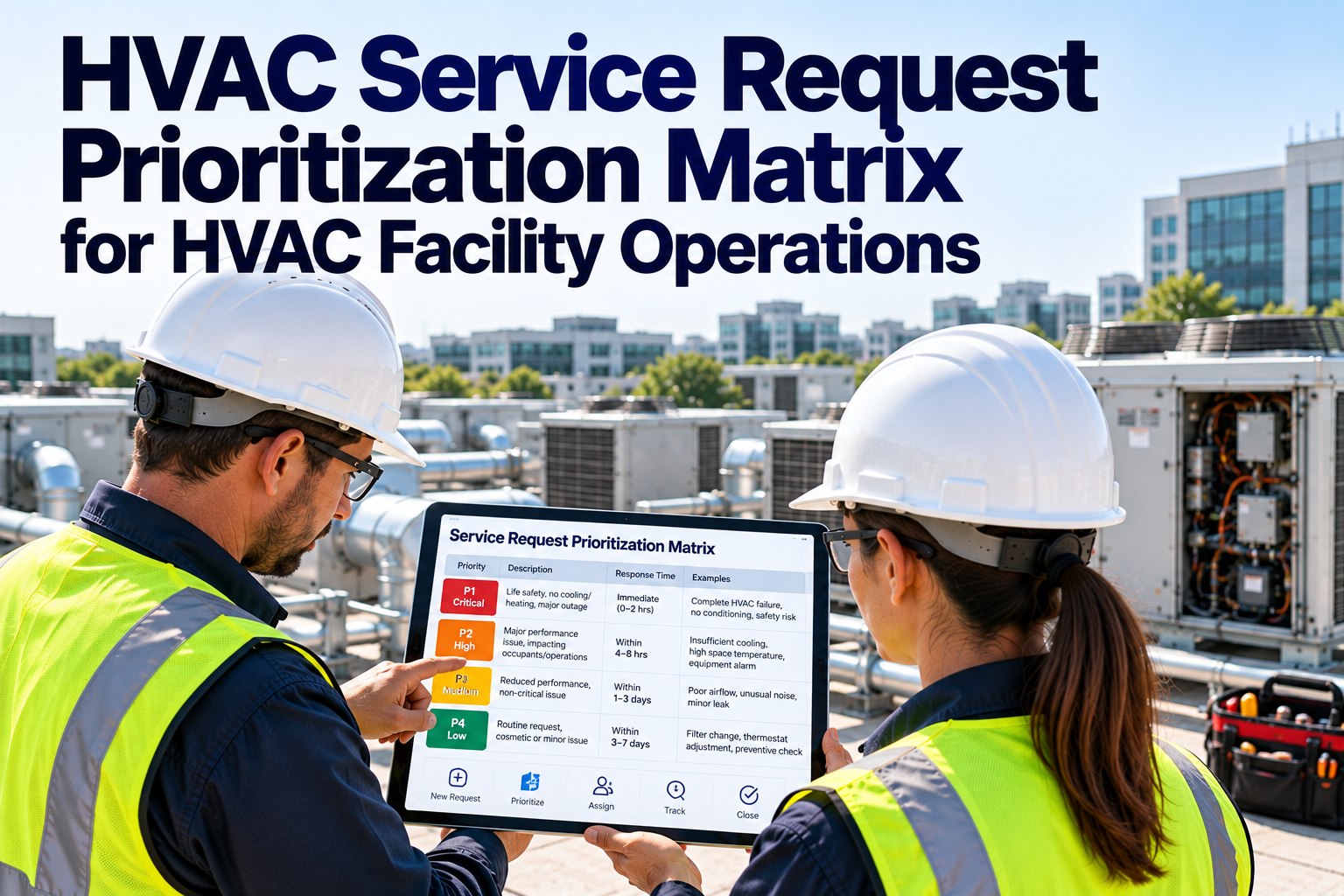
Not all HVAC issues carry the same weight. A compressor failure in a data center is fundamentally different from a squeaky fan in a storage room—yet without a clear prioritization framework, both sit in the same queue. The facilities that resolve issues fastest aren't necessarily the ones with the most technicians. They're the ones that route every work order through a priority matrix that accounts for safety risk, operational impact, and asset criticality.
Response: Immediate
Gas leak, refrigerant release, total system failure in critical zone, safety hazard
Response: Within 4 Hours
Compressor failure, no cooling in occupied space, broken thermostat in server room
Response: Within 24 Hours
Partial cooling loss, unusual noise, minor leak, overdue preventive maintenance
Response: Scheduled
Cosmetic issues, non-urgent filter change, thermostat label replacement, painting
The 80/20 rule applies directly: experts recommend that 80% of maintenance activities should be proactive (planned work orders) while only 20% should be reactive. Facilities that book a demo to see automated priority routing can see how work orders automatically escalate based on asset criticality, zone occupancy, and failure history—removing guesswork from the triage process entirely.
From Paper to Platform: The Before and After
The contrast between manual and digital work order management isn't subtle—it's dramatic. Facilities still running on paper forms, spreadsheets, or email chains are operating with structural inefficiency baked into every maintenance interaction. Here's what changes when you move to a CMMS platform.
Swipe to compare all columns
Sources: FMX, Siemens 2024 True Cost of Downtime Report
The 62% improvement in daily work order completion alone justifies the shift. But the real value compounds over time: every closed work order with proper documentation becomes a data point that makes your next maintenance decision smarter. Teams that sign up to digitize their HVAC work orders stop losing information and start building the equipment intelligence that prevents failures before they happen.
See What Structured Work Orders Look Like
Watch how HVAC work orders flow from request to resolution—automatically prioritized, assigned, tracked, and documented in one platform.
KPIs That Tell You If Your Work Orders Are Working
You can't improve what you don't measure. The facilities with the strongest HVAC performance track a handful of work order KPIs that reveal whether their process is tightening or slipping. These aren't vanity metrics—each one connects directly to cost, uptime, and team productivity.
Avg Response Time
Target: Under 4 hours
Measures speed from request creation to work start. Long response times signal staffing or routing issues.
On-Time Completion Rate
Target: 90%+
Percentage of work orders completed within scheduled timeframe. Below 80% indicates backlog or resource problems.
Maintenance Backlog
Target: Under 2 weeks
Total pending work hours. Over 4 weeks signals understaffing; under 1 week may indicate overstaffing.
Planned vs. Reactive Ratio
Target: 80/20
Proportion of planned work orders to emergency requests. Below 60% planned means your process is reactive-dominant.
Tracking these KPIs isn't a reporting exercise—it's the feedback loop that tells you whether your work order process is actually reducing costs and downtime or just generating paperwork. Facilities that sign up for real-time maintenance analytics can monitor these metrics on a live dashboard, catching process breakdowns before they become systemic problems.
Expert Perspective: What Separates Good Work Order Management from Great
The biggest mistake facility teams make with work orders isn't technical—it's behavioral. They treat work orders as task lists instead of intelligence assets. Every completed work order should answer three questions: what failed, why it failed, and what would prevent it from failing again. When you build that discipline into your process, your work orders stop being reactive paperwork and start becoming the foundation of a predictive maintenance program. The data is already flowing through your operations. The question is whether you're capturing it.
Standardize the Request
Every work order should capture asset ID, location, symptom, urgency, and requester contact. Incomplete requests create return trips, rework, and delays.
Close the Loop Every Time
A work order that's "done" but not documented is worse than one that's pending. Proper closure with root cause, parts used, and labor time builds the maintenance intelligence you need.
Let the Data Drive Scheduling
If the same rooftop unit generates 3 emergency work orders in 6 months, your preventive schedule for that asset is wrong. Use work order history to recalibrate intervals.
The facilities succeeding with HVAC maintenance share a common trait: they've connected their work order process to a CMMS that automates the lifecycle from request to analysis. They're not chasing paper trails—they're receiving prioritized, assigned, and tracked work orders on mobile devices. If you're ready to see this in your operation, book a free demo to watch the complete work order workflow.
Stop Losing Work Orders. Start Closing Them.
Join facilities using OXmaint to automate HVAC work orders from request to resolution. Every task prioritized, every technician notified, every repair documented.
Frequently Asked Questions
What should an HVAC work order include?
A complete HVAC work order should include the asset ID and location, a clear description of the issue or requested service, priority level, assigned technician, scheduled date, required parts or materials, and any relevant asset history. Upon completion, the work order should document labor hours, parts used, root cause findings, and photos when applicable. This documentation creates the maintenance record that supports compliance audits, warranty claims, and data-driven scheduling decisions.
How should HVAC work orders be prioritized?
HVAC work orders should be prioritized based on safety risk, operational impact, and asset criticality. Emergency work orders involving gas leaks, refrigerant releases, or total system failures in critical zones require immediate response. High-priority orders like compressor failures in occupied spaces should be addressed within 4 hours. Medium-priority items such as partial cooling loss or overdue preventive maintenance should be resolved within 24 hours. Low-priority requests can be scheduled during planned maintenance windows. The recommended ratio is 80% proactive to 20% reactive work orders.
How does a CMMS improve HVAC work order management?
A CMMS automates the entire work order lifecycle: standardized request submission through digital forms, automatic priority assignment based on rules, technician routing by skill and availability, mobile access to job details and asset history, and automatic documentation upon completion. Facilities using CMMS software complete 62% more maintenance requests per day than those using manual methods. The system also tracks KPIs like response time, completion rate, and maintenance backlog—providing the visibility needed to continuously improve the process.
What KPIs should I track for HVAC work order performance?
The four essential KPIs are: average response time (target under 4 hours from request to work start), on-time completion rate (target 90%+), maintenance backlog (target under 2 weeks of pending work), and planned-to-reactive ratio (target 80/20). Tracking these metrics reveals whether your process is reducing downtime and costs or simply generating activity. A growing backlog or declining completion rate signals resource or process issues that need immediate attention.
What's the cost difference between reactive and planned HVAC work orders?
Reactive HVAC maintenance costs 3-5 times more than planned work orders when accounting for emergency labor rates, expedited parts, production losses, and cascading equipment damage. The Department of Energy estimates that comprehensive planned maintenance programs reduce total maintenance costs by 50% compared to reactive approaches. Emergency HVAC repairs alone cost 50-100% more than standard service calls. For every dollar invested in preventive maintenance supported by proper work orders, facilities can expect more than a 545% return on investment.