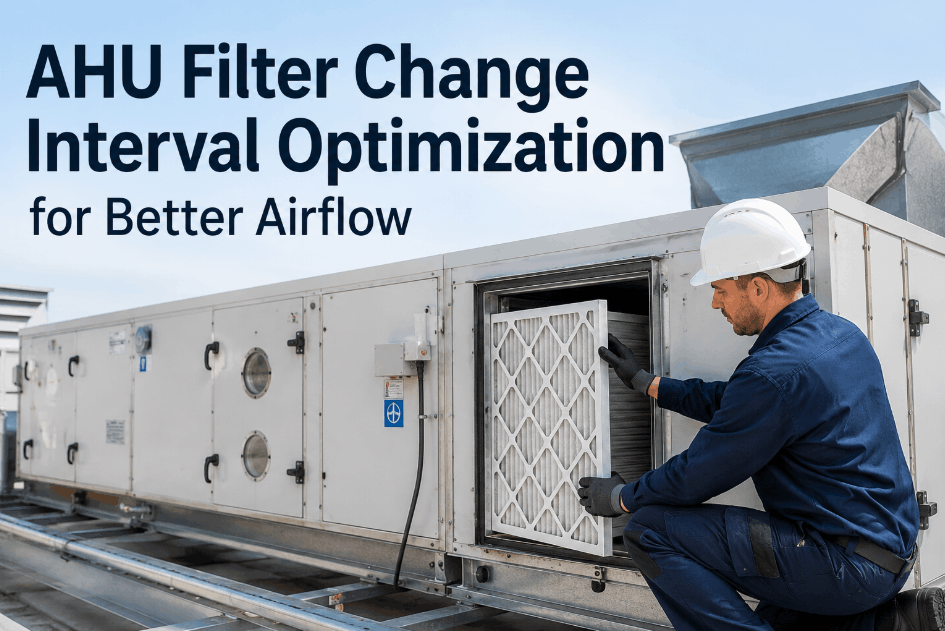
Filter replacement in school HVAC systems is one of the most routinely mismanaged maintenance tasks in K-12 and higher education facilities — not because teams lack intent, but because change intervals are set by calendar rather than by actual filter condition. A multi-building school district operating central air handling units across several campuses found itself replacing filters too early on some units and too late on others, with no pressure drop data to guide decisions. Labor costs were higher than necessary, indoor air quality was inconsistent across classrooms, and airflow performance was suffering on units where clogged filters had gone undetected past their useful life. If your school facility is managing filter replacement on fixed schedules without pressure monitoring to guide actual change intervals, Sign Up Free to see how Oxmaint structures preventive maintenance for education facilities — or Book a Demo with a facility maintenance specialist.
Filter Life · Pressure Drop · Change Intervals · Indoor Air Quality
Stop Replacing School Filters on a Calendar and Start Replacing Them When the Data Says It's Time
Preventive maintenance scheduling, pressure monitoring records, asset-level filter tracking, change interval optimization, and airflow performance history — Oxmaint helps school facility teams extend filter life and reduce labor waste through condition-based decisions.
Facility Profile
The Operation: Multi-Campus School District With Calendar-Based Filter Management and Rising Maintenance Labor Costs
Facility Overview
IndustryK-12 education — multi-building district with centralized and rooftop air handling units
Scope6 school buildings, 34 air handling units, shared maintenance crew across campuses
Team8 facility technicians, 2 building supervisors, 1 district facilities coordinator
Prior SystemFixed 90-day calendar schedule, paper change logs, no pressure drop tracking per unit
Oxmaint FeaturesPreventive Maintenance · Asset-Level Filter Tracking · Pressure Reading Logs · Condition-Based Scheduling · Work Order Management · Inspection Checklists · Maintenance History · Technician Assignment
Baseline Pressure Points
38%
Of filters replaced before reaching actual end-of-life — early replacement driven by fixed schedule rather than measured pressure drop
2.4×
Variability in actual filter life across units — identical schedules applied to units with very different load conditions and usage patterns
22%
Of units showing airflow degradation from filters left in service past recommended pressure drop thresholds on buildings with heavier occupancy
Root Cause Analysis
Why Filter Costs Stayed High and Airflow Stayed Inconsistent — Despite a Regular Maintenance Schedule
A review of filter change records, unit performance logs, and building occupancy data across all six campuses identified three gaps sustaining the cost and airflow problem. The district had maintenance capacity and intent — the failure was in measurement and decision logic. Every unit was treated identically regardless of how heavily it was used, what was circulating through the air in that building, or what pressure drop readings actually showed. Without per-unit pressure monitoring, the schedule was producing both waste and risk simultaneously. Sign Up Free to bring condition-based filter tracking to your school facility — or Book a Demo to see how Oxmaint manages asset-level PM scheduling for education environments.
41%
Fixed Intervals Applied Uniformly Across Units With Very Different Load Profiles
Gymnasium units, kitchen-adjacent handlers, and standard classroom units were all on identical 90-day schedules. High-load units accumulated pressure drop far faster, while low-traffic building units were replaced long before they needed to be — wasting materials and labor on both ends.
31%
No Pressure Drop Data Captured Per Unit — Decisions Made Without Condition Visibility
Technicians performed filter changes without recording pressure drop readings before or after replacement. There was no historical trend to identify which units were reaching threshold faster, making optimization impossible and leaving high-load units at risk of airflow degradation between scheduled visits.
18%
No Asset-Level Filter History — Repeat Issues at the Same Units Went Unidentified
Because filter records were kept on paper by date rather than by unit, there was no way to identify which specific air handlers were consuming filters at above-average rates. Units with persistent high-load conditions or duct issues were never flagged for investigation.
10%
Indoor Air Quality Complaints Not Linked to Maintenance Records — Root Cause Invisible
When classroom air quality complaints were logged, there was no structured way to link them to filter condition data or unit performance history. Complaints were resolved reactively without preventing recurrence, and problem units were not identified for adjusted monitoring frequency.
The Solution
How Oxmaint Helped the District Extend Filter Life and Reduce Labor Waste Through Pressure-Based Scheduling
The district deployed Oxmaint to replace paper logs and fixed-calendar scheduling with asset-level filter tracking and condition-driven PM intervals. Each air handling unit was set up as a distinct asset in Oxmaint, with filter type, location, and load category recorded. Technicians began capturing pressure drop readings at every inspection using structured checklists, creating a per-unit trend history for the first time. Change intervals were adjusted based on actual pressure data — high-load units received tighter monitoring windows while low-demand units were extended beyond the previous 90-day default. Indoor air quality complaints were linked to work orders on the relevant unit, enabling root cause visibility across the maintenance record. Book a Demo to see how condition-based filter management works across multi-building school portfolios.
01
Asset-Level Filter Tracking With Per-Unit Pressure Drop History
Every air handling unit was structured as a separate asset in Oxmaint. Filter inspections were tied directly to each unit record, and technicians recorded as-found pressure drop at every visit. For the first time, the district had a trend line per unit showing how quickly each handler was accumulating restriction — enabling meaningful interval decisions rather than uniform defaults.
02
Condition-Based PM Intervals Calibrated by Unit Load and Pressure Data
Inspection and change intervals were reconfigured in Oxmaint by unit category rather than a single district-wide schedule. High-load units in gyms and cafeteria-adjacent spaces were moved to shorter inspection cycles with pressure-triggered change thresholds. Lower-demand units in administrative areas were extended, reducing unnecessary replacement and associated labor visits.
03
Inspection Checklists Capturing Pressure Readings at Every Service Visit
Structured inspection checklists were built in Oxmaint requiring technicians to log pre- and post-change pressure drop, filter condition rating, and airflow observations at each unit. This created a documented, searchable maintenance record that replaced loose paper logs and enabled comparison across units and buildings over time.
04
Complaint-to-Work-Order Linking for Root Cause Identification by Unit
Indoor air quality complaints were entered as work orders in Oxmaint and linked to the specific air handling unit serving the affected area. The maintenance team could now compare complaint frequency against filter pressure history for each unit — identifying repeat offenders, adjusting monitoring for problem assets, and demonstrating response to building occupants through closed work order records.
Results at 90 Days
Filter Cost, Labor, and Indoor Air Quality Metrics Three Months After Deployment
29%
Reduction in total filter replacement cost — condition-based intervals eliminated premature changes on low-load units
34%
Reduction in filter-related labor visits — optimized scheduling removed unnecessary trips to units not yet at replacement threshold
100%
Of air handling units now tracked individually with pressure drop history — replacing a single district-wide calendar schedule
-71%
Reduction in units found past pressure drop threshold at inspection — high-load units now monitored at appropriate intervals
58%
Reduction in indoor air quality complaints linked to filter condition — proactive pressure monitoring prevented degraded airflow
2.6×
ROI on Oxmaint platform cost within 90 days from reduced material spend and recovered technician capacity
| Metric |
Before Oxmaint |
90 Days After |
Change |
| Filter replacement cost (annual basis) |
Calendar-driven, unoptimized |
29% reduction |
-29% |
| Labor visits for filter service |
Fixed 90-day uniform schedule |
34% reduction |
-34% |
| Units with individual pressure history |
0% — paper logs, no per-unit data |
100% tracked in Oxmaint |
+100% |
| Units found past pressure threshold |
22% at inspection |
Under 6% at inspection |
-71% |
| IAQ complaints linked to filter condition |
Reactive, unlinked to records |
58% reduction |
-58% |
| Change interval optimization |
Single 90-day blanket schedule |
Per-unit condition-based intervals |
Optimized |
Key Business Impact
What Pressure-Monitored Filter Management Means for School Facility Operations
"School facilities are running dozens of air handlers across multiple buildings, and every one of them behaves differently based on what's happening in that space. A gym unit and a storage room unit should not be on the same filter schedule — but without pressure drop data per unit, that's exactly what most districts do. The moment you start capturing readings at each asset and trending them over time, the schedule practically writes itself. High-load units get tighter windows, low-demand units get extended, and the team stops wasting time and materials on changes that weren't needed yet. Oxmaint gives districts the structure to make that shift without adding headcount or complexity — just better data, applied systematically."
Dana Reyes, K-12 Facility Operations and HVAC Maintenance Advisor
16 years education facility management · Former district facilities director, multi-campus K-12 operations · Specialist in preventive maintenance optimization, filter life management, and indoor air quality programs for school environments
Filter Tracking · Pressure Monitoring · PM Optimization · IAQ Management
Replace Fixed Filter Schedules With Pressure-Based Decisions Before Early Replacement Drains Your Maintenance Budget
Asset-level filter tracking, pressure drop logging, condition-based PM scheduling, inspection checklists, and complaint-to-work-order linking — Oxmaint gives school facility teams the data structure to extend filter life and protect indoor air quality across every campus.
FAQs
Frequently Asked Questions
How does Oxmaint support pressure-based filter management in school facilities?
Each air handling unit is tracked as a separate asset in Oxmaint. Technicians log pressure drop readings at every inspection using structured checklists, building a per-unit trend that drives condition-based change decisions rather than fixed calendar intervals.
Can Oxmaint manage different filter change intervals for different types of school buildings?
Yes. PM schedules in Oxmaint are configured per asset, not per building. High-load units like gym or cafeteria handlers can have tighter monitoring windows while low-demand units run on extended cycles — all managed from a single platform.
How does Oxmaint help link indoor air quality complaints to specific HVAC assets?
Complaints are entered as work orders in Oxmaint and associated with the air handling unit serving the affected space. This creates a linked maintenance history that allows teams to identify recurring problem units and adjust monitoring accordingly.
Is Oxmaint suitable for school districts managing maintenance across multiple campuses?
Yes. Oxmaint supports multi-site asset management, allowing district teams to track filter status, open work orders, and PM schedules across all buildings from a single view with location-based filtering.
How quickly can pressure monitoring and condition-based schedules be set up in Oxmaint?
Asset setup and PM schedule configuration typically complete within the first week. Most teams begin capturing pressure readings and seeing schedule optimization within the first 30 days of deployment.
Every Pressure Reading Is a Smarter Change Decision
Give Your School Facility the Filter Tracking Structure It Needs to Stop Replacing Filters Before They Need It
Oxmaint brings asset-level PM scheduling, pressure drop logging, condition-based intervals, and IAQ complaint tracking to school facility teams — with no additional headcount required.