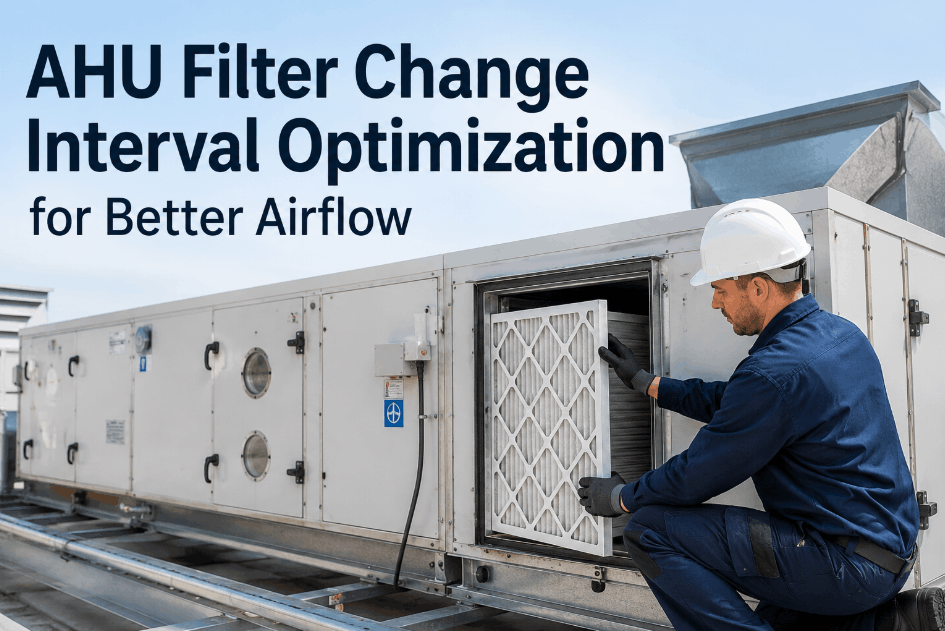
AHU filter change intervals set by calendar alone waste maintenance labor and parts while simultaneously allowing airflow to degrade — because real-world dust loading varies dramatically by season, occupancy, nearby construction, and HVAC system operating hours. Facilities using Sign Up Free with Oxmaint replace calendar-based filter schedules with pressure-drop-triggered and runtime-adjusted intervals, ensuring filters are changed when they actually need it — not three months too early or two months too late. An air handler running with a clogged filter at 1.5" w.g. above design pressure drop is consuming 8–15% more fan energy while delivering reduced airflow to occupied spaces. Conversely, changing filters at fixed intervals during low-occupancy periods discards filter media that has only reached 40% of its loading capacity. Book a Demo to see how Oxmaint's preventive maintenance scheduling adapts filter change intervals to actual operating conditions.
AHU · FILTER MAINTENANCE · AIRFLOW OPTIMIZATION · PRESSURE DROP · 2026
AHU Filter Change Interval Optimization for Better Airflow
Use pressure drop monitoring, dust loading data, and runtime hours to set AHU filter change intervals that maintain stable airflow, protect IAQ, and eliminate wasted labor and parts from over-servicing or under-servicing.
8–15%Additional fan energy consumption from a filter loaded beyond its design final pressure drop
40%Average filter media capacity wasted by calendar-only intervals during variable occupancy periods
25–35%Filter cost reduction achieved through pressure-drop-based versus fixed-interval change programs
MERVFilter efficiency rating that must be matched to AHU fan capacity — higher MERV requires more static pressure
Why Fixed-Interval Filter Changes Fail Both Ways
Calendar-based filter programs represent the maintenance world's equivalent of changing oil at 3,000 miles regardless of engine condition. The schedule is simple to manage but ignores the actual variable that matters — how loaded the filter media is. Oxmaint's condition-based maintenance framework supports filter change triggers based on pressure drop readings, runtime hours, and outdoor air quality events rather than arbitrary calendar dates. Sign Up Free to configure AHU filter maintenance tasks with condition-based triggers in Oxmaint.
The Over-Service Problem
Changing Too Early — Wasted Labor and Parts
During low-occupancy periods (summer in schools, overnight in offices, post-pandemic reduced density), actual dust loading can be 30–60% lower than design. A quarterly filter program established for peak occupancy changes filters when they have reached only 40–50% of loading capacity — doubling the number of filter changes needed over the building's life with no airflow or IAQ benefit.
The Under-Service Problem
Changing Too Late — Fan Strain and Airflow Loss
During construction-adjacent periods, seasonal pollen events, or high-dust industrial processes, filters can load to their final pressure drop in 30–40% of their normal service life. A filter held on a 90-day schedule through a construction period may have been beyond final design pressure drop for 50+ days — degrading airflow, straining fan motors, and allowing bypass around filter seals as differential pressure increases.
The 3 Data Inputs That Define Optimal AHU Filter Change Intervals
1
Differential Pressure Across Filter Bank
Pressure drop is the most direct measure of filter loading. Each filter type has a published initial resistance and a final (loaded) resistance — when the measured differential approaches 75–85% of final resistance, the change interval trigger fires. Analog gauges require manual reading; electronic transmitters connected to the BAS or CMMS allow automatic threshold alerts. Oxmaint can receive BAS alerts and auto-generate filter change work orders at configured thresholds.
2
AHU Runtime Hours
Runtime-based intervals correct for AHUs serving variable-schedule spaces. A school AHU running 1,800 hours per year and an office AHU running 3,200 hours per year should not share the same calendar interval. Runtime-hour-based triggers normalize for actual equipment operation — Oxmaint tracks asset runtime and schedules filter tasks at configured hour thresholds, not calendar periods.
3
Outdoor Air Quality Events
Wildfire smoke, construction dust events, and high pollen periods can reduce filter service life by 50–70%. Linking OAQ monitoring to filter inspection triggers ensures filters are checked after significant particulate events — not waiting for the next scheduled maintenance date while pressure drop climbs silently above design limits.
Filter Change Interval Reference — By AHU Type and Application
| AHU Application |
Filter Grade |
Calendar Baseline |
Pressure Drop Trigger |
Runtime Trigger |
Condition Override |
| Office — standard occupancy | MERV 8 pre / MERV 13 final | Quarterly pre / Semi-annual final | 0.5" w.g. pre / 1.0" final | 750 hrs pre / 1,500 final | AQI >150 event check |
| Hospital — general | MERV 13 pre / MERV 16 final | Monthly pre / Quarterly final | 0.4" pre / 0.8" final | 500 hrs pre / 1,000 final | Outbreak / construction event |
| School — classroom AHU | MERV 8 pre / MERV 13 final | Each semester pre / Annual final | 0.5" pre / 1.0" final | 600 hrs pre / 1,200 final | Post-summer check mandatory |
| Industrial — process exhaust | MERV 8 or application-specific | Monthly inspection | Application-specific | 300–500 hrs | After high-dust process events |
| Data center — CRACs/CRAHs | MERV 8 standard | Semi-annual | 0.3" above initial resistance | 2,000 hrs | After raised floor work |
| Laboratory — 100% OA | MERV 13 pre / HEPA final | Monthly pre / Annual HEPA | 0.4" pre / 1.5" HEPA | 400 hrs pre | Chemical fume events |
How Oxmaint Optimizes AHU Filter Maintenance Programs
Oxmaint's CMMS treats AHU filter maintenance as a condition-based program, not a fixed-date calendar entry. Pressure drop thresholds, runtime hour triggers, and manual inspection findings all feed into work order generation — ensuring filter changes happen when needed, with full documentation of the pressure reading that triggered the change. Book a Demo to see how Oxmaint structures AHU filter programs across multi-building portfolios.
Condition-Based Work Orders
BAS pressure drop alerts and runtime meter readings trigger Oxmaint work orders automatically — no manual scheduling required for condition-triggered changes.
Inspection Checklists
Digital filter inspection forms capture pressure drop readings, filter condition observations, and bypass seal checks — creating a documented performance record for every AHU.
Parts & Inventory Tracking
Filter inventory consumption tracked against each AHU — enabling accurate reorder point management and identification of units consuming filters faster than expected.
Analytics & Reporting
Portfolio-level filter change frequency reports identify AHUs with unusually short intervals — flagging leaky seals, MERV-capacity mismatches, or unusually dirty air intake locations.
Predictive Maintenance
Pressure drop trend analysis identifies AHUs where filter loading is accelerating — allowing proactive investigation of intake contamination sources before a blocked filter causes fan motor overload.
Compliance Documentation
JCAHO, ASHRAE 180, and local code requirements for filter maintenance are documented through Oxmaint work order completion records — audit-ready without manual log compilation.
Stop Guessing on Filter Intervals. Let Pressure Drop and Runtime Decide.
Oxmaint's condition-based maintenance scheduling replaces fixed-date filter calendars with pressure-drop and runtime triggers — reducing both over-servicing waste and under-servicing risk across your entire AHU fleet.
Frequently Asked Questions — AHU Filter Change Intervals
What is the primary indicator that an AHU filter needs changing?
Differential pressure across the filter bank is the most reliable indicator. When measured pressure drop reaches 75–85% of the filter's rated final resistance, airflow begins declining significantly and the filter should be changed regardless of calendar date.
Does a higher MERV rating mean more frequent filter changes?
Not necessarily. Higher MERV filters capture more particulate, which can load them faster in dusty environments — but they also have higher initial and final resistance ratings. The key is ensuring the AHU fan has adequate static pressure capacity for the selected MERV grade at final loading.
How do I know if my AHU is running with an over-loaded filter?
Declining supply air CFM at constant fan speed, increasing fan motor current draw, and differential pressure readings above the filter's rated final resistance are all indicators. Tenant complaints about stuffiness or temperature inconsistency often precede formal measurement.
Can Oxmaint automate filter change work orders based on BAS pressure readings?
Yes. Oxmaint integrates with BAS systems to receive pressure differential data and automatically generates work orders when configured thresholds are crossed — eliminating the need for manual monitoring of individual AHU gauges.
What happens when filters are changed too infrequently beyond just higher pressure drop?
Extended over-loading causes filter media failure (bypass), seal degradation from differential pressure, fan motor overload and premature bearing failure, and in severe cases structural damage to filter housings. IAQ also deteriorates as bypass increases particle delivery to occupied spaces.
Optimize AHU Filter Intervals. Protect Airflow. Reduce Waste.
Oxmaint's CMMS replaces fixed-calendar filter schedules with condition-based triggers, runtime tracking, and pressure drop work orders — so every filter change is both necessary and timely across your entire building portfolio.