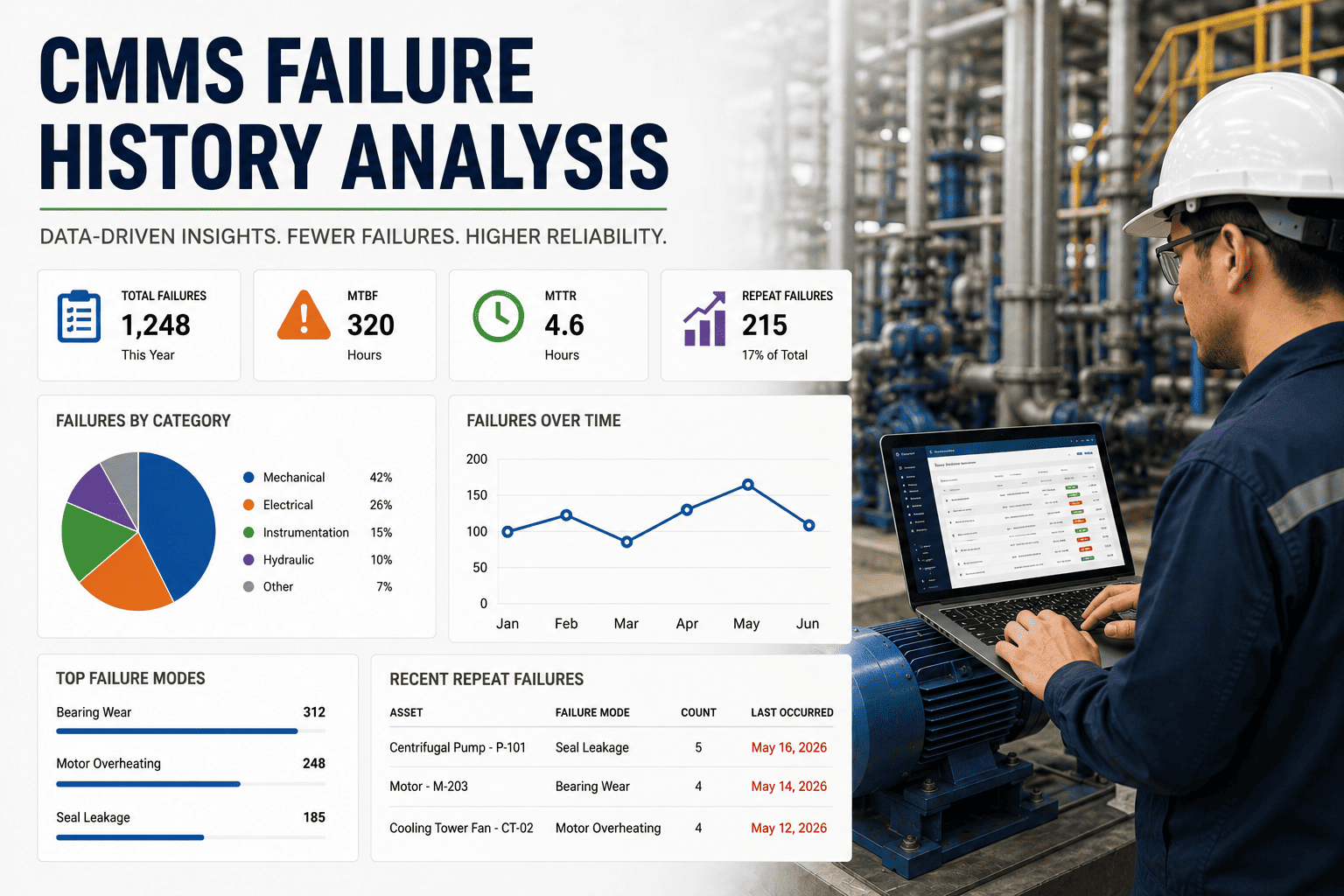
Most manufacturing plants are not failing at maintenance because their teams lack effort. They are failing because the system around the team is broken — work orders live on whiteboards, preventive schedules slip when production pressure rises, spare parts arrive three days after the breakdown, and the CMMS that was supposed to fix everything has 14% of its assets entered correctly. The result is the pattern documented across the industry: 67% of manufacturers still rely on reactive maintenance, the average plant absorbs 25 unplanned downtime events per month, and unplanned downtime now costs Fortune 500 manufacturers an average of $2.8 billion per year — roughly 11% of revenue. The 10 reasons below are not theory; they are the recurring failure modes that show up when maintenance audits are done across hundreds of plants. Book a 30-minute demo to see how OxMaint identifies these failure modes in your plant and gives your maintenance team a system that actually works.
Maintenance Failure Analysis · Manufacturing Plants · Fix Roadmap Included
10 Reasons Manufacturing Plants Fail at Maintenance (And How to Fix Them)
67% of manufacturers still run reactive maintenance. The average plant loses 326 hours per year to unplanned downtime — and the cost of every hour has nearly doubled since 2019. This guide breaks down the 10 most common failure modes and the practical fix for each.
The State of Manufacturing Maintenance — 2025/2026
Manufacturers still relying on reactive maintenance
67%
Plants reporting aging equipment as #1 downtime cause
42%
Companies unaware of when equipment is due for service
70%
Maintenance professionals 50 years or older
69%
PdM cost reduction vs reactive maintenance
40%
Sources: L2L 2025, Plant Engineering 2024, Deloitte, ABB 2023 Survey, MaintainX 2025
Strategic Failures · 01–05
Five Failures That Start at the Top — Where Strategy Breaks Before Execution Begins
The first five failures originate above the shop floor — in how leadership defines maintenance, allocates budget, and measures success. A maintenance team cannot out-execute a broken strategy. These are the structural issues that make every other improvement effort underperform.
01
Maintenance Treated as a Cost Centre, Not a Reliability Function
Problem Only 32% of maintenance leaders see maintenance as a profit centre. The remaining 68% treat it as a budget line to compress — which means every initiative that improves reliability has to fight for capital against the assumption that the cheapest maintenance is the best maintenance. The data says the opposite: reactive maintenance costs 3 to 5 times more than planned maintenance once downtime, defect rates, and emergency labour are included.
Fix Reframe maintenance ROI in production terms — output, OEE, on-time delivery — not maintenance cost in isolation. A platform like OxMaint surfaces the dollar value of prevented downtime per asset, giving maintenance leaders the financial language they need to defend reliability investment in front of the CFO.
02
No Defined Failure Modes for Critical Assets
Problem Most plants run preventive maintenance from generic OEM intervals — replace bearing every 6 months, inspect motor every 12 — without documenting how each critical asset actually fails. The result is over-maintenance on assets that don't need it and under-maintenance on the ones that do. 70% of companies admit they don't know when their equipment is actually due for service.
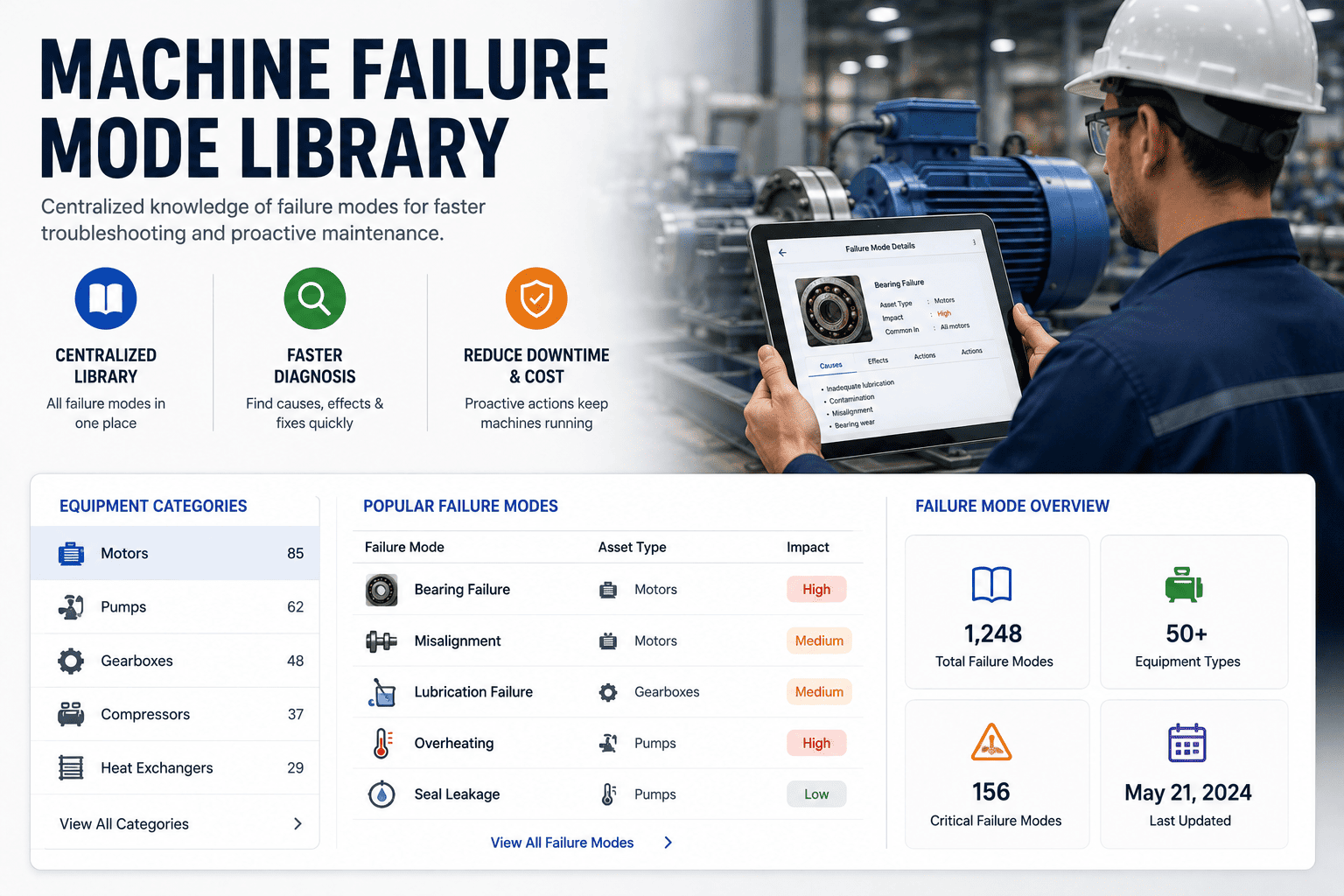
Fix Build an FMEA (Failure Mode and Effects Analysis) for the top 20% of critical assets — the ones that drive 80% of downtime cost. Document each failure mode, frequency, detection method, and recommended PM. OxMaint stores FMEA data alongside the asset record, so every work order is informed by failure history, not generic intervals.
03
Production Pressure Always Cancels Preventive Maintenance
Problem The PM is scheduled. Production runs hot. The line supervisor pushes back: "We can't take it down right now, do it next week." Next week becomes next month. The asset fails three weeks later, taking the line down for 11 hours instead of the 2 hours the PM would have required. This pattern repeats across 25 unplanned downtime events per month at an average plant — most of them traceable to a deferred PM.
Fix Make PM compliance a tracked KPI with the same visibility as production output. OxMaint dashboards show PM completion rate per line and per shift in real time, so when production pushes back the data shows exactly what the deferred PM has historically cost the plant in unplanned downtime.
04
No Single Source of Truth — Data Lives in Spreadsheets, Whiteboards and Heads
Problem Asset history is in three Excel files. Spare parts inventory is on a printed sheet taped to the storeroom door. The senior technician carries 22 years of "I remember when this pump did this in 2017" in his head — and is retiring in 8 months. When information is fragmented, every maintenance decision is partial and every failure investigation starts from zero. 88% of plants outsource some maintenance, often because they cannot find the institutional knowledge they need internally.
Fix Consolidate asset records, work order history, spare parts, and PM schedules into one mobile-first system that captures the senior technician's tacit knowledge before he leaves. OxMaint converts every closed work order into searchable history, so the next failure on the same asset comes with 3 years of context already attached.
05
The CMMS Was Implemented But Adoption Failed
Problem The single most common reason CMMS projects fail is user adoption. Software is purchased, licences activated, IT confirms it is set up — and then technicians keep using whiteboards because the system feels like extra work. When work orders go unlogged, the data layer rots, and within a year the CMMS is a passive reporting tool generating reports nobody trusts. CMMS usage actually declined from 59% in 2017 to 50% in 2018 — adoption is the bottleneck, not licensing.
Fix Choose a CMMS designed for the technician on the floor, not the analyst at the desk. Mobile-first interface, QR-code asset access, work orders that close in three taps. OxMaint's mobile app removes the friction that kills adoption — when the system makes the technician's day easier, usage compounds instead of decays.
Halfway There
Recognise Your Plant in Any of the First Five? Most Manufacturers Do.
Every failure mode above has a documented cost — and a documented fix. The hard part is not knowing what's wrong. The hard part is putting one system in place that tracks all of it, gives your team mobile-first tools they will actually use, and turns maintenance data into reliability decisions. That is what OxMaint does on day one.
Execution Failures · 06–10
Five Failures That Happen on the Shop Floor — Where Daily Execution Breaks the System
The next five failures show up in execution — the gap between what is scheduled and what actually gets done, between what the system records and what really happened on the line. These are the failures that erode reliability in small daily increments until the cumulative drift becomes a major breakdown.
06
Spare Parts Inventory Is Wrong, Late, or Both
Problem The bearing the technician needs is not in the storeroom — even though the system says it is. Or it is in the storeroom but in the wrong bin. Or the part was ordered three weeks ago and is still in transit. Mean time to repair has climbed from 49 minutes to 81 minutes on average across manufacturing — driven largely by parts and skills delays, not the actual repair time. Every minute of MTTR inflation is uptime lost.
Fix Connect spare parts inventory to work orders so every part transaction updates inventory in real time. OxMaint flags low stock against minimum levels, links critical spares to specific assets, and gives the storeroom the same view the technician sees — eliminating the disconnect that turns a 30-minute repair into a 4-hour wait.
07
Work Orders Don't Capture Root Cause — Just "Fixed It"
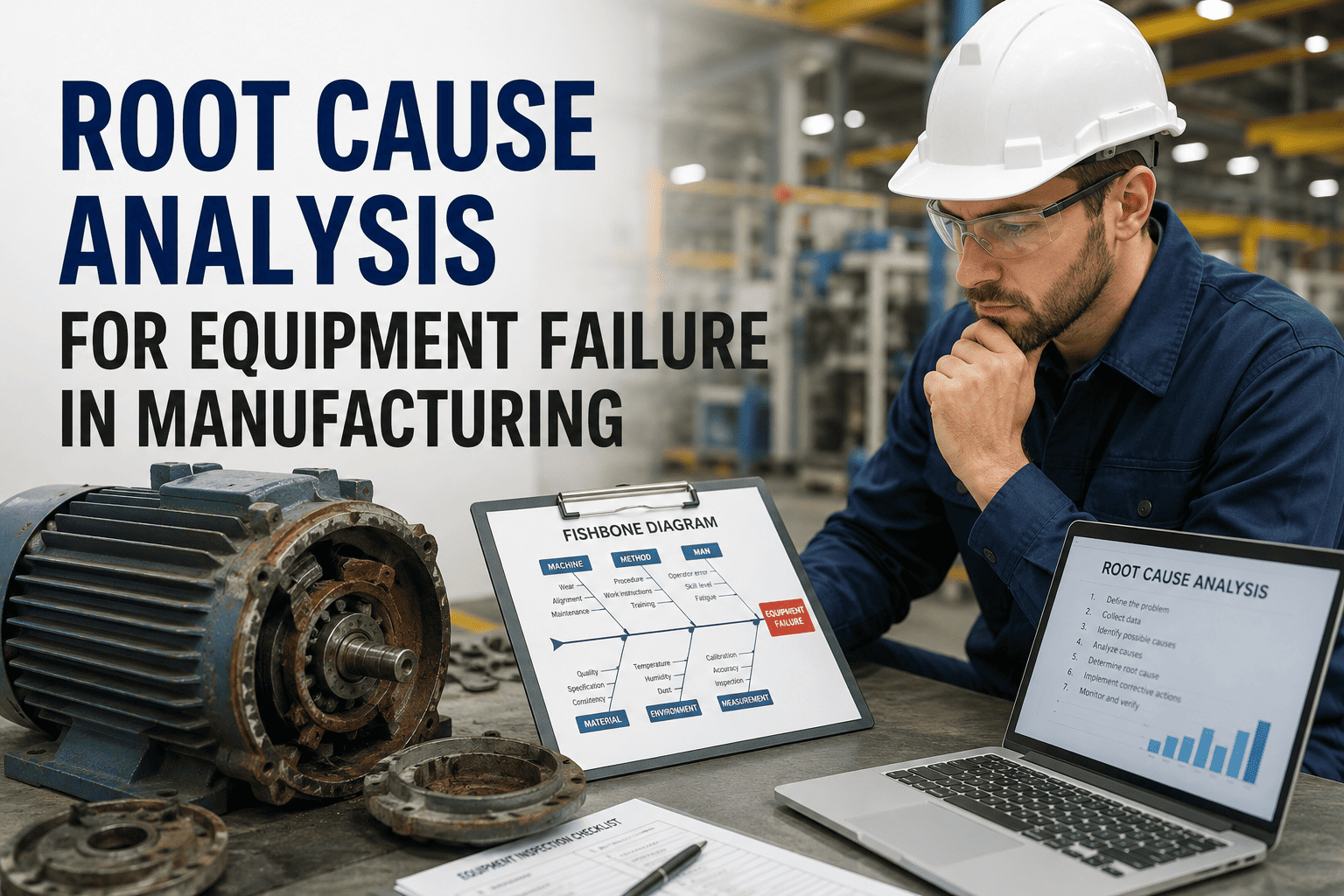
Problem The work order says "replaced motor". It does not say why the motor failed, what the failure mode was, what conditions led up to it, or whether the same failure has occurred on this asset before. Without root cause data, the same failure repeats every 4 to 6 months — and the plant treats each occurrence as a fresh incident. This is how recurring failures hide in a CMMS that technically has all the data.
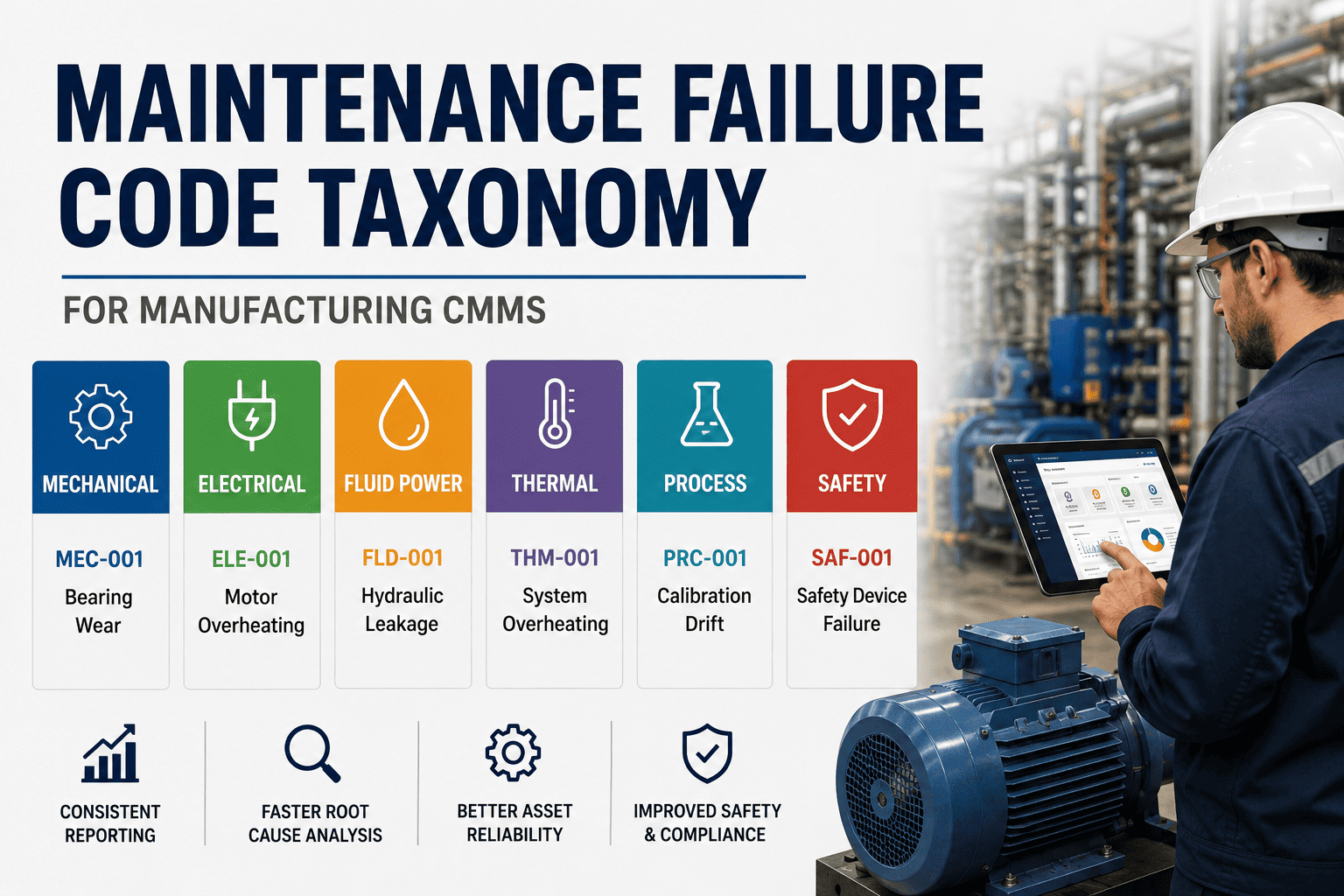
Fix Make root cause coding a required field on closure for any unplanned work order, with a structured pick list — bearing wear, lubrication failure, contamination, misalignment, electrical, control logic. OxMaint enforces structured failure coding so reliability engineers can run "top 10 recurring failures" reports across the plant and break the repeat-failure cycle at the source.
08
Operators Are Not Part of the Maintenance Chain
Problem The operator hears the new vibration in the pump three days before the bearing fails. He mentions it to the line supervisor, who logs it in his head. The work order is not raised until the actual breakdown. Operators are the early-warning system for 70%+ of mechanical failures — and most plants have no structured way for them to flag developing issues into the maintenance queue.
Fix Give operators a frictionless way to report developing issues from their phone — scan the asset QR code, describe the symptom, attach a 10-second voice note or video. OxMaint converts that report into a triaged maintenance request with the asset history already attached, so the planner makes a real-time decision instead of waiting for the failure.
09
No KPI Visibility — The Team Doesn't Know If It's Improving
Problem The plant manager asks: "How are we doing on maintenance?" The maintenance manager replies: "Better than last quarter, I think." Without tracked KPIs — PM compliance, MTBF, MTTR, schedule adherence, work order backlog, planned-to-unplanned ratio — there is no way to know if a fix is working, where the next problem is forming, or whether last year's investment paid off. PM completion is the most tracked KPI but only 56% of plants track it; everything else is even thinner.
Fix Stand up a maintenance KPI dashboard from day one with five core metrics — and make them visible to the team, not just management. OxMaint's dashboard shows PM compliance, MTTR trends, top 10 problem assets, backlog age and work order aging in real time, so improvement is measurable shift by shift.
10
No Structured Path from Reactive to Predictive Maintenance
Problem Predictive maintenance reduces costs by up to 40% and is associated with the lowest unplanned downtime of any strategy at 5.42% — yet only 32% of teams have any AI or PdM solution in place. The gap is not awareness; it is the missing roadmap from where the plant is today (reactive, perhaps with some preventive) to where it needs to be (condition-based, with AI flagging developing failures from sensor data). Without a maturity model the plant stalls at preventive forever.
Fix Use a maturity ladder: Reactive to Preventive to Condition-Based to Predictive to Prescriptive. OxMaint is built to walk plants up the ladder one rung at a time — starting with structured PMs and work orders, layering in IoT sensor inputs, then enabling AI-flagged failure prediction once 6 to 12 months of clean asset data is established.
Maintenance Maturity Model
Where Is Your Plant on the Maintenance Maturity Ladder?
Most manufacturing plants sit at Level 1 or Level 2 — and the data shows the cost of staying there. Each level on the ladder represents a measurable shift in unplanned downtime, maintenance cost per asset, and team productivity. The path forward is not a leap; it is a structured climb, one rung at a time.
Level 1
Reactive
Run-to-failure. No CMMS or unused CMMS. 67% of plants live here.
8.43% of all unplanned downtime
Level 2
Preventive
Time-based PMs from OEM intervals. CMMS in use but inconsistent.
7.96% unplanned downtime
Level 3
Condition-Based
PMs triggered by asset condition (vibration, temp, runtime).
6.5% unplanned downtime (avg)
Level 4
Predictive
AI/ML detects failure signatures before they cause downtime.
5.42% unplanned downtime
Level 5
Prescriptive
AI recommends specific corrective action with cost and risk weighting.
Up to 40% maintenance cost reduction
Cost Comparison
What Each Maintenance Strategy Actually Costs Per Year
The dollar gap between reactive and predictive maintenance is wider than most maintenance budgets assume. The table below summarises documented industry benchmarks across cost per horsepower, downtime exposure, defect rates, and ROI multiplier.
| Cost Dimension |
Reactive |
Preventive |
Predictive |
RCM (Best Case) |
| Pump maintenance cost (per HP per year) |
$18 |
$13 |
$9 |
$6 |
| Share of unplanned downtime attributable |
8.43% |
7.96% |
5.42% |
Below 5% |
| Defect rate (relative to predictive baseline) |
16× higher |
2× higher |
Baseline |
Baseline or better |
| Lost sales from defects (relative) |
2.8× higher |
1.5× higher |
Baseline |
Baseline |
| Equipment lifespan extension |
None |
10–15% |
20–25% |
25–40% |
| Maintenance cost reduction vs reactive |
— |
20–25% |
35–40% |
Up to 50% |
Sources: Piotrowski pump study (NIST AMS 100-18), UpKeep unplanned downtime data, EPA PdM benchmarks, Deloitte 2024.
90-Day Fix Roadmap
From Recognising the Problem to Measurable Improvement in 90 Days
Fixing maintenance is not a multi-year transformation programme. Plants that move with discipline see measurable improvement inside one quarter — provided the first 30 days are spent on foundation, not features.
30
Days 1–30
Foundation
Define top 50 critical assets with structured asset hierarchy. Import existing PM schedules. Train technicians on mobile work order flow. Lock down naming conventions and failure code lists. Goal: 100% of critical assets in OxMaint with clean records.
60
Days 31–60
Adoption
Switch off whiteboards and email-based work orders. All requests originate in OxMaint. Operators trained to log issues via QR code. Spare parts inventory connected to work orders. Goal: 80%+ of work orders captured digitally with root cause coding.
90
Days 61–90
Optimisation
First KPI dashboard live — PM compliance, MTTR, top 10 problem assets, backlog age. Reliability engineer reviews recurring failure codes weekly. PM intervals adjusted from real failure data, not OEM defaults. Goal: 15–25% reduction in unplanned downtime vs baseline.
Frequently Asked Questions
Common Questions About Fixing Manufacturing Maintenance
Our team has tried CMMS software before and it didn't stick. What's different this time?
User adoption is the single biggest reason CMMS projects fail — usually because the tool was built for analysts, not technicians. OxMaint is mobile-first, QR-driven, and designed for three-tap work order closure on the shop floor.
Book a demo to see the technician experience your team will actually use.
How long before we see measurable downtime reduction after deploying OxMaint?
Plants that follow the 30-60-90 day roadmap typically see 15 to 25% unplanned downtime reduction by day 90 — driven by PM compliance gains, faster MTTR, and root cause data eliminating repeat failures. Predictive savings layer in over 6 to 12 months as asset history accumulates.
Do we need to be at a certain maintenance maturity level to use OxMaint?
No. OxMaint is built to start at Level 1 (reactive) or Level 2 (preventive) and walk you up the ladder. Most plants begin with structured PMs and work orders, layer in IoT sensor inputs, then activate AI-flagged failure prediction.
Start a free trial to map your current maturity in 24 hours.
Will OxMaint integrate with our ERP, SCADA and existing IoT sensors?
Yes. OxMaint connects to ERP, SCADA, MES, and IoT platforms via API and standard protocols, so spare parts, work orders, asset condition data, and production data flow into one source of truth without manual re-entry. Integration scope is reviewed during your demo.
How does OxMaint help with the maintenance skills shortage and retiring technicians?
Every closed work order becomes searchable history attached to the asset — capturing the senior technician's tacit knowledge before retirement. New technicians scan an asset QR code and see the last 3 years of work, common failure modes, and recommended procedures, dramatically reducing ramp-up time.
OxMaint · Maintenance Operations Platform
Stop Patching Maintenance. Start Fixing the System Underneath It.
If you recognised your plant in three or more of the failures above, you are not alone — but you also do not have to stay there. OxMaint replaces whiteboards, scattered spreadsheets, and unused CMMS modules with one mobile-first platform that your technicians will actually use, that captures structured failure data from every work order, and that walks your plant up the maintenance maturity ladder one quarter at a time.