Maintenance leaders and CFOs speak two different languages. The maintenance manager talks about PM compliance, MTTR, and wrench time. The CFO asks one question — what is the payback period, and what is the year-one ROI? When the business case for a CMMS is built in operational vocabulary instead of financial vocabulary, it gets rejected at the budget cycle even when the underlying numbers are excellent. That is the gap this article closes. The financial case for CMMS in a manufacturing plant is documented across hundreds of deployments: typical payback in 6 to 18 months, year-one ROI of 300 to 500%, and 5-year cumulative returns of 5x to 15x the platform investment — built from measurable savings across downtime, labour, parts, energy, and asset life. The economics are not theoretical; they are the difference between a $125,000-per-hour unplanned downtime event and a scheduled PM that costs $4,000. Book a 30-minute ROI session and OxMaint's team will build a finance-ready ROI projection from your plant's actual maintenance spend, downtime hours, and asset profile.
Manufacturing CMMS · Financial Case for the CFO
The ROI of Implementing CMMS in a Manufacturing Plant
Average CMMS payback in manufacturing: 6–18 months. Year-one ROI: 300–500%. 5-year cumulative return: 5x–15x. Built from documented savings across five distinct cost categories — and quantifiable from your own plant's numbers in under an hour.
Three Numbers Your CFO Asks For
The Financial Metrics That Get CMMS Budget Approved
Operational metrics — PM compliance, MTBF, technician wrench time — do not move a finance committee. The three numbers below do. Lead with these in any CMMS business case and the conversation shifts from "can we justify this?" to "why haven't we done this already?"
6–18
months
Payback Period
The CFO's first question — when do we recover the spend? Plants with high reactive maintenance recover faster, often in 6–9 months.
300–500%
year one
First-Year ROI
Most recognisable financial metric for capital approval. Documented across 1,400+ deployments. Compare against company hurdle rate to make the case mathematically obvious.
5x–15x
5-year
Cumulative ROI
Total platform value over a 5-year horizon. Aligns with US Department of Energy's documented 10:1 return on predictive maintenance programmes.
Where the ROI Comes From
Five Cost Categories That Make Up the Total CMMS Return
CMMS ROI is not a single number — it is the compounding total of five distinct savings streams, each with its own calculation method and timeline. Most business cases stop at labour savings and capture only 25–35% of the real total. The bar below shows the typical contribution of each category to total CMMS ROI in a manufacturing context.
25%
Labour & Productivity
01
Downtime Reduction
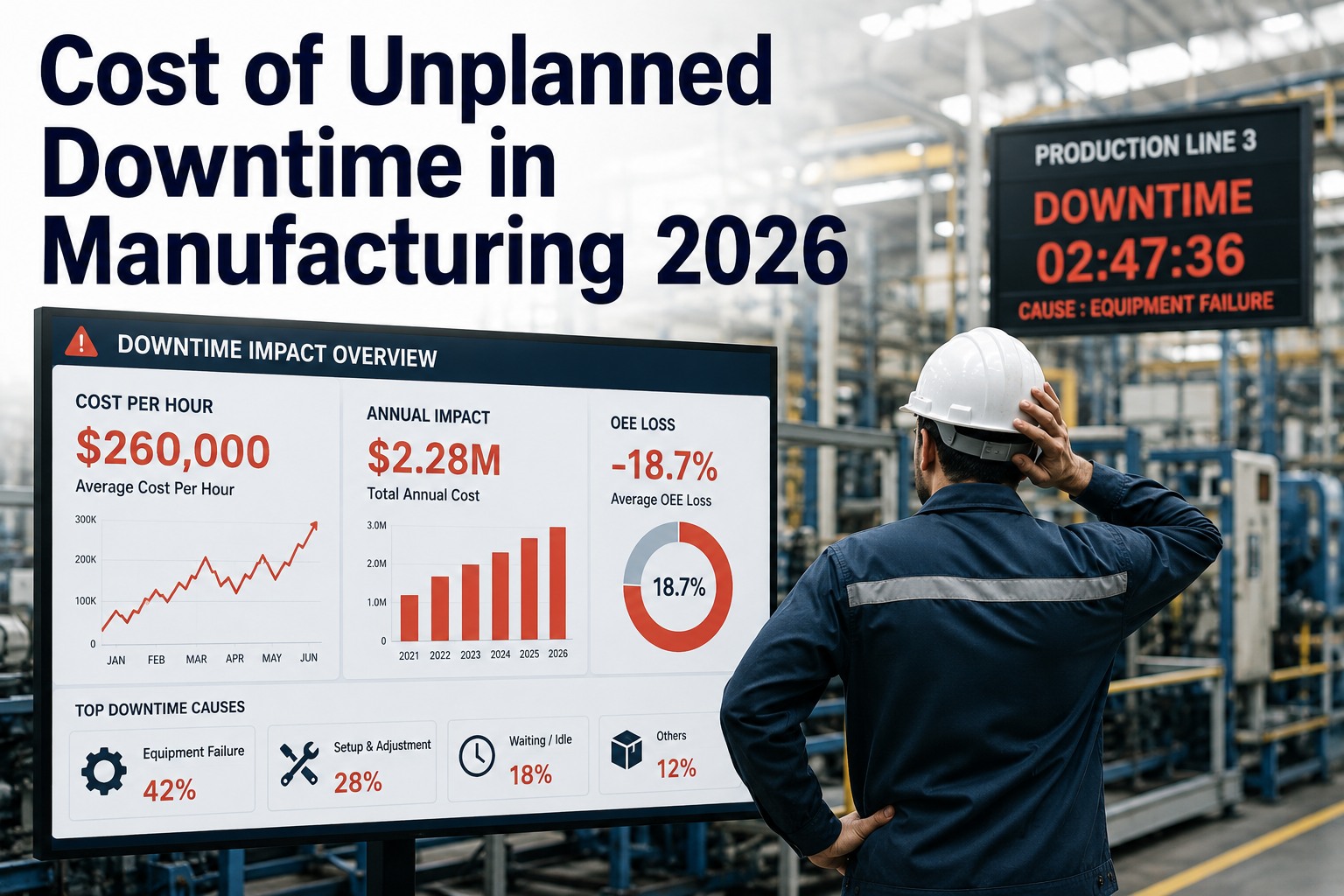
The largest single category. Average unplanned downtime cost is $125,000/hour for mid-size manufacturers and $260,000/hour at industry average. CMMS-driven PM reduces unplanned downtime by 25–45% in year one.
Typical annual saving: $200K–$2M+
02
Labour & Productivity
Technicians spend only 24.5% of their day on actual repair work — the rest is paperwork, parts hunting, and walking. Mobile CMMS recovers 15–25% of labour capacity. Same team, more output, less overtime.
Typical annual saving: $80K–$300K
03
Parts & Inventory
Emergency parts cost 2.4x planned procurement. CMMS-linked inventory cuts emergency orders by 25–30% and reduces carrying costs 20–30% by linking parts to actual asset consumption.
Typical annual saving: $50K–$500K
04
Asset Life Extension
Equipment under structured PM lasts 20–25% longer. Every year of life extension on a $500K asset is $50K of CapEx deferred — direct balance-sheet impact CFOs recognise immediately.
Typical annual saving: $40K–$200K
05
Energy & Compliance
Poorly maintained equipment runs 10–15% below optimal energy efficiency. CMMS-driven scheduled maintenance recovers 3–5% in energy cost and eliminates audit penalties from missed compliance.
Typical annual saving: $30K–$250K
Worked Example — Mid-Size Plant
A Real ROI Calculation: 200-Person Plant, 10-Technician Team
Below is a documented year-one ROI calculation for a representative mid-size manufacturing facility — a plant employing 200 people with a 10-technician maintenance team and an annual CMMS investment of $45,000. Every figure uses conservative industry benchmarks; aggressive scenarios produce significantly higher returns.
| Cost Category |
Baseline (Pre-CMMS) |
Reduction Applied |
Year-1 Saving |
| Unplanned downtime |
312 hours × $5,400/hr = $1,684,800 |
25% reduction |
$421,200 |
| Maintenance labour overtime |
4,800 hours OT × $52/hr = $249,600 |
20% reduction |
$49,920 |
| Emergency parts premium |
$340,000 emergency orders @ 2.4x |
25% reduction |
$85,000 |
| Asset replacement deferral |
$3.2M annual CapEx exposure |
3-yr deferral on 4 assets |
$120,000 |
| Compliance penalty avoidance |
2 missed audits historical avg |
Eliminated |
$45,000 |
| Total Year-1 Savings |
— |
— |
$721,120 |
| CMMS Investment |
— |
— |
$45,000 |
| Year-1 ROI / Payback |
— |
— |
1,502% / 23 days |
Inputs based on conservative industry benchmarks: $5,400/hr downtime cost (manufacturing average from MaintainX 2024), 2.4x emergency parts multiplier (ABB Reliability Survey), 25% downtime reduction (Deloitte). Results scale linearly with plant size.
Build the Case With Your Own Numbers
OxMaint's Team Builds a Finance-Ready ROI Projection in 30 Minutes
Bring your annual maintenance spend, downtime hours, and overtime totals. Walk out with a documented payback period, year-one ROI, and 5-year NPV projection — formatted for board-level capital approval. No commitment, no consultant fee, no slides — just the numbers your CFO needs to approve the budget.
When the Money Lands
Payback Timeline — What CMMS Returns and When
CMMS ROI is not a single payment at the end of year one — it is a compounding return that begins in week one and matures over 24 months. The timeline below shows when each category of saving becomes measurable and bankable.
Weeks 1–4
Quick Wins
Mobile work orders eliminate paperwork delay
Technician wrench time +15% measurable
Reporting time cut by 70%
First measurable savings
Months 2–3
PM Compliance
PM completion rates climb from 35% to 80%+
Reactive work orders drop 20–25%
Overtime reduction visible
Software cost recovered
Months 4–6
Full Payback
15–30% total maintenance cost reduction
Inventory carrying costs down 20–30%
Audit-ready compliance trails
Year-1 ROI confirmed
Months 7–24
Compounding Return
Predictive analytics layer activates on clean data
Asset life extension quantified, CapEx deferrals booked
Total ROI typically 5x–15x
Strategic ROI realised
ROI by Plant Profile
How Industry, Plant Size and Starting Maturity Affect Your Return
Not every plant has the same ROI curve. Plants in high-margin sectors and plants starting from fully reactive maintenance see the strongest returns — because their baseline cost of inefficiency is largest. The matrix below summarises typical year-one outcomes across plant profiles.
| Plant Profile |
Hourly Downtime Cost |
Typical Payback |
Year-1 ROI |
| Automotive (assembly, paint) |
$2.3M / hour |
2–4 months |
800%–1,500% |
| Process / chemical / pharma |
$300K–$800K / hour |
3–6 months |
500%–900% |
| Heavy industry (steel, cement, mining) |
$125K–$300K / hour |
6–10 months |
400%–700% |
| General manufacturing — mid-size |
$40K–$125K / hour |
8–14 months |
300%–500% |
| Discrete manufacturing — small |
$5K–$40K / hour |
12–18 months |
180%–350% |
| Brownfield with reactive baseline |
Variable |
Faster — larger gap to close |
+30–50% vs sector avg |
Sources: Siemens True Cost of Downtime 2024, ABB Reliability Survey 2023, Aberdeen Group, McKinsey, US Department of Energy. Lower-end ranges apply to plants with mature preventive programmes; higher-end ranges apply to plants moving from reactive baselines.
Speak the CFO's Language
Hard Savings vs Cost Avoidance — Frame Both Correctly
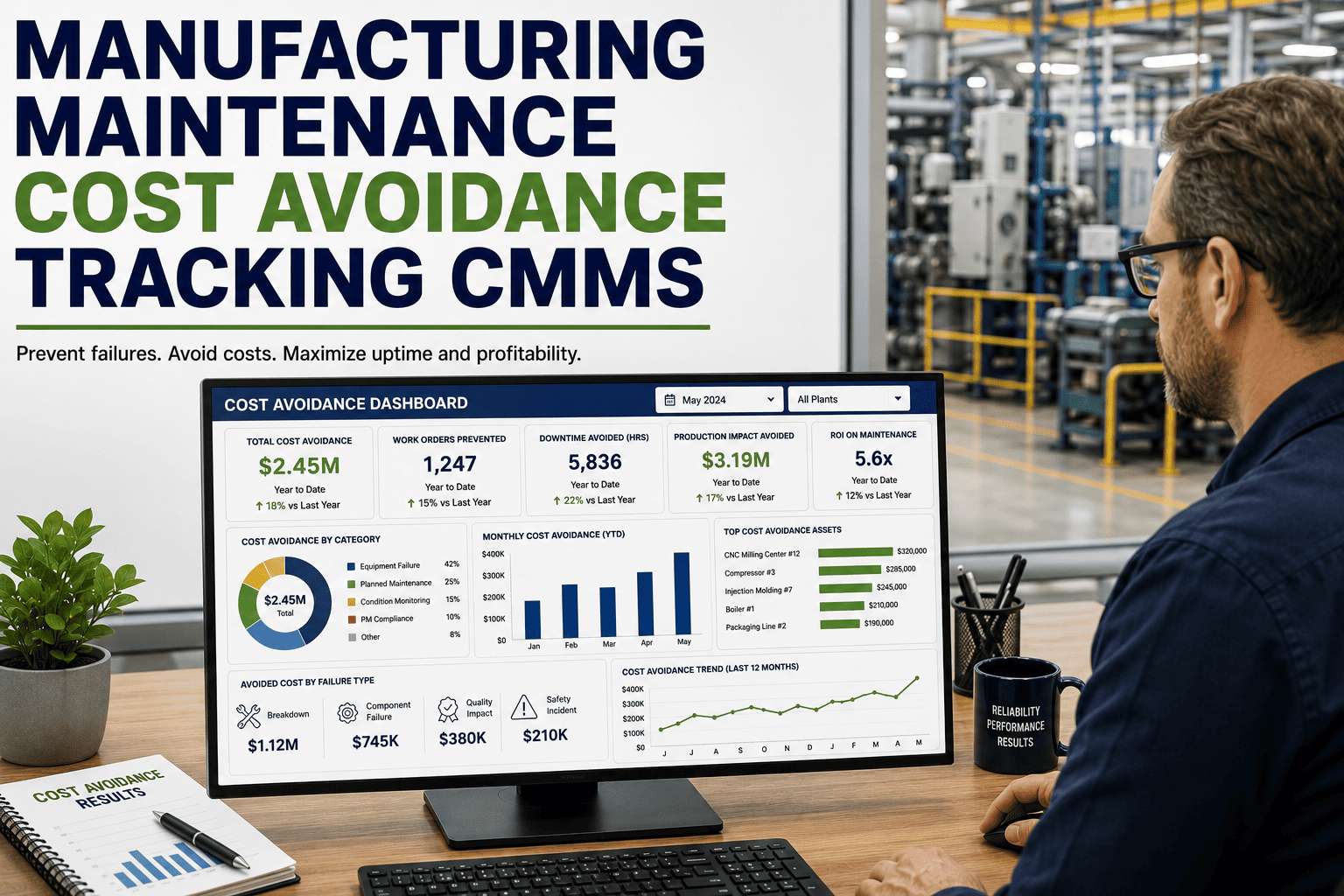
A board-level CMMS business case requires both categories — but they must be presented separately and labelled correctly. Hard savings are reductions in actual spending; cost avoidance is the prevention of future spending. CFOs accept both when they are quantified and tied to specific budget lines.
Hard Savings
Money that stops leaving the bank account
Reduced overtime labour — fewer emergency callouts, less weekend work
Lower emergency parts spend — fewer 2.4x rush procurement orders
Cut administrative overhead — 70% reduction in reporting time
Reduced contractor mobilisation — fewer out-of-hours specialist callouts
Energy cost recovery — 3–5% from optimal-condition equipment
Cost Avoidance
Money that never had to leave because the failure never happened
Prevented unplanned downtime — quantified at $/hour × prevented hours
Avoided compliance penalties — audit failures, regulatory fines
Asset replacement deferred — 20–25% life extension = direct CapEx postponement
Avoided customer penalties — late-delivery clauses (typically 0.5–1% of order/week)
Avoided reputation damage — sustained on-time delivery, customer retention
Frequently Asked Questions
CMMS ROI — Common Questions From CFOs and Operations Directors
What payback period should we use in our internal business case?
For board-level submissions, 12-month payback is well-supported by documented outcomes and conservative for most manufacturing plants. Operational payback — when downtime savings alone cover the platform cost — typically lands at 3–6 months.
Book a session to model both scenarios against your actual data.
Do small plants get the same percentage ROI as large plants?
Often higher in percentage terms. Smaller facilities have proportionally higher manual overhead to eliminate and lower starting maturity — meaning a larger gap to close. The absolute dollar return is smaller, but the percentage return frequently exceeds large-plant benchmarks.
How long does it take to start producing the data needed for the ROI case?
Labour productivity gains are measurable in 2 weeks. PM compliance and downtime data accumulate over 60–90 days. Full ROI confirmation by month 4–6.
Start a free trial and OxMaint begins capturing baseline data from your first work order.
Should we lead the CFO conversation with cost savings or cost avoidance?
Lead with hard savings because they are easier to verify and book against specific GL codes. Layer cost avoidance second, clearly labelled — CFOs accept both when quantified, but they require precise terminology to distinguish the two.
How does cloud CMMS ROI compare to on-premise deployment?
Cloud CMMS typically delivers 40–50% better ROI due to lower implementation costs, faster deployment (2–6 weeks vs 3–6 months), no IT infrastructure overhead, and automatic updates. On-premise is generally only justified by data sovereignty or specialised security requirements.
OxMaint · Documented ROI Across 1,400+ Deployments
Build the Business Case Once. Recover the Investment in 23 Days.
Every quarter you delay a CMMS decision is another quarter of unplanned downtime at $125,000 per hour, emergency parts at 2.4x markup, and technicians spending 75% of their shift on tasks that should be automated. The financial case is documented. The platform is ready. The only thing left is the budget approval — and OxMaint's team will help you build that case from your own plant's numbers.


.png)