Reliability-Centered Maintenance was born in 1978 as a series of workshops. A cross-functional team sat in a conference room for weeks, worked through the seven RCM questions for each critical asset, filled out FMEA worksheets, and emerged with a maintenance strategy that was correct on the day of the workshop and static from that day forward. Every deviation from the assumed failure pattern, every unexpected P-F interval, every process change, every new sensor — none of it made it back into the FMEA unless someone scheduled another workshop. Which is why traditional RCM programs take 6 to 18 months per asset class to complete, and why the SAE JA1011 standard explicitly requires that the program be reviewed and updated when actual failure experience deviates from predictions. That review rarely happens on paper. AI-native RCM is the operating model that closes this gap. Machine learning and anomaly detection continuously re-answer the seven RCM questions from live asset data — failure modes, criticality scores, P-F intervals, and PM tasks all update automatically as new sensor readings and work-order history arrive. Plants that layer AI predictive reliability on top of their RCM program typically cut unplanned downtime 30–50% and reduce total maintenance cost 10–25% within the first year, while eliminating 20–30% of unnecessary PMs. Below is the working guide to what AI-native RCM actually is, how it differs from spreadsheet RCM, and how Oxmaint operationalises it on the plant floor. Book a demo and see AI-native RCM running against your live asset data, or start free and put continuous FMEA on your critical asset register.
Manufacturing · Reliability Engineering · SAE JA1011 · 2026
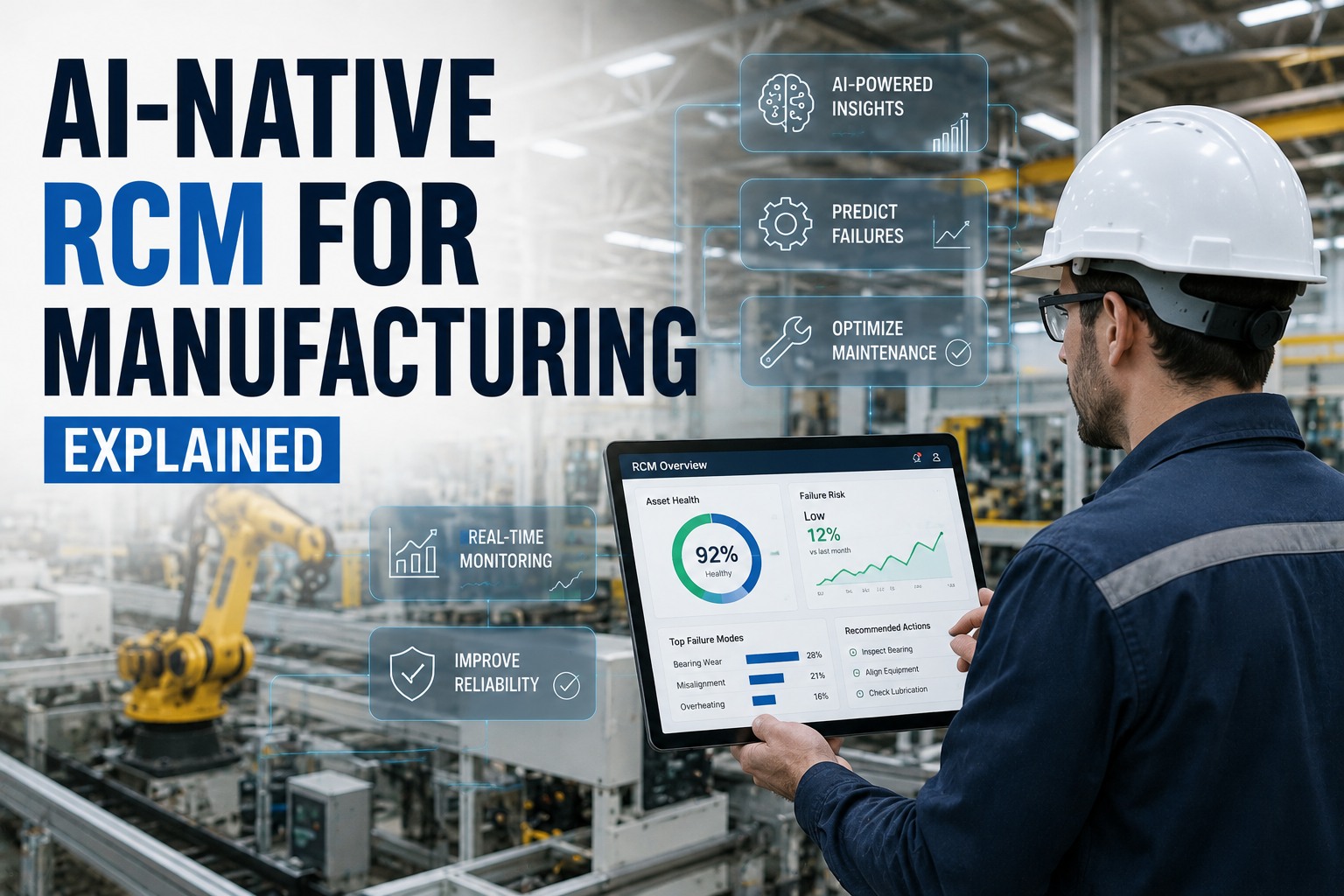
AI-Native RCM for Manufacturing Explained
The seven RCM questions Nowlan and Heap defined in 1978 — now answered continuously by machine learning from live sensor data and work-order history, instead of once every 18 months in a facilitator-led workshop. Continuous FMEA, live criticality, auto-generated PM tasks. Start on the free forever plan and prove it on one asset class.
30–50%
unplanned downtime reduction with AI-native RCM
10–25%
total maintenance cost reduction within year one
20–30%
unnecessary calendar PMs eliminated by AI analysis
$0
free forever plan to prove AI-native RCM on one asset class
The Definition
What "AI-Native" Actually Means for RCM
The term is used loosely across reliability marketing, so it is worth being precise. AI-native RCM is not "spreadsheet RCM with a chatbot bolted on." It is a reliability program where the seven classic RCM questions are answered continuously from live plant data, and where every element of the FMEA — functions, failure modes, causes, consequences, criticality scores, task intervals — updates automatically as new evidence arrives. This is what that means in operating terms.
Failure modes update from live sensor data
Machine-learning models watch vibration, thermal, current draw, and process telemetry across the asset base. New failure modes surface automatically as new patterns appear — no re-workshop required. When actual failure experience deviates from predictions, the FMEA entry flags for review, satisfying the JA1011 feedback-loop requirement without manual audit cycles.
Consequence scoring reflects current operating context
Criticality is not a spreadsheet field written once and forgotten. It reflects current production schedule, downstream demand, bottleneck status, and safety-instrumented-system state. An asset feeding tomorrow's export order has different criticality than the same asset on a slow shift — and AI-native RCM sees that difference and reranks maintenance priority accordingly.
PM tasks fire when data crosses P-thresholds
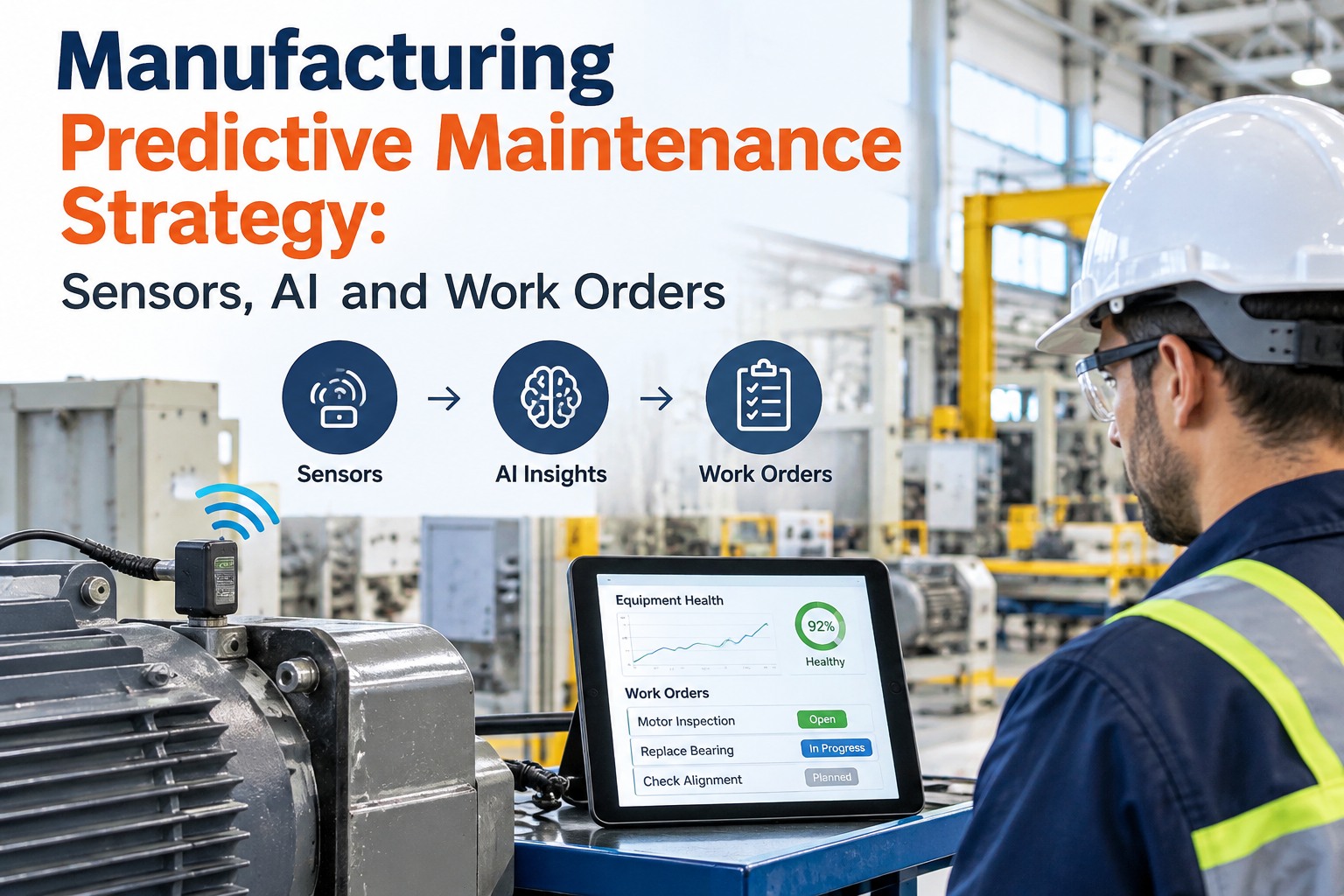
The output of the RCM analysis is not a static PM schedule. It is a set of triggers — sensor thresholds, work-order patterns, condition trends — that fire work orders when a potential failure is actually detectable, not on a calendar interval. The PM either provably prevents a failure or it does not run.
Every closed work order feeds the model
When a technician closes a work order with the root cause tagged, that data goes into the model. Predictions improve. False positives fall. New failure patterns get caught earlier over time. The reliability program never becomes stale because it is never finished — it is a live system, not a workshop deliverable.
The Seven Questions, Two Ways
Spreadsheet RCM vs AI-Native RCM Answering the Same Questions
The best way to see the difference is to walk through the seven classic RCM questions — the ones defined by Nowlan and Heap in 1978 and codified in SAE JA1011 — and see how a spreadsheet program and an AI-native program answer each one differently. The questions are the same; the answers are worlds apart.
-
Q1
What are the functions and performance standards?
SpreadsheetDocumented in workshop, static thereafter. Secondary functions frequently missed.
AI-NativeIngested from ISA-95 hierarchy and OPC-UA tags; secondary functions surfaced by pattern analysis.
-
Q2
In what ways can it fail to deliver those functions?
Spreadsheet8–15 failure modes per complex asset, brainstormed in workshop, frozen.
AI-NativeContinuous discovery of new modes from sensor anomalies and historical WO patterns.
-
Q3
What causes each functional failure?
SpreadsheetCause-of-failure tagged from OEM data, expert opinion, and past experience.
AI-NativeRoot-cause inference from sensor signatures and correlated work-order closure data.
-
Q4
What happens when the failure occurs?
SpreadsheetEffects listed at workshop, updated only when a major incident forces revision.
AI-NativeEffects modelled from historical event data and simulated across current operating scenarios.
-
Q5
What are the consequences of the failure?
SpreadsheetConsequence category assigned once — safety, environmental, operational, non-operational.
AI-NativeConsequence re-scored against live production schedule, bottleneck status, and SIS state.
-
Q6
What can be done to prevent or detect each failure?
SpreadsheetTask selection using RCM decision logic; interval set from OEM or convention.
AI-NativeTask selection auto-tuned to P-F interval derived from actual condition-monitoring data.
-
Q7
What if no proactive task is worth doing?
SpreadsheetRun-to-failure or redesign decision documented; rarely revisited.
AI-NativeFailure-finding tasks scheduled on protected functions; RTF decisions re-evaluated when consequence changes.
Fast Deployment
AI-Native RCM Should Not Take 18 Months to Deploy
Oxmaint is cloud-based and mobile-first — no server procurement, no consulting engagement, no year-long workshop cycle. Start on the free forever plan, connect your CMMS asset register and historical work-order data, seed the FMEA from historical patterns, and have continuous condition-triggered work orders dispatching to technician phones inside a phased rollout window. Traditional workshop-driven RCM takes 6 to 18 months per asset class to reach the same starting line.
Asset Register & Data Ingest
Asset hierarchy imported; historical work orders and sensor tags mapped to the model.
Model Training & FMEA Seeding
Historical work-order data used to seed failure modes; reliability engineer review and validation.
Live Predictions & Auto-WO
Condition-triggered work orders dispatching to technician phones; first false-positive tuning cycle complete.
What the Operator Sees
The Chat Loop That Runs Between Sensor and Technician
AI-native RCM does not send technicians PDF reports. It sends actionable, contextual instructions right into the mobile work-order flow — with the sensor evidence, the recommended task, and the reason attached. This is a representative operator-AI dialogue during a shift.
Pump P-204B: bearing vibration signature drifted 22% since last shift. P-F interval estimate 96 hours. Recommend condition-based inspection this shift. Similar signature preceded 3 failures in the last 12 months.
Accept. Route to me for 09:00.
Work order 4471 dispatched. Torque spec, seal PN, and PPE requirements attached. Historical failure notes from March 2026 event on P-204A included for reference.
Bearing race pitting confirmed. Replaced. Photo attached.
Root cause logged: fatigue. FMEA entry for P-204 series updated. P-F interval refined to 84 hours. Sister asset P-204A queued for pre-emptive inspection next PM window.
Scope of the Platform
What Oxmaint Includes Beyond the AI Model
AI predictions matter only if they land inside the daily work-order flow. Oxmaint ships the complete AI-native RCM stack — model, CMMS, mobile execution, IoT ingestion, and reporting — as one integrated platform. No SAP/Maximo replacement required; overlay mode preserves your existing ERP investment.
-
FMEA Engine
Live Failure Mode Analysis
Every asset carries a live FMEA that updates when new failure patterns are detected. JA1011-compliant feedback loop built in — deviations flag automatically for reliability engineer review.
-
Criticality Scoring
Dynamic Consequence-Weighted Priority
Consequence scoring adjusts to current production schedule, downstream demand, and bottleneck status. High-consequence assets in critical windows get elevated maintenance priority automatically.
-
Auto PM Triggers
Tasks Fire on Data, Not Calendar
PM work orders generated when condition data crosses P-thresholds, at less than half the estimated P-F interval. 20–30% of unnecessary calendar PMs eliminated at deployment.
-
IoT & Vibration Ingestion
Every Signal Feeds the Same Record
Vibration sensors, thermal cameras, current-draw monitors, and process historian all flow into the same asset record. One source of truth for condition trend and P-F prediction.
-
Mobile Execution
Technicians Work From the Same Platform
Oxmaint mobile app dispatches condition-triggered work orders directly to the technician's phone with sensor evidence, torque specs, and safety notes. Closure feeds the model.
-
SAP / Maximo Overlay
Preserves Your ERP Investment
Overlay mode ingests asset hierarchy and work order state from SAP or Maximo without replacement. AI-native RCM runs on top of your existing ERP — no data migration project required.
Measured Outcomes
What Plants Report in the First 12 Months
-
30–50%
Unplanned Downtime Reduction
Industry benchmarks for ML predictive maintenance consistently show this range once AI failure prediction is embedded in the daily work-order flow — the key word being "embedded."
-
10–25%
Total Maintenance Cost Reduction
Over-maintenance eliminated on Nowlan-Heap Pattern D/E/F assets while condition monitoring caught previously-missed failures on the high-consequence 11%.
-
20–30%
Unnecessary Calendar PMs Removed
The classic RCM win — doing less work and getting more uptime. AI-native analysis pinpoints which calendar PMs never prevented a failure and safely retires them.
-
$0
Free Forever Plan to Start
Cloud-based, mobile-first — no server procurement, no consulting engagement. Prove AI-native RCM on one critical asset class, then scale across the plant.
Frequently Asked
AI-Native RCM Questions
Do we still need to do a workshop-driven RCM analysis first?
No. Oxmaint seeds the initial FMEA from your historical work-order data, OEM manuals, and industry failure-mode libraries during the model-training phase (Weeks 3–6 of deployment). Reliability engineers review and validate — a matter of days, not months — and the model tunes from there. Full workshop-driven RCM as the entry point is not required. Book a demo to see the FMEA seeding workflow.
Is this SAE JA1011 compliant?
Yes. All seven RCM questions are answered per asset, RCM decision logic drives task selection, and the JA1011 requirement to review and update the program when actual failure experience deviates from predictions is met by design — the model flags deviations automatically for reliability engineer review, closing the feedback loop that spreadsheet programs typically leave open.
How does this work alongside our existing SAP or Maximo?
Oxmaint runs in overlay mode. Asset hierarchy and work order state ingest from SAP or Maximo without replacement, and AI-generated work orders push back into your ERP for financial and stores integration. Your existing ERP investment is preserved; AI-native RCM sits on top of it. Talk to support about overlay-mode integration for your ERP.
Is there a free plan to prove AI-native RCM on one asset class first?
Yes. Oxmaint offers a free forever plan — enough to import one critical asset class, seed the FMEA from historical work-order data, enable condition-triggered PM auto-generation, and prove the reliability gain before scaling to the full asset register. Cloud-based and mobile-first, so no server procurement or infrastructure commitment to get started.
What happens on Day 1 of deployment?
Cloud-based, so Day 1 is asset register import and historical work-order ingestion — Oxmaint engineers coordinate with your IT and maintenance planning teams. Sensor and historian tags map during Week 1–2, model training runs against historical work-order data in Weeks 3–6, and live condition-triggered work orders start dispatching to technician phones by Week 7–12. Full live-in-flow inside a phased rollout window. Book a demo and see the deployment plan mapped to your plant.
Continuous · JA1011-Compliant · Mobile-First
Retire the Spreadsheet. Deploy Continuous, Data-Driven RCM.
The seven RCM questions answered continuously from live plant data, criticality scoring that reflects current production reality, PM tasks that fire on evidence rather than calendar — running on Oxmaint, cloud-based and mobile-first. Start on the free forever plan and prove it on one asset class before you scale.
30–50%
unplanned downtime reduction in year one
20–30%
unnecessary calendar PMs safely retired
JA1011
SAE-compliant seven-question framework
$0
free forever plan to prove AI-native RCM on one asset class