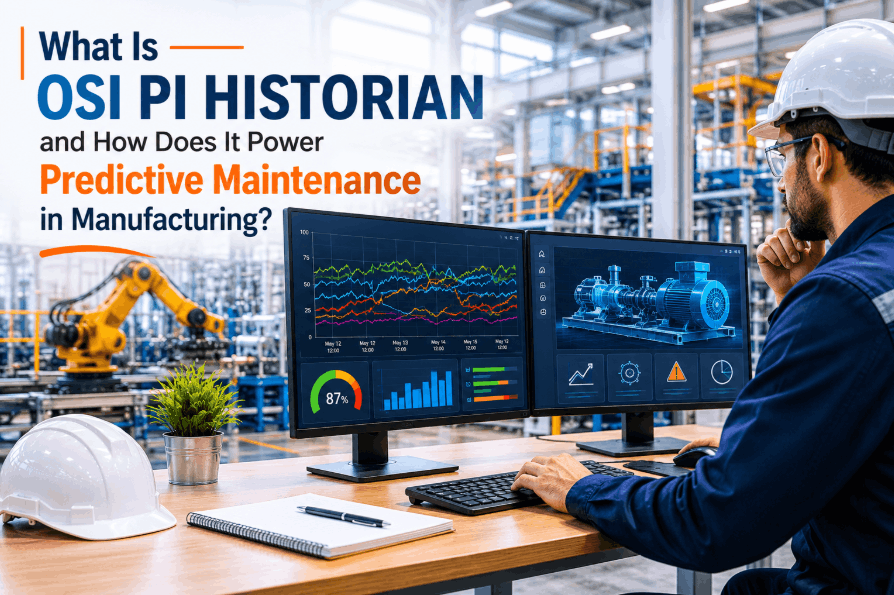
Manufacturing plants generate millions of data points every second — from motor temperatures and valve pressures to flow rates and vibration signatures. Without a structured system to capture and contextualize this data, predictive maintenance remains out of reach. OSI PI Historian (now branded as AVEVA PI System) is the industrial-grade time-series data platform that stores, retrieves, and distributes this high-frequency process data at scale. When connected to a CMMS like Sign Up Free on OxMaint, PI Historian becomes the live intelligence layer that drives true predictive maintenance — moving plants from scheduled guesswork to condition-driven, failure-preventing action. This guide breaks down what OSI PI Historian is, how its data architecture works, and how OxMaint integrates with PI to convert raw process tags into automated work orders before failures occur. Book a Demo to see a live PI-connected predictive maintenance configuration for your plant environment.
Connect Your PI Historian Data to Predictive Maintenance
OxMaint integrates with AVEVA PI System to convert real-time process tags into condition-based work orders — automatically triggered before equipment fails.
What Is OSI PI Historian?
OSI PI Historian — developed by OSIsoft and now part of the AVEVA PI System platform — is an industrial time-series data historian designed to continuously capture, compress, and store high-frequency process data from manufacturing equipment, sensors, PLCs, SCADA systems, and DCS infrastructure. Unlike relational databases optimized for transactional records, PI Historian uses a proprietary compression algorithm (Swinging Door Trending) that preserves data fidelity while reducing storage footprint by up to 90% — enabling plants to retain decades of high-resolution process data in manageable storage. Each measured variable in PI is stored as a PI Tag — a unique identifier tied to a specific sensor or calculated data point. A single large manufacturing facility may run thousands to hundreds of thousands of active PI tags, creating a comprehensive real-time map of plant behavior that forms the foundation for AI-driven predictive maintenance when connected to platforms like OxMaint. Book a Demo to explore how OxMaint consumes PI tag data across your asset hierarchy.
Core Components of the AVEVA PI System Architecture
The core time-series storage engine. Stores compressed historical and real-time process values for every PI tag — retrievable at millisecond resolution for model training and anomaly detection.
Organizes raw PI tags into a structured asset hierarchy — mapping sensor readings to equipment, units, and systems. Provides the semantic layer that OxMaint uses to associate data with specific maintainable assets.
Collect data from PLCs, SCADA, DCS, OPC servers, and IoT edge devices — feeding real-time values into the PI Data Archive without custom engineering per data source.
RESTful API layer that exposes PI data to external applications — the integration pathway through which OxMaint retrieves tag values, event frames, and calculated attributes for condition-based maintenance triggers.
Structured records of time-bounded plant events — process upsets, batch completions, alarm periods. OxMaint ingests event frame data to correlate equipment behavior patterns with historical failure signatures.
Operational visualization layer for real-time trend monitoring. OxMaint complements PI Vision by adding maintenance workflow execution — converting observed anomalies into scheduled, tracked work orders.
How PI Historian Data Powers Predictive Maintenance
The gap between PI Historian and predictive maintenance is a workflow gap — not a data gap. PI captures the signal; the maintenance team needs a system that acts on it. OxMaint bridges this gap by ingesting PI tag streams and event frames, applying configurable condition thresholds and AI-driven anomaly models, and automatically generating work orders when process data indicates developing failures. Sign Up Free and configure your first PI-connected condition trigger in minutes.
PI Historian Use Cases in Manufacturing Predictive Maintenance
Vibration, bearing temperature, and shaft speed tags from pumps, compressors, and turbines are analyzed for spectral anomalies — triggering OxMaint work orders days before mechanical failure.
Differential temperature and pressure drop tags track fouling rate over time — enabling OxMaint to schedule cleaning before heat transfer efficiency drops below process thresholds.
Current draw, power factor, and thermal tags flag winding degradation, bearing wear, and cooling fan failures — converting PI signals into OxMaint condition-based PMs automatically.
Valve travel time and position feedback tags expose stem packing wear and actuator degradation — driving OxMaint inspection work orders before process control loops are affected.
Corrosion probe and ultrasonic thickness monitoring tags feed OxMaint predictive models — scheduling piping inspections based on actual corrosion rate rather than fixed calendar intervals.
Compressed air, steam, and chilled water system tags identify leak signatures and efficiency degradation — triggering OxMaint utility maintenance before energy losses compound.
OxMaint + PI Historian: Integration Architecture
OxMaint connects to AVEVA PI System through PI Web API — the secure RESTful interface that exposes tag values, attributes, and event frames to authorized external applications. The integration maps PI Asset Framework elements directly to OxMaint asset records, preserving the equipment hierarchy and ensuring that condition triggers generated from PI data are associated with the correct work order, parts list, and maintenance history. No custom middleware or manual data export is required. Sign Up Free and connect your PI server within a single configuration session.
| Integration Layer | PI System Component | OxMaint Function | Maintenance Outcome |
|---|---|---|---|
| Real-time tag data | PI Data Archive | Condition threshold monitoring | Automatic work order on breach |
| Asset hierarchy | PI Asset Framework | Asset record mapping | Correct WO assignment and history |
| Process events | PI Event Frames | Failure signature correlation | AI model training and refinement |
| Historical data | PI Data Archive (backfill) | Predictive model baseline | Accurate anomaly detection thresholds |
| Calculated attributes | PI Analytics | Derived health KPI ingestion | Equipment health score dashboards |
Why PI Historian Alone Is Not Enough for Predictive Maintenance
PI stores and visualizes process data — but does not generate work orders, assign technicians, track completion, or maintain compliance records. Maintenance teams need a CMMS layer to execute on PI signals.
PI Vision shows trending anomalies — but routing that observation into a prioritized, parts-ready work order requires OxMaint's work order engine and technician dispatch system.
PI tags are sensor-centric. OxMaint adds the maintenance context — failure modes, repair history, safety procedures, and spare parts — that transforms a tag breach into an actionable, informed work order.
Regulatory inspections, audit trails, and PM compliance records require structured documentation that PI does not generate. OxMaint auto-creates audit-ready records from every PI-triggered maintenance event.
Benefits Manufacturing Plants Achieve with OxMaint + PI Historian
How to Configure PI-Connected Predictive Maintenance in OxMaint
Provide your PI Web API server URL and authentication credentials inside OxMaint's integration settings. OxMaint validates connectivity and discovers available PI Asset Framework elements automatically.
Match PI Asset Framework equipment nodes to corresponding OxMaint asset records — linking sensor data to maintenance history, failure modes, and assigned technician groups.
Choose which PI tags to monitor per asset — vibration, temperature, pressure, current, flow — and configure threshold ranges based on historical operating data or engineering specifications.
Set single-tag thresholds, multi-tag compound conditions, or rate-of-change rules — specifying the work order type, priority, and assigned crew that fires when each condition is met.
Activate OxMaint's machine learning layer — trained on historical PI tag data — to detect deviation patterns that precede failures before they cross hard threshold limits.
Track condition trigger accuracy, work order completion rates, and equipment health trends from OxMaint's PI-integrated dashboard — refining models as failure data accumulates. Book a Demo to see the full configuration flow.
Turn Your PI Historian Data into Predictive Maintenance Action
OxMaint connects to AVEVA PI System out of the box — converting tag streams into condition-based work orders, technician dispatch, and compliance documentation automatically.
OSI PI Historian vs. Other Industrial Data Historians
| Capability | AVEVA PI System | Honeywell Uniformance PHD | GE Proficy Historian | Aspentech IP.21 |
|---|---|---|---|---|
| Time-series compression | Swinging Door (industry standard) | Yes | Yes | Yes |
| Asset Framework / Context | PI Asset Framework (AF) | Limited | Limited | Yes (Process Explorer) |
| REST API Access | PI Web API (mature) | Yes | Yes | Limited |
| OxMaint Native Integration | Yes | Via OPC-UA/REST | Via OPC-UA/REST | Via REST |
| Market Penetration | Largest installed base globally | Process/refining focus | Power & utilities focus | Refining/chemicals focus |
| Cloud Deployment | AVEVA Connect (cloud) | Limited cloud | Proficy Cloud | AspenONE Cloud |
Industries That Deploy PI Historian with OxMaint for Predictive Maintenance
Upstream, midstream, and refining operations use PI to monitor wellhead pressures, compressor trains, and distillation columns — with OxMaint converting deviation signals into field work orders.
Continuous process plants rely on PI for reactor temperature and pressure control — OxMaint uses these tags to predict catalyst degradation and heat exchanger fouling before process impact.
Turbine rotor vibration, boiler drum levels, and generator excitation data feed PI at millisecond resolution — OxMaint triggers condition-based maintenance to protect critical generation assets.
GMP-regulated batch processes use PI event frames for process deviations — OxMaint ingests these events to schedule corrective maintenance with full audit trail documentation for FDA compliance.
Crusher vibration, mill bearing temperatures, and conveyor drive health tags are monitored via PI — OxMaint converts anomalies into prioritized field work orders before catastrophic equipment failure.
Pump station flow, pressure, and energy data feed PI continuously — OxMaint monitors these tags to schedule pump maintenance based on actual efficiency degradation, not fixed intervals.
Frequently Asked Questions
What is OSI PI Historian used for in manufacturing?
OSI PI Historian (AVEVA PI System) captures and stores high-frequency time-series data from plant sensors, PLCs, and SCADA systems. It is used for process monitoring, operational reporting, and as the data foundation for predictive maintenance when connected to a CMMS like OxMaint.
How does OxMaint integrate with PI Historian?
OxMaint connects to AVEVA PI System via PI Web API — subscribing to tag values and event frames mapped through PI Asset Framework. When configured condition thresholds are breached, OxMaint automatically generates and assigns work orders without manual intervention.
What is a PI tag and why does it matter for predictive maintenance?
A PI tag is a unique identifier for a specific measured variable in PI Historian — a temperature sensor, pressure transmitter, or vibration probe. OxMaint monitors selected PI tags and triggers maintenance actions when tag values indicate developing failure conditions.
Can OxMaint use PI Event Frames for maintenance triggers?
Yes. OxMaint ingests PI Event Frames to correlate structured process events — alarms, batch deviations, equipment trips — with historical failure signatures, enabling more accurate predictive model training and automatic work order generation.
What is PI Asset Framework and how does OxMaint use it?
PI Asset Framework (AF) organizes PI tags into a logical equipment hierarchy. OxMaint maps AF elements to its asset records — ensuring that condition triggers from PI data generate work orders attached to the correct equipment, maintenance history, and parts inventory.
Does OxMaint support condition-based maintenance without PI Historian?
Yes. OxMaint supports condition-based maintenance via direct IoT sensor connections, OPC-UA, MQTT, and REST API integrations — in addition to PI Historian. Plants without PI can still deploy condition-based PM scheduling through OxMaint's native sensor integration layer.
Ready to Connect PI Historian to Predictive Maintenance?
Join manufacturing teams using OxMaint and AVEVA PI System together — automating condition-based work orders, cutting unplanned downtime, and maintaining full compliance documentation across every asset.