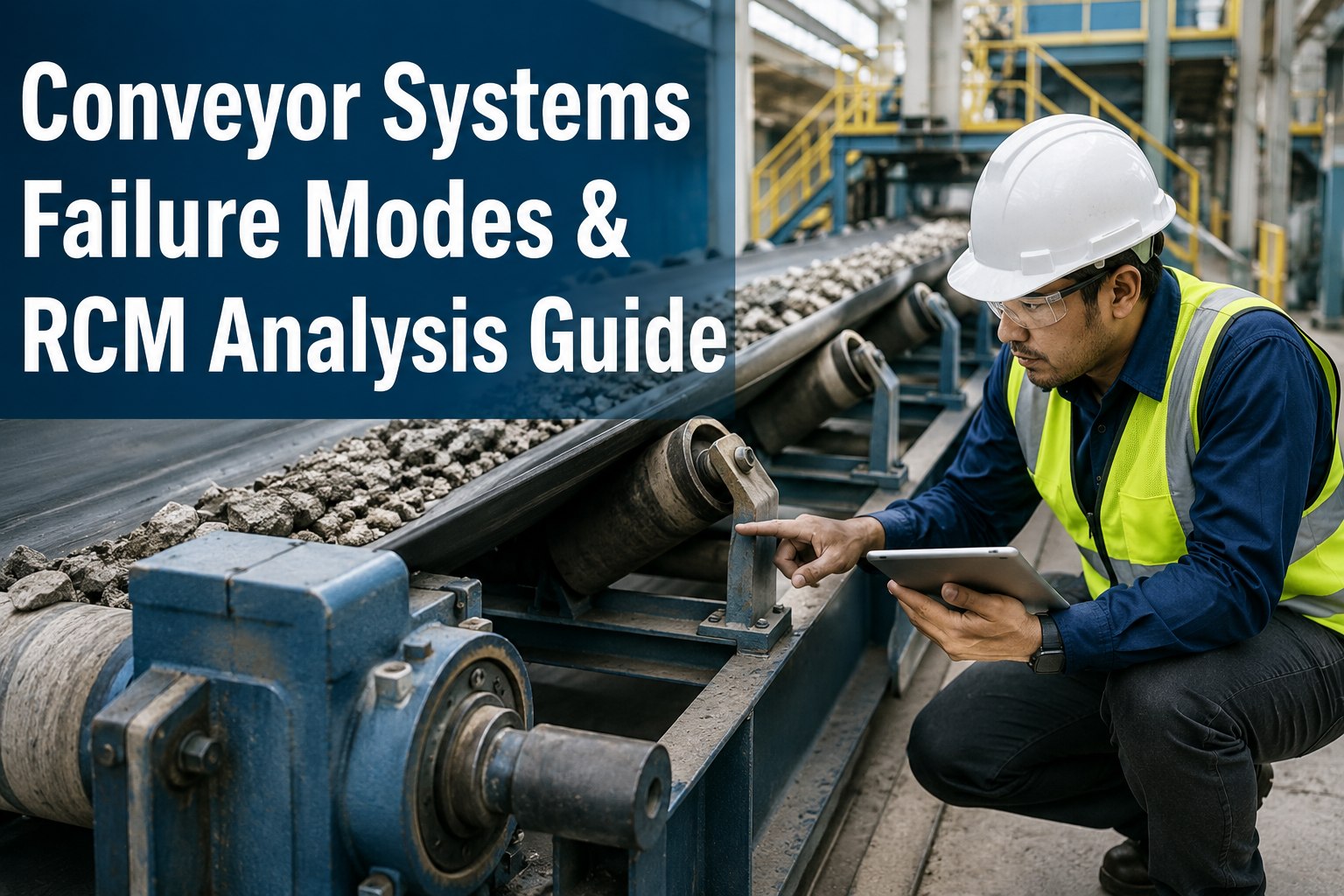
AI-Powered Predictive Maintenance for Conveyor Systems in Manufacturing Plants
By oxmaint on February 27, 2026
Every manufacturing plant depends on conveyor systems to keep production moving. Yet most facilities still rely on scheduled inspections or wait-until-it-breaks approaches that leave them blind to the 5 early warning signs of conveyor failure. AI-powered predictive maintenance uses IoT sensors, vibration analysis, and machine learning to detect bearing degradation, belt misalignment, and motor faults weeks before they cause a shutdown. The result is up to 50% less unplanned downtime, 40% lower maintenance costs, and conveyor systems that run longer and stronger. Schedule a free conveyor health assessment to find out which failure risks are hiding in your production lines right now.
The Real Cost of Unplanned Conveyor Downtime
Conveyor breakdowns do not just stop one machine. They starve downstream equipment, halt packaging lines, delay shipments, and trigger overtime costs that ripple through your entire operation. Understanding the true financial impact is the first step toward building a case for predictive maintenance investment.
$260,000
per hour
Maximum cost of unplanned conveyor downtime in high-output manufacturing. Average outages last 4 hours, costing facilities up to $2 million per event.
82%
of US companies experienced unplanned downtime in the past three years
51%
of conveyor operators report productivity losses from unexpected belt damage
$50B
estimated annual cost of unplanned downtime across industrial manufacturers globally
These numbers make one thing clear: reactive maintenance is not a strategy. It is a gamble. Every hour your team spends on emergency repairs is an hour of lost production, missed deadlines, and eroded profit margins. Predictive maintenance flips this equation by catching problems when they are still minor and fixable, not after they have already shut down your line. Sign up free to start tracking your conveyor health data and stop losing thousands per hour to preventable breakdowns.
5 Early Warning Signs AI Detects Before Conveyor Failure
Conveyor systems rarely fail without warning. The challenge is that most warning signs are invisible to the human eye and inaudible over factory noise. AI-powered sensors detect these micro-level changes continuously, translating raw data into clear failure predictions with weeks of lead time.
01
Abnormal Vibration Patterns
Healthy conveyors produce predictable vibration signatures. AI detects micro-changes in frequency, amplitude, and harmonics that indicate bearing inner-race defects, roller imbalance, or shaft misalignment, often 2 to 6 weeks before physical symptoms appear.
Detection lead: 2-6 weeks
02
Rising Temperature at Key Points
Excess heat at drive pulleys, bearings, or idlers signals friction, lubrication breakdown, or electrical resistance issues. Thermal sensors paired with AI catch gradual temperature climbs that manual checks miss entirely.
Detection lead: 1-4 weeks
03
Motor Current Irregularities
Changes in motor current draw reveal overloading, winding deterioration, belt slippage, and gearbox problems. AI correlates current patterns with load data to distinguish normal variations from genuine degradation signals.
Detection lead: 2-8 weeks
04
Belt Tracking Drift and Tension Loss
A belt that starts to wander or lose tension is heading toward edge damage, material spillage, and eventual failure. AI monitors position and tension continuously, flagging drift trends before they reach critical thresholds.
Detection lead: Days to weeks
05
Acoustic Emission Changes
Grinding, squeaking, or rattling that is masked by factory noise gets picked up by acoustic sensors. AI filters ambient noise to isolate the specific frequencies associated with roller seizure, chain wear, and sprocket damage.
Detection lead: 1-3 weeks
Detect all 5 warning signs automatically on your conveyor systems. Sign up for Oxmaint to receive AI-powered failure alerts weeks before breakdowns hit your production line, with automatic work orders sent straight to your maintenance team.
How IoT Sensors and Machine Learning Power Conveyor Predictions
AI predictive maintenance is not a single technology. It is a layered system where IoT sensors feed raw data into edge processors, which then pass refined signals to cloud-based machine learning models trained on millions of equipment data points. Here is how each layer works together to protect your conveyors.
Layer 1: Smart Sensor Network
Vibration accelerometers, temperature probes, current transformers, acoustic emission sensors, and belt tension load cells are placed on bearings, motors, pulleys, rollers, and gearboxes. Data is captured at sub-second intervals, providing a continuous health stream from every critical component.
Layer 2: Edge Computing and Noise Filtering
Industrial edge devices aggregate and validate sensor data locally. Initial anomaly detection runs without cloud latency, ensuring critical alerts arrive in real-time. Noisy, incomplete, or erroneous readings are filtered out before data moves to the analytics engine.
Layer 3: AI Pattern Recognition Engine
Machine learning models trained on historical failure data and real-time sensor streams analyze degradation trends, correlate multi-sensor signals, and calculate remaining useful life for every monitored component. Models continuously retrain as new data arrives, getting smarter over time.
Which Conveyor Components Need Predictive Monitoring
Not every component fails at the same rate or carries the same risk. A strategic sensor placement plan focuses on the highest-impact failure points first, then expands coverage as the system proves value. Here is where AI monitoring delivers the greatest return on your conveyor systems.
Bearings and Rollers
The most frequent source of conveyor failures. AI vibration analysis detects inner-race defects, cage wear, and roller wobble with specific frequency signatures weeks before seizure.
Sensors: Vibration, temperature, acoustic
Belt Surface and Splices
Nearly 90% of in-operation belt failures start at splice points. AI tracks splice integrity, surface wear progression, and thickness loss to schedule replacements during planned windows.
Sensors: Visual, thickness gauge, vibration
Drive Motors and Gearboxes
Motor current signature analysis and thermal monitoring reveal winding deterioration, shaft misalignment, and gear tooth wear 2 to 8 weeks before functional failure.
Misaligned pulleys cause uneven belt wear, tracking problems, and premature failure. Laser alignment sensors paired with AI detect drift trends before they cause damage.
Sensors: Laser alignment, vibration, displacement
Structural Framework
Conveyor frame vibrations indicate mounting looseness, structural fatigue, or foundation settling that can escalate into catastrophic system failure if uncorrected.
Sensors: Accelerometers, strain gauges
Belt Tension and Tracking
Over-tensioned belts pull wire apart; under-tensioned belts slip. AI monitors tension and lateral position continuously, adjusting alerts dynamically based on load and speed.
Sensors: Load cells, displacement, position
Find out which conveyor components at your plant need monitoring first. Book a free demo with our maintenance experts to get a custom sensor placement plan built around your highest-risk conveyor lines and biggest downtime cost areas.
Reactive vs Preventive vs Predictive: Which Maintenance Strategy Fits Your Plant
Most manufacturing plants operate with a mix of maintenance strategies. Understanding where each approach works best and where it falls short helps you build the right combination for your conveyor systems.
Reactive
Fix It When It Breaks
No upfront monitoring investment
Maximum component utilization
Unplanned downtime of 8-12% annually
Emergency repair costs 3-5x planned repairs
Cascading damage to adjacent components
High RiskSuitable only for non-critical, easily replaceable components
Preventive
Fix It on a Schedule
Reduces unexpected failures by 25-30%
Predictable maintenance windows
Replaces healthy parts prematurely
Does not adapt to actual equipment condition
Misses failures between inspection intervals
Moderate RiskGood baseline, but leaves significant optimization on the table
Predictive (AI)
Fix It When Data Says To
Reduces unplanned downtime by up to 50%
Cuts maintenance costs by up to 40%
Extends component life by 20-40%
Adapts to real operating conditions continuously
Generates automatic work orders with failure context
Lowest RiskOptimal for critical conveyors where downtime costs exceed $5K/hour
Upgrade from Scheduled Inspections to Data-Driven Predictions
Oxmaint connects your conveyor sensor data to intelligent maintenance workflows. Every vibration spike, temperature anomaly, and current irregularity becomes a prioritized work order with clear instructions, giving your team the confidence to act before failures happen.
How CMMS Software Automates Conveyor Maintenance Workflows
Predictive insights only create value when they trigger action. A CMMS platform like Oxmaint bridges the gap between AI-generated predictions and your maintenance team's daily work, ensuring no failure warning goes unaddressed.
From Detection to Resolution: Automated Workflow
AI Detects Anomaly
Sensor data reveals bearing vibration on Conveyor Line 3 exceeds learned baseline by 34%. AI calculates failure probability at 78% within 14 days.
Work Order Auto-Generated
Oxmaint creates a priority-2 work order with failure type, affected component, recommended repair window, and spare part requirements attached.
Technician Assigned and Notified
The work order is assigned based on technician skill and availability. Mobile notification with full context arrives instantly, no manual dispatching needed.
Planned Repair During Scheduled Window
Bearing replacement completed during next shift change. Zero unplanned downtime. Total cost: $340 in parts and 45 minutes of labor versus $50,000+ for an emergency breakdown.
Most conveyor belts do not wear out or use up their natural service life. They fail because of factors that are detectable and preventable: improper tension, misalignment, bearing degradation, and splice deterioration. AI gives maintenance teams the visibility to catch these issues before they become emergencies.
-- Manufacturing Maintenance Engineering Lead
Proven Results: What Manufacturers Achieve with AI Conveyor Monitoring
The business case for predictive maintenance is backed by documented results from manufacturing plants that have deployed AI-powered monitoring on their conveyor systems. These are not theoretical projections, they are measured outcomes from real-world implementations.
70%
Reduction in unplanned conveyor downtime reported by facilities using AI monitoring with vibration analysis
50%
Extension in belt service life through condition-based replacement instead of fixed-interval schedules
500+
Minutes of annual production disruption prevented at BMW using AI to monitor conveyor assembly lines
88%
Of manufacturers who adopted AI predictive systems report fewer breakdowns and improved asset visibility
Getting Started: Your First 90 Days with Conveyor Predictive Maintenance
You do not need to instrument every conveyor on day one. The most successful implementations start focused, prove value fast, then expand. Here is a practical roadmap that balances quick wins with long-term scalability.
Days 1-21
Identify and Prioritize
Audit your conveyor assets and rank them by criticality, failure history, and downtime cost impact. Select 2-3 high-value conveyor lines for pilot monitoring. Review existing sensor infrastructure and data availability.
AI models learn your conveyors' unique patterns. Import historical maintenance records and failure data. Calibrate anomaly detection thresholds and test alert workflows with your maintenance team.
Days 71-90+
Optimize and Scale
Review first predictive catches and measure downtime prevented. Refine alert sensitivity based on team feedback. Expand monitoring to additional conveyor lines based on proven results from pilot phase.
Turn Your Conveyor Data Into Maintenance Intelligence
Your conveyors are already generating the signals that predict their own failures. The question is whether you have the technology to listen. Oxmaint connects vibration sensors, thermal monitors, and current analyzers to AI models that generate automatic work orders, prioritize repairs by severity, and help your maintenance team stay ahead of every potential breakdown before it costs you another hour of lost production.
What types of conveyor systems work with AI predictive maintenance?
AI predictive maintenance applies to belt conveyors, roller conveyors, chain conveyors, screw conveyors, and overhead systems. The monitoring approach adapts to each type's unique failure modes. Belt systems focus on wear tracking and splice integrity while chain systems prioritize stretch and sprocket analysis. Roller conveyors focus on bearing health and rotation consistency. Sign up free to check which conveyor types at your facility qualify for AI monitoring.
How far in advance can AI predict a conveyor failure?
Detection lead time varies by component and failure type. Bearing degradation is typically detected 2 to 6 weeks in advance. Motor winding issues can be caught 2 to 8 weeks early. Belt tracking problems may surface days to weeks before critical failure. The more historical data the AI model has, the more accurate and earlier its predictions become.
Do we need to install new sensors or can AI use existing equipment data?
Many plants can start with existing sensor data and PLC control signals. BMW demonstrated this approach by extracting predictive value from existing conveyor control data without any new sensors. Adding dedicated vibration and temperature sensors on critical components significantly improves prediction accuracy and lead time. Book a free infrastructure review to find out what your existing sensors can already predict.
What is the typical ROI timeline for conveyor predictive maintenance?
Most manufacturing facilities identify savings within 30 to 90 days of deployment. Quick wins from catching imminent failures and eliminating unnecessary scheduled replacements typically deliver full payback within 3 to 6 months. One global manufacturer reported positive ROI within three months while monitoring over 10,000 machines including conveyor systems.
How does predictive maintenance integrate with our existing CMMS?
AI predictive maintenance connects directly with CMMS platforms like Oxmaint through API integrations. When the system predicts an impending failure, it automatically creates a work order with the failure type, affected asset, priority level, recommended repair window, and required parts. This ensures every prediction turns into a tracked, accountable maintenance action.