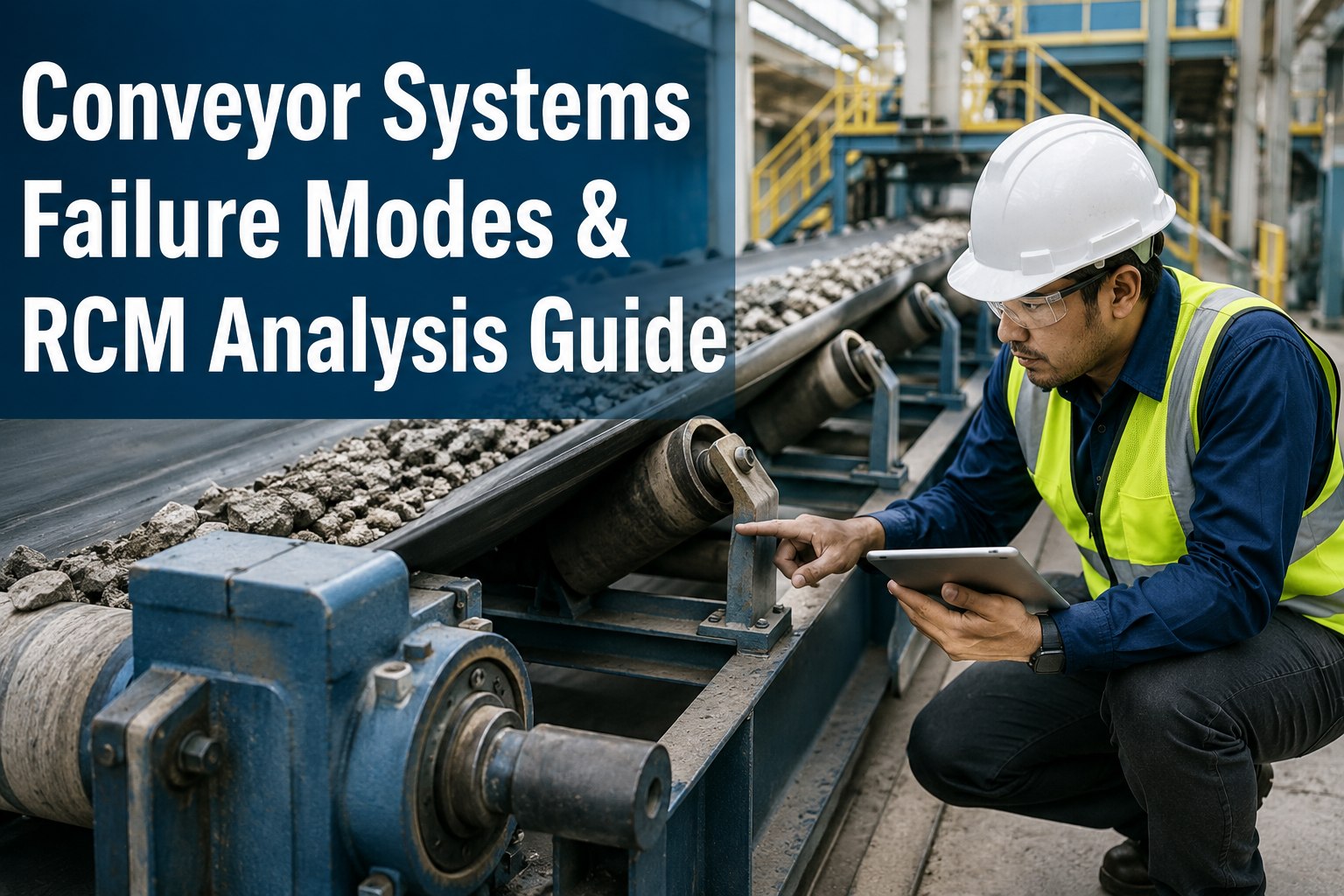
Conveyor Systems Failure Modes & RCM Analysis Guide

By William Jerry on August 26, 2026

conveyor-systems-failure-modes-and-rcm-analysis-guide

Conveyor systems FMEA and RCM analysis is where reliability engineering earns its keep  a single belt conveyor carries 20+ distinct failure modes across five subsystems (belt, splice, idler, drive, structural), and one seized idler bearing dragging on a moving belt has taken out entire conveyor lines before the operator finishes the shift walk-around. The classic FMEA RPN calculation (Severity × Occurrence × Detection, each 1–10) sorts risk numerically — but modern practice cross-checks against Action Priority, because a safety item scoring S=10 with a low RPN still outranks a nuisance failure with RPN=250. Programs that convert FMEA rankings into scheduled OxMaint work orders (with condition triggers on the highest-Occurrence items) consistently cut unplanned conveyor downtime and eliminate the guard-interlock-and-idler-bearing incidents that show up on every RCA report. Book a Demo to see the 5-subsystem conveyor FMEA library pre-loaded in OxMaint with RPN + Action Priority scoring.

Conveyor Reliability · FMEA + RCM · CMMS 2026

Conveyor Systems Failure Modes & RCM Analysis Guide

Complete FMEA and RCM guide for conveyor systems: dominant failure modes, root causes, detection tactics, and OxMaint AI mitigation. From spreadsheet FMEA to live CMMS work orders in 30 days.

20+
Unique failure modes documented across a single belt conveyor in a three-year academic study
5
Conveyor subsystems every FMEA must cover — belt, splice, idler, drive, structural
S × O × D
RPN formula — Severity, Occurrence, Detection each scored 1–10, product ranks risk
Action Priority
Modern cross-check — S=10 safety items outrank higher-RPN nuisance failures

The 5 Conveyor Subsystems Every FMEA Must Cover

A conveyor FMEA that stops at "the belt" misses four subsystems where most failures actually originate. The tree below shows the five domains every credible analysis walks — with the dominant failure modes catalogued under each. Start a free OxMaint workspace and load these five subsystems as an asset hierarchy in one session — the free plan includes FMEA templates, RPN scoring, criticality analysis, and mobile work orders from day one.

CONVEYOR SYSTEM
BELT
Mistracking
Cover wear / abrasion
Impact damage / slicing
Longitudinal tearing
SPLICE
Vulcanized splice separation
Mechanical fastener wear
Angle / squareness drift
IDLER
Bearing seizure & stall
Roll flat spots
Shell wear / debris ingress
Alignment / drop-out
DRIVE
Motor overload / winding
Gearbox oil / bearing
Coupling misalignment
Pulley lagging wear
STRUCTURAL
Skirt / chute wear
Guard interlock bypass
Take-up / tension drift
Frame corrosion / fatigue

RPN Scoring — What the Numbers Actually Mean

RPN (Risk Priority Number) sorts failure modes numerically, but the numbers only matter when the scoring rubric is consistent across the team. Below is the working scale for each dimension — Severity (impact), Occurrence (frequency), Detection (how easily caught before failure). Multiply the three: 1 to 1,000. Book a live demo to see OxMaint's RPN calculator populated with your conveyor asset list — an OxMaint reliability engineer walks Action Priority overrides against your actual failure history during the call.

SEVERITY (S)
Impact of failure if it occurs
10Safety hazard — injury or fatality risk
8–9Extended line stop, major product loss
5–7Localized downtime, quality impact
2–4Minor nuisance, easily contained
1No noticeable effect on operation
OCCURRENCE (O)
How often failure happens
10Very frequent — weekly or more
8–9Monthly recurring on same asset
5–7Several times a year
2–4Rare — every few years
1Never observed in field history
DETECTION (D)
Likelihood of catching before failure
10Cannot detect — fail-without-warning
8–9Post-failure only — no lead time
5–7Manual inspection detects sometimes
2–4Routine PM or CM sensor catches
1Continuous monitoring — always caught
RPN = S × O × D · Range 1 to 1,000 · High RPN drives priority — but S=10 items go to Action Priority regardless of total

Worked FMEA — Transfer Conveyor Feeding a Packaging Line

Below is a compact FMEA on three of the most credible conveyor failure modes. Notice how the guard-interlock bypass scores lower on RPN than the bearing wear item, yet Action Priority correctly flags it High because Severity is 10 — a safety exposure that no amount of low frequency justifies deprioritizing. Sign up free and run this exact analysis on your own conveyor within your first shift — OxMaint's Action Priority logic overrides pure-RPN sorting automatically so safety items never slip.

Failure Mode
Cause
Effect
S
O
D
RPN
Action Priority
Idler bearing seizure
Debris ingress · lack of lube
Belt drag · frictional damage · risk of belt failure
7
6
4
168
MEDIUM
Belt mistracking
Off-center loading · idler misalign
Edge wear · downtime · product spill
6
7
3
126
MEDIUM
Guard interlock bypass
Operator override · faulty switch
Nip-point exposure · fatality risk
10
2
4
80
HIGH ⚠
Ranked by pure RPN, the guard interlock would come third. Under Action Priority, S=10 flags it High regardless — the exact override modern FMEA practice enforces.

FMEA on a Spreadsheet Dies on the Shelf. FMEA in OxMaint Runs the Plant.

A 200-line conveyor FMEA nobody opens is a compliance artifact. The same 200 lines feeding scheduled work orders, condition triggers, and Action Priority overrides in OxMaint is a reliability program.

Top 6 Conveyor Failure Modes — Root Cause and OxMaint RCM Task

Every failure mode routes through the RCM 7-question logic to select the right task: scheduled restoration, condition monitoring, failure-finding inspection, or default action. Below are the six highest-consequence conveyor failure modes with their RCM-selected task and OxMaint execution channel. Schedule a working session to migrate your existing FMEA spreadsheet into OxMaint's live RCM module — most teams complete their first critical conveyor during the demo call itself.

Idler Bearing Seizure
Root Cause: Debris ingress, seal failure, lubrication gap · Detection: Vibration + thermal signature · RCM Task: Condition monitoring on critical idlers · OxMaint: Auto-generated corrective WO on threshold breach
Belt Mistracking
Root Cause: Off-center loading, pulley misalignment, seized idler, splice angle · Detection: Edge sensor + operator walk · RCM Task: Scheduled tracking inspection · OxMaint: Recurring PM with laser alignment check
Splice Failure
Root Cause: Cure age, fastener wear, angle drift, cyclic fatigue · Detection: Visual + high-frequency inspection · RCM Task: Time-based splice inspection · OxMaint: Cycle-count triggered inspection WO with photo
Drive Motor Overload
Root Cause: Overloaded belt, gearbox drag, cooling failure · Detection: Motor current signature · RCM Task: Continuous current monitoring · OxMaint: Anomaly-triggered corrective WO with load history
Skirt / Chute Wear
Root Cause: Abrasive material, misaligned liners, flow-rate change · Detection: Wear thickness gauge · RCM Task: Scheduled measurement PM · OxMaint: Recurring PM with reading capture per liner
Guard Interlock Bypass
Root Cause: Operator override, faulty switch, wiring damage · Detection: Failure-finding inspection · RCM Task: Frequent test of safety devices · OxMaint: Failure-finding PM — Action Priority HIGH regardless of RPN

Spreadsheet FMEA vs. OxMaint CMMS-Native RCM

The reason most conveyor FMEAs never change plant outcomes is simple — the analysis lives in Excel, and the CMMS runs unrelated PM schedules that never absorb the FMEA's conclusions. Here's what closes when FMEA and CMMS become one system. Start free and connect your first conveyor FMEA to OxMaint's live PM engine within your first shift — no rip-and-replace, no consulting engagement.

Layer
Spreadsheet FMEA
OxMaint CMMS-Native RCM
Storage
Excel — versions diverge across teams
Live records tied to asset — every edit versioned
Priority logic
Flat RPN sort — safety items get missed
Action Priority overrides RPN when S=10
PM generation
Manual re-entry into CMMS
FMEA task directly generates PM schedule
Condition triggers
Vibration data doesn't reach work orders
IoT thresholds fire WOs into same queue
Interval review
Annual project — often skipped
AI flags PMs whose failure data suggests interval change
Audit reporting
Assembled by hand for ISO 55000
MTBF, MTTR, PM compliance live — export ready
"

Our conveyor FMEA sat in a shared drive for three years — 180 failure modes across four transfer lines and nobody touched it. Moving it into OxMaint changed the math. The Action Priority logic caught two guard interlock items we'd been ranking too low, and the condition triggers on idler bearings caught a stall on the packaging feed within the first month. We stopped losing production time to seized idlers and started catching them at Yellow instead of Red. The FMEA didn't change — it just started being executed.

Reliability Manager · Regional Food & Beverage Plant · 12 conveyor lines · Midwest USA

Frequently Asked Questions

Do I need a completed FMEA before starting RCM in OxMaint?
No. OxMaint's FMEA template runs inside the platform — you can build the analysis during scoping rather than migrating a completed spreadsheet. Most teams start with one critical conveyor and expand from there.
How does Action Priority differ from pure RPN sorting?
Pure RPN can mask safety-critical items with low frequency. Action Priority overrides RPN whenever Severity = 10 (safety exposure) or when Severity + Occurrence signal an unacceptable combined risk — regardless of the numerical RPN total.
Does OxMaint replace SAP PM or IBM Maximo?
No — OxMaint overlays SAP PM or IBM Maximo, adding the RCM analysis, mobile execution, and condition-monitoring layer without disturbing ERP-side PM records finance depends on.
Can OxMaint handle both belt conveyors and other types (screw, drag, roller)?
Yes. Belt, screw, drag chain, roller, and pallet conveyor asset types all register with subsystem hierarchies and their own FMEA templates. Failure modes differ by type — the platform handles each on the same platform.
Does OxMaint support ISO 55000 audit reporting?
Yes. Asset criticality, PM compliance, MTBF, MTTR, and reliability history export as audit-ready records against the ISO 55000 asset management framework and internal reliability programs.

Move Your Conveyor FMEA Out of Excel and Into the Work Order Queue.

OxMaint runs FMEA, RPN + Action Priority scoring, RCM task selection, and PM execution as one system — with condition triggers feeding the same queue. Analysis stops being an annual document and starts being how the plant runs.

Share This Story, Choose Your Platform!