Anomaly detection workflow design is the critical gap between factories that catch failures early and those that absorb the full cost of unplanned downtime. When sensors generate thousands of data points per shift, the challenge is not data volume — it is knowing which signals represent genuine asset degradation versus normal operating variance. Without a structured anomaly detection workflow integrated into your CMMS, reliability teams spend hours chasing false alarms instead of acting on the patterns that actually predict breakdowns. Sign Up Free to connect Oxmaint's anomaly detection and asset health modules to your existing sensor infrastructure today. Facilities that implement structured anomaly workflows with automated alert routing reduce mean time to detect (MTTD) by 40–60% and cut false alarm rates by over 50%, freeing reliability engineers to focus on the faults that matter. Book a Demo to see how Oxmaint transforms raw telemetry into prioritized, actionable maintenance signals across your plant floor.
ANOMALY DETECTION · PREDICTIVE MAINTENANCE · FACTORY RELIABILITY
Build Smarter Anomaly Detection Workflows in Oxmaint
Automated signal ranking, alert routing, false alarm filtering, and real-time asset health scoring — purpose-built for high-throughput manufacturing environments.
Why Anomaly Detection Workflows Fail in Factory Environments
Most reliability teams deploy sensors and monitoring tools but lack the workflow layer that converts raw anomaly alerts into structured maintenance actions. When alert routing is undefined, fault filtering is absent, and model confidence thresholds are not configured, engineers face alert fatigue that causes real faults to be dismissed alongside false positives. Sign Up Free to audit your current anomaly detection gaps using Oxmaint's reliability workflow assessment tools.
CORE FAILURE POINTS IN FACTORY ANOMALY DETECTION WORKFLOWS
01
No Signal Ranking Layer
Raw sensor alerts are treated with equal priority regardless of asset criticality, failure mode severity, or production impact. Without signal ranking, high-consequence faults compete for attention alongside routine variance triggers.
02
Undefined Alert Routing Logic
Anomaly alerts land in a generic inbox rather than routing to the correct technician, reliability engineer, or supervisor based on asset type, shift schedule, and fault classification. Routing delays cost hours of response time per event.
03
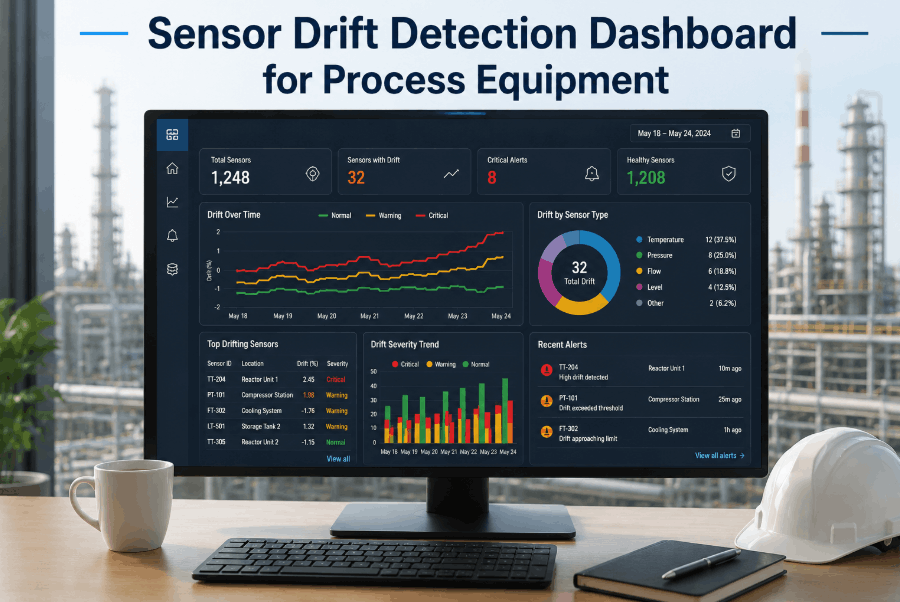
Sensor Drift Goes Undetected
Sensors calibrate out of range over time, generating false anomaly patterns that are indistinguishable from genuine degradation signals without automated drift detection and recalibration triggers built into the workflow.
04
Alert Fatigue from False Positives
When false alarm rates exceed 30–40% of total anomaly alerts, reliability teams develop dismissal habits. The next genuine fault signal gets treated with the same skepticism as noise — and the window to act before failure closes.
05
Missing Data Context at Alert Time
An anomaly alert without asset history, recent work order context, production load data, and baseline comparisons forces engineers to spend 15–30 minutes gathering context before deciding how to respond — if they respond at all.
06
No Closed-Loop Feedback to Models
When technician outcomes — confirmed fault, false alarm, deferred — are not fed back into detection models, prediction quality degrades over time as operating conditions change and feature drift goes uncorrected.
Anomaly Detection Workflow Architecture: Five Stages
An effective factory anomaly detection workflow moves from raw telemetry through signal processing, pattern recognition, fault classification, alert routing, and response tracking in a single integrated loop. Book a Demo to see how Oxmaint structures each stage of this workflow inside its predictive maintenance and CMMS platform.
ANOMALY DETECTION WORKFLOW — 5-STAGE ARCHITECTURE
01
Telemetry Ingestion and Normalization
Collect sensor data streams across vibration, temperature, pressure, current draw, and cycle time. Normalize against baseline operating windows for each asset and shift condition before passing signals to the anomaly detection layer. Oxmaint integrates with PLC, SCADA, and IoT sensor networks to centralize telemetry without custom middleware.
02
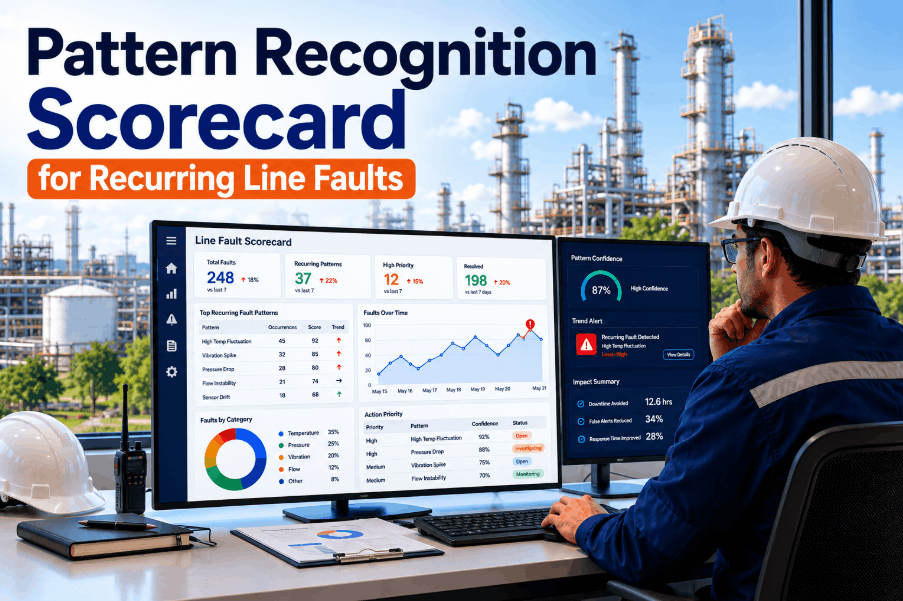
Pattern Recognition and Anomaly Scoring
Apply statistical and machine learning models to identify deviations from normal operating patterns. Score each anomaly by magnitude, persistence, rate of change, and historical fault correlation. Oxmaint's anomaly scoring engine provides confidence scores that filter noise before alerts are generated, reducing false positive rates at the source.
03
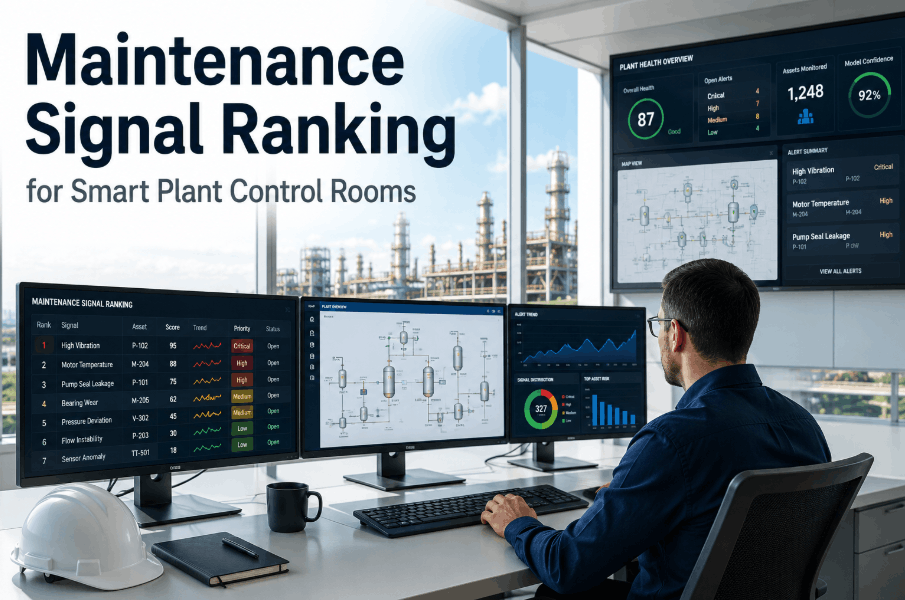
Fault Filtering and Signal Ranking
Apply asset criticality weights, production schedule context, and failure mode libraries to filter low-confidence signals and rank surviving anomalies by operational impact. A bearing anomaly on a single-point-of-failure compressor ranks higher than the same signal on a redundant secondary motor — even at identical confidence scores.
04
Alert Routing and Work Order Generation
Route ranked alerts to the correct team member based on asset ownership, fault type, shift roster, and escalation rules. Oxmaint auto-generates conditional work orders for high-confidence anomalies, pre-populated with asset history, recommended inspection steps, and required parts — eliminating response lag between detection and action.
05
Outcome Feedback and Model Improvement
Record technician findings against each anomaly alert — confirmed fault, false alarm, or deferred observation. Feed outcomes back to detection models to recalibrate thresholds, correct for sensor drift, and improve prediction quality over time. Oxmaint's closed-loop feedback system ensures detection accuracy compounds with every work order completion.
Anomaly Detection KPIs: Benchmarks for Factory Reliability Programs
Reliability teams without KPI benchmarks for their anomaly detection program cannot distinguish between a well-calibrated system and one that is generating noise at scale. These metrics define performance standards across the detection-to-response workflow. Book a Demo to see Oxmaint's reliability KPI dashboard tracking all detection and response metrics in real time.
ANOMALY DETECTION WORKFLOW KPIs — FACTORY RELIABILITY BENCHMARKS
False Alarm Rate
False alerts ÷ total alerts generated
> 45%
15–30%
< 10%
Mean Time to Detect (MTTD)
Time from fault onset to alert generation
> 72 hrs
8–24 hrs
< 4 hrs
Alert Response Rate
Alerts actioned within SLA ÷ total alerts
< 60%
75–88%
> 95%
Detection-to-WO Time
Time from alert to work order creation
> 4 hrs
30–90 min
< 15 min
Model Confidence Score
Avg confidence of confirmed fault alerts
< 60%
72–85%
> 90%
Sensor Drift Incidents
Drift events detected per 100 sensors/month
> 12
3–6
< 2
How Oxmaint Powers Factory Anomaly Detection Workflows
Oxmaint's CMMS and predictive maintenance platform closes the gap between anomaly detection tools and maintenance execution. Rather than treating detection and work order management as separate systems, Oxmaint connects sensor signals to technician actions in a single workflow — with automated routing, contextual work orders, and closed-loop feedback built into the core platform. Sign Up Free to activate Oxmaint's anomaly detection workflow module for your facility.
HOW OXMAINT POWERS ANOMALY DETECTION FOR FACTORY RELIABILITY TEAMS
01
Integrated Sensor Telemetry Hub
Centralizes data from vibration sensors, thermal cameras, power monitors, and process instrumentation into a unified asset health view — no separate monitoring platform required.
02
Configurable Anomaly Thresholds
Set per-asset anomaly thresholds based on operating mode, production load, and seasonal conditions. Oxmaint's threshold engine adjusts detection sensitivity automatically to reduce false alarm rates across variable production schedules.
03
Auto-Routed Alert Notifications
Route anomaly alerts to the correct technician, engineer, or manager based on asset type, shift, and fault classification — via mobile push, SMS, or email — with escalation rules that trigger if responses breach SLA windows.
04
Contextual Work Order Auto-Generation
High-confidence anomalies automatically generate conditional work orders pre-loaded with asset history, failure mode checklists, and recommended parts — eliminating the manual step between detection and scheduled inspection.
05
Feedback Loop for Model Refinement
Technician outcomes feed directly back into Oxmaint's anomaly scoring models, improving detection accuracy and reducing false alarm rates with every closed work order — creating a self-improving reliability program.
06
Control Room Live Dashboard
Real-time view of all active anomaly alerts, alert age, response status, and asset health scores across every production line — giving reliability managers full situational awareness without leaving the control room.
PREDICTIVE MAINTENANCE · ANOMALY DETECTION · RELIABILITY ENGINEERING
Connect Sensor Data to Maintenance Action in Oxmaint
Signal ranking, automated alert routing, contextual work orders, and closed-loop feedback — designed for factory reliability teams managing high-throughput assets.
Frequently Asked Questions
Q1 What is an anomaly detection workflow in manufacturing?
It is a structured process that moves sensor telemetry through signal normalization, pattern recognition, fault filtering, alert routing, and technician response tracking to convert raw data into prioritized maintenance actions with minimal false alarms.
Q2 How does Oxmaint reduce false alarm rates in anomaly detection?
Oxmaint applies asset criticality weights, model confidence scoring, and sensor drift detection to filter low-quality signals before alerts are generated. Technician feedback on closed work orders continuously refines detection thresholds to improve accuracy over time.
Q3 What is alert fatigue and how does structured routing prevent it?
Alert fatigue occurs when engineers receive too many low-quality alerts and begin dismissing them habitually. Structured routing ensures only ranked, high-confidence alerts reach the relevant team member — reducing volume while increasing the signal-to-noise ratio of each notification received.
Q4 Can Oxmaint detect sensor drift automatically?
Yes. Oxmaint monitors sensor output patterns against expected calibration baselines and triggers recalibration work orders when drift exceeds defined thresholds — preventing false anomaly patterns caused by degraded sensor accuracy.
Q5 How does anomaly detection integrate with Oxmaint's CMMS work order system?
High-confidence anomaly alerts in Oxmaint automatically generate conditional inspection work orders, pre-populated with asset history and failure mode checklists. This eliminates the manual handoff between the detection system and the maintenance execution layer.
Q6 What role does machine learning play in Oxmaint's anomaly detection?
Machine learning models in Oxmaint score anomaly signals by analyzing historical failure patterns, operating condition variance, and feature drift across asset classes. Confidence scores improve with each closed work order, making the system more accurate over time without manual model retraining.
ANOMALY DETECTION · CMMS · ASSET HEALTH · FACTORY RELIABILITY
Start Building Your Anomaly Detection Workflow in Oxmaint
From telemetry ingestion to closed work orders — Oxmaint gives reliability teams the structured workflow to catch failures early, route alerts fast, and keep production running.