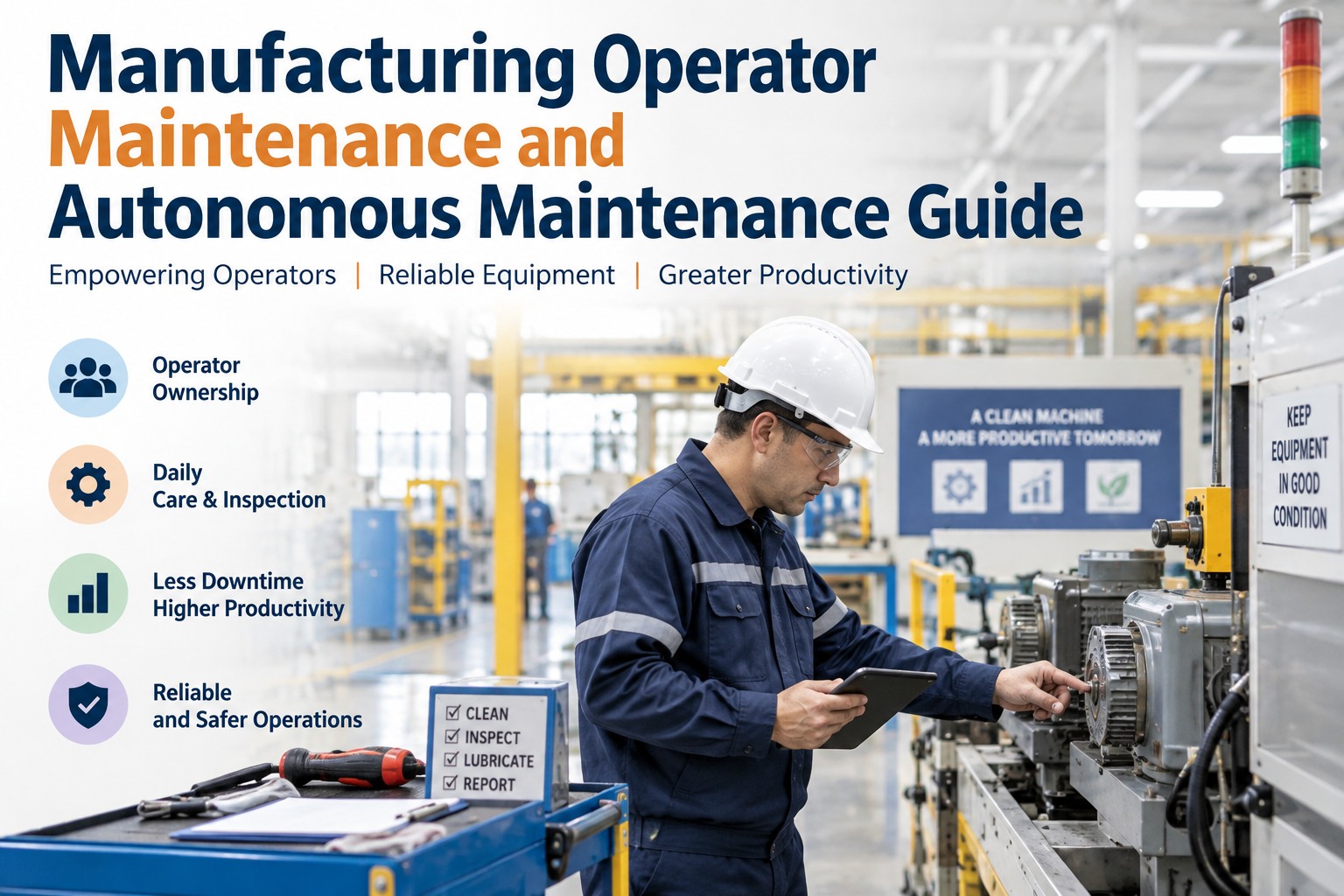
Autonomous maintenance — known in TPM as Jishu Hozen — shifts routine inspection, cleaning, and minor servicing responsibilities from maintenance teams to the operators who run equipment every day. In 2026, manufacturing plants adopting this TPM pillar are seeing measurable reductions in unplanned downtime, faster defect detection, and maintenance departments freed to focus on complex reliability work. Sign Up Free to deploy operator checklists, AM inspection workflows, and Jishu Hozen step tracking inside OxMaint — the CMMS built for manufacturing plants running TPM programs. Book a Demo to see how OxMaint structures autonomous maintenance by equipment, shift, and operator role on mobile.
Put Jishu Hozen Into Practice — Not Just Theory
OxMaint gives operators structured AM inspection checklists on mobile, routes defect tags to maintenance, and tracks step progression across your entire TPM program — all connected to the asset register.
What Is Autonomous Maintenance (Jishu Hozen) in TPM?
Autonomous maintenance is the first and most operator-visible pillar of Total Productive Maintenance. The principle is straightforward: the operator who runs a machine every shift is best positioned to detect early signs of deterioration — abnormal sounds, vibration changes, oil discolouration, loose fasteners. Book a Demo to see how OxMaint structures Jishu Hozen checklists and defect tagging for operator-driven maintenance programs. Rather than waiting for a maintenance technician to discover a developing fault during a scheduled inspection, autonomous maintenance trains operators to clean, inspect, lubricate, and report — intercepting failures before they cause downtime. OxMaint's mobile-first CMMS supports this model by putting structured AM checklists directly in the operator's hands, routing any identified abnormality to the maintenance team as a tagged work order, and tracking completion rates by asset, line, and shift.
Without Autonomous Maintenance
Operators report faults only after production impact
Equipment deterioration undetected between PM cycles
Maintenance team reactive, overwhelmed with breakdowns
No operator ownership over equipment condition
Defect tags informal — verbal reports lost at shift change
No visibility into AM compliance by line or shift
OxMaint AM Program
Operators complete structured inspection rounds each shift
Abnormalities detected and tagged before failure occurs
Maintenance focuses on complex work — not routine checks
Operators own equipment condition within defined standards
Defect tags become trackable work orders — nothing lost
AM compliance dashboards live by asset, line, and crew
The 7 Steps of Jishu Hozen — Applied to Manufacturing in 2026
The seven-step Jishu Hozen progression is the structured path from reactive operator behaviour to genuine equipment ownership. Each step builds on the last — establishing baseline conditions, developing operator competency, and ultimately creating self-managing production teams. Sign Up Free to track your plant's AM step progression in OxMaint and issue step-specific operator checklists as your program advances.
Step 1
Initial Cleaning and Inspection
Operators perform a thorough clean of each machine — removing grease, dust, and contaminants while simultaneously identifying all abnormalities, defects, and unsafe conditions. Cleaning becomes inspection at this stage.
Step 2
Eliminate Sources of Contamination
The team identifies and eliminates the root sources of contamination and hard-to-reach areas. Kaizen improvements — guards, covers, drain modifications — make the cleaning standard sustainable without heroic effort.
Step 3
Establish Cleaning and Lubrication Standards
Operators define the cleaning and lubrication standard for each machine — specifying method, lubricant type, interval, and responsibility. Standards become the baseline for all future AM inspection rounds.
Step 4
General Inspection Training
Operators receive technical training on mechanical, hydraulic, pneumatic, and electrical systems. They learn to identify out-of-standard conditions across all major subsystems — expanding their inspection competency beyond cleaning.
Step 5
Autonomous Inspection
Operators conduct full autonomous inspections using self-developed checklists. These combine the cleaning standard from Step 3 with the technical inspection scope from Step 4 — requiring no supervision to execute correctly.
Step 6
Standardisation and Visual Management
Standards are formalised and visual management tools installed — oil level sight glasses, lubrication point colour coding, fastener torque marks. Abnormalities become immediately visible without reference to documentation.
Step 7
Full Autonomous Management
Operators independently manage equipment condition — self-auditing, identifying improvement opportunities, and driving kaizen on their lines. Maintenance works in partnership, not as a rescue service.
Key Elements of an Effective Operator Autonomous Maintenance Checklist
Equipment Identification
Asset ID, machine name, line, and shift — ensuring the inspection record links directly to the asset history in your CMMS rather than existing as a standalone paper record.
Cleaning Points with Pass/Fail Criteria
Specific surfaces, guards, and components to clean — with defined acceptance criteria so operators know when the standard is met, not just that cleaning was performed.
Lubrication Check Points
Lubrication points, lubricant type, quantity or level indicator, and interval — covering all greasing, oiling, and hydraulic fluid checks within the operator's AM responsibility.
Fastener and Structural Checks
Bolts, guards, brackets, and fixings to inspect for tightness, corrosion, or damage — particularly on high-vibration equipment where fastener loosening is a common early failure signal.
Abnormality Tagging Workflow
A structured defect logging section where operators record any out-of-standard condition found — automatically generating a maintenance work order rather than relying on verbal handover.
Completion Timestamp and Sign-Off
Operator name, completion time, and any comments — providing the audit trail that makes AM compliance verifiable and feeds shift-level completion reporting for plant managers.
Autonomous Maintenance Inspection Record: Sample Format
Scroll →
| AM Step |
Asset ID |
Inspection Point |
Standard / Criteria |
Finding |
Action Required |
WO Raised |
Operator |
Date / Shift |
| Step 3 |
EQ-014 |
Gearbox oil level |
Between MIN and MAX on sight glass |
At MIN mark |
Top up with ISO VG 220 |
WO-5112 |
P. Sharma |
14 May 2026 / Day |
| Step 5 |
EQ-022 |
Drive belt tension |
15mm deflection at mid-span under 10N |
Pass |
None |
— |
A. Mehra |
14 May 2026 / Day |
| Step 1 |
EQ-007 |
Coolant filter screen |
No visible blockage or discolouration |
Partial blockage — brown deposit |
Clean and inspect coolant system |
WO-5118 |
R. Joshi |
14 May 2026 / Night |
| Step 4 |
EQ-031 |
Pneumatic FRL unit |
Pressure 5–6 bar, bowl clear, drain open |
Bowl 30% full of condensate |
Drain and inspect auto-drain valve |
WO-5124 |
S. Rao |
15 May 2026 / Day |
| Step 5 |
EQ-019 |
Conveyor surface and guides |
No product residue, guides aligned within 2mm |
Pass |
None |
— |
P. Sharma |
15 May 2026 / Day |
| Step 6 |
EQ-041 |
Hydraulic hose and fittings |
No seepage, hose condition good, no chafing |
Minor seepage at union fitting |
Hydraulic team to check and reseal |
WO-5131 |
A. Mehra |
15 May 2026 / Night |
How OxMaint Supports Your Autonomous Maintenance Program
01
AM Checklists on Mobile
Operators access shift-specific AM inspection checklists via mobile — no paper, no missed points.
Book a Demo to see the operator interface.
02
Defect Tags to Work Orders
Any abnormality flagged by an operator becomes a structured corrective work order — routed to the right trade with asset context attached automatically.
03
Jishu Hozen Step Tracking
Track each asset's AM step progression — from initial cleaning through full autonomous management — with completion evidence stored against the asset record.
04
AM Compliance Dashboards
Live compliance rates by line, shift, and operator — giving maintenance managers visibility into where AM program adherence needs support, not just whether tasks were ticked.
05
Linked to Asset History
Every AM round, defect tag, and resulting work order links to the asset record — building the maintenance history that supports PM optimisation and reliability analysis over time.
Autonomous Maintenance Implementation Roadmap
1
Pilot Asset Selection
Week 1–2
Select 3–5 assets for your AM pilot. Import into OxMaint, assign operators, and configure initial cleaning inspection checklists aligned with Jishu Hozen Step 1.
2
Operator Onboarding
Week 2–3
Train operators on OxMaint mobile, AM inspection standards, and defect tagging workflow. First autonomous rounds completed with maintenance team support on-site.
3
Standard Setting and Rollout
Month 2
Cleaning and lubrication standards locked into OxMaint checklists. AM program rolled out across remaining priority assets. Compliance tracking active for all lines.
4
Step Progression and Audit
Month 3+
Assets advance through Jishu Hozen steps with OxMaint tracking evidence per step. Regular AM audits validate standards. Defect trend data drives PM optimisation decisions.
Results Manufacturing Plants Achieve with Structured AM Programs
40%
Reduction in minor stoppages within 6 months of AM program activation on pilot lines
3×
More defects detected before failure when operators run structured AM inspection rounds vs informal observation
Zero
Missed AM rounds — OxMaint mobile compliance tracking eliminates the paper-based gap between completion and visibility
Live
AM compliance rates, defect tag frequency, and step progression — available to plant managers in real time without spreadsheet chasing
Deploy Autonomous Maintenance Checklists Across Your Plant in Days
OxMaint structures your Jishu Hozen program end-to-end — operator checklists on mobile, defect tags into work orders, and step progression tracked against every asset.
Book a Demo to see AM in action for your plant type, or
Sign Up Free and configure your first autonomous maintenance checklist today.
Frequently Asked Questions
What is the difference between autonomous maintenance and preventive maintenance?
Autonomous maintenance is performed by operators as part of their daily role — covering cleaning, lubrication, and basic inspection. Preventive maintenance is scheduled, trade-executed work on components requiring technical skill. AM and PM work together in a TPM program; AM prevents deterioration, PM restores and upgrades.
How long does it take to implement a Jishu Hozen program in a manufacturing plant?
Most plants complete Steps 1–3 across pilot assets within 6–8 weeks. Full plant rollout through Step 5 typically takes 6–12 months depending on workforce size and asset count. OxMaint accelerates this by digitising checklist deployment and tracking from week one.
Can OxMaint support plants that are at different Jishu Hozen steps on different assets?
Yes. OxMaint tracks AM step progression per asset — so Line 1 can be at Step 5 while a recently onboarded line runs Step 1 checklists. Each asset's AM maturity is visible independently without affecting plant-wide reporting.
How does OxMaint handle defect tagging in an autonomous maintenance program?
Operators flag any abnormality directly in the AM checklist on mobile — this raises a corrective work order automatically, routed to the right maintenance trade with the asset ID, defect description, and photo attached. No verbal handover required.
Does autonomous maintenance work for process industries as well as discrete manufacturing?
Yes. The Jishu Hozen framework applies to process plants — refineries, food and beverage, pharmaceuticals, water treatment — wherever operators interact with equipment daily. OxMaint supports AM checklist configuration for rotating equipment, pipework, instrumentation, and utilities across all plant types.
How does OxMaint measure autonomous maintenance compliance across shifts?
OxMaint timestamps every AM round completion and reports compliance rates by asset, line, shift, and operator — giving maintenance managers and plant supervisors live visibility into AM execution without manual tracking or paper collection.
Free to Start — No Credit Card Required
Every Operator. Every Shift. Every Asset — Autonomous Maintenance Running in OxMaint.
Replace paper AM rounds and verbal defect handovers with structured digital checklists, automatic work order creation, and live compliance dashboards. Start your Jishu Hozen program in OxMaint today.
-how-to-empower-operators-in-2026.png)

-for-manufacturing-plants-a-2026-guide.png)


