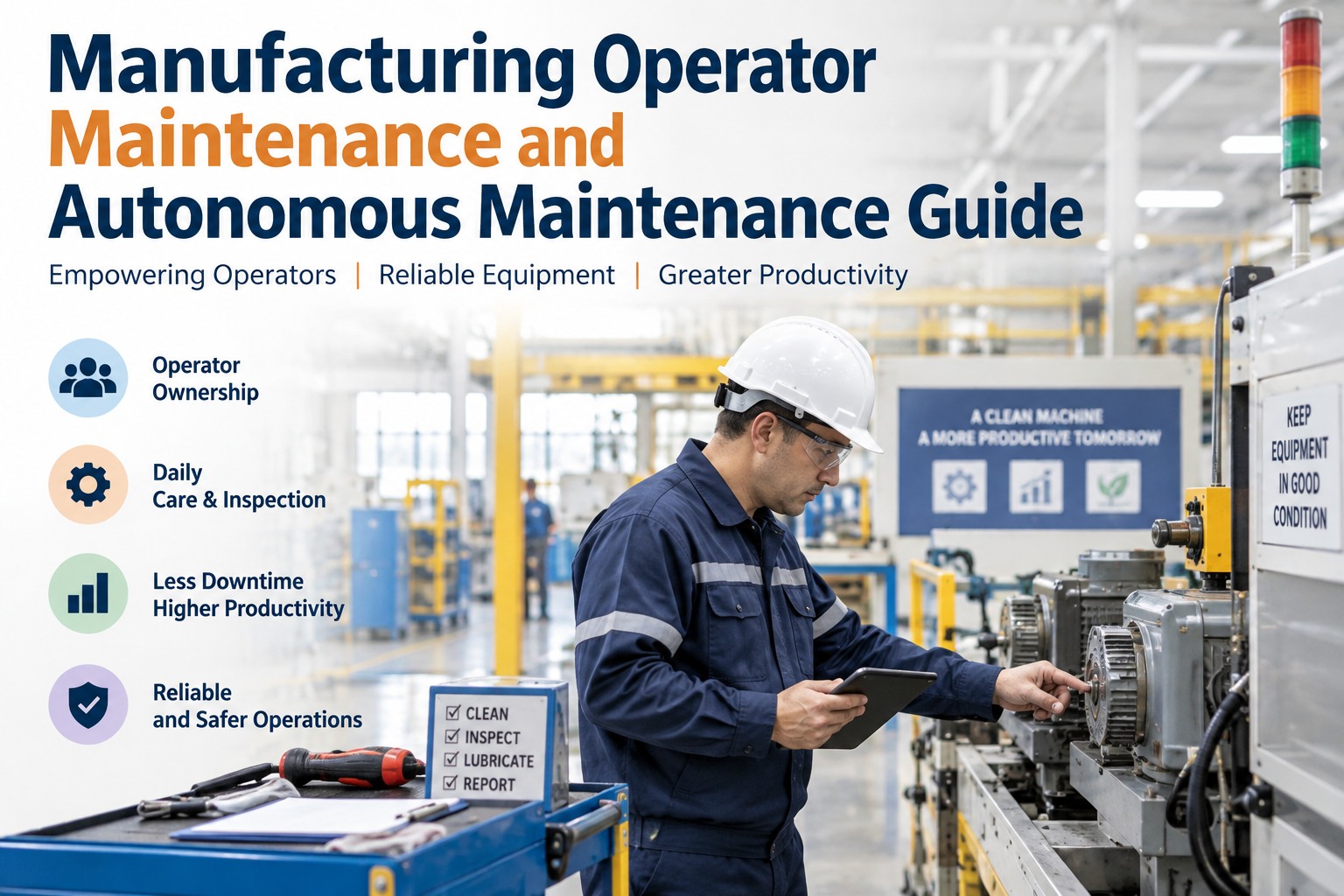
In high-performance manufacturing plants, the most reliable assets share one trait: operators who own their equipment. Sign Up Free on OxMaint to digitize your autonomous maintenance program with structured checklists, real-time operator task tracking, and CMMS integration that closes the loop between the production floor and your maintenance team. Operator-driven reliability — commonly formalized as Autonomous Maintenance (AM) under the Total Productive Maintenance (TPM) framework — shifts frontline operators from passive equipment users to active reliability contributors. When operators detect, report, and prevent defects at the source, maintenance teams gain the capacity to focus on higher-value planned and predictive work. This guide covers the operational framework, implementation steps, OxMaint's role in enabling it, and the KPIs that define success.
What Is Operator-Driven Reliability (ODR)?
Operator-Driven Reliability is a structured maintenance strategy that extends equipment ownership responsibilities to production operators — empowering them to perform daily inspections, basic cleaning and lubrication, minor adjustments, and early-stage defect detection. Book a Demo with OxMaint to see how mobile operator checklists and defect tagging reduce unplanned downtime events before they reach the maintenance queue. ODR is not about replacing skilled maintenance technicians — it is about creating a first line of defense at the machine level that catches developing faults hours or days before they cause production-stopping failures.
Operators are trained to understand their machine's normal operating parameters — enabling them to detect early warning signs that would be invisible to a scheduled inspection team.
Operators identify and tag abnormalities — unusual noise, vibration, leaks, temperature — at the point of operation, giving maintenance planners lead time to schedule corrective action.
Daily cleaning, lubrication, and fastener checks performed by operators maintain equipment at rated condition between formal maintenance intervals — extending asset life and MTBF.
Operator findings feed directly into the CMMS work order queue — connecting floor-level observations to formal maintenance planning, scheduling, and closure tracking.
The 7 Steps of Autonomous Maintenance Implementation
Autonomous Maintenance follows a structured seven-step progression defined under the TPM framework. Each step builds operator competency and equipment control incrementally — preventing the common failure mode of deploying AM programs without adequate training foundations. Sign Up Free on OxMaint to manage each AM step with digital task templates, completion tracking, and real-time visibility across your operator teams.
Operators perform a thorough deep-clean of their assigned equipment, physically touching every component surface. This cleaning activity reveals hidden defects — loose fasteners, oil contamination sources, worn seals, frayed cables — that visual-only inspections miss. All identified abnormalities are tagged for maintenance action.
Maintenance and operators collaborate to eliminate the root causes of contamination — leaking seals, unguarded chip ejection, lubricant overflow points — and to improve access for future cleaning and inspection activities. This step prevents the rapid return of the defects identified in Step 1.
Formal operator standards are created — specifying what is cleaned, lubricated, and inspected; at what frequency; using what method and materials; and to what acceptance criterion. OxMaint digitizes these standards as structured mobile checklists with pass/fail criteria and photo capture capabilities.
Operators receive structured technical training on machine subsystems — hydraulics, pneumatics, drives, controls, fastening systems — building the equipment knowledge required to detect abnormal conditions beyond their immediate operating parameters. Training completion and competency verification are tracked against each operator-asset assignment.
Operators independently execute their machine inspections using digital checklists — without requiring maintenance supervision for each round. At this stage, operators have the competency to distinguish normal wear from failure-trend conditions and to escalate defect reports with sufficient technical detail for maintenance planning. Book a Demo to see OxMaint's mobile inspection workflow for autonomous maintenance teams.
Operator maintenance activities are standardized across all shifts and asset types — ensuring consistent execution quality regardless of which operator is assigned to which machine on a given shift. Visual standards, simplified work instructions, and digital checklists are the tools that maintain program discipline at this stage.
Operators proactively improve their equipment — identifying improvement opportunities, proposing PM frequency adjustments based on observed wear patterns, and participating in reliability reviews. At this maturity level, operator-maintenance collaboration produces measurable reductions in MTTR, breakdown frequency, and unplanned downtime cost.
Core Operator Tasks in an Autonomous Maintenance Program
Defining clear task boundaries between operator autonomous maintenance and technician-performed maintenance is essential to program success. The following table maps common AM task categories to operator responsibility, frequency, and OxMaint's execution support.
| AM Task Category | Operator Responsibility | Frequency | OxMaint Support |
|---|---|---|---|
| Equipment Cleaning | Full surface cleaning, chip/debris removal, coolant wipe-down | Daily / Per Shift | Shift checklist with completion sign-off |
| Lubrication Checks | Visual oil level inspection, grease point application per schedule | Daily / Weekly | Lube point checklist with quantity tracking |
| Fastener Inspection | Visual and tactile check for loose bolts, guards, covers | Weekly | Structured checklist with pass/fail capture |
| Abnormality Detection | Identification and tagging of noise, vibration, leaks, heat | Continuous / Per Shift | Mobile defect tagging → auto WO creation |
| Operating Parameter Checks | Pressure, temperature, and cycle time within specification limits | Per Shift | Numeric reading capture with threshold alerts |
| Minor Adjustments | Belt tension, guide alignment, sensor position within defined scope | As Required | Linked to work permit and competency verification |
| Defect Escalation | Formal defect report with photo, location, and severity classification | As Identified | Direct CMMS escalation to maintenance queue |
How OxMaint Enables Operator-Driven Reliability at Scale
Most autonomous maintenance programs fail not because of poor intent but because of poor execution infrastructure. Paper checklists get skipped, defects go unreported, and maintenance teams have no visibility into what operators are actually finding. Sign Up Free on OxMaint to replace paper-based AM execution with a digital platform that connects every operator inspection to your maintenance planning system in real time.
OxMaint delivers structured AM checklists to operator mobile devices at shift start — covering cleaning, lubrication, inspection, and parameter checks for each assigned asset. Completion is tracked in real time with timestamped sign-off, eliminating the compliance ambiguity of paper-based programs. Checklist non-completion triggers automatic supervisor alerts before the shift window closes.
When an operator identifies an abnormality, OxMaint's mobile defect reporting allows them to log the issue with photo, asset tag, defect category, and severity — directly from the machine. The platform auto-creates a corrective work order in the maintenance queue, pre-populated with the operator's findings and assigned to the correct trade. This closes the most common gap in AM programs: the defect that gets verbally reported but never formally acted upon.
Every operator inspection, defect report, and AM task completion is recorded against the specific asset record in OxMaint's CMMS. This builds a complete operational history per asset — showing maintenance planners what operators observe between formal PM intervals and enabling pattern recognition for failure mode analysis. Reliability engineers gain a data layer that traditional maintenance-only CMMS systems cannot provide.
OxMaint's real-time dashboards give maintenance managers and plant leadership visibility into AM compliance rates by shift, line, and asset — showing checklist completion percentages, defect report volumes, and open defect aging. Operations achieving greater than 90% AM checklist compliance consistently report 20–35% reductions in unplanned breakdown events within 6 months of sustained program execution. Book a Demo to see the AM compliance reporting module live.
OxMaint closes the communication gap that undermines operator engagement in most AM programs: operators receive automatic notification when their defect report generates a work order, when that work order is scheduled, and when the repair is completed. This feedback confirms that operator findings drive real maintenance action — building the reporting habit that sustains program compliance over time.
Operator-Driven Reliability KPIs and Industry Benchmarks
Measuring the impact of an autonomous maintenance program requires KPIs that capture both operator activity compliance and the equipment reliability outcomes that AM activity should drive. Use these benchmarks to evaluate program maturity and identify improvement priorities. Sign Up Free on OxMaint to track all AM KPIs from a single dashboard connected to your live operator checklist and work order data.