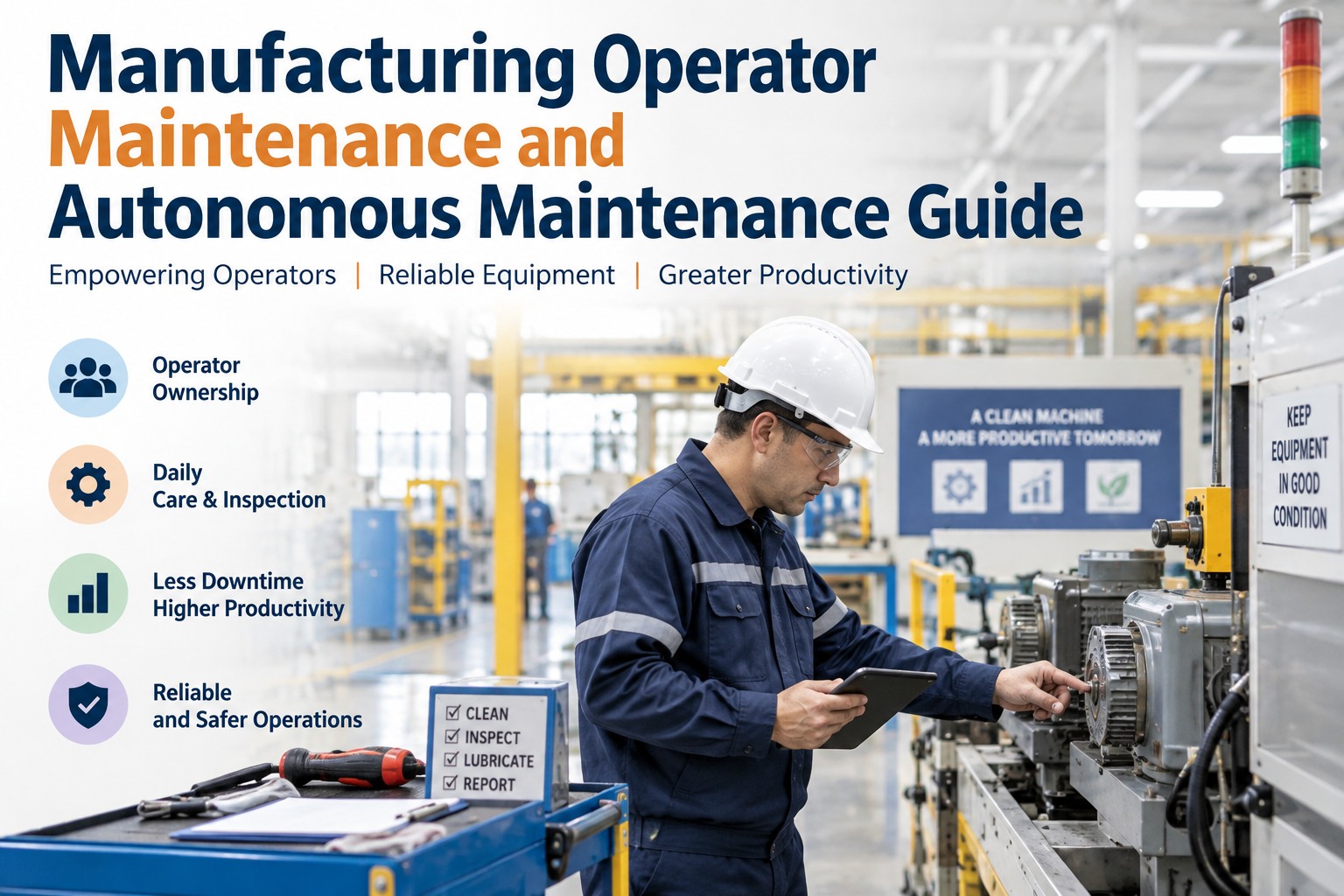
Operator-led equipment care isn't a nice-to-have add-on to a maintenance program it's one of TPM's eight pillars for a reason. Studies on autonomous maintenance programs consistently find that 40–60% of equipment breakdowns are preventable through basic operator care: catching a loose bolt, a small leak or unusual noise before it becomes a failure. The daily routine behind that is deceptively simple — Clean, Inspect, Lubricate, often extended to CLAIR (Clean, Lubricate, Adjust, Inspect, Repair) — and it takes most operators just 10 to 15 minutes a shift once it's built into the routine. The strategic payoff isn't just fewer breakdowns — it's freeing skilled technicians from firefighting minor issues so they can focus on the complex repair work only they can do. This guide covers the seven-step framework and how OXMAINT AI connects an operator's tagged defect straight into a technician's work order.
Manufacturing · TPM · Operator-Led Reliability · 2026
Manufacturing Operator Maintenance and Autonomous Maintenance Guide
A loose bolt an operator notices during a cleaning round is either caught in ten seconds or missed until it becomes a breakdown — the difference is whether that observation goes anywhere. OXMAINT AI connects the workflow behind autonomous maintenance: daily CIL checklists log against the specific asset, any tagged defect becomes a tracked work order routed to maintenance, and the repair history feeds back into future inspection points — so operator care and technician repair work run on the same system instead of a clipboard and a verbal handoff.
Daily CIL Round Logged
→
Defect Tagged
→
Work Order Created
→
Repair History Updated
40–60%
of equipment breakdowns are preventable through basic operator care
7 Steps
the JIPM framework that structures a mature Jishu Hozen program
10–15 min
typical daily CIL routine an operator will actually sustain long-term
85%+
world-class OEE that mature TPM programs target
CIL: Why Cleaning Is Really Inspection
The daily routine looks like housekeeping and functions like condition monitoring — each pass puts hands and eyes on the machine in a way a monthly PM never will. Sign up free and build your first operator checklist today.
🧽
Cleaning
Wiping every surface puts hands and eyes on leaks, cracks, loose fasteners and abnormal wear — the point is detection, not shine.
🔍
Inspection
Checking gauges, temperature, vibration and noise against a known normal — bolts, belts, bearings, fluid levels, guards and interlocks.
🛢
Lubrication
Confirming fluid levels and applying lubrication on schedule — the step most often skipped, and most often behind a preventable failure.
🏷
Tagging
Every defect found gets tagged against the asset immediately — not remembered until the end of shift, or not at all.
The Seven Steps of Autonomous Maintenance
Jishu Hozen builds in stages — each step earns the next. Skipping ahead usually means the program collapses back to firefighting within a few months. Book a demo to see how digital checklists support each step.
1
Initial Cleaning
Operators deep-clean their equipment for the first time, surfacing hidden defects a routine wipe-down never would.
2
Eliminate Contamination Sources
Address the root causes of dirt, dust and leaks, and improve access to hard-to-reach points.
3
Set CIL Standards
Define exactly what cleaning, inspection and lubrication should look like, and how long each should take.
4
General Inspection Training
Operators learn to recognize abnormal readings, sounds and wear — inspection skill, not just a checklist to complete.
5
Autonomous Inspection
Operators run the full inspection independently, integrated into the daily production routine.
6
Standardize & Organize
CIL, safety and workplace standards are unified across shifts and lines, not left to individual habit.
7
Full Self-Management
Operators manage their own equipment goals and continuous improvement, closing the loop with reliability engineering.
Where Operator Care Programs Actually Break Down
📋
Tags Stay on Paper
An operator tags a defect with a physical tag on the machine. It sits there until someone happens to notice it during a walkthrough.
🔁
No Feedback Loop
Operators report findings but never hear what happened to them — and stop bothering to report the next one.
📉
Standards Drift Between Shifts
One shift's CIL routine looks nothing like another's, so the same asset gets inconsistent care depending on who's on it.
🐌
Repeat Defects Go Unnoticed
The same bearing gets tagged for noise three separate times across three months, and nobody connects the pattern.
A Defect Tag That Doesn't Reach a Work Order Trains Operators to Stop Tagging.
OXMAINT AI routes every operator-logged defect straight into a tracked work order — so the loop closes, and the habit sticks.
From Operator Tag to Closed Work Order
1
CIL round performed
Operator completes the daily clean, inspect and lubricate checklist on their assigned equipment.
→
2
Defect tagged
Any abnormality found is tagged digitally against the specific asset, with a photo if useful.
→
3
Work order created
A work order routes to maintenance automatically, with the tag and asset history attached.
→
4
Technician resolves
The repair is logged against the asset, and the operator sees the tag closed out.
→
5
Pattern reviewed
Repeat tags on the same asset surface automatically, flagging a bad actor before it becomes chronic.
Paper Tags vs. Digital CIL in OXMAINT AI
Paper Tags & Verbal Handoff
A defect tag hangs on the machine until someone notices it
Operator never learns whether the finding was acted on
CIL standard varies by shift, habit and memory
Repeat defects on the same asset go unnoticed across separate tags
Digital CIL in OXMAINT AI
A tagged defect creates a work order the moment it's logged
Operator sees the tag move from open to resolved
CIL checklist is identical across every shift and line
Repeat defects on the same asset flag automatically
What OXMAINT AI Gives Operators & Reliability Teams
Mobile CIL Checklists
Standardized clean, inspect, lubricate routines completed from a mobile device, identical across every shift and operator.
Digital Defect Tagging
Operators tag an abnormality directly against the asset, with a photo attached, instead of a physical tag on the machine.
Tag-to-Work-Order Routing
A tagged defect creates a work order automatically, so operators see their findings actually move.
Bad Actor Detection
Repeat tags on the same asset surface automatically, flagging chronic problem equipment before it becomes a bigger failure.
Operator-Technician Visibility
Both sides see the same record — the operator's tag and the technician's repair — closing the loop that paper tags never do.
Program Maturity Tracking
See CIL completion rates and tag-to-close times by line or shift, to know where the seven-step rollout actually stands.
"
We rolled out CIL checklists years ago, but the tags operators found lived on a paper slip stuck to the machine — half the time nobody acted on them until the next PM cycle, and operators noticed. Once we moved tagging into OXMAINT AI, a defect an operator finds becomes a work order the same shift, and they can see it get closed. Tag volume actually went up at first, because operators trusted that reporting something meant it would get fixed — and a bearing that had been tagged twice before on the same line got caught before its third failure.
Manufacturing Reliability Lead · Discrete Parts Manufacturer
Frequently Asked Questions
What's the difference between autonomous maintenance and preventive maintenance?
Autonomous maintenance is operator-led basic care — cleaning, inspection, lubrication and defect tagging performed daily by the person running the machine. Preventive maintenance is scheduled, more technical work performed by skilled technicians. Autonomous maintenance complements PM by catching early-stage issues before they need a technician at all.
How long does it take to roll out all seven steps of Jishu Hozen?
It varies by facility, but mature programs typically build the seven steps over months, not weeks — each step depends on the discipline established in the one before it, and rushing ahead usually causes the program to collapse back into firefighting.
How does OXMAINT AI prevent operator-tagged defects from being ignored?
Every tagged defect automatically creates a work order routed to maintenance, and the operator can see its status change from open to resolved — closing the feedback loop that a physical tag on a machine can't provide.
What is a "bad actor" asset and how is it identified?
A bad actor is equipment with a pattern of repeat failures or repeat defect tags. Because every tag and repair logs against the specific asset in OXMAINT AI, a recurring issue surfaces automatically instead of hiding across separate, disconnected reports.
Give Every Operator Tag Somewhere to Go.
Daily CIL rounds, defect tags, work orders and repeat-failure detection — all connected in one system, so operator care and technician repair work reinforce each other. That's the workflow OXMAINT AI runs.

-in-manufacturing.png)


