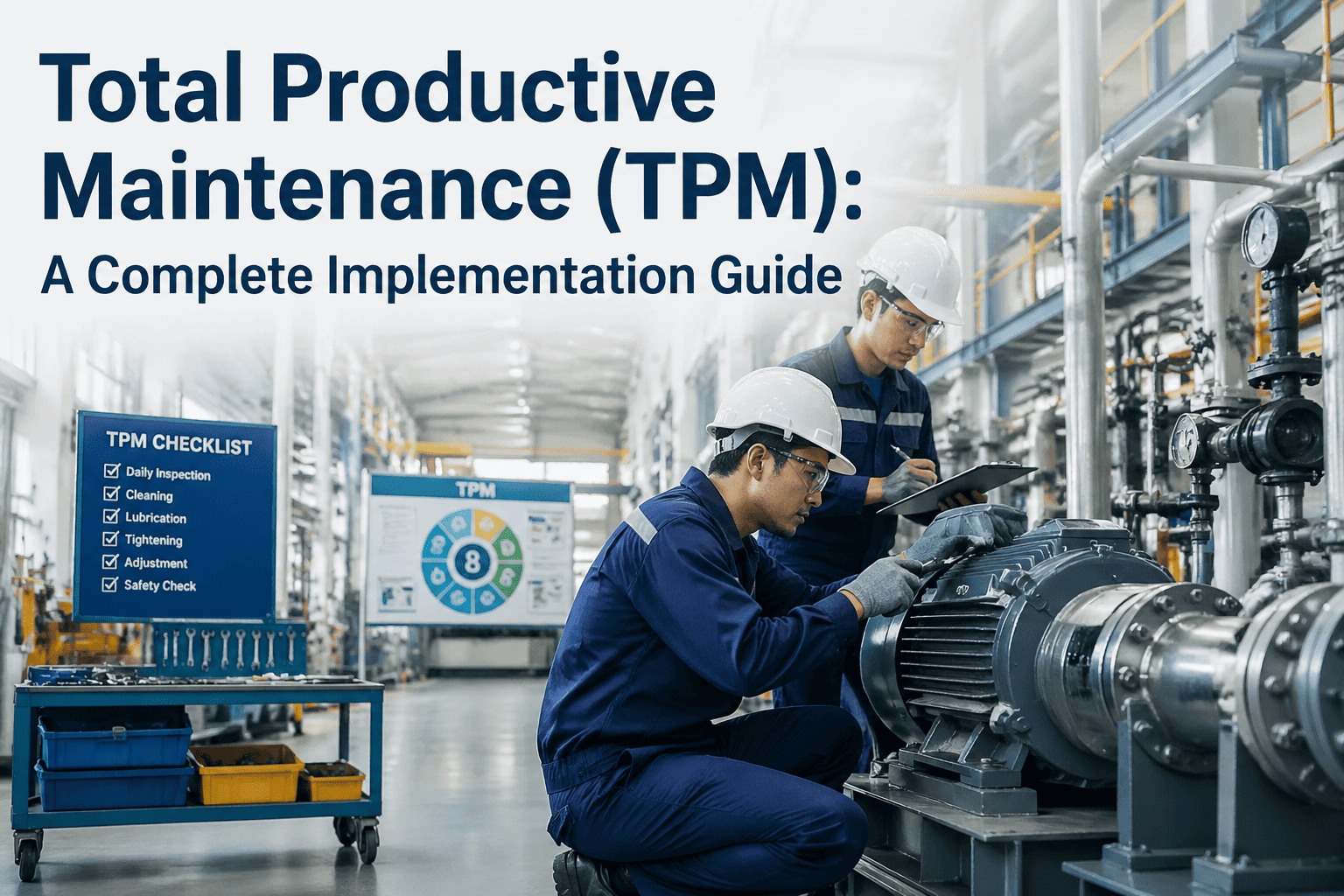
Total Productive Maintenance is the most comprehensive maintenance strategy available to manufacturing — and the most frequently misunderstood. Most TPM programmes stall at pillar two because teams treat it as a training initiative rather than an operational system. Start your TPM programme with OxMaint — free, with built-in PM scheduling, operator task management, and OEE tracking from day one.
Maintenance Strategy · OxMaint · 2026 Guide
TPM Implementation Guide for Manufacturing Plants (2026)
A structured, pillar-by-pillar TPM rollout roadmap — from autonomous maintenance and planned PMs through quality maintenance and continuous improvement — built to deliver measurable OEE gains within 90 days.
25–35%
OEE improvement at 12 months in well-executed TPM programmes
50%
Reduction in unplanned downtime within the first 6 months of AM deployment
8 pillars
The complete TPM framework — each addressing a distinct loss category
90 days
To first measurable OEE improvement with the right deployment sequence
TPM Fundamentals
What TPM Actually Is — and Why Most Implementations Fail
Total Productive Maintenance is a company-wide approach to equipment effectiveness that involves every person in the facility — from operators to senior management — in eliminating the six major losses that suppress production output. It is not a maintenance department initiative. That misunderstanding is the primary reason 60–70% of TPM programmes produce no sustained improvement beyond the first year.
The 6 Big Losses TPM Targets
Availability Losses
Unplanned Breakdowns
Avg 18% OEE impact
Setup & Changeover Time
Avg 12% OEE impact
Performance Losses
Idling & Minor Stoppages
Avg 9% OEE impact
Reduced Speed Operation
Avg 8% OEE impact
Quality Losses
Process Defects & Rework
Avg 6% OEE impact
Startup & Yield Losses
Avg 4% OEE impact
Why Implementations Fail
Treated as a maintenance programme
TPM requires operator ownership of equipment condition. When maintenance retains all equipment-related tasks and operators remain passive, autonomous maintenance never takes hold and the first two pillars produce no lasting change.
All 8 pillars launched simultaneously
Launching all pillars at once dilutes focus, overwhelms the team, and produces no measurable result in any pillar. The correct approach sequences pillars — Autonomous Maintenance and Planned Maintenance first, with the remaining six following in phases.
No baseline OEE measurement
Without a documented pre-TPM OEE baseline, improvement is invisible to management and the team loses motivation. Measure OEE on the pilot line for four weeks before the first TPM activity — this baseline becomes the proof of value at 90 days.
Paper-based task tracking
Operator AM checklists on paper produce completion rates of 40–60% because non-completion is invisible to supervisors. Digital task management with mobile completion visibility raises AM compliance to 85–95% within 30 days of deployment.
The 8 TPM Pillars
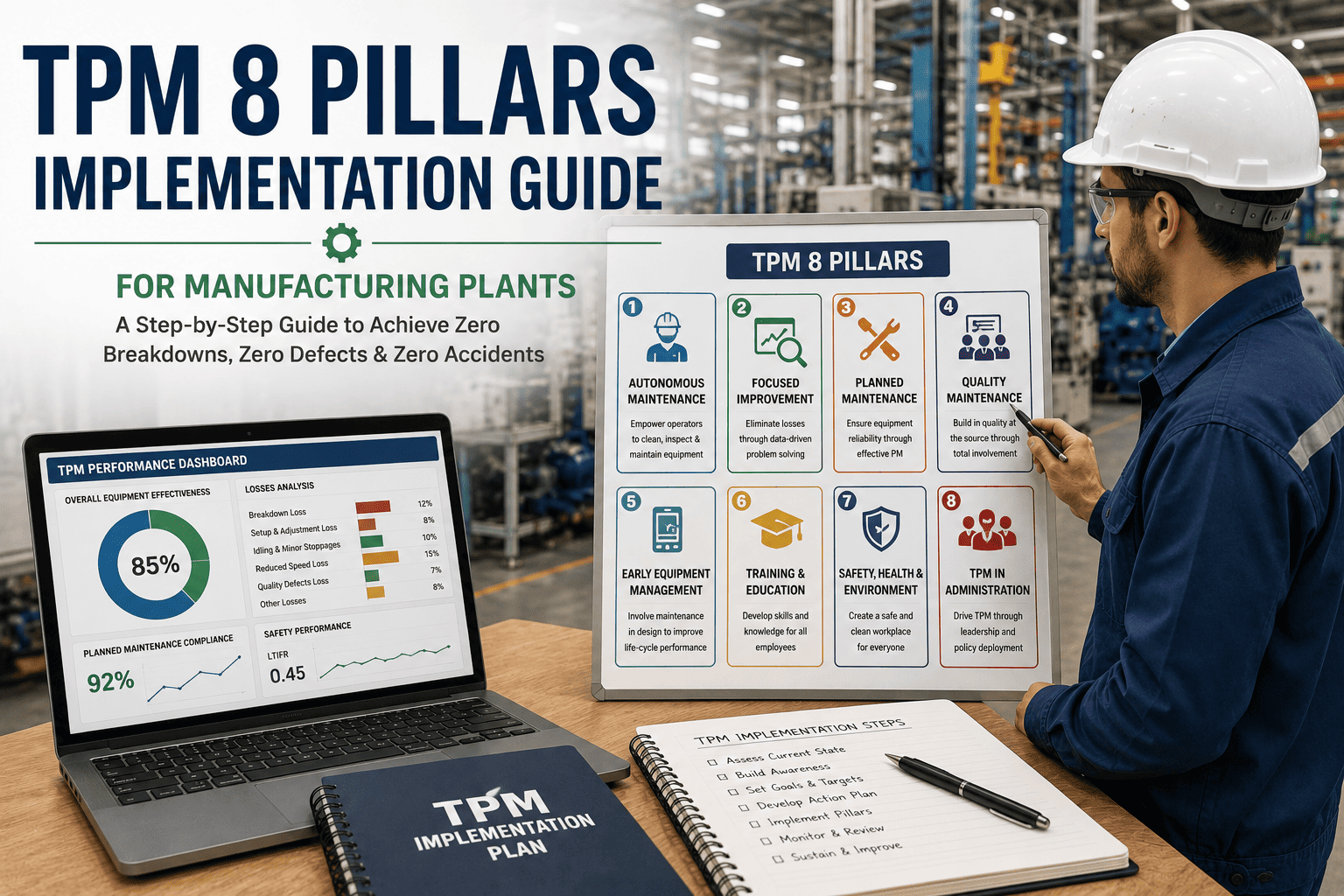
The 8 Pillars of TPM: What Each Does and When to Deploy
Deployment sequence matters as much as pillar content. This sequence is based on interdependency — each pillar builds on the foundation of the pillars deployed before it.
Phase 1 — Foundation (Months 1–3)
1
Autonomous Maintenance
Operator-led
Operators perform daily cleaning, inspection, and basic servicing of their own equipment. Eliminates contamination-related failures and transfers first-line condition monitoring from maintenance to production. The highest-ROI pillar — and the hardest to sustain without digital task management.
Target: 85%+ AM checklist compliance at 30 days
2
Planned Maintenance
Maintenance-led
Structured PM schedules replace reactive breakdown response. Maintenance shifts from firefighting to scheduled work — with PM compliance, MTTR, and unplanned work ratio as the governing KPIs. Cannot succeed without a CMMS tracking every PM work order.
Target: 80%+ PM compliance, 30% reduction in unplanned WOs at 90 days
Phase 2 — Improvement (Months 3–6)
3
Focused Improvement
Cross-functional
Small cross-functional teams (Kaizen groups) identify and eliminate the specific losses measured in the OEE baseline. Each Kaizen targets one defined loss — never a general improvement. Projects are time-boxed to 4–6 weeks with a measurable OEE impact target.
Target: 2–4 completed Kaizen projects with documented OEE gain
4
Quality Maintenance
Quality + Maintenance
Identifies the equipment conditions that cause quality defects — and builds maintenance tasks that prevent those conditions. Shifts quality from inspection-based to prevention-based. Requires data linking work orders to quality outcomes, which OxMaint provides natively.
Target: 20%+ reduction in process-caused quality defects at 6 months
5
Early Equipment Management
Engineering-led
Applies TPM learning to new equipment design — specifying maintenance access, lubrication points, and inspection windows during procurement. Prevents the next generation of equipment from inheriting the same maintenance problems as the current fleet.
Target: Maintenance input included in all new capital procurement specs
Phase 3 — Sustain (Months 6–12)
6
Training & Education
HR + Operations
Formalises the skills required to maintain each piece of equipment and closes the gaps between current and required capability. Not a one-time training event — a continuous skills matrix updated as equipment and processes evolve.
Target: Skills gap closed for 90%+ of maintenance-critical tasks
7
Safety, Health & Environment
Safety-led
Integrates safety conditions into every TPM activity — ensuring that AM, PM, and Kaizen tasks do not introduce new hazards. Zero accident target is measured alongside OEE as a primary TPM performance indicator.
Target: Zero lost-time accidents attributable to maintenance activities
8
TPM in Admin & Office
Organisation-wide
Extends TPM principles to supporting functions — procurement, planning, finance — to eliminate administrative losses that slow maintenance response. Often the most overlooked pillar and the one that determines whether TPM becomes a company culture or remains a maintenance project.
Target: Admin process waste reduction supporting maintenance lead time
Autonomous Maintenance Deep-Dive
Autonomous Maintenance: The 7 Steps That Build Operator Ownership
AM is the pillar that most directly determines TPM success or failure. These seven steps are the standardised progression from reactive cleaning to full operator-driven condition management — each step has a defined exit criterion before advancing.
S1
Initial Cleaning
Deep-clean the equipment to its as-new state. Cleaning is inspection — operators discover every defect, abnormality, and wear point during the cleaning process. Tag every identified defect with a red tag (operator responsibility) or blue tag (maintenance responsibility).
Exit criterion: Equipment is clean to standard, all defects tagged and logged
S2
Eliminate Contamination Sources
Identify and eliminate the root causes of dirt, leaks, and contamination. If a machine leaks oil onto the floor, the S1 cleaning will not hold. Counter-measures at source — seals, covers, containment trays — must be implemented before the cleaning standard can be sustained.
Exit criterion: All identified contamination sources have a documented counter-measure
S3
Cleaning & Lubrication Standards
Document the cleaning and lubrication standard — what to clean, how to clean it, what lubricant to use, how much, how often. The standard must be achievable within the available shift time. A standard that takes 45 minutes but is allocated 20 minutes is a compliance guarantee for failure.
Exit criterion: Written AM standard created, timed, and validated by the operator who will perform it
S4
General Inspection Training
Train operators to inspect beyond cleaning — to identify electrical, mechanical, hydraulic, and pneumatic abnormalities. Operators who can identify a loose terminal block, a worn V-belt, or a low hydraulic level before it causes a failure are performing condition-based monitoring on every shift.
Exit criterion: Operators pass inspection competency assessment on their specific equipment
S5
Autonomous Inspection
Operators perform all S4 inspections independently, without maintenance supervision. The AM checklist is now fully operator-owned. Maintenance reviews the completed checklists and the flagged items — but does not supervise the inspection itself.
Exit criterion: 90 days of autonomous inspection with 90%+ compliance and zero supervisor-prompted completion
S6
Standardisation
Standardise the AM activities across the production line and across shifts. Visual standards, colour-coded inspection points, and OxMaint digital checklists ensure every operator on every shift performs the same inspection to the same standard — regardless of experience level.
Exit criterion: AM standards consistent across all shifts with audited compliance rate above 90%
S7
Full Self-Management
Operators manage the AM programme autonomously — updating standards as equipment changes, identifying new inspection points, and initiating improvement proposals based on their daily interaction with the equipment. This is TPM maturity: operators who are the primary guardians of their equipment's condition.
Exit criterion: Operators initiate AM standard revisions without prompting from maintenance or management
OxMaint powers both AM and Planned Maintenance from a single platform.
Operator checklists, PM work orders, OEE tracking, and compliance dashboards — all connected, all visible in real time.
OEE Framework
Measuring TPM Progress: The OEE Dashboard You Need
OEE — Overall Equipment Effectiveness — is the single number that summarises TPM performance. World-class OEE is 85%. Most manufacturing plants start between 45–65%. This is how OEE is calculated and how each TPM pillar moves each component.
Availability
Planned Production Time − Downtime ÷ Planned Production Time
World class: 90%+Typical start: 70–80%
Improved by: Pillar 1 (AM) + Pillar 2 (Planned Maintenance)
×
Performance
Actual Output ÷ (Run Time × Ideal Cycle Rate)
World class: 95%+Typical start: 65–75%
Improved by: Pillar 3 (Focused Improvement) + Pillar 1 (AM)
×
Quality
Good Parts ÷ Total Parts Produced
World class: 99.9%+Typical start: 90–96%
Improved by: Pillar 4 (Quality Maintenance)
OEE
= A × P × Q
World class: 85%+ · Industry average: 60% · Most plants start: 45–65%
90-Day Rollout
Your 90-Day TPM Launch Roadmap
TPM is a multi-year programme, but the first 90 days determine whether it survives. This roadmap concentrates effort on the pilot line, the two foundation pillars, and the baseline metrics that prove value before the programme expands.
Days 1–14
Baseline & Pilot Selection
Select the pilot production line — highest loss impact, receptive supervisor, operator buy-in
Measure OEE on the pilot line for two weeks — Availability, Performance, Quality separately
Identify the top 3 recurring failure modes from maintenance history
Set up OxMaint with pilot line assets, operator accounts, and initial PM templates
Output: Documented OEE baseline · Pilot line in OxMaint · Top loss identified
Days 14–30
AM Steps 1–3 + PM Launch
Execute AM Steps 1–2: initial deep clean and contamination source elimination on pilot line
Create and validate AM standard (Step 3) — timed, operator-approved, entered into OxMaint
Activate PM schedule in OxMaint for pilot line assets — first PM work orders generated
Brief all operators and supervisors on TPM purpose, their role, and the OEE baseline
Output: AM Steps 1–3 complete · PM programme running · Operators briefed and engaged
Days 30–60
AM Steps 4–5 + First Kaizen
Train operators in general inspection (AM Step 4) — run competency assessment
Move to autonomous inspection (AM Step 5) — maintenance reviews, not supervises
Launch first Focused Improvement Kaizen targeting the top loss identified in baseline
Review PM compliance in OxMaint dashboard — target 80%+ at day 45
Output: Operators performing autonomous inspections · First Kaizen in progress · PM compliance tracked
Days 60–90
Measure, Present, Expand
Measure OEE at day 90 — compare against baseline using OxMaint analytics
Complete first Kaizen and document the OEE improvement achieved
Present results to management — downtime reduction, PM compliance, OEE delta
Plan TPM expansion to second line based on pilot learning and resource availability
Output: Measurable OEE improvement vs baseline · Business case for expansion · Second line planned
Common Questions
TPM Implementation: What Teams Ask Most
How long does a full TPM implementation take?
A single-line TPM pilot that includes AM Steps 1–5, a functioning planned maintenance programme, and first Kaizen results takes 3–4 months. Expanding to a full plant typically takes 2–3 years — not because the activities are slow, but because sustainable culture change requires that each line completes the full AM step sequence before the next line begins. Organisations that try to run plant-wide TPM launches simultaneously achieve compliance-on-paper and no sustained behaviour change. The pilot-and-expand model is slower on paper and dramatically faster in practice.
Sign up to access OxMaint's TPM rollout templates — free.
What is the difference between TPM and TQM?
Total Productive Maintenance (TPM) targets equipment effectiveness — its goal is to maximise OEE by eliminating the six big losses through operator involvement, planned maintenance, and focused improvement. Total Quality Management (TQM) targets product and process quality — its goal is to eliminate defects through process control, quality systems, and continuous improvement across the organisation. The two are complementary, not competing: TPM's Quality Maintenance pillar (Pillar 4) directly intersects with TQM principles, because equipment condition is often the root cause of quality variation. Many manufacturing plants run both in parallel, with TPM governing equipment effectiveness and TQM governing product quality systems.
How do I get operators to take ownership of autonomous maintenance?
Operator AM ownership requires three conditions to be met simultaneously. First, operators must understand why — the direct connection between their daily cleaning and inspection activity and the breakdowns that disrupt their work must be made visible. Second, the AM tasks must be achievable within allocated time — an AM standard that requires 30 minutes when 15 minutes is available will be skipped or rushed. Third, non-compliance must be visible to supervisors without confrontation — OxMaint's AM compliance dashboard shows every operator's daily checklist completion in real time, making non-completion a management conversation rather than an accusation. When all three conditions are met, AM compliance consistently reaches 85–90% within the first month.
Book a demo to see OxMaint's AM tracking in action.
What CMMS features are essential for TPM support?
A CMMS supporting TPM must provide five capabilities: operator-facing mobile checklists for AM task completion (distinct from maintenance work orders), PM work order generation on time and hour-based triggers, OEE or downtime reporting that connects equipment failures to the specific assets in the CMMS, compliance dashboards showing AM and PM completion rates by asset and by team, and work order history that feeds Kaizen analysis with actual failure data. OxMaint provides all five natively — AM operator checklists, PM scheduling, downtime logging, compliance reporting, and full work order history — without requiring separate modules or integrations.
TPM Implementation · OxMaint · 2026
Start Your TPM Programme With the Platform Built to Support Every Pillar
OxMaint delivers AM checklists, PM scheduling, OEE tracking, and compliance dashboards in one platform — free to start, no implementation consultant required, first AM checklists active this week.

-how-to-empower-operators-in-2026.png)