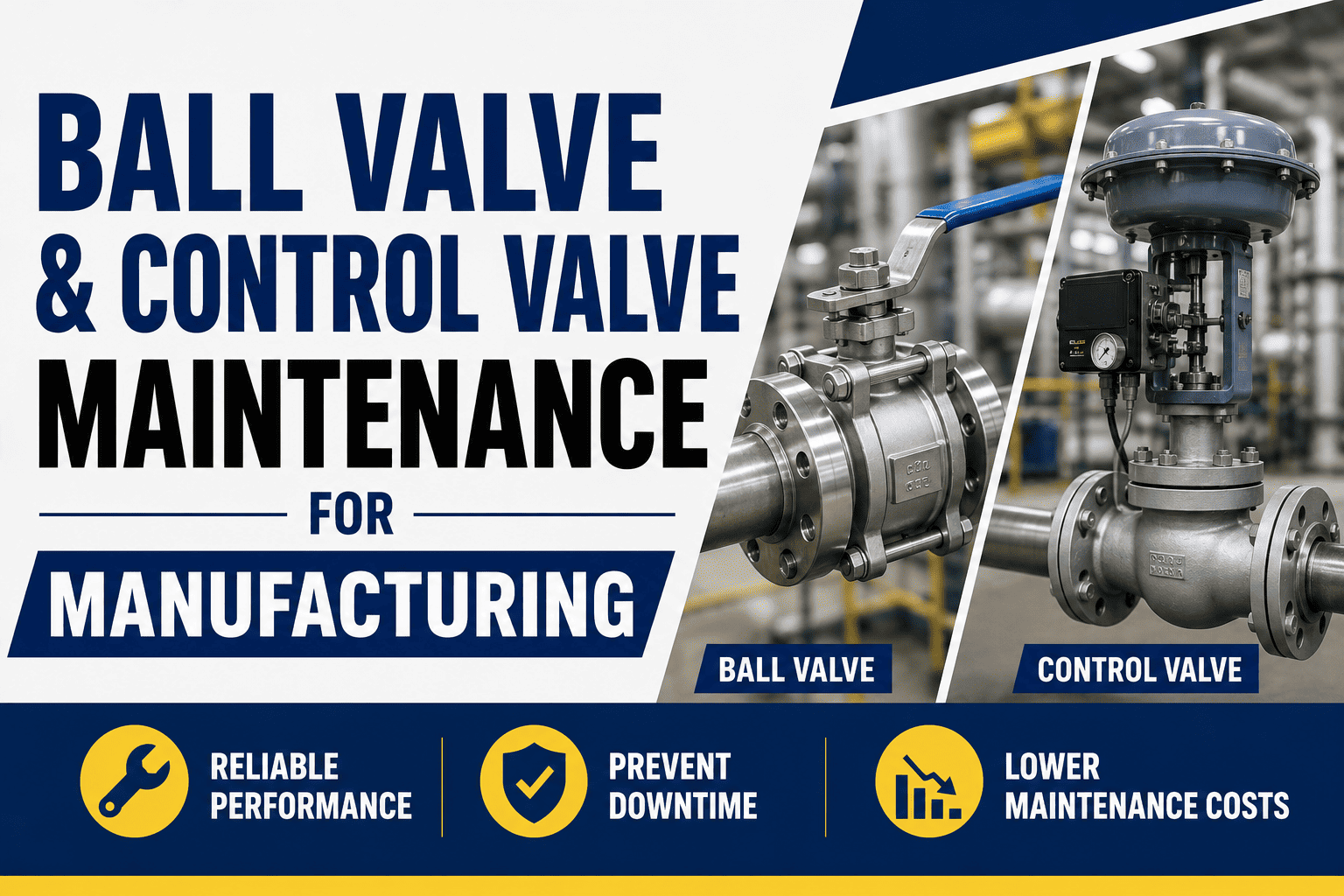
Ball valve and control valve maintenance in manufacturing plants is the difference between steady throughput and unplanned shutdowns that cost $12,000–$50,000 per hour in lost production. This guide covers everything from packing gland inspection and actuator PM to positioner calibration and valve stroking tests — and shows how scheduling valve PM in a CMMS based on criticality and service severity prevents the leaks, sticking, and fail-open events that derail operations. Whether you manage 50 valves or 5,000, building a structured ball valve PM schedule and control valve maintenance plan in Start Free Trial with OxMaint turns reactive fire-fighting into predictable, audit-ready reliability.
Valve Maintenance Guide for Manufacturing
Is One Stuck Control Valve Quietly Draining Your Plant's Profitability?
A single failed control valve on a critical loop can cascade into a full-line shutdown within minutes. Plants that run valve PM on spreadsheets experience 3.5× more unplanned downtime than those using a CMMS. OxMaint schedules, tracks, and predicts valve health — so you never discover a leak at 2 AM.
Why Valves Fail First
Why Ball Valves and Control Valves Get Dropped From PM Schedules
In most manufacturing plants, valves are treated as passive piping components rather than active mechanical assets. A mid-sized chemical plant typically operates 800–2,500 ball and control valves, yet fewer than 35% appear on a formal preventive maintenance calendar. The result: packing leaks discovered by EPA audits, actuators that seize during emergency shutdowns, and positioners that drift 8–15% off calibration before anyone notices.
When a 6-inch control valve on a reactor feed line fails closed, the upstream pump deadheads, pressure spikes trigger safety trips, and the entire batch is lost. A single incident like this can cost $40,000–$120,000 in scrapped product, overtime, and delayed orders. Yet the preventive task that prevents it — a quarterly stroking test and packing inspection — takes a technician under 20 minutes when it's pre-scheduled in a CMMS.
Ball Valve PM Checklist
Ball Valve Maintenance Guide: PM Tasks by Service Severity
Ball valve maintenance in manufacturing depends heavily on what the valve handles. Clean water service may need only an annual visual check, while slurry, steam, or corrosive chemical service demands quarterly seat inspection and packing gland adjustment. Use this tiered checklist to build your ball valve PM schedule.
- Visual body and flange inspection for corrosion
- Manual handle cycle — full open to full close
- Verify bolting torque on flange connections
- Check for external leakage at stem packing
- Lubricate stem if applicable per OEM spec
- All light-duty tasks plus:
- Packing gland adjustment — tighten to OEM torque
- Seat leak test — bubble or pressure-decay method
- Actuator air supply pressure verification
- Stem travel smoothness — no binding or chatter
- Body cavity drain and flush
- All moderate-duty tasks plus:
- Full seat extraction and visual inspection
- Ball surface scoring and erosion assessment
- Replace live-loaded packing set
- Actuator spring rate test and diaphragm check
- Valve body wall thickness UT measurement
Control Valve PM
Control Valve Maintenance Plan: Actuator, Positioner & Packing Care
Control valves are dynamic assets — they modulate continuously, and their health depends on three subsystems working in harmony: the actuator, the positioner, and the packing assembly. A control valve PM schedule that ignores any one of these creates blind spots. Plants that implement structured valve actuator maintenance and valve positioner maintenance reduce control-loop variability by 40–60%, directly improving product quality and yield.
Actuator PM
Pneumatic actuator maintenance: verify supply air pressure (typically 3–15 psi or 6–30 psi), inspect diaphragm for tears, test spring return stroke time, and check for air leaks at fittings. A slow-acting actuator adds 2–5 seconds to stroke time — enough to destabilize a tight control loop.
Positioner Calibration
Valve positioner maintenance requires a 4–20 mA loop simulator and calibrator. Verify zero and span at 0%, 25%, 50%, 75%, and 100% travel. Acceptable deviation is under 2% of full scale. Drift beyond 5% causes process oscillation that operators often misdiagnose as a tuning problem.
Packing Gland Care
Inspect packing for process leaks, fugitive emissions, and rising stem friction. Adjust gland bolts evenly in a star pattern to OEM torque. Live-loaded packing sets should be replaced every 2–3 years on severe service. Friction increase above 10% signals imminent failure.
Valve Stroking Tests
Full-stroke valve stroking tests confirm mechanical integrity. Command the valve from 0% to 100% and back, recording actual travel vs. command. Stiction above 3% of stroke or hysteresis above 5% indicates worn seats or actuator problems that need correction before the next process upset.
PM Frequency Matrix
Ball Valve PM Schedule & Control Valve PM Cadence by Criticality
Not every valve deserves the same attention. A valve on a non-critical utility water line rated for 500 cycles/year should not consume the same PM hours as a reactor isolation valve cycling 12,000 times per year on corrosive service. The matrix below aligns maintenance frequency with asset criticality (A = critical, B = essential, C = non-critical) and service severity.
| Task | Service Severity | Criticality A | Criticality B | Criticality C |
|---|---|---|---|---|
| Visual & leak inspection | All | Monthly | Quarterly | Annual |
| Packing gland adjustment | Moderate / Severe | Quarterly | Semi-annual | Annual |
| Valve stroking test | All actuated | Quarterly | Semi-annual | Annual |
| Positioner calibration | Control valves | Quarterly | Semi-annual | Annual |
| Seat leak test | Moderate / Severe | Semi-annual | Annual | 2 years |
| Actuator diaphragm/spring test | All actuated | Semi-annual | Annual | 2 years |
| Full rebuild / seat replacement | Severe | Annual | 2 years | 3–5 years |
A 1,200-asset food processing plant implemented this criticality-based valve PM schedule in OxMaint and cut valve-related unplanned downtime by 47% within nine months — saving an estimated $180,000 annually in lost production and emergency repair costs.
How OxMaint Helps
CMMS Valve Maintenance: How OxMaint Automates Your Valve PM Program
Managing hundreds of ball and control valves on spreadsheets or whiteboards is how plants lose $50,000+ incidents. OxMaint's AI-powered CMMS turns valve maintenance from a guessing game into a predictable, data-driven process — with automatic PM triggers, mobile work order execution, and predictive analytics that flag failing valves before they leak or seize.
Auto-Scheduled PM by Criticality & Severity
OxMaint generates ball valve PM schedules and control valve PM triggers automatically based on asset criticality (A/B/C), service severity, cycle counts, and runtime hours. No more missed quarterly positioner calibrations or skipped packing inspections — the system pushes work orders to technicians on time, every time.
Mobile Work Orders with Digital Checklists
Technicians receive valve-specific PM checklists on their mobile devices — including OEM torque specs, acceptable stroke-time ranges, and calibration limits. Photos of leaking packing or scored balls attach directly to the work order, creating a complete audit trail for ISO 55000 and regulatory compliance.
Predictive Valve Health Analytics
OxMaint's AI analyzes stroking test trends, positioner deviation data, and packing leak history to predict valve failures 2–6 weeks before they occur. A control valve showing increasing stiction over three consecutive PMs gets flagged for rebuild before it destabilizes the process loop.
Spare Parts & Inventory Tracking
Link each valve asset to its specific packing kit, seat set, actuator diaphragm, and positioner model. OxMaint tracks min/max stock levels and auto-generates purchase requisitions when spares dip below safety stock — so that 72-hour emergency spare lead time becomes a non-issue.
Stop Discovering Valve Failures at 2 AM
See how OxMaint schedules, tracks, and predicts valve health across your entire plant — book a 30-minute demo on your assets today.
ROI of Valve CMMS
What Manufacturing Valve Maintenance Costs Without a CMMS
The financial math of reactive valve maintenance is brutal. Below is a worked example for a mid-sized manufacturing plant with 1,000 ball and control valves — typical of food processing, chemicals, or pulp & paper operations.
Net annual savings: $272,000 — a 37% reduction in valve maintenance spend, with payback in under 4 months on a typical OxMaint subscription. Most plants see full ROI within the first quarter after go-live.
Implementation Timeline
How to Launch Valve PM in Your CMMS in 30 Days
Switching from spreadsheet-based valve tracking to OxMaint is faster than most teams expect. Here's a realistic 4-week rollout plan that gets your highest-criticality valves into a scheduled PM program before month-end.
Asset Register & Criticality Ranking
Import your valve list into OxMaint via CSV. Tag each valve with service type, media, pressure class, and criticality (A/B/C). Most plants complete 500–1,000 valves in a single afternoon using existing P&ID data.
PM Template Configuration
Build PM templates for each valve category — ball valve light/moderate/severe, control valve with positioner, actuated isolation valve. OxMaint's template library includes pre-built checklists based on API 598, API 570, and IEC 61511 standards.
Spare Parts Linking
Connect each valve to its packing kit, seat set, and actuator parts in the OxMaint inventory module. Set min/max levels for critical spares. The system flags items below safety stock and can auto-generate purchase requisitions.
Mobile Go-Live & First PM Cycle
Technicians download the OxMaint mobile app and begin executing PM work orders in the field. Photos, measurements, and pass/fail results sync instantly. By end of week four, your first round of criticality-A valve PMs is complete and documented.
FAQ
Valve Maintenance in Manufacturing: Frequently Asked Questions
How often should ball valves be serviced in a manufacturing plant?
Ball valve PM frequency depends on service severity and criticality. Clean-water service valves need annual visual inspection and handle cycling, while severe-duty valves on steam, slurry, or corrosive media require quarterly seat inspection, packing adjustment, and stroking tests. Critical (Category A) valves on any service should be inspected monthly. A CMMS like OxMaint auto-generates these PMs based on the criticality and severity tags you assign, so nothing falls through the cracks.
What is included in a control valve PM checklist?
A complete control valve PM checklist includes actuator supply pressure verification, diaphragm and spring inspection, positioner calibration (4–20 mA zero and span at 0/25/50/75/100% travel), packing gland inspection and adjustment, full-stroke valve test with travel-time recording, and seat leak testing. Acceptable positioner deviation is under 2% of full scale; stiction above 3% or hysteresis above 5% flags the valve for rebuild. OxMaint's mobile checklists embed these thresholds so technicians get pass/fail prompts in real time.
How does a CMMS improve valve maintenance in manufacturing?
A CMMS eliminates the spreadsheet blind spots that cause 65% of valve failures to be discovered during production rather than during PM. It auto-schedules ball valve and control valve PMs by criticality, pushes mobile work orders with OEM-specific checklists to technicians, tracks spare parts inventory, and trends stroking-test data to predict failures. Plants using OxMaint for valve maintenance typically cut unplanned downtime 30–50% and reduce PM execution time by 35%. Book a Demo to see this on your valve inventory.
What are the signs a control valve positioner needs calibration?
Key indicators include process loop oscillation that tuning cannot fix, a valve position reading that drifts more than 2% from the controller command, slow stroke times exceeding OEM spec, and visible stiction or hysteresis during stroking tests. If a loop operator frequently switches a control valve to manual mode, the positioner is likely the culprit. Quarterly calibration in a CMMS-scheduled PM catches drift before it impacts quality — most plants find 15–20% of positioners are out of calibration at any given time without scheduled checks.
Can I track valve packing leaks and fugitive emissions in a CMMS?
Yes. OxMaint lets you log packing leak inspection results on every valve PM work order, including EPA Method 21 readings for fugitive emissions compliance. You can set alert thresholds (e.g., >500 ppm above background) that auto-generate corrective work orders, attach photos of leaking stems, and generate audit-ready reports for environmental regulators. This turns a reactive compliance scramble into a documented, data-backed program that passes inspections without drama.
Put Every Valve on a Predictive PM Schedule
Join the manufacturing plants that cut valve-related downtime by up to 50% with OxMaint's AI-powered CMMS. Start your free trial or book a personalized demo on your assets today.
Free 14-day trial · No credit card