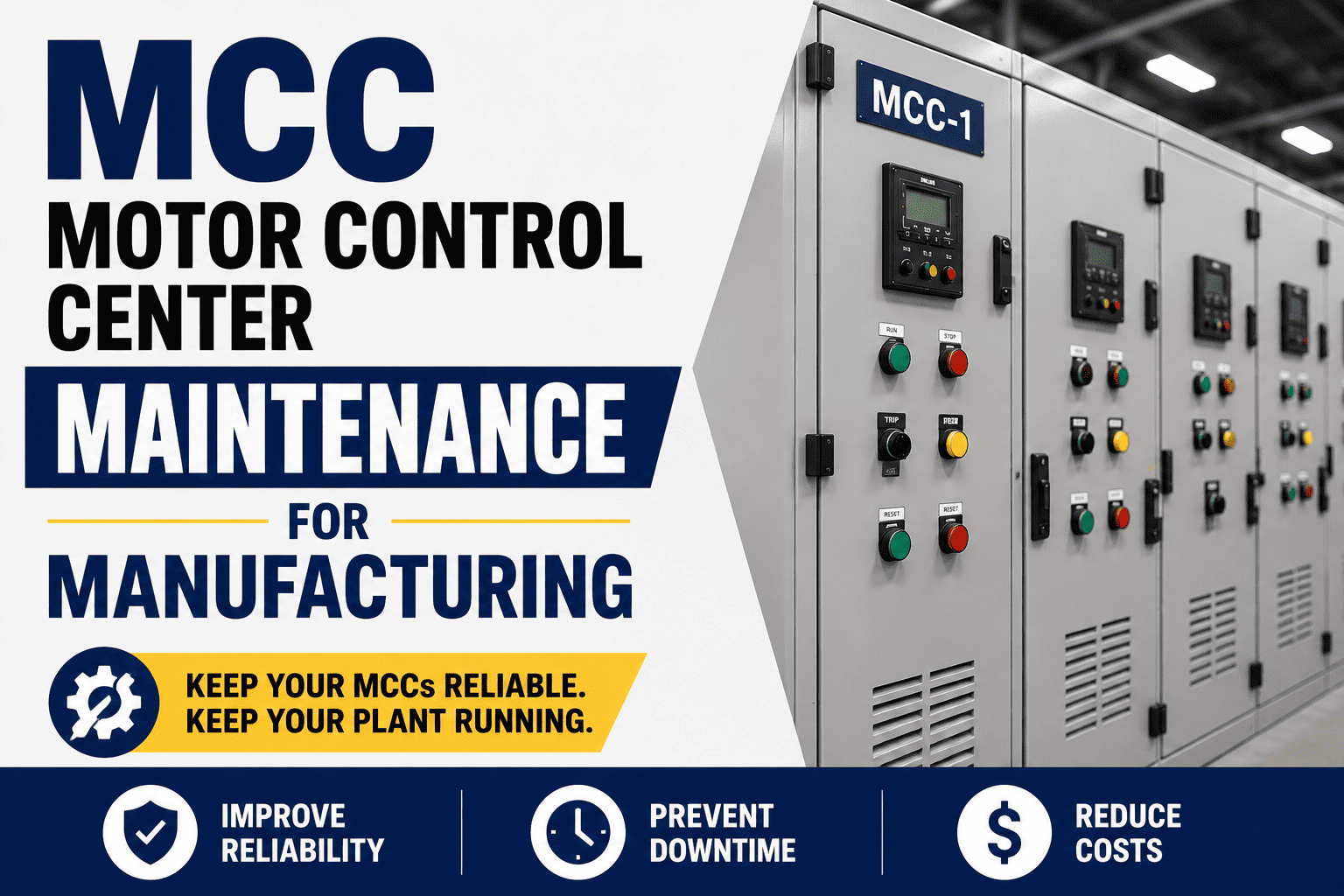
Motor control center maintenance is the single most impactful reliability task a manufacturing plant can perform to prevent arc flash incidents, cascading production outages, and unplanned downtime. A well-structured MCC PM schedule—covering thermal scanning, breaker exercising, bus bar torque checks, and cleaning—keeps your electrical infrastructure safe and efficient. Linking these maintenance records to arc flash label compliance within a modern CMMS ensures audit readiness and protects both your workforce and your bottom line. Stop relying on scattered spreadsheets and Start Free Trial to centralize your electrical maintenance today.
MCC MAINTENANCE GUIDE
Is One Overlooked Bucket Controlling Your Entire Plant's Power?
A single loose bus bar connection in a 480V motor control center can generate temperatures exceeding 200°C, causing catastrophic arc flash failures and halting production across the entire facility. Proactive MCC maintenance prevents 85% of these electrical failures before they ever trip a breaker.
INSPECTION FRAMEWORK
Essential MCC Inspection Checklist for Manufacturing Plants
An effective motor control center PM schedule targets the four highest-risk failure points: deteriorating contactors, drifting overload relays, thermal expansion in bus bars, and contaminated cable connections. Here is the industry-standard MCC inspection framework for manufacturing environments.
Contactor Inspection
Inspect pitting, wear, and discoloration on contacts. Measure coil resistance and replace contactors when tip thickness drops below 50% of original spec to prevent welded contacts and single-phasing.
Overload Relay Testing
Inject primary test currents to verify trip times against manufacturer curves. Calibrate or replace eutectic and solid-state overloads if trip times deviate by more than 10% from the expected tripping band.
Bus Bar Thermography
Scan energized bus bars and splices under normal load. Flag any connection exceeding a 15°C temperature rise above ambient, indicating high resistance and impending failure requiring immediate retorquing.
Cable Connection Torque
De-energize and verify torque values on all incoming and outgoing lugs. Thermal cycling loosens connections over time; retorque to manufacturer specs to eliminate the #1 cause of arc flash incidents.
MAINTENANCE SCHEDULE
MCC PM Schedule: Monthly, Quarterly & Annual Intervals
A data-driven MCC maintenance schedule dictates task frequency based on operating environment, load cycles, and criticality. Use this timeline to structure your CMMS triggers and shift from reactive firefighting to predictive electrical reliability.
Visual & Thermographic Scan
Open dead-front doors to perform infrared scans on energized bus bars and breakers. Record temperature baselines. Look for dust buildup, moisture ingress, and abnormal humming. Takes roughly 1-2 hours per 10 buckets.
Breaker Exercise & Cleaning
Exercise mechanical mechanisms of molded case breakers and contactors 3-5 times to prevent mechanism seizure. Vacuum dust using non-conductive nozzles and verify space heaters are functional to control condensation.
Torque Audits & Overload Testing
De-energize for a full outage. Retorque all bolted bus connections and cable lugs. Perform primary injection testing on overload relays. Update arc flash warning labels to reflect current available fault current and clearing times.
CMMS INTEGRATION
Linking MCC Maintenance to Arc Flash Label Compliance
NFPA 70E and CSA Z462 require arc flash risk assessments to be updated when electrical equipment is modified or maintained. By linking MCC maintenance records directly to your CMMS, you create a closed-loop audit trail ensuring every retorqued bucket and replaced breaker triggers a label review.
| Maintenance Task | CMMS Trigger | Arc Flash Compliance Impact | NFPA 70E Priority |
|---|---|---|---|
| Breaker Replacement | Asset Record Update | Recalculate clearing time & incident energy | Critical |
| Bus Bar Retorquing | Work Order Completion | Verify short-circuit path resistance | High |
| Overload Relay Calibration | Scheduled PM Trigger | Validate overcurrent protection curves | High |
| Infrared Thermography | Predictive Alert | Document normal operating baseline | Medium |
| Cable Lug Tightening | Annual PM Trigger | Maintain fault current carrying capacity | Critical |
Stop Reactive Electrical Maintenance Before It Stops You
Unplanned electrical outages cost manufacturing plants an average of $260,000 per hour. See how OxMaint digitizes your MCC PM schedule and prevents cascading failures.
REAL-WORLD IMPACT
The Cost of Neglecting Motor Control Center Maintenance
Consider a mid-sized automotive parts plant operating 120 motors across 15 MCCs. By shifting from a reactive run-to-failure model to a structured MCC maintenance schedule managed in a CMMS, the facility drastically reduced electrical incidents.
Eliminated $35K average repair cost per cascading outage and cut spare contactor spend by optimizing PM timing.
Cut unplanned motor downtime by catching deteriorating bus bar connections via monthly thermography before failure.
Achieved a recordable-free year by enforcing torque audits and locking out faulty buckets flagged by predictive analytics.
OxMaint SOLUTION
How OxMaint Streamlines Motor Control Center CMMS Workflows
OxMaint transforms your motor control center maintenance from a paper-heavy burden into a fully automated, predictive workflow. By centralizing work orders, asset tracking, and compliance documentation, our platform ensures your electrical infrastructure operates flawlessly.
Automated PM Scheduling
Trigger monthly thermography and annual torque audits automatically based on runtime or calendar days. OxMaint ensures no bucket is missed, cutting manual scheduling effort by 90% and eliminating spreadsheet sprawl.
Predictive Thermal Analytics
Upload infrared images directly to the asset record. OxMaint's AI detects temperature trend anomalies in bus bars before they breach critical thresholds, preventing 30-50% of unexpected electrical failures.
Digital Arc Flash Compliance
Link every completed MCC work order directly to updated arc flash warning labels. Generate NFPA 70E audit reports in one click, reducing compliance prep time from weeks to mere minutes.
Centralized Spare Parts Tracking
Track contactor and overload inventory in real-time. OxMaint auto-reserves critical spares for scheduled MCC outages, eliminating 25% of delays caused by missing parts during maintenance windows.
FREQUENTLY ASKED QUESTIONS
MCC Maintenance FAQs
How often should motor control centers be maintained?
Motor control centers should undergo visual and thermographic inspections monthly, breaker exercising and cleaning quarterly, and a comprehensive de-energized torque audit with overload testing annually. High-cycle or harsh-environment MCCs may require bi-monthly thermal scans. You can automate these exact frequencies by setting up PM triggers when you Start Free Trial.
What is included in an MCC PM schedule?
A standard MCC PM schedule includes infrared thermography of bus bars, contactor inspection for pitting and wear, overload relay primary injection testing, cable connection torque verification, arc flash label validation, and internal compartment cleaning to prevent dust tracking.
Why is thermography important for MCC maintenance?
Thermography detects high-resistance connections in bus bars and breakers that are invisible to the naked eye. Identifying a 15°C temperature rise early allows you to retorque or replace the failing connection during a planned outage, preventing catastrophic arc flash incidents and cascading plant outages.
How does a CMMS help with MCC compliance?
A CMMS links completed work orders directly to equipment asset records, providing a time-stamped audit trail of who performed what maintenance and when. This ensures NFPA 70E arc flash label compliance is verified whenever modifications occur, replacing fragmented paper logs with instantly accessible digital reports.
Can OxMaint track spare parts for motor control centers?
Yes. OxMaint tracks critical MCC spares like contactors, overloads, and fuses in real-time. The platform automatically alerts you when stock falls below reorder points and reserves parts for scheduled outages, ensuring your maintenance team always has the right components on hand. Book a Demo to see the inventory module in action.
Digitize Your MCC Maintenance Today
Join the manufacturing plants using OxMaint to prevent arc flash incidents, automate PM schedules, and eliminate unplanned downtime. See our AI-powered CMMS on your assets—book a 30-min demo.
Free 14-day trial · No credit card

-inspection-checklist-for-industrial-facilities.png)