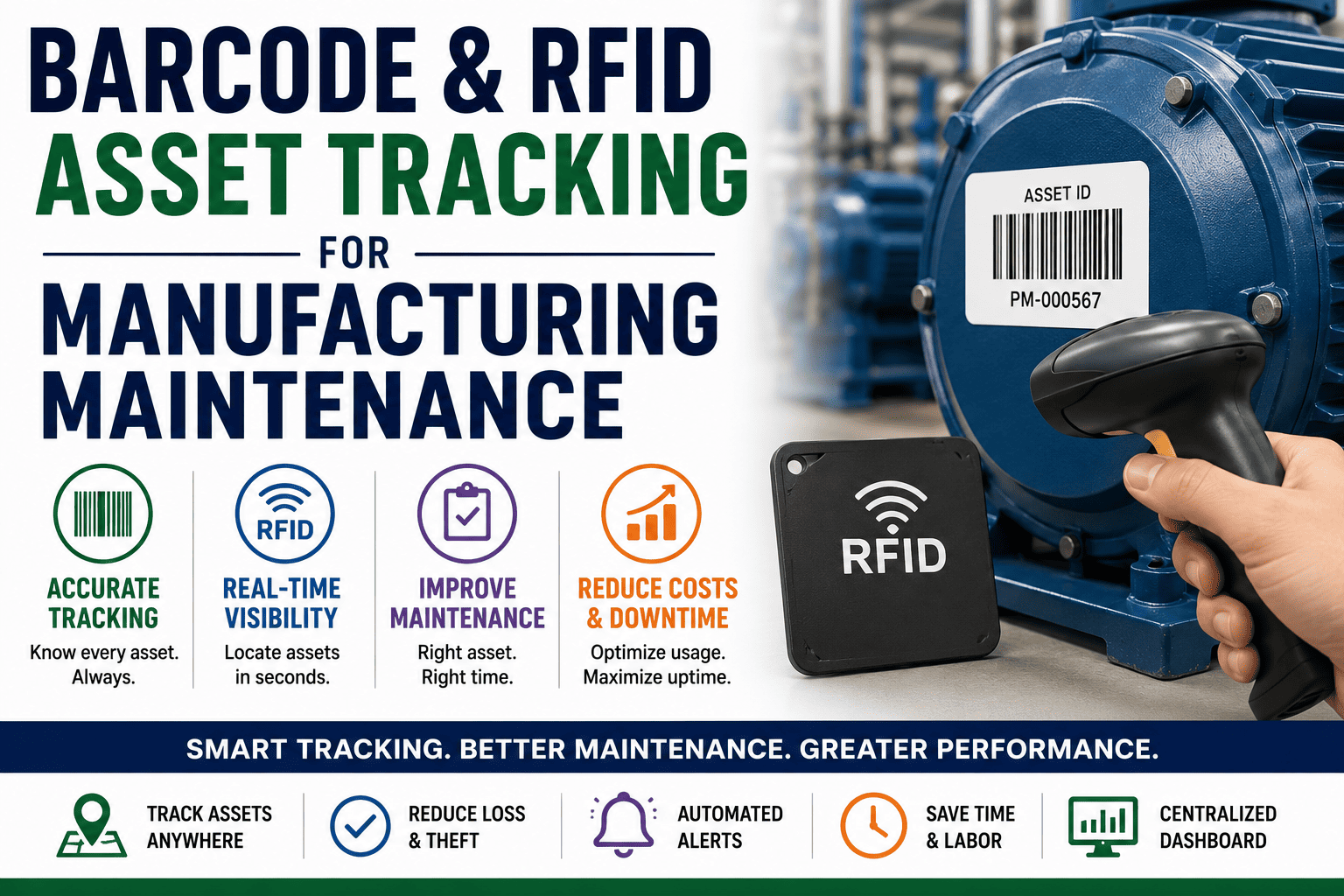
Barcode and RFID asset tracking for manufacturing maintenance eliminates the single largest source of CMMS data corruption: technicians logging hours and parts against the wrong machine. In plants managing thousands of near-identical pumps, motors, and conveyors, a manual keystroke error on an asset ID instantly pollutes maintenance history, voids warranty claims, and misdirects preventive maintenance schedules. By linking durable physical tags to a mobile CMMS, maintenance teams achieve 99.9% data accuracy and retrieve full asset history in a single scan. See how OxMaint closes this data gap when you Start Free Trial today.
Are technicians logging work orders against the wrong assets?
Manual asset entry causes up to 18% of maintenance records to be filed against incorrect equipment, destroying the reliability data your predictive maintenance program depends on. Barcode and RFID tracking eliminates this failure point at the source.
Choosing the right asset tags for a manufacturing plant
Selecting the optimal tag technology for your environment dictates whether your manufacturing RFID maintenance system survives the next five years or fails during the first high-temperature washdown. Environmental conditions, not price, should drive your asset barcode CMMS strategy.
Barcode Tags
From $0.05 / tag
1D/2D barcodes (Code 128, QR) printed on polyester or aluminum. Ideal for dry, indoor assets. Requires line-of-sight scanning but integrates seamlessly with any mobile CMMS via standard smartphone cameras.
Passive RFID
From $0.15 / tag
UHF passive tags read multiple assets simultaneously without line-of-sight up to 30 feet. Perfect for plant asset barcode conversions in dense storage yards, motor rooms, and spare-parts inventory cages.
Ruggedized Metal RFID
From $1.20 / tag
On-metal RFID tags with engineered ceramic or hard epoxy casings withstand chemical washdowns, UV exposure, and direct impact. Required for ISO 55000 compliance in food, pharma, and heavy steel manufacturing.
Barcode vs. RFID for maintenance tracking: which fits your plant?
The barcode vs. RFID debate for plant asset management comes down to scan volume, environment, and budget. Use this comparison to map the right technology to your manufacturing maintenance workflows.
| Criteria | Barcode | Passive RFID |
|---|---|---|
| Cost per Tag | $0.05 - $0.25 | $0.15 - $2.50 |
| Scan Speed (Single Asset) | 2-4 seconds | 0.5 seconds |
| Batch Scanning (Multiple Assets) | One at a time | 100+ tags per second |
| Line-of-Sight Required | Yes | No |
| Lifespan in Harsh Env. | 1-3 years | 5-10+ years |
| Hardware Cost (Scanner) | Smartphone or $50+ scanner | $300+ dedicated reader |
How to phase RFID asset tracking into a live plant without downtime
Rolling out an RFID CMMS manufacturing system across a live facility risks disrupting production if handled all at once. A 4-month phased approach ensures zero operational downtime while building immediate reliability momentum.
Audit & Critical Asset Tagging
Pull existing asset registry from spreadsheets or legacy CMMS. Tag the top 20% of critical assets (the 80/20 rule) — typically high-HP motors, core conveyors, and primary hydraulic units. Validate scan readability in the actual operating environment before scaling.
Mobile CMMS Integration
Deploy the mobile CMMS app to maintenance technicians. Map scanned asset IDs directly to digital work orders and PM schedules. Train techs on scan-to-close workflows, eliminating manual asset ID entry from daily rounds.
Spare Parts & Inventory Linking
Apply RFID tags to high-value spare parts bins and critical replaceable components. Link parts consumption directly to parent asset histories via scan, auto-decrementing inventory and triggering reorder points.
Full Fleet Rollout & Analytics
Expand tagging to the remaining 80% of plant assets. Activate maintenance analytics dashboards to track scan compliance, mean time to repair (MTTR), and asset history completeness across all equipment classes.
See OxMaint scan-to-close workflows on your own assets
Book a 30-minute demo and watch how fast technicians pull full asset history with a single barcode or RFID scan.
The cost of wrong-asset data in manufacturing maintenance
When a 180-asset plant spending $42K annually on maintenance relies on manual data entry, the hidden costs of misidentified assets compound rapidly. Bad data directly degrades your OEE and predictive maintenance algorithms.
Each misidentified asset triggers wasted technician time, incorrect parts ordering, and invalidated PM schedules that accelerate unplanned downtime.
How OxMaint powers barcode & RFID asset tracking for plants
OxMaint is an AI-powered CMMS and EAM platform built to turn every scan into actionable maintenance intelligence. Here is how OxMaint maps RFID and barcode capabilities directly into measurable plant outcomes.
Instant Scan-to-Work-Order
Technicians scan an asset barcode or RFID tag with a mobile device to instantly open the equipment's full profile, active work orders, and historical PM records. Eliminates 100% of manual ID entry errors and accelerates MTTR.
Predictive Maintenance Triggers
Every scan logs time-stamped condition data into OxMaint's AI engine. The system automatically predicts bearing failures and motor degradation based on accurate, high-fidelity asset history, cutting unplanned downtime 30-50%.
Automated Spare-Parts Decrement
Scanning an asset to close a work order auto-decrements the installed spare parts from inventory and triggers reorder alerts. Keeps maintenance analytics perfectly aligned with actual parts consumption and stock levels.
Audit-Ready Compliance Logs
OxMaint ties every scan to a specific technician, timestamp, and GPS location, creating an immutable audit trail. Satisfies ISO 55000, OSHA, and FMCSA requirements with zero manual documentation effort.
Barcode & RFID asset tracking for manufacturing: common questions
What is the difference between barcode and RFID asset tracking in manufacturing?
Barcode tracking requires line-of-sight scanning and reads one asset at a time, making it ideal for low-cost, straightforward deployments. RFID tracking uses radio waves to read multiple tags simultaneously without line-of-sight, which is better for dense plant environments and batch inventory scans, though it requires dedicated reader hardware.
How does a mobile CMMS integrate with barcode and RFID scanners?
A mobile CMMS like OxMaint uses the smartphone camera for barcode scans or pairs via Bluetooth with handheld RFID readers. When a technician scans a tag, the CMMS instantly pulls up the asset's work order history, PM schedule, and parts list, eliminating manual data entry. You can see this in action by booking a demo.
How much does it cost to implement RFID asset tracking in a manufacturing plant?
For a typical 180-asset plant, passive RFID tags cost $0.15 to $2.50 each, while ruggedized on-metal tags run $1.20+. Factoring in handheld readers ($300-$1,500 each) and CMMS software, most mid-sized plants see a total rollout cost of $3,000 to $8,000, which is usually paid back in under 12 months through reduced downtime and labor savings.
Can RFID tags survive harsh manufacturing environments?
Yes, specialized on-metal and encapsulated RFID tags are engineered to withstand extreme temperatures (-40°F to 500°F), chemical washdowns, UV exposure, and direct impact. These ruggedized tags are essential for food processing, pharmaceutical, and heavy steel manufacturing plants operating under strict hygiene or safety standards.
How long does it take to deploy barcode asset tracking in a CMMS?
Deploying a barcode asset management system in a CMMS typically takes 1 to 2 months for a mid-sized plant. The process involves auditing the asset registry, printing and applying tags, configuring the mobile CMMS app, and training technicians on scan-to-close workflows. Start your deployment today with a Start Free Trial of OxMaint.
Ready to eliminate wrong-asset data from your maintenance program?
Deploy OxMaint's AI-powered CMMS with barcode and RFID mobile scanning to cut unplanned downtime 30-50% and achieve 100% audit-ready asset history.
Free 14-day trial · No credit card required

.png)