Bearing Inspection Checklist for Manufacturing & Plant Operations
By oxmaint on January 27, 2026
Bearing failures account for over 60% of all rotating equipment breakdowns in manufacturing plants, making them the single largest cause of unplanned downtime. A systematic bearing inspection checklist transforms reactive maintenance into proactive asset protection, catching wear patterns, contamination, and lubrication issues before they cascade into production-halting failures. Whether you're managing conveyor systems, pumps, motors, or processing equipment, structured bearing inspections are the foundation of operational reliability. Schedule a consultation to explore how digital inspection checklists can strengthen bearing maintenance at your facility.
Why Bearing Inspection Matters in Manufacturing
Manufacturing environments subject bearings to extreme conditions including high loads, temperature fluctuations, contamination, and continuous operation. Without systematic inspection protocols, minor issues like inadequate lubrication or slight misalignment compound rapidly, leading to catastrophic failures that halt production lines and damage adjacent components.
The Cost of Bearing Failures in Manufacturing
60%+
Of rotating equipment failures originate from bearing-related problems in manufacturing plants
$250K+
Average cost per hour of unplanned downtime in continuous manufacturing operations
41%
Of critical machine failures are directly attributed to bearing faults according to industry research
8x
Longer equipment lifespan when bearings receive systematic preventive maintenance inspections
Ready to reduce bearing-related failures? Join manufacturing teams using Oxmaint to digitize inspections and catch problems early.
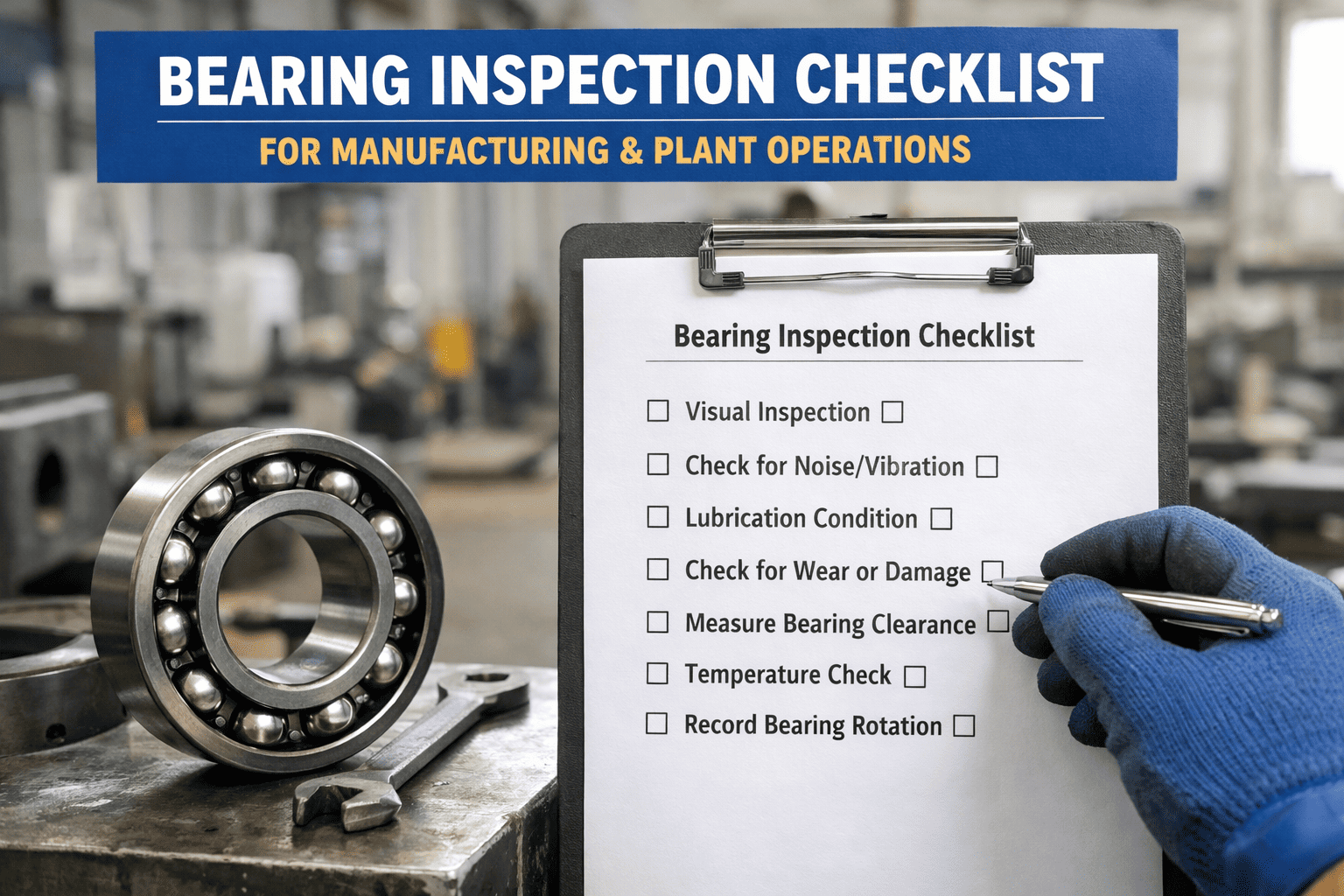
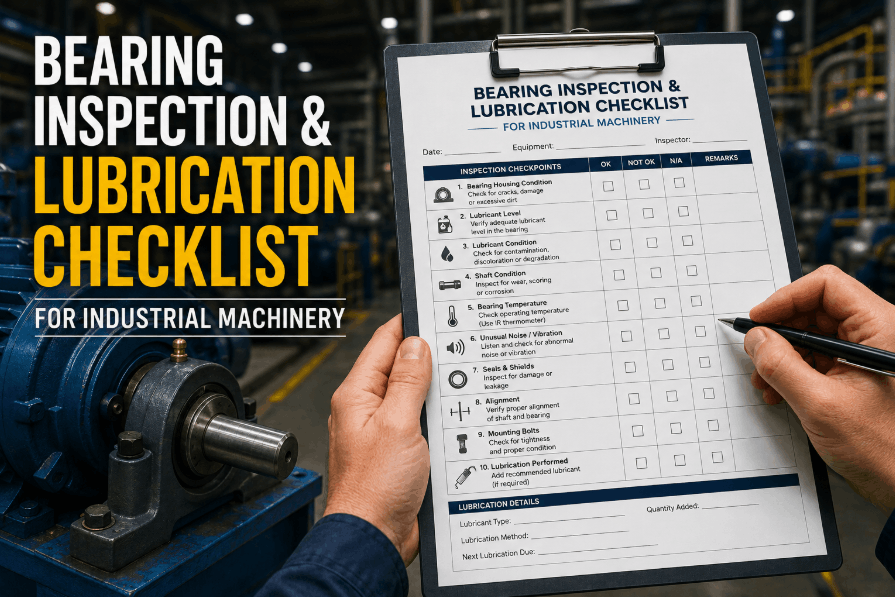
A thorough bearing inspection examines multiple failure indicators across visual, acoustic, thermal, and operational parameters. This checklist covers the critical inspection points that identify developing problems before they cause equipment damage.
Daily Pre-Operation Checks
Visual Contamination Check
Inspect bearing housings and seals for signs of contamination ingress, oil leakage, or grease purging that indicates seal degradation
Temperature Assessment
Use infrared thermometer or thermal camera to verify bearing temperature is within normal operating range (typically 40-70°C above ambient)
Noise Evaluation
Listen for abnormal sounds including grinding, squealing, or clicking that indicate lubrication issues or mechanical damage
Vibration Sense Check
Touch bearing housing (when safe) to detect unusual vibration patterns that suggest imbalance, misalignment, or bearing wear
Weekly Inspection Points
Lubrication Condition
Check grease condition at relief ports for color changes, contamination, or hardening indicating degradation
Seal Integrity
Examine lip seals and labyrinth seals for wear, cracking, or improper seating that allows contaminant entry
Mounting Security
Verify bearing housing bolts and pillow block fasteners remain properly torqued with no loosening
Alignment Verification
Check for signs of shaft misalignment including uneven wear patterns, coupling damage, or unusual loads
Monthly Detailed Assessment
Vibration Analysis
Perform spectral analysis to identify characteristic defect frequencies for inner race, outer race, rolling elements, and cage
Oil Analysis (Oil-Lubricated)
Sample lubricating oil to check for metal particles, contamination levels, and viscosity degradation
Clearance Measurement
Use dial indicators to measure shaft end play and radial clearance against manufacturer specifications
Thermal Trending
Compare current operating temperatures against historical baselines to identify developing thermal issues
Want to see digital bearing checklists in action? Book a demo and we'll show you automated inspection scheduling for your equipment.
Understanding what to look for during inspections enables early detection of developing problems. Each failure mode produces distinctive warning signs that trained inspectors can identify before catastrophic damage occurs.
Excessive Vibration
Shaft wobble or playResonant hummingPulsating motion
Typically indicates misalignment, imbalance, or internal bearing damage from raceway defects
Contamination
Discolored greaseGritty feelAbrasive particles
Foreign particles cause accelerated wear and surface damage to rolling elements and raceways
Overheating
Hot housing surfaceBurnt lubricant odorDiscoloration
Results from inadequate lubrication, excessive preload, or insufficient cooling causing thermal degradation
Spalling/Flaking
Metal flakes in greaseRough rotationCyclic noise
Fatigue failure where subsurface cracks propagate causing material to break away from raceways
Vibration-Based Bearing Diagnostics
Vibration analysis is the most powerful predictive tool for bearing condition assessment. Different defect types produce characteristic frequencies that reveal exactly where problems are developing inside the bearing.
Bearing Defect Frequencies and Detection Methods
Defect Location
Characteristic Frequency
Detection Stage
Recommended Action
Outer Race (BPFO)
Ball Pass Frequency Outer
Early detection possible
Monitor progression, plan replacement
Inner Race (BPFI)
Ball Pass Frequency Inner
Moderate detection difficulty
Schedule replacement within 2-4 weeks
Rolling Elements (BSF)
Ball Spin Frequency
Challenging early detection
Immediate inspection, likely replacement
Cage (FTF)
Fundamental Train Frequency
Low frequency, often masked
Investigate lubrication and loading
Vibration analysis can detect bearing defects 1-3 months before failure, enabling planned maintenance and parts procurement.
Best Practices for Effective Bearing Inspections
Maximizing the value of bearing inspections requires consistent procedures, proper documentation, and integration with your maintenance management system.
01
Establish Baseline Measurements
Record vibration levels, operating temperatures, and noise characteristics when bearings are new or recently replaced. These baselines enable meaningful trend analysis and early anomaly detection.
02
Standardize Inspection Procedures
Use digital checklists that guide technicians through consistent inspection sequences. Standardization ensures no critical checks are missed and enables meaningful comparison across inspections. Sign up for Oxmaint to create standardized inspection templates for your equipment.
03
Document Everything
Capture photos of concerning conditions, record measurement values, and note environmental factors. Complete documentation supports root cause analysis and continuous improvement.
04
Integrate with CMMS
Connect inspection findings to work order generation, spare parts inventory, and maintenance scheduling. Schedule a demo to see how Oxmaint automates the inspection-to-action workflow.
Manual vs. Digital Bearing Inspections
Paper-Based Inspections
Inconsistent checklist completion
Delayed data entry and analysis
Lost or illegible inspection records
No automated trending or alerts
Difficult to track inspection compliance
CMMS-Integrated Digital Inspections
Guided, standardized inspection workflows
Real-time data capture with photos
Automatic work order generation
Trend analysis and predictive alerts
Complete audit trail and compliance tracking
Transform Bearing Maintenance with Digital Inspections
Oxmaint helps manufacturing teams implement systematic bearing inspection programs that catch failures early, extend equipment life, and eliminate unplanned downtime. Move from reactive repairs to predictive maintenance with mobile checklists, automated scheduling, and vibration trend analysis.
How often should bearing inspections be performed?
Inspection frequency depends on equipment criticality and operating conditions. Critical equipment typically requires daily visual checks, weekly detailed inspections, and monthly vibration analysis. High-speed or heavily loaded bearings may need more frequent monitoring. Sign up for Oxmaint to set up automated inspection schedules tailored to your equipment.
What are the most common causes of premature bearing failure?
Research indicates that improper lubrication causes approximately 36% of bearing failures, followed by contamination (14%), improper mounting (16%), and fatigue (34%). Regular inspections specifically targeting lubrication condition and contamination ingress can prevent the majority of premature failures.
When should a bearing be replaced versus reused?
Bearings should be replaced immediately if they show cracks, flaking, significant smearing, loose cage rivets, rust on rolling surfaces, or excessive clearance beyond specifications. Minor surface marks may allow reuse in non-critical applications after careful evaluation by experienced personnel.
How can vibration analysis predict bearing failure?
Bearing defects produce characteristic vibration frequencies based on bearing geometry and rotational speed. By monitoring these frequencies over time, maintenance teams can detect developing defects 1-3 months before failure. Book a demo to see how Oxmaint integrates vibration trending with inspection programs.
What temperature indicates a bearing problem?
Normal bearing operating temperature is typically 40-70°C above ambient temperature. A sudden temperature increase of more than 15°C from baseline, or sustained operation above 80°C, indicates potential problems requiring immediate investigation of lubrication, loading, or alignment conditions.