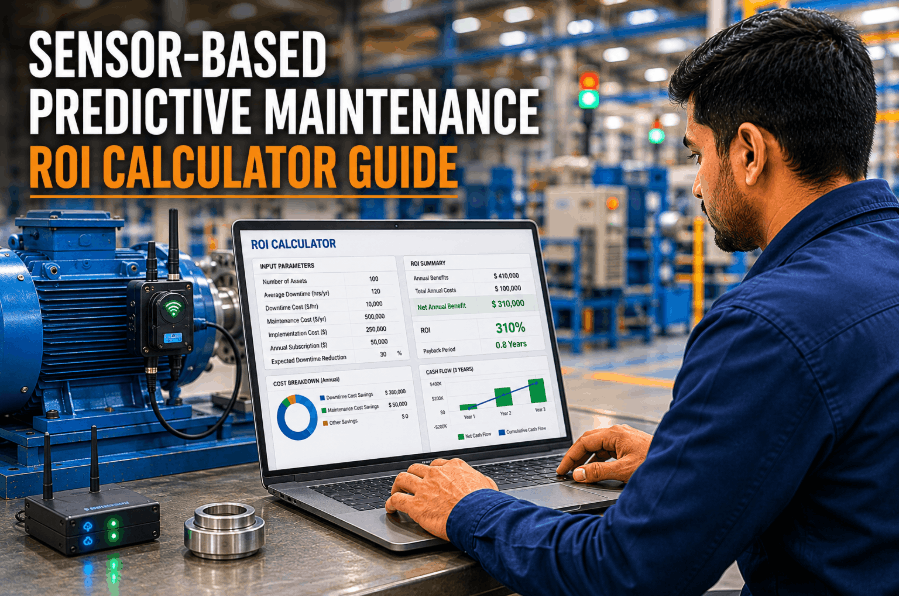
Sensor-based predictive maintenance is no longer a technology reserved for aerospace or automotive giants. As IoT sensor costs continue to fall and CMMS platforms gain real-time condition monitoring integrations, mid-sized manufacturing plants and industrial facilities can now quantify the return on investment from predictive maintenance programs before committing capital. Sign Up Free on OxMaint to connect your condition monitoring data directly to a maintenance work order system that acts on sensor alerts before failures occur. This guide breaks down how to use a sensor-based predictive maintenance ROI calculator, which input variables drive the most impact, and what benchmark outcomes mature programs achieve across industries.
What Is a Predictive Maintenance ROI Calculator?
A predictive maintenance ROI calculator is a structured financial model that estimates the cost savings and productivity gains generated by shifting from reactive or time-based preventive maintenance to sensor-driven condition-based maintenance. Book a Demo with OxMaint to see how facilities map condition monitoring inputs directly to work order outcomes and track avoided downtime cost over time. The calculator inputs typically include current breakdown frequency, average downtime cost per event, sensor and integration costs, maintenance labor savings, and asset lifespan extension estimates — producing a payback period and 3-year ROI projection.
The largest ROI driver. Sensor-based early warning typically reduces unplanned breakdown events by 30–50%, directly cutting lost production revenue and emergency repair costs.
Condition-based triggers reduce reactive callouts and unnecessary PM task execution — shifting technician time toward high-value planned work and reducing overtime spend.
Detecting failure trends before failure events allows planned parts procurement — eliminating emergency freight costs, reducing safety stock levels, and improving parts utilization rates.
Early intervention on developing faults prevents secondary damage cascades. Mature predictive maintenance programs consistently document 15–25% increases in mean time between failures per critical asset.
Key Input Variables for Your Sensor-Based PdM ROI Model
Accurate ROI projection requires honest baseline data. The following variables are the primary drivers in any sensor-based predictive maintenance financial model. Sign Up Free on OxMaint to begin capturing the asset downtime, work order cost, and maintenance activity data needed to build a reliable ROI baseline for your operation.
| ROI Input Variable | What to Measure | Data Source | Impact on ROI |
|---|---|---|---|
| Unplanned Downtime Frequency | Breakdown events per asset per year | CMMS work order history | Very High |
| Downtime Cost per Hour | Lost production revenue + labor + restart costs | Finance / Operations | Very High |
| Average MTTR | Mean time to repair per breakdown event | CMMS work order data | High |
| Emergency Parts Spend | Expedited procurement costs per year | Procurement records | High |
| Sensor + Integration Cost | Hardware, connectivity, and CMMS integration | Vendor quotes | Medium (one-time) |
| PM Over-Maintenance Spend | Time-based PM tasks replaceable by condition triggers | PM schedule review | Medium |
| Asset Replacement Deferral | Extended useful life per critical asset | Maintenance engineering | Medium–High |
The 5 Sensor Types That Drive the Highest Predictive Maintenance ROI
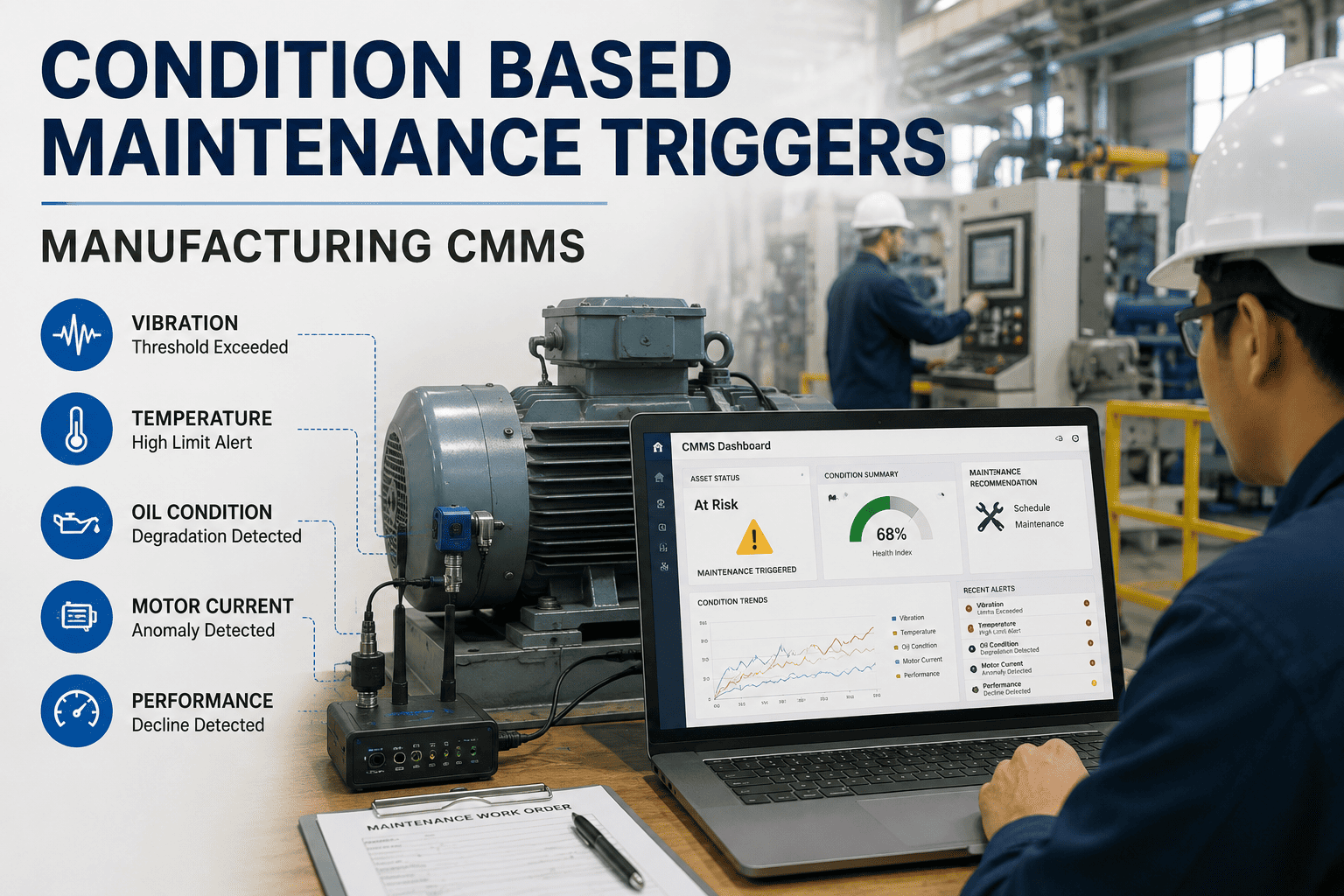
Not all sensor investments return equal value. The ROI of a sensor-based predictive maintenance program is heavily concentrated in a small number of failure modes that sensors can detect weeks or months before they cause production-stopping events. Book a Demo to see how OxMaint integrates condition monitoring sensor alerts into automated maintenance work orders without requiring custom development work.
Vibration analysis on motors, pumps, fans, compressors, and gearboxes detects bearing degradation, imbalance, misalignment, and looseness weeks before catastrophic failure. Rotating equipment accounts for the majority of unplanned breakdown events in most manufacturing facilities, making vibration sensor ROI consistently the highest of any condition monitoring investment category.
Thermal sensors and infrared monitoring on electrical panels, motor windings, and mechanical drive components detect resistance faults, lubrication breakdown, and overload conditions before they produce fires, motor burnout, or production line shutdowns. Electrical failure prevention alone typically covers sensor investment cost within the first avoided event.
Oil condition monitoring detects contamination, viscosity degradation, and metallic particle counts that indicate internal component wear in hydraulic systems, gearboxes, and large compressors. Condition-based oil change scheduling typically reduces lubricant consumption by 30–40% while extending component service intervals — delivering measurable cost savings independent of breakdown avoidance.
Pressure drop monitoring across filters, heat exchangers, and compressed air systems enables condition-based replacement scheduling that prevents both premature replacement and failure-causing degradation. Flow anomalies in cooling water, hydraulic circuits, and pneumatic systems detect developing blockages, leaks, and pump degradation before they affect process quality or cause asset damage.
Ultrasonic monitoring detects compressed air leaks, steam trap failure, electrical discharge, and early bearing defects at frequency ranges invisible to human operators during normal production noise conditions. Compressed air leak elimination alone delivers rapid ROI — the average industrial facility loses 20–30% of compressed air output through undetected leaks in aging distribution systems. Sign Up Free to connect ultrasonic alert outputs to OxMaint work orders.
Industry Benchmarks: Sensor-Based Predictive Maintenance ROI by Sector
ROI outcomes vary by industry due to differences in asset criticality, production line structure, and downtime cost profiles. These benchmarks represent documented outcomes from mature sensor-based predictive maintenance programs with consistent CMMS integration. Book a Demo to discuss which benchmark profile most closely matches your facility type and how OxMaint's condition monitoring integration supports your ROI targets.
How OxMaint Connects Condition Monitoring to Maintenance Execution
Sensor data generates ROI only when it triggers maintenance action before failure occurs. The most common failure point in sensor-based predictive maintenance programs is not sensor accuracy — it is the gap between alert generation and work order execution. OxMaint closes that gap by integrating condition monitoring alert outputs directly into a full CMMS work order management workflow.
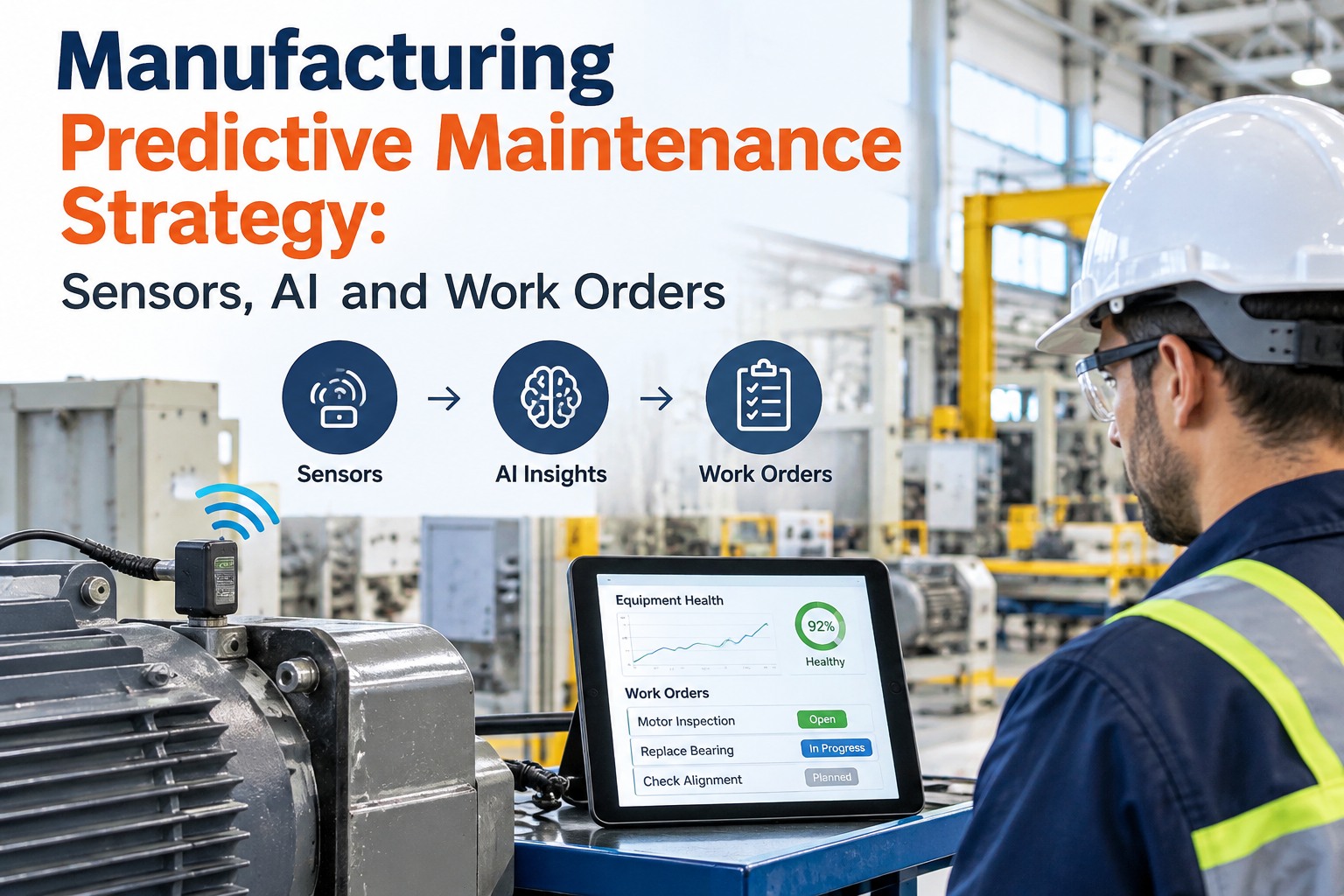
When a sensor threshold breach occurs — vibration amplitude, temperature exceedance, pressure drop — OxMaint auto-generates a corrective work order pre-populated with asset ID, alert type, severity classification, and linked sensor reading history. Maintenance planners receive immediate notification with the data required to assign trades, source parts, and schedule intervention without a separate diagnostic visit.
OxMaint maintains a complete condition monitoring history against each asset record — linking sensor readings, generated work orders, repair outcomes, and parts used in a single timeline. Reliability engineers gain the data layer needed to identify recurring failure modes, validate sensor alert thresholds, and build evidence-based PM interval adjustments that further reduce maintenance cost per asset.
OxMaint's maintenance KPI dashboards track the planned-to-reactive work order ratio in real time — the primary leading indicator of predictive maintenance program maturity. Facilities targeting world-class maintenance performance aim for greater than 80% planned work. OxMaint gives maintenance managers the dashboard visibility to track ratio improvement as sensor coverage expands and CMMS integration matures.
When a condition-triggered work order reaches a technician's mobile device, OxMaint delivers the full sensor context — alert type, reading trend, historical failure data for that asset class — alongside the job instructions. Technicians arrive at the asset prepared for the specific failure mode indicated, reducing diagnostic time and improving first-time fix rates on condition-based interventions.
OxMaint's reporting module tracks avoided breakdown events — work orders generated from condition alerts that were completed before failure — and calculates the avoided downtime cost based on your asset-specific downtime cost inputs. This gives maintenance leadership a continuously updated ROI figure for the predictive maintenance program, directly supporting capital justification for sensor fleet expansion. Book a Demo to see the avoided cost reporting module live.

.png)
.png)