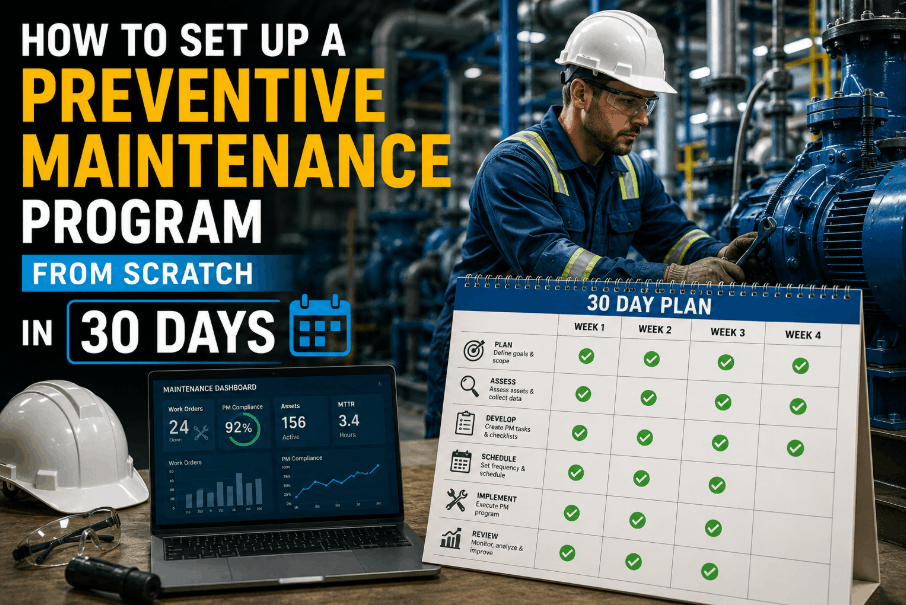
Building a preventive maintenance program from scratch is the single highest-ROI step a manufacturing plant can take to cut unplanned downtime, extend asset life, and stabilize maintenance costs — yet most teams stall because the sequence feels overwhelming. The reality: a well-structured PM program setup follows a clear, repeatable path from asset inventory and criticality ranking through OEM-based task creation, CMMS scheduling, and 90-day KPI targets that prove ROI. This guide walks maintenance and reliability leaders through exactly how to start preventive maintenance in a real plant, using the same framework OxMaint deploys across manufacturing PM programs — so you can move from reactive firefighting to planned, predictable execution. Ready to skip the spreadsheet phase? You can Start Free Trial and configure your first PM schedule today.
Still running your plant on reactive maintenance?
Unplanned downtime costs manufacturers an average of $260,000 per hour — and 80% of those failures are preventable with a structured PM program. The gap between world-class maintenance (85%+ PM compliance) and reactive maintenance (40%+ unplanned work) isn't a software problem alone. It's a sequence problem. Follow the right order and a manufacturing PM program pays for itself within 90 days.
Why a preventive maintenance plan is non-negotiable for manufacturing
A plant operating without a preventive maintenance plan spends 3–5× more on emergency repairs, experiences 40% more unplanned downtime, and replaces critical assets 30% sooner than peers with a structured PM program. Here's what the status quo actually costs — and what changes when you build one.
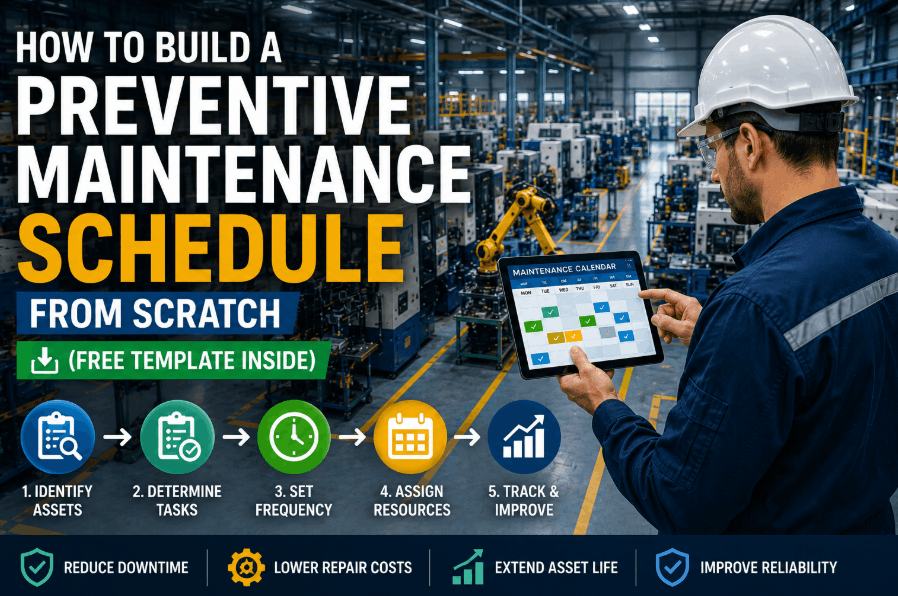
How to build a preventive maintenance program from scratch — 5 sequential steps
The most common mistake teams make when they create a PM program is jumping straight to scheduling lubrication routes without an asset register or criticality ranking. That creates a schedule nobody trusts. The correct order — validated across hundreds of manufacturing PM implementations — is below.
Build a complete asset inventory & register
Start preventive maintenance by listing every production-critical asset: name, location, manufacturer, model, serial number, install date, criticality, and current condition. A 180-asset plant typically discovers 15–25 "ghost assets" during this step — equipment that exists on the floor but not in any system. Load this register into your CMMS as the single source of truth. Without it, every downstream PM task is built on sand.
Rank assets by criticality & failure risk
Not every asset deserves a PM task. Score each asset on a 1–10 criticality matrix weighing production impact, safety/environmental risk, redundancy, and lead time for replacement. Focus your preventive maintenance plan on A-critical (top 20%) and B-critical (next 30%) assets first. A-critical assets that fail typically cost $10K–$50K per hour in lost production — these are where your PM schedule manufacturing ROI lives.
Create OEM-based PM tasks for each critical asset
For every A and B asset, pull OEM maintenance manuals and build task lists: inspections, lubrication, calibration, component replacement, and condition-based checks. Each task should specify frequency (hours, cycles, calendar days), required skills, estimated labor hours, spare parts, and safety procedures. A well-built PM task library for a 180-asset plant typically contains 400–600 unique task definitions — this becomes the backbone of your manufacturing PM program.
Schedule PMs in a CMMS — not spreadsheets
Schedule PMs in a CMMS — not spreadsheets
This is where preventive maintenance setup either scales or dies. Manual spreadsheets collapse at 50+ assets because they can't auto-generate work orders, track completion, or flag overdue tasks. A CMMS like OxMaint auto-generates PM work orders based on triggers (calendar, runtime hours, or condition sensors), assigns them to the right technician, checks spare-parts availability, and routes completed work orders for approval — all without a single spreadsheet.
Measure KPIs that prove the PM program works
Within 90 days of PM program launch, you should see: PM compliance climbing above 80%, unplanned downtime falling 20–30%, wrench-time increasing from 25% to 40%+, and emergency work orders dropping by half. These are the metrics that justify the program to leadership and unlock budget for predictive maintenance sensors in phase two. If PM compliance is below 60% at day 90, the schedule is over-loaded — trim task frequency on C-critical assets.
What a preventive maintenance program costs — and what it returns
A common objection to building a PM program is "we can't afford the software or the labor." The math tells a different story. Here's a worked example for a mid-sized manufacturing plant running 180 production assets.
320 unplanned hrs × $2,600/hr production loss + repair
CMMS ($18K) + 1.5 FTE tech ($60K) + PM parts ($16K)
$291,200 downtime savings − $94,000 program cost = 2.1× ROI in year one
| Metric | Before PM Program | After 90 Days | After 12 Months |
|---|---|---|---|
| PM compliance | 0% | 75–85% | 90%+ |
| Unplanned downtime (hrs/yr) | 320 | 260 | 180 |
| Emergency work orders | 45%/month | 28% | 12% |
| Mean time between failures | Baseline | +15% | +30% |
| Maintenance cost as % RAV | 4.8% | 3.9% | 2.6% |
| Wrench time (productive labor %) | 25% | 33% | 42% |
Build and run your PM program in OxMaint — not spreadsheets
OxMaint is an AI-powered CMMS and EAM platform built specifically for maintenance and reliability teams. Every capability below maps directly to a step in the preventive maintenance program framework above — so you go from asset list to live PM schedule in days, not months.
Centralized asset register & criticality scoring
Import your 180-asset inventory via CSV, auto-categorize by type, and score criticality with built-in matrices. OxMaint becomes the single source of truth — eliminating ghost assets and duplicate spreadsheets in the first session.
Outcome: 100% asset visibility in week oneAutomated PM work-order generation
Define PM triggers by calendar, runtime hours, or condition thresholds. OxMaint auto-generates and assigns work orders, checks spare-parts inventory, and escalates overdue PMs — cutting manual scheduling time by 90%.
Outcome: 85%+ PM compliance within 90 daysLive maintenance analytics & KPI dashboards
Track PM compliance, MTBF, MTTR, downtime cost, and wrench time on real-time dashboards. OxMaint's AI flags assets whose failure patterns don't match the PM schedule — so you optimize frequency based on data, not gut feel.
Outcome: cut unplanned downtime 30–50%Spare-parts inventory linked to PM tasks
Every PM work order auto-checks required parts against current stock, reserves them, and triggers reorder alerts when minimums are hit. No more arriving at a PM with the wrong filter — or no filter at all.
Outcome: eliminate 95% of parts-related PM delaysSee OxMaint on your assets — book a 30-min demo
Watch us build a preventive maintenance schedule for your plant, live. We'll import your asset list, set criticality scores, and generate your first PM work orders in under 30 minutes.
Preventive maintenance program — what teams ask before they start
How long does it take to implement a preventive maintenance program?
A manufacturing PM program for 150–250 assets typically takes 6–8 weeks to stand up: 2 weeks for asset inventory, 1 week for criticality ranking, 2–3 weeks for OEM-based task creation, and 1 week for CMMS scheduling. First measurable KPI improvements (PM compliance, downtime reduction) appear within 90 days of go-live. You can accelerate this significantly by starting in OxMaint — book a demo and we'll have your first PM schedule live in the same session.
What is the difference between preventive and predictive maintenance?
Preventive maintenance is time- or usage-based — you service an asset every 90 days or 500 run-hours regardless of its actual condition. Predictive maintenance is condition-based — sensors (vibration, temperature, oil analysis) monitor the asset in real time and trigger maintenance only when degradation is detected. A mature maintenance program starts with preventive (the foundation) and adds predictive on A-critical assets in phase two. OxMaint supports both in a single platform.
What KPIs should I track for a new PM program?
The five core KPIs are: PM compliance (target 85%+), unplanned downtime hours (target declining 20–30% in 90 days), MTBF (target improving), emergency work-order ratio (target below 15%), and maintenance cost as a percentage of replacement asset value (target 2–3% for manufacturing). Track these on a weekly dashboard — OxMaint's analytics module calculates them automatically from completed work orders.
Can I build a PM program without a CMMS?
You can start with spreadsheets for a small operation (under 30 assets), but it doesn't scale. Spreadsheets can't auto-generate work orders, check spare-parts availability, track completion status, or calculate KPIs. Most teams that try the spreadsheet route abandon it within 3 months because maintaining the spreadsheet becomes a full-time job. A CMMS like OxMaint eliminates that overhead — Start Free Trial and you'll have a working PM schedule before your next shift.
How much does a preventive maintenance program cost?
For a 180-asset manufacturing plant, expect $80K–$100K in year one: CMMS software ($12K–$20K), 1–1.5 FTE maintenance technician time allocated to PMs ($50K–$65K), and PM-specific spare parts ($12K–$18K). Against typical downtime savings of $200K–$400K, the program returns 2–4× ROI in year one. OxMaint's pricing scales with asset count and includes work orders, PM scheduling, inventory, and analytics — no per-user fees.
Stop firefighting. Start preventing.
Your preventive maintenance program is 30 minutes away. Book a demo and we'll build your first PM schedule live — on your assets, with your team watching.
Free 14-day trial · No credit card