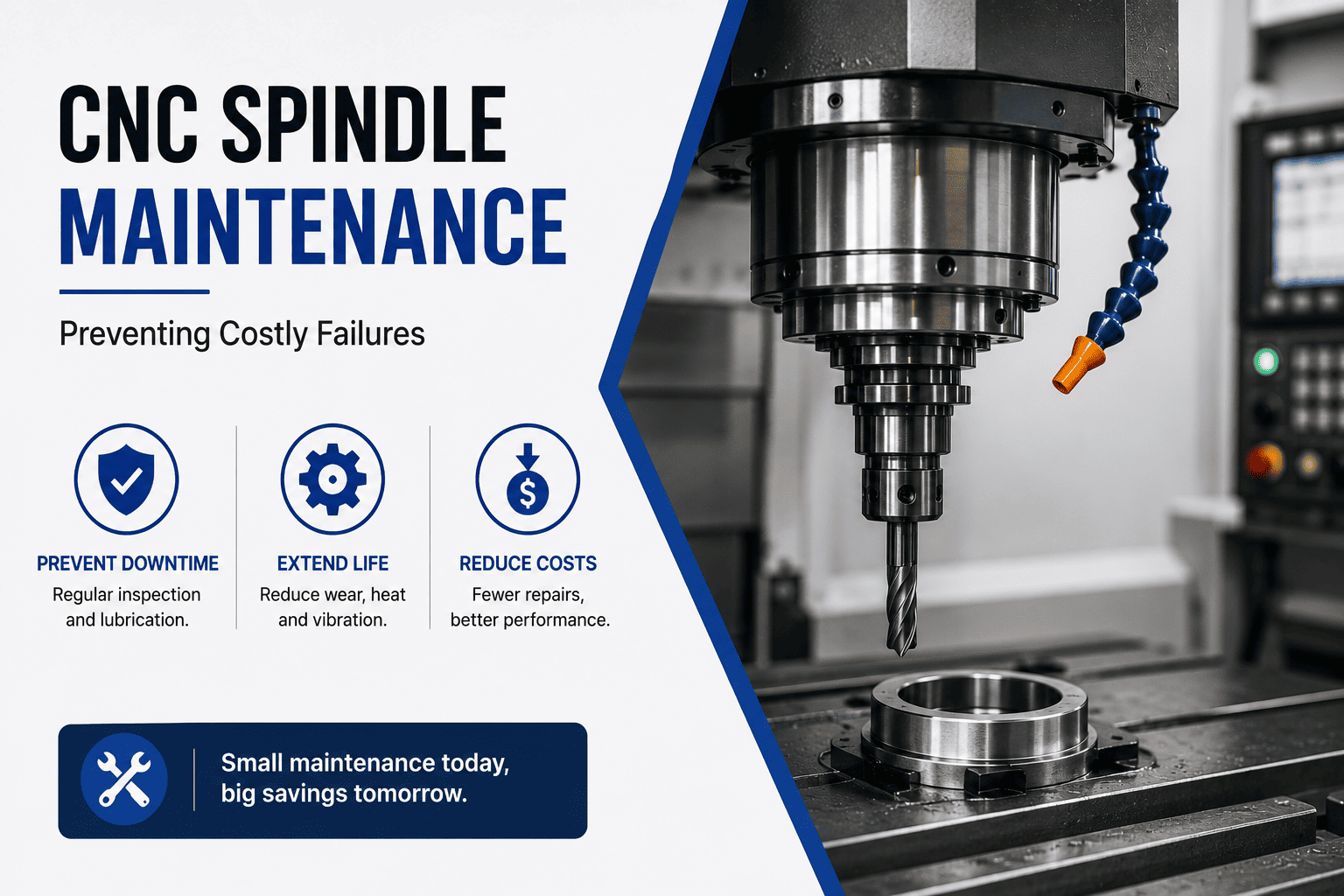
CNC spindle maintenance is the single highest-leverage reliability practice on any machining floor, because the spindle is the most expensive component to replace — a single failure can cost $15,000 to $40,000 in parts, labor, and lost production. The spindle is the heart of every CNC machine tool, and almost every premature failure is preventable with disciplined attention to bearings, lubrication, runout, thermal stability, and contamination control. This guide gives maintenance technicians and reliability managers a practical playbook for spindle care — warm-up cycles, vibration trending, temperature monitoring, coolant contamination checks, and CMMS-driven PM routines that can stretch spindle life two to three times. Stop reacting to spindle failures and start preventing them with OxMaint — you can Start Free Trial today or book a demo to see predictive spindle monitoring in action.
CNC SPINDLE MAINTENANCE PLAYBOOK
What would a single spindle failure cost your plant today?
A CNC spindle rebuild runs $8K–$25K and takes the machine down for 1–3 weeks. Yet 90% of failures are preventable with the right maintenance rhythm — warm-up cycles, lubrication discipline, vibration trending, and thermal monitoring inside a CMMS that never forgets a PM.
WHY SPINDLE FAILURES HAPPEN
The real cost of skipping CNC spindle maintenance
Spindle failures rarely happen without warning — they happen because the warnings were never tracked, trended, or acted upon. Here is what the data from hundreds of machine shops reveals about why spindles die early.
REAL-WORLD SCENARIO
A 40-machine job shop in the Midwest was spending $84,000 per year on emergency spindle rebuilds — averaging two failures annually across their VMCs. After implementing structured spindle PM routines in a CMMS (warm-up cycles, quarterly vibration trending, monthly lubrication checks), failures dropped to one every 18 months. Annual spindle repair spend fell to under $20,000, and machine availability improved 6%.
SPINDLE PM CHECKLIST
Essential CNC spindle maintenance checklist by frequency
Build these tasks into your CMMS as recurring work orders. Every check below maps directly to a failure mode that costs shops tens of thousands when ignored.
Startup & operating checks
- Run a spindle warm-up cycle — 10–15 min at 500–1,500 RPM in 25% increments to stabilize thermal expansion and protect bearings from shock loads on cold starts.
- Monitor spindle temperature — baseline 35–45°C; flag any reading above 55°C or a rapid 10°C rise within an hour, which signals bearing or lubrication distress.
- Listen for abnormal noise — grinding, squealing, or rumbling indicates bearing race wear or lubrication starvation; log it immediately.
- Check coolant flow & nozzle alignment — misdirected coolant contaminates bearings and washes out grease; verify flow rate and aim daily.
Inspection & cleaning
- Inspect taper & face for contamination — clean the spindle nose and tool holder tapers; chips and coolant residue accelerate wear and cause runout.
- Measure spindle runout — use a dial test indicator; TIR should stay under 0.0002" (5 microns). Trend the reading weekly to catch bearing wear early.
- Check air purge & seal pressure — verify that the labyrinth seal air supply is clean and at spec (typically 2–5 PSI) to block coolant ingress.
Lubrication & trending
- Verify lubrication system function — for grease-lubricated spindles, confirm the automatic lubricator is cycling; for oil-air systems, check flow rate (typically 0.5–2 mL/hr) and line integrity.
- Trend vibration spectra — take a baseline velocity reading (mm/s RMS) at 1,200 RPM; a 2x increase in the bearing defect frequencies (BPFO, BPFI) is an early failure flag.
- Inspect coolant for tramp oil — tramp oil degrades coolant and contaminates spindle bearings; use a refractometer and skimmer weekly to keep concentration below 2%.
Deep diagnostics
- Full vibration analysis — capture FFT spectra across 3–5 speed bands and compare to the baseline signature; escalating sidebands indicate bearing race spalling or cage wear.
- Thermal imaging of spindle housing — hot spots above 60°C near bearing journals signal preload loss or lubrication breakdown before catastrophic failure.
- Review drawbar force — test pull force with a drawbar force gauge; a 15%+ drop from spec means Belleville washers are fatigued and tool retention is compromised.
FAILURE CAUSES & PREVENTION
Common CNC spindle failure modes and how to prevent each one
Understanding the dominant failure modes helps you target PM effort where it matters most. This table maps each failure to its root cause, warning signs, and the preventive action that stops it.
| Failure Mode | Root Cause | Warning Signs | Preventive Action |
|---|---|---|---|
| Bearing spalling | Lubrication starvation, contamination, overload | High-frequency vibration, rising temperature, rumbling noise | Monthly lube checks, quarterly vibration FFT, coolant contamination control |
| Thermal seizure | Inadequate warm-up, blocked cooling, preload drift | Temperature above 60°C, thermal expansion drift in tolerances | Daily warm-up cycles, continuous thermal monitoring, clean cooling fins |
| Coolant ingress | Seal failure, low air-purge pressure, coolant chemistry breakdown | Rust on taper, grease washout, milky residue, rising TIR | Daily air-purge check, weekly seal inspection, quarterly tramp-oil testing |
| Runout drift | Bearing wear, drawbar fatigue, taper damage from crashes | TIR above 0.0003", poor surface finish, tool chatter | Weekly runout trending, quarterly drawbar force test, crash inspection protocol |
| Grease degradation | Over-greasing, wrong grease grade, high operating temp | Stiff rotation after idle, temperature spike on startup, seal weeping | Follow OEM grease spec & volume, purge annually, monitor startup temp |
MAINTENANCE ROI
The cost math: preventive spindle maintenance vs. reactive repair
The economics are straightforward — a structured spindle PM program costs a fraction of a single rebuild. Run the numbers for your own fleet and the payback is immediate.
ANNUAL FAILURE COST FORMULA
Failure Cost = (Spindles × Annual Failure Rate) × (Rebuild Cost + Downtime Cost)
Example: 20 spindles × 8% failure rate × ($18K rebuild + $12K downtime) = $48,000/yr
PREVENTIVE PROGRAM COST FORMULA
PM Cost = (Labor Hrs × Rate × Frequency) + Lubricant & Sensor Costs
Example: 20 spindles × 2 hrs/month × $75 + $1,200 supplies = $37,200/yr — and cuts failures 60–80%
| Metric | Reactive Only | CMMS-Driven PM | Savings |
|---|---|---|---|
| Annual spindle failures (20 machines) | 1.6 events | 0.4 events | 75% fewer |
| Annual repair spend | $48,000 | $12,000 | $36,000 saved |
| Unplanned downtime hours | 240 hrs | 60 hrs | 180 hrs recovered |
| Mean spindle life | 5,000 hrs | 12,000 hrs | 2.4x longer |
| PM program cost | $0 | $37,200 | Net ROI Year 1: ~$11K+ |
See OxMaint protect your spindles — book a 30-minute demo
Watch how maintenance teams use OxMaint to schedule spindle PMs, trend vibration data, and catch bearing failures weeks before they shut down a machine.
HOW OXMAINT HELPS
How OxMaint's CMMS prevents CNC spindle failures before they happen
OxMaint turns spindle maintenance from a memory game into a system. Automated PM scheduling, predictive analytics, and full asset history ensure no spindle check is ever missed — and every warning sign is acted on.
Automated PM scheduling
Auto-generate warm-up, lubrication, runout, and vibration work orders on the exact frequency each spindle needs. OxMaint sends reminders, assigns technicians, and closes the loop — no spreadsheet can slip.
Cut missed PMs by 95% and eliminate "I forgot to check it" failures.
Predictive vibration & thermal trending
Log vibration spectra, temperature readings, and runout measurements directly in OxMaint. AI detects trend shifts and alerts you when a bearing defect frequency accelerates — weeks before failure.
Catch 80%+ of bearing failures in the warning zone, not the failure zone.
Full spindle asset history
Every rebuild, grease change, crash, and vibration reading is tied to the asset record. When a spindle starts drifting, you see the full timeline — not a blank slate.
Cut mean-time-to-repair 30% and justify rebuild vs. replace with hard data.
Spare-parts & bearing inventory
Track spare bearings, grease cartridges, and seals by part number. OxMaint auto-reorders when stock hits a minimum so the right parts are on the shelf when a spindle needs service.
Eliminate 2-week parts delays and cut inventory carrying cost 20%.
FAQ
CNC spindle maintenance FAQs
How often should CNC spindle maintenance be performed?
Daily checks should include a warm-up cycle, temperature monitoring, and noise inspection. Weekly, inspect the taper, measure runout, and verify air-purge pressure. Monthly tasks cover lubrication system verification and vibration trending. Schedule a full vibration FFT analysis and thermal imaging quarterly. The key is consistency — a CMMS like OxMaint automates these schedules so nothing is missed. Start Free Trial to set up your spindle PM calendar in minutes.
What is the most common cause of CNC spindle failure?
Bearing failure accounts for roughly 70% of spindle failures, and the root causes are almost always lubrication starvation, coolant contamination, or thermal overload. These are preventable with proper grease or oil-air lubrication management, air-purge seal maintenance, and disciplined warm-up cycles that prevent thermal shock on cold starts.
How long should a CNC spindle warm-up cycle be?
A proper warm-up runs 10–15 minutes, ramping through 3–5 speed increments (25%, 50%, 75%, 100% of max RPM). This stabilizes thermal expansion, distributes lubricant across bearing races, and prevents shock loading. Skipping warm-ups is one of the fastest ways to shorten spindle bearing life — especially in cold shop environments below 60°F.
What spindle runout is acceptable and when should I worry?
New CNC spindles typically spec TIR (total indicator runout) under 0.0002" (5 microns). Anything above 0.0003" warrants investigation, and above 0.0005" means the spindle likely needs service or rebuild. The critical practice is trending — measure weekly and act on any sustained increase, not just the absolute number.
Can a CMMS really extend spindle life 2–3 times?
Yes — a CMMS like OxMaint ensures every PM task happens on time, every reading is trended, and every warning sign triggers a work order before failure. Shops that move from reactive maintenance to CMMS-driven spindle PMs routinely see mean spindle life jump from 5,000 to 12,000+ operating hours. Book a demo at calendly.com/oxmaintapp/30min to see the workflow on your own assets.
Stop replacing spindles. Start preventing failures.
Join the maintenance teams using OxMaint to schedule spindle PMs, trend vibration data, and catch bearing failures weeks before they cost you $28K and three weeks of downtime.
Free 14-day trial · No credit card