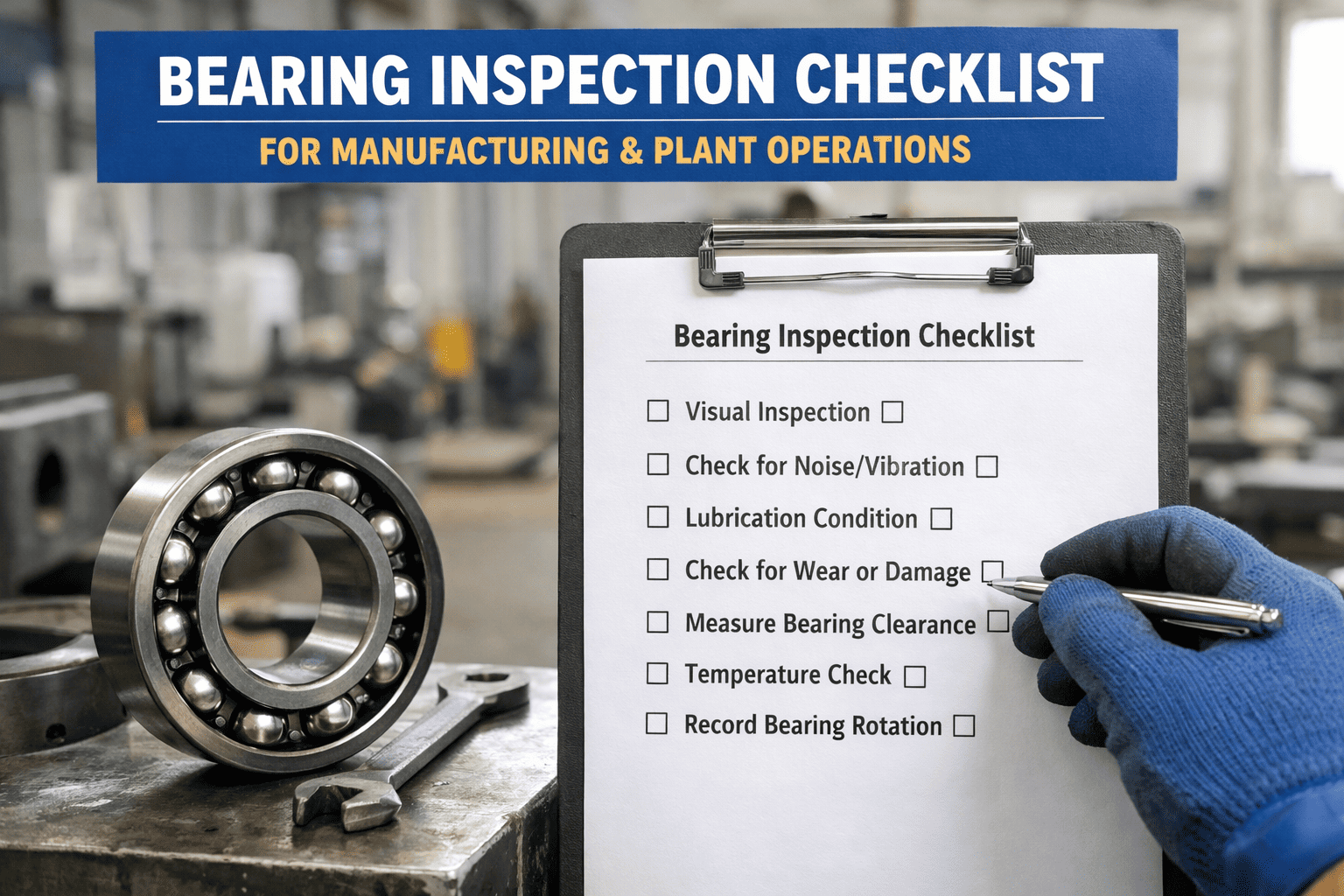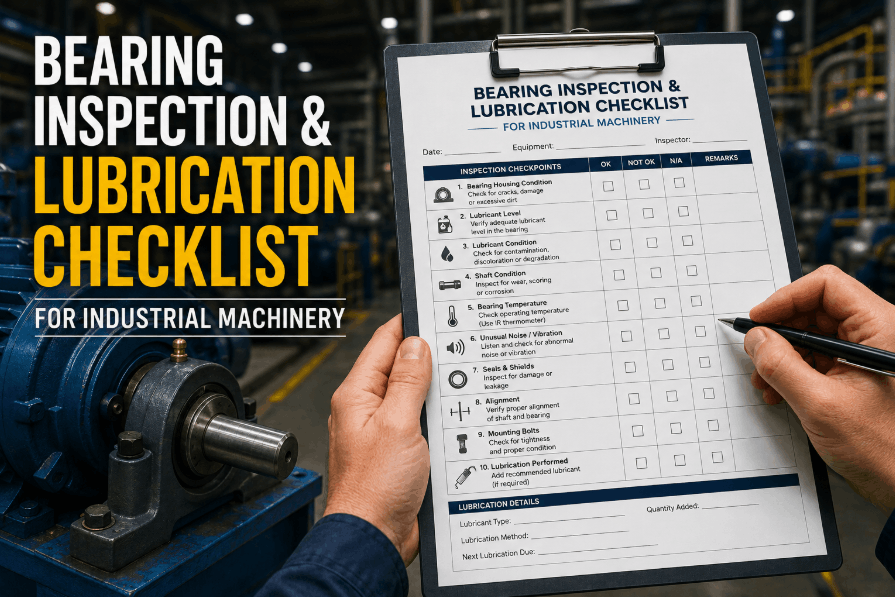
A bearing inspection and lubrication checklist is the most direct tool maintenance teams have for preventing unplanned downtime from rolling element bearing failures in industrial machinery. Under ISO 18436-2, ANSI/AFBMA standards, and OEM service requirements, bearings in motors, gearboxes, pumps, and conveyor drives demand structured inspection covering operating temperature, vibration signature, audible noise, grease quantity and condition, contamination control, and seal integrity. A missed bearing inspection cycle doesn't just accelerate wear — it converts a correctable lubrication deficiency into a catastrophic seizure event that takes the entire production line offline. This bearing inspection and lubrication checklist covers every task reliability engineers and maintenance technicians need, organized by condition monitoring zone so your team catches bearing problems before they become failures. Sign Up Free to digitize bearing inspection work orders, auto-schedule lubrication routes by asset class, and maintain a complete bearing condition history for every machine in your plant.
Your Plant's Bearings Are Telling You Something. Are You Documenting What They're Saying?
Oxmaint auto-schedules bearing inspection and lubrication routes by equipment type, routes work orders to certified technicians, and generates timestamped condition records that satisfy reliability auditors and OEM warranty reviewers — from a single CMMS platform.
Bearing Operating Temperature Inspection Checklist
Elevated bearing temperature is the first measurable indicator of lubrication starvation, overgreasing, misalignment, or internal defect progression. ISO 18436-2 condition monitoring practice requires baseline temperature recording at each bearing location during normal load — any deviation above 10°C from the established baseline is an actionable flag, not a watch item. A bearing running 20°C above baseline on a gearbox output shaft is days away from seizure, not months. Book a Demo to see how Oxmaint captures bearing temperature readings against individual asset baselines and alerts maintenance planners when thermal trends cross defined thresholds.
Bearing Vibration and Audible Noise Condition Monitoring Checklist
Vibration signature analysis and structured audible inspection are the two earliest detection methods for bearing defect progression in industrial machinery. ISO 10816 and ISO 20816 define vibration severity limits by machine class — a pump bearing producing broadband high-frequency vibration above baseline is exhibiting raceway spall progression. Structured listening with an acoustic probe or ultrasonic detector at defined bearing points converts subjective technician judgment into a documented, repeatable inspection record. Sign Up Free to log vibration readings against ISO severity zones in Oxmaint work orders and trend bearing condition data across full asset operating history.
Bearing Greasing and Lubrication Quality Inspection Checklist
Incorrect lubrication quantity is the single largest preventable cause of bearing failure in industrial machinery — both overgreasing and under-greasing are active failure modes, not just maintenance errors. Overgreasing raises operating temperature by churning excess lubricant; undergreasing allows metal-to-metal contact within hours of starvation. ISO 15242 and OEM regreasing specifications define quantity, interval, and grease compatibility requirements that must be followed exactly — not approximated. Book a Demo to see how Oxmaint's lubrication work orders enforce OEM grease quantity, record grease type used, and prevent cross-contamination through built-in compatibility verification before technicians apply lubricant.
Bearing Contamination Control and Seal Integrity Checklist
Contamination ingress is responsible for over 50% of premature bearing failures in food processing, mining, paper, and heavy manufacturing environments. A bearing seal that allows particulate ingress reduces L10 fatigue life by a factor of 3 to 10, depending on particle hardness and quantity. Seal inspection is not a secondary checklist item — it is a primary failure prevention task that directly determines whether the bearing reaches its design life or fails at a fraction of it. Sign Up Free to attach seal inspection findings directly to each bearing asset record in Oxmaint and trigger corrective seal replacement work orders automatically when deficiencies are found.
Bearing Alignment, Fit, and Mounting Condition Inspection Checklist
Misalignment and incorrect bearing fit are the two most common installation-induced failure modes in industrial rotating equipment — and both are invisible to visual inspection once the machine is assembled. Shaft misalignment above 0.05mm parallel offset on a direct-coupled pump increases bearing radial load beyond design, accelerating fatigue progression on the loaded hemisphere of the raceway. Bearing fit inspection at installation and periodic shaft runout checks during operation are non-negotiable elements of a complete bearing condition monitoring program. Book a Demo to see how Oxmaint's structured work orders capture alignment readings, fit condition notes, and installation torque records linked to each bearing replacement event across your asset register.
Bearing Inspection and Lubrication Frequency Reference Table
| Inspection Zone | Inspection Task | Frequency | Governing Standard |
|---|---|---|---|
| Temperature Monitoring | Housing temperature, baseline deviation check | Monthly | ISO 18436-2 / OEM |
| Vibration Monitoring | Overall vibration velocity, ISO severity zone classification | Monthly / Quarterly | ISO 10816 / ISO 20816 |
| Audible Noise Inspection | Acoustic probe, ultrasonic emission check | Monthly | ISO 18436-2 / OEM |
| Grease Quantity Check | Regreasing per OEM spec, quantity verification | Per OEM Interval | ISO 15242 / OEM |
| Grease Quality Inspection | Purge color, debris content, oxidation check | Each Lubrication Event | NLGI / OEM |
| Seal Condition | Lip seal, labyrinth, shield integrity check | Quarterly | OEM / ISO 11171 |
| Contamination Control | Moisture ingress, particulate contamination check | Monthly | ISO 4406 / OEM |
| Shaft Alignment | Coupling alignment, angular and parallel offset | Annual / Post-Maintenance | ISO 1940 / ANSI/AFBMA |
| Mounting Condition | Housing bore, shaft journal, fretting inspection | Each Bearing Replacement | ANSI/AFBMA / OEM |
| CMMS Recordkeeping | Condition readings, lube records, corrective actions | Each Inspection | OEM / Insurance / Reliability |
Stop Managing Bearing Lubrication Routes on Paper Sheets and Spreadsheets.
Oxmaint builds OEM-aligned bearing inspection and lubrication checklists into your CMMS, enforces required data capture at every condition monitoring checkpoint, and generates timestamped bearing history records that satisfy reliability engineers and insurance loss control auditors — from a single mobile-ready platform.
Frequently Asked Questions — Bearing Inspection and Lubrication Checklist
Every Bearing. Every Inspection Point. Every Lubrication Record — Documented and Audit-Ready in Oxmaint.
Oxmaint makes bearing inspection and lubrication the most defensible part of your plant reliability program — not the documentation gap that surfaces when a warranty claim is denied or a reliability audit reveals missing inspection history.

-inspection-checklist-for-industrial-facilities.png)