A CNC machine that runs at micron-level precision today can begin producing scrap tomorrow — not from operator error, not from bad programming, but because someone skipped a lubrication cycle three weeks ago. 82% of companies have experienced unplanned CNC downtime in the past three years, and the hard truth is that most of those breakdowns were entirely preventable. This guide covers every maintenance pillar — lubrication, coolant management, spindle care, calibration, and predictive monitoring — and shows you exactly how to turn reactive fire-fighting into a structured PM program that protects accuracy, extends machine life by years, and cuts maintenance costs by up to 18%.
15–25 yrs
CNC lifespan with proper maintenance
35%
Of downtime caused by poor coolant management
50%
Downtime reduction with structured PM program
5.42%
Annual unplanned downtime rate with predictive maintenance
The Four Pillars of CNC Machine Maintenance
Effective CNC maintenance is not a checklist of tasks — it is a system of four interdependent disciplines. When any one pillar is neglected, the others compensate temporarily until they too begin to fail. Understanding how these four areas connect is the foundation of building a maintenance program that actually prevents breakdowns rather than just managing them.
01
Lubrication Management
The single most critical maintenance task
Proper lubrication of spindle bearings, linear guides, ballscrews, and sliding surfaces prevents the excessive wear, friction heat, and accuracy loss that account for the majority of mechanical failures. Nearly 7 out of 10 unexpected spindle shutdowns occur because lubrication was missed or poorly recorded. Greasing components every 500 operating hours reduces thermal errors by half and significantly extends bearing service life.
70%
of spindle shutdowns linked to missed lubrication
02
Coolant System Health
The system most frequently overlooked
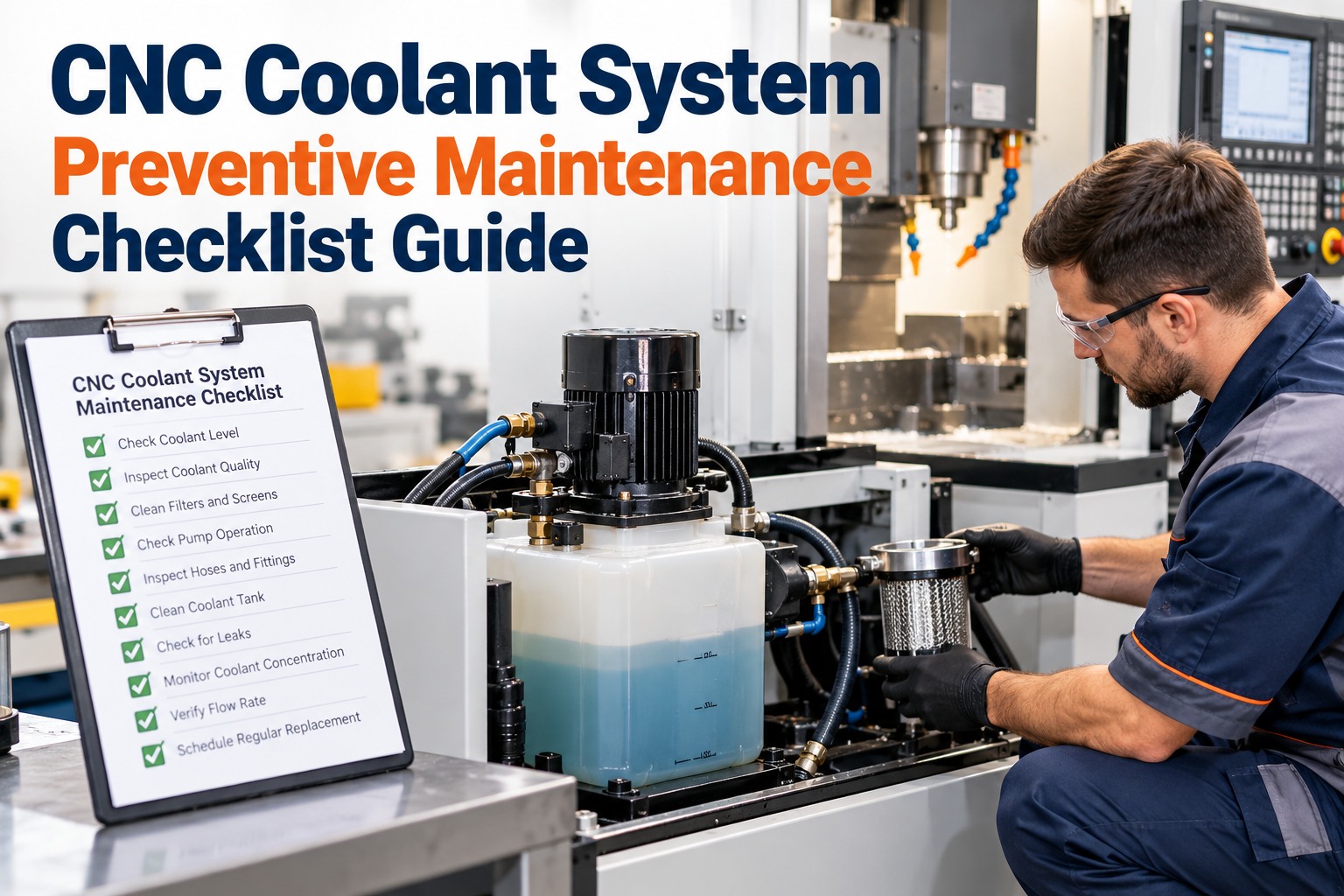
Coolant does far more than cool the cut — it lubricates, evacuates chips, and prevents corrosion on precision surfaces. Improper coolant management accounts for nearly 35% of unplanned CNC downtime. Just 5 minutes without coolant can raise spindle bearing temperature by 30°C, triggering thermal shutdown. Maintain concentration at 5–8% for emulsifiable oils and 3–5% for synthetics. Full coolant change every 2–3 months. pH must stay between 8.5 and 9.5.
35%
of CNC downtime from poor coolant management
03
Spindle Care & Monitoring
Your most expensive and most critical component
The spindle is the functional heart of every CNC machine. A spindle that is slightly out of balance causes chatter marks. Contaminated taper causes runout. Worn bearings cause dimensional drift long before audible failure. Spindle maintenance requires daily listening, weekly taper inspection, monthly load trend review, and formal runout measurement every 6 months. Vibration sensors can detect bearing wear 4–8 weeks before failure — turning a $35,000 emergency into a $3,500 planned repair.
4–8 wks
advance warning from vibration analysis
04
Calibration & Geometric Accuracy
The discipline that protects part quality
CNC machines lose calibration over time — it is not a question of if, but when. Ball screws wear. Bearings develop play. Thermal cycling expands and contracts components. The machine foundation settles. Regular calibration checks detect accuracy drift before it produces out-of-tolerance parts. Backlash compensation, geometric leveling, axis alignment, and thermal compensation verification must be performed on a defined schedule — not just when a customer complaint arrives.
±0.005mm
positioning accuracy maintained with regular compensation
Lubrication: The Science Behind CNC Machine Life
No maintenance task delivers a higher return than proper lubrication. The physics are straightforward: without an adequate lubricant film between moving surfaces, metal-to-metal contact generates heat, increases friction, and accelerates wear geometrically — not linearly. Track every lubrication interval automatically with Oxmaint and eliminate the memory-based scheduling that causes 70% of spindle failures.
Spindle Bearings
Every 500 operating hours
Grease: high-speed angular contact bearing grease
Failure without: Thermal seizure, $22K–$35K rebuild
Critical
Linear Guides & Slideways
Auto-lube system — verify daily
Oil: manufacturer-specified way oil (ISO VG 32–68)
Failure without: Guide scoring, positioning errors
Critical
Ballscrews
Auto-lube system — inspect monthly
Oil: light machine oil or manufacturer-specified
Failure without: Backlash, positional inaccuracy
High
Tool Changer Mechanism
Weekly per manufacturer spec
Grease: lithium-based multi-purpose grease
Failure without: ATC jams, dropped tools, crashes
High
Chip Conveyor Chain
Monthly
Grease: chain lubricant, EP-rated
Failure without: Conveyor jam, coolant contamination
Standard
Pallet Changer (HMC)
Per manufacturer cycle count
Grease: heavy-duty lithium complex grease
Failure without: Locating pin wear, fixture repeat error
Standard
Lubrication failure is the root cause of 50–80% of rotating asset failures. Over-lubrication attracts metal chips and dust. Use only manufacturer-specified lubricant types and quantities — substitutions change viscosity and shear characteristics.
Never Miss a Lubrication Interval Again
Oxmaint auto-schedules every lubrication task by operating hours, calendar time, or machine trigger — and sends mobile alerts before tasks go overdue. 67% of maintenance teams miss scheduled tasks on paper-based systems. Zero on Oxmaint.
Coolant Management: The Hidden Driver of CNC Accuracy
Most shops treat coolant as a consumable. The ones with the best OEE treat it as a precision system. Contaminated coolant with metal chips, fungi, or bacteria does not just smell bad — it degrades tool life, causes part defects, corrodes cast iron guideways, and can short-circuit servo drives when mist infiltrates control cabinets. See how Oxmaint tracks coolant condition and concentration history per machine.
Concentration (Emulsifiable Oil)
Too low: rust, bacterial growth. Too high: foaming, skin irritation, residue buildup on parts
Coolant pH Level
Low pH: cast iron corrosion, guideway damage. High pH: bacterial growth indicator, skin issues
Full Coolant Replacement Interval
Every 2–3 months standard operation
Delayed change: bacteria multiply, tramp oil builds up, pump damage, 15% increase in unplanned downtime
Daily
Check level and top off. Inspect color and smell. Verify coolant delivery to all nozzles. Check for foaming during cuts.
Weekly
Test concentration with refractometer. Measure pH. Clean tank strainers. Skim tramp oil from surface. Clean and unclog all coolant nozzles.
Monthly
Deep clean coolant filters. Check pump output flow rate. Inspect coolant lines for blockages. Check through-spindle coolant pressure if equipped.
Quarterly
Full drain and coolant replacement. Clean coolant tank — remove all chips and sludge. Inspect pump seals. Ultrasonic clean TSC channels to prevent 90% of internal coolant failures.
Calibration Strategy: Protecting Part Accuracy Over the Long Run
Accuracy drift in a CNC machine does not announce itself. It accumulates invisibly over weeks of thermal cycling, vibration, and mechanical wear — until the day a customer's CMM catches it or your scrap rate spikes. The fastest path from scrap to precision is a documented calibration program that measures drift on a schedule, not after a complaint.
Ballscrew Backlash
Positional error that varies with temperature and cutting load. Shows up as part-to-part dimensional variation on the same setup.
Run backlash program. Update CNC compensation parameters. Maintain positioning within ±0.005mm.
Thermal Drift
Machine expands during warmup. First parts made cold differ from parts made after 2 hours of operation. Ignoring warmup procedure wastes 15–20 minutes of daily accuracy.
Use consistent warmup cycle. Verify thermal compensation sensors are active. Calibrate compensation semi-annually.
Spindle Runout
Bearing wear or taper contamination creates eccentricity. Even 0.002mm runout appears as chatter marks and diameter variation on tight-tolerance bores.
Measure axial and radial runout with dial indicator every 6 months. Clean spindle taper weekly. Replace bearings at first sign of trend.
Machine Level Shift
Floor vibration, anchor bolt loosening, and foundation settling shift machine level over months. An unlevel machine produces out-of-round parts — often misdiagnosed as a tool or program problem.
Verify level with precision electronic levels every 6 months. Adjust anchor bolts and re-verify after any major machine move.
Monthly
Backlash check. Review axis positioning trend from control data. Compare first-piece dimensions to SPC baseline.
Quarterly
Geometric accuracy verification. Verify axis squareness and alignment. Ballbar or laser check on critical machines.
Semi-Annual
Spindle runout measurement. Thermal compensation calibration. Gib adjustment. Machine leveling verification with precision level.
Annual
Full geometric audit — squareness, flatness, straightness. Document all results against machine spec. Compare to prior year baseline to trend wear rates.
The 8 Most Common CNC Failures and How to Stop Them
Building a CNC Maintenance Program That Scales
Individual checklists and manual scheduling work for a single machine. They collapse under the weight of a multi-machine shop floor. The transition from paper-based tracking to a structured CMMS is the point where maintenance programs stop being reactive and start generating measurable reliability improvements. Oxmaint's preventive maintenance scheduling engine handles complexity that grows with your operation — without growing your admin overhead.
Phase 1
Establish Baselines (Week 1–2)
Audit all CNC assets — capture make, model, age, operating hours
Pull last 90 days of breakdown history to identify top failure modes
Document current lubrication, coolant, and calibration intervals
Configure Oxmaint machine profiles and PM schedules per asset
Phase 2
Launch PM Schedules (Week 3–4)
Activate daily operator checklists via mobile app on every machine
Set automated work orders for weekly, monthly, and semi-annual tasks
Train technicians on digital work order completion with photo capture
Begin recording all coolant and lubrication readings per machine
Phase 3
Measure and Optimize (Week 5–8)
Review MTBF and MTTR trends — identify which machines need extra attention
Cross-reference maintenance records with any quality or scrap events
Adjust PM intervals for high-use machines vs. lightly loaded assets
Present downtime reduction data to leadership with ROI calculation
Frequently Asked Questions
How often should CNC machine preventive maintenance be performed?
What is the most common root cause of CNC machine failure?
Contaminated coolant and poor lubrication are the leading causes of premature bearing and ballscrew failure — together responsible for the majority of unplanned CNC downtime. These two failures are also the most preventable: consistent daily checks for coolant level and condition, and verification that automatic lubrication systems are cycling correctly, eliminate most bearing failures before they start. Documentation matters too — nearly 7 in 10 spindle shutdowns trace back to lubrication that was missed or not recorded.
Track every lubrication and coolant event with a digital timestamp in Oxmaint.
How does thermal drift affect CNC machining accuracy and how is it controlled?
Thermal drift occurs as the machine structure expands during warmup — typically 15 to 30 minutes of operation after a cold start — and can cause positional shifts of several microns depending on machine size and ambient temperature. Modern CNC controls use temperature sensors and software compensation to automatically adjust tool paths, but this system requires semi-annual verification and calibration to remain accurate. The simplest operational control is a consistent warmup cycle run before the first production part every shift.
Schedule a demo to see how Oxmaint documents calibration history and thermal compensation verification intervals.
Can operators perform CNC maintenance tasks, or does it require trained technicians?
Operators are the first and most important line of defense — they interact with the machine every shift and are best positioned to notice changes in sound, finish quality, or behavior before those changes become failures. Daily tasks like coolant level checks, visual inspection for leaks or chip buildup, and listening during spindle warmup are operator responsibilities. Tasks requiring lockout/tagout, specialized measurement tools, or system access — such as ballscrew inspection, calibration verification, and electrical cabinet maintenance — require trained maintenance technicians.
Oxmaint's role-based work orders assign daily tasks to operators and technical tasks to the right maintenance team members automatically.
What is the ROI of investing in a CMMS for CNC machine maintenance?
A structured CMMS-driven PM program reduces unplanned downtime by up to 50%, cuts maintenance costs by up to 18%, and extends CNC machine life from the typical 10–15 year neglected lifespan to 15–25 years with proper care. When you factor in the $10,000–$250,000 per-hour cost of unplanned downtime and the $22,000–$50,000 cost of a single catastrophic spindle failure, even one prevented breakdown pays for years of CMMS subscription. Teams also recover 8–12 hours per week previously spent on manual reporting and paperwork.
Sign up free and start building your CNC PM program in Oxmaint today — no credit card required.
Start Protecting Your CNC Investment Today
The Machines That Run the Longest Are the Ones Someone Planned For
Oxmaint gives every CNC machine in your shop a structured, automated PM program — auto-scheduling lubrication, coolant, calibration, and inspection tasks, capturing digital completion records, and calculating live MTBF and MTTR so you know exactly where your reliability stands and what to fix next.

.png)


