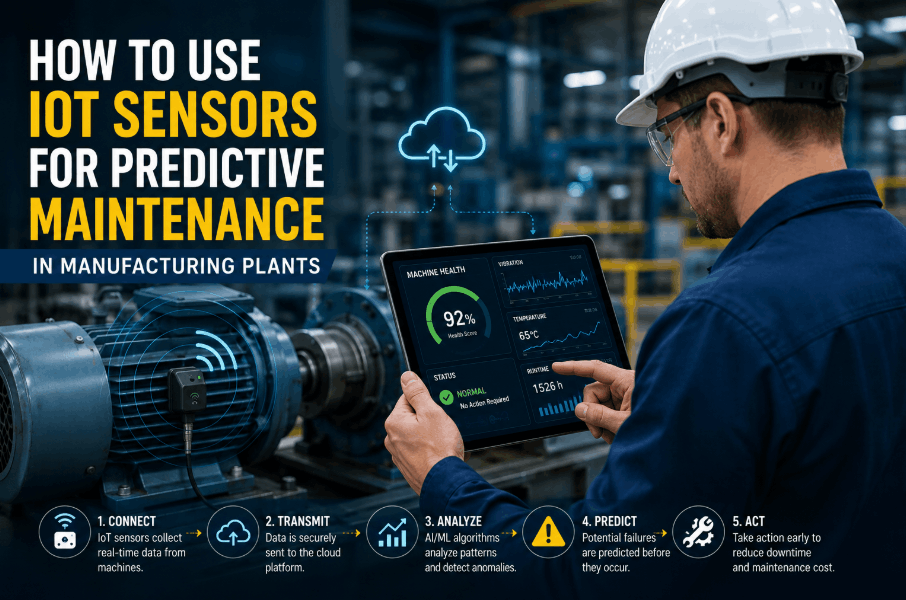
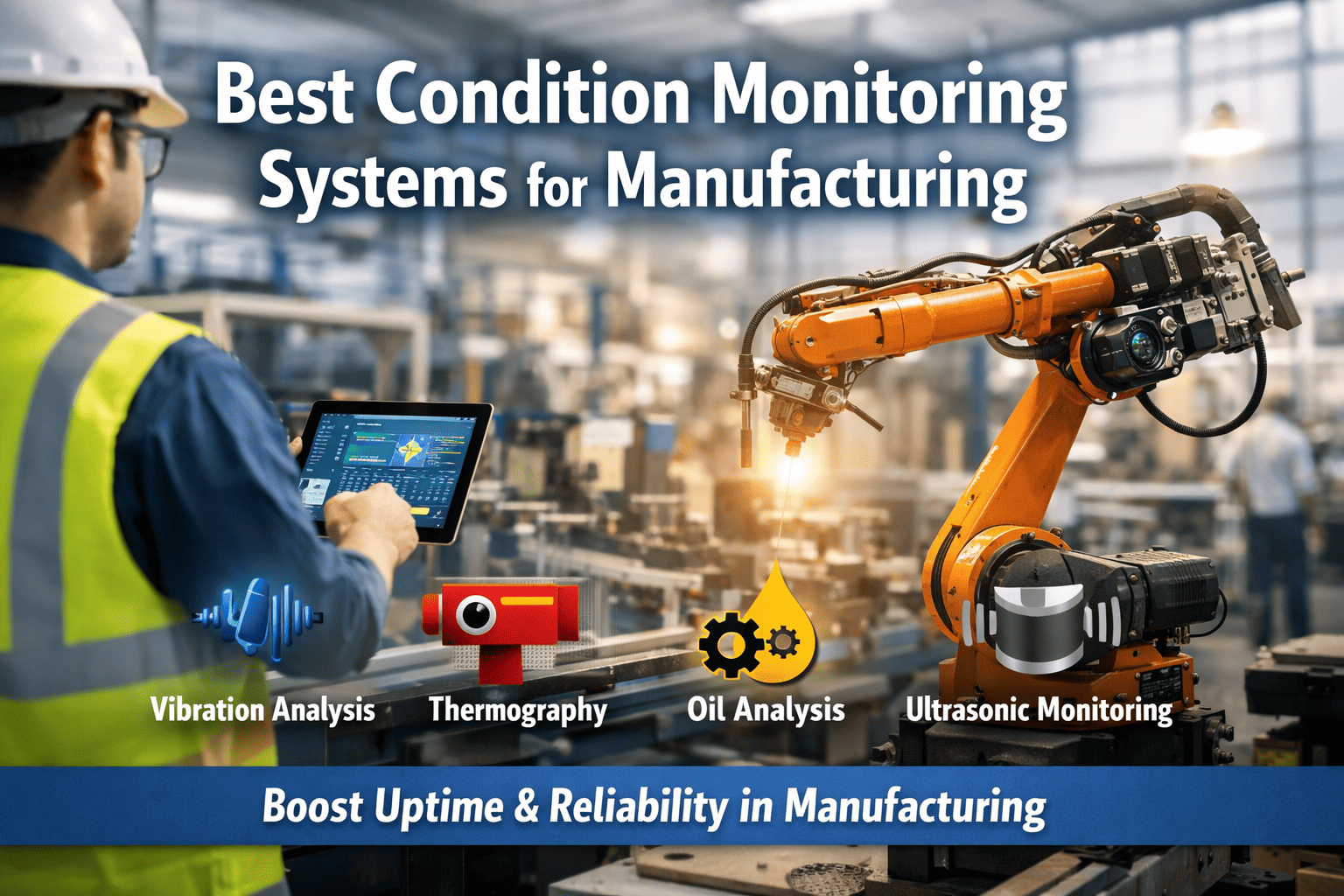
Unplanned downtime costs U.S. manufacturers roughly $50 billion every year, with equipment failure accounting for over one-third of all production stoppages. Condition monitoring systems—spanning vibration analysis, thermal imaging, ultrasonic detection, and IoT sensor networks—give your maintenance teams the ability to detect bearing wear, electrical hotspots, misalignment, and lubrication breakdown weeks or months before a failure shuts down the line. This technology guide breaks down exactly how each monitoring technique works, where to deploy sensors for maximum impact, and how to connect real-time machine health data to your maintenance workflows. Schedule a free demo to see how Oxmaint turns vibration, thermal, and IoT sensor alerts into automated maintenance workflows for your plant.
The Hidden Cost of Ignoring Machine Health
Most manufacturing plants still operate in a reactive or time-based maintenance cycle—fixing machines after they break or servicing them on arbitrary schedules regardless of actual condition. Both approaches leave significant money on the table. Research consistently shows that reactive maintenance costs four to six times more per incident than planned repairs, while time-based approaches waste resources maintaining equipment that does not need attention yet.
$260K
Average hourly cost of unplanned downtime across industrial manufacturing sectors
800 hrs
Annual unplanned downtime faced by a typical manufacturing facility—over 15 hours per week
42%
Of all unplanned downtime directly caused by equipment failure that monitoring could prevent
Condition monitoring flips the equation. By tracking real-time vibration patterns, thermal signatures, acoustic emissions, and oil condition, your maintenance team receives early warnings weeks before failure occurs—turning emergency repairs into planned, low-cost interventions. Manufacturing plants using condition monitoring report a 35% reduction in downtime, and 87% of manufacturing firms are now investing in predictive maintenance capabilities. Sign up for Oxmaint free and start tracking equipment health with condition-based work orders that cut your reactive maintenance costs.
Vibration Analysis: Reading Your Equipment's Vital Signs
Vibration analysis is the most widely adopted condition monitoring technique in manufacturing, commanding roughly 33% of the global monitoring market. Every rotating machine—motors, pumps, compressors, fans, gearboxes, turbines—produces a unique vibration signature when operating normally. As components wear, loosen, or fall out of alignment, those vibration patterns shift in predictable, measurable ways that trained analysts and AI algorithms can decode.
How Vibration Analysis Works
Accelerometers and velocity transducers mounted on machine housings capture vibration data continuously or at scheduled intervals. The raw time-domain signal is converted into a frequency spectrum using Fast Fourier Transform (FFT), which separates the overall vibration into individual frequency components.
Each mechanical fault produces vibration at specific, predictable frequencies. Shaft imbalance appears at 1X running speed. Misalignment shows at 2X. Bearing defects generate characteristic frequencies tied to bearing geometry—inner race, outer race, ball spin, and cage frequencies. Gear mesh problems appear at gear-mesh frequency and its harmonics.
By comparing current spectra against healthy baselines, analysts identify exactly which component is degrading, how rapidly, and how much operating life remains before intervention is required.
What Vibration Analysis Detects
Bearing Wear
2-6 months advance warning
Shaft Misalignment
Immediate detection
Rotor Imbalance
Immediate detection
Gear Tooth Damage
1-3 months advance warning
Looseness & Foundation Issues
Immediate detection
Belt & Sheave Problems
Weeks of advance warning
Cavitation in Pumps
Immediate detection
Vibration monitoring applies to any equipment with rotating parts—pumps, turbines, conveyor components, compressors, gears, fans, rotors, and more. By detecting abnormal operation in these components, condition-based maintenance eliminates production issues before they cascade.
Sign up now to automate work orders the moment vibration sensors flag a developing bearing, alignment, or balance fault on your production line.
Thermal Imaging: Seeing Problems Before They Surface
Infrared thermography captures heat signatures that are completely invisible to the human eye—revealing overheating connections, failing insulation, friction from worn bearings, blocked cooling passages, and process temperature abnormalities without touching the equipment or interrupting production. Thermal imaging achieves 75-98% fault detection accuracy across different equipment types, with electrical systems showing the highest detection rates.
Electrical Systems
Thermal cameras detect loose connections, overloaded circuits, corroded contacts, and phase imbalances in distribution panels, motor control centers, switchgear, and transformers. Electrical faults cause 25-30% of all unplanned downtime in manufacturing—thermal imaging catches 85-90% of these before failure.
Rotating Machinery
Motors, pumps, compressors, and conveyors generate specific thermal patterns during normal operation. Bearing wear, misalignment, lubrication failure, and mechanical imbalances create temperature anomalies that thermal systems detect long before catastrophic failure. Combining thermal data with vibration analysis provides a comprehensive diagnostic view.
Process Equipment
Refractory linings, steam traps, heat exchangers, and insulated piping develop hotspots or cold spots that indicate degradation. Thermal imaging identifies these issues during normal operation—no shutdown required—and drone-mounted cameras can survey large facilities rapidly and safely.
See how vibration spikes and thermal hotspots appear together on one screen. Book a personalized demo where we walk through Oxmaint's live condition monitoring dashboard using real equipment data from your industry.
Book a Demo
Building a Multi-Sensor Monitoring Strategy
No single monitoring technique catches every failure mode. The most effective condition monitoring programs layer multiple technologies—each targeting different fault types and equipment categories. The key is matching the right sensors to the right assets based on criticality, failure history, and the specific degradation patterns that threaten production.
What Changes When You Monitor Continuously vs. Periodically
Manufacturing plants typically choose between three monitoring approaches—and the difference in outcomes is dramatic. Continuous online monitoring catches faults in real-time, route-based portable monitoring provides periodic snapshots, and the hybrid approach combines both based on asset criticality.
Recommended for Critical Assets
Continuous Online Monitoring
Permanent sensors stream data 24/7 to cloud analytics
Anomalies detected within minutes of occurrence
AI models learn degradation curves and predict remaining life
Automatic alerts and CMMS work order generation
Highest cost per asset, highest value for critical equipment
<5 min
Detection-to-alert time
Route-Based Portable Monitoring
Technicians collect data on scheduled routes using handheld tools
Monthly or quarterly measurement intervals typical
Lower cost per asset, good for non-critical equipment
Requires trained vibration analysts on staff
Gaps between measurements mean some faults develop undetected
30-90 days
Typical measurement interval
Hybrid Approach
Online monitoring on the top 20% most critical assets
Route-based monitoring for the remaining 80% of equipment
All data centralized in a single CMMS platform
Best cost-to-coverage ratio for most manufacturing plants
Scales as budget allows—add online sensors where value is proven
Best ROI
For most manufacturing plants
Need help deciding which equipment deserves continuous sensors vs. periodic routes? Create your free Oxmaint account to access asset criticality templates, then let our maintenance engineers tailor a sensor deployment plan matched to your plant's risk profile.
Sign Up Free
Equipment Criticality Matrix: Where to Deploy Sensors First
Not every asset warrants the same level of monitoring investment. An equipment criticality assessment ranks each machine by its impact on production, safety, quality, and repair cost—then matches the appropriate monitoring technology and frequency to each tier.
Tier 1 — Critical Assets
Equipment whose failure immediately stops production, creates safety hazards, or causes major quality defects. These assets justify continuous online monitoring with automated alerts.
Examples: Main drive motors, primary compressors, CNC spindle motors, boiler feed pumps, kiln drives, turbine generators, high-voltage switchgear
Monitoring: Continuous vibration + thermal + oil analysis where applicable. Online sensors with real-time CMMS integration.
Tier 2 — Important Assets
Equipment that causes partial production loss or can be bypassed temporarily using redundant systems. These benefit from frequent route-based monitoring supplemented with wireless sensors.
Examples: Secondary pumps, HVAC systems, packaging line motors, conveyor drives, cooling tower fans, air handling units
Monitoring: Monthly vibration routes + quarterly thermal inspections. Wireless temperature and vibration sensors for trending.
Tier 3 — General Assets
Equipment with readily available spares, minimal production impact, or low replacement cost. Quarterly route-based monitoring and visual inspections are typically sufficient.
Examples: Small utility pumps, workshop equipment, non-critical conveyors, lighting systems, sump pumps, office HVAC
Monitoring: Quarterly vibration routes. Run-to-failure acceptable for lowest-cost items with available spares.
Real-World Performance Gains from Condition Monitoring
The business case for condition monitoring is built on measurable results—not theoretical projections. Across automotive, food production, metals, pharmaceuticals, and other manufacturing sectors, condition monitoring programs consistently deliver returns that justify investment within the first year.
35%
Reduction in downtime reported by plants using condition monitoring systems
30-40%
Savings over reactive maintenance with a properly functioning predictive program
8:1
Average return on investment achieved within 12 months of deployment
92%
Equipment failure prediction accuracy using machine learning with condition data
Automotive Manufacturing
An automotive assembly plant deployed condition monitoring across its welding robots, tracking electrical current signatures to detect welding tip wear. Unplanned downtime dropped from 4.7 hours per week to 0.8 hours—an 83% reduction. Maintenance costs decreased by 47% while product quality improved by 23%.
Heavy Industry
A major automotive manufacturer installed AI-powered vibration monitoring at its production plant to detect misalignments, bearing problems, and other rotating machinery faults. The system decreased production halts and extended equipment lifespan by identifying issues before they escalated to failures.
Chemical Processing
A chemical manufacturer deployed comprehensive thermal monitoring across 63 substation assets, continuously tracking over 100 condition variables. The system eliminated catastrophic electrical failures and optimized maintenance scheduling through early pattern recognition of thermal degradation.
Ready to achieve these results at your facility? Sign up for Oxmaint free and get instant access to condition monitoring dashboards, automated work order generation, and asset health scoring—so your team can start preventing failures from day one.
Sign Up Free
Connecting Sensors to Maintenance Action Through CMMS
Condition monitoring sensors generate data. A CMMS turns that data into action. Without integration between your monitoring systems and your maintenance management platform, alerts pile up in dashboards that nobody watches, and the gap between detection and repair remains wide open. The closed-loop workflow—sensor detects fault, CMMS generates work order, technician resolves issue, system confirms completion—is what separates effective monitoring programs from expensive data collection exercises.
1
Sensor detects abnormal vibration, thermal spike, or acoustic anomaly on equipment
2
Alert classified by severity and fault type using AI pattern recognition
3
CMMS auto-generates prioritized work order with diagnostic context and parts list
4
Work order assigned to qualified technician with mobile notification
5
Repair completed, verified by sensor re-baseline, history logged for trend analysis
Oxmaint's CMMS receives condition monitoring alerts via API from major sensor platforms, IoT gateways, and edge computing devices. Every alert becomes a tracked work order—nothing falls through the cracks. Asset health trends, MTBF, MTTR, and OEE metrics update automatically, giving plant managers real-time visibility into the reliability program's performance.
Turn Machine Health Data Into Maintenance Intelligence
Your equipment is generating vibration patterns, thermal signatures, and acoustic signals right now. Oxmaint gives you the platform to capture that data, automate responses, and build a maintenance program that prevents failures instead of chasing them. Stop reacting. Start predicting.
Frequently Asked Questions
What is the difference between condition monitoring and predictive maintenance?
Condition monitoring is the continuous or periodic measurement of machine health parameters—vibration, temperature, oil condition, acoustic emissions. Predictive maintenance uses that condition data, combined with machine learning algorithms and historical failure patterns, to forecast when a specific component will fail and schedule repair before it does. In practice, condition monitoring provides the raw intelligence and predictive maintenance is the strategic decision-making layer built on top of it.
Sign up for Oxmaint to manage condition alerts, predictive work orders, and equipment health history in one unified maintenance platform.
Which monitoring technology should a manufacturing plant implement first?
Vibration analysis is the strongest starting point for most manufacturers. It covers the widest range of rotating equipment faults, delivers the fastest ROI, and has the most mature analysis methodologies. Thermal imaging is an excellent second technology because it is non-contact, covers electrical systems that vibration cannot monitor, and requires less specialized training. Most plants see the best results by combining these two technologies before expanding to oil analysis or ultrasonic monitoring.
Can condition monitoring be installed on older, legacy equipment?
Yes. Modern wireless condition monitoring sensors are specifically designed for brownfield installations on legacy equipment. Battery-powered vibration and temperature sensors mount with magnets or adhesive—no wiring, drilling, or equipment modifications required. IoT gateways bridge the data to your network and CMMS. Even machines that are decades old can be effectively monitored with the right sensor placement strategy, and many manufacturers start by retrofitting their most critical legacy assets first.
How quickly do manufacturers see ROI from condition monitoring?
Most plants identify significant savings within the first 30-60 days, as the system detects previously invisible issues such as loose connections, early bearing degradation, or lubrication problems. Full program ROI is typically achieved within 6-12 months. Industry research consistently reports ROI ratios of 8:1 within the first year, with predictive maintenance programs delivering 30-40% savings over reactive approaches.
Book a free demo and our team will walk you through projected savings based on your plant's equipment count, downtime history, and maintenance spend.
How does Oxmaint integrate with condition monitoring sensors?
Oxmaint connects to vibration sensors, thermal monitoring systems, ultrasonic detectors, and IoT platforms through API integrations and edge gateway compatibility. When a sensor detects an anomaly, Oxmaint automatically generates a prioritized work order with fault type, severity, asset location, and recommended corrective action. Completed repairs are verified against post-maintenance sensor readings, and all data is stored for trend analysis and compliance reporting.
Sign up free today to connect your vibration sensors, thermal cameras, and IoT devices to Oxmaint's automated maintenance workflows.