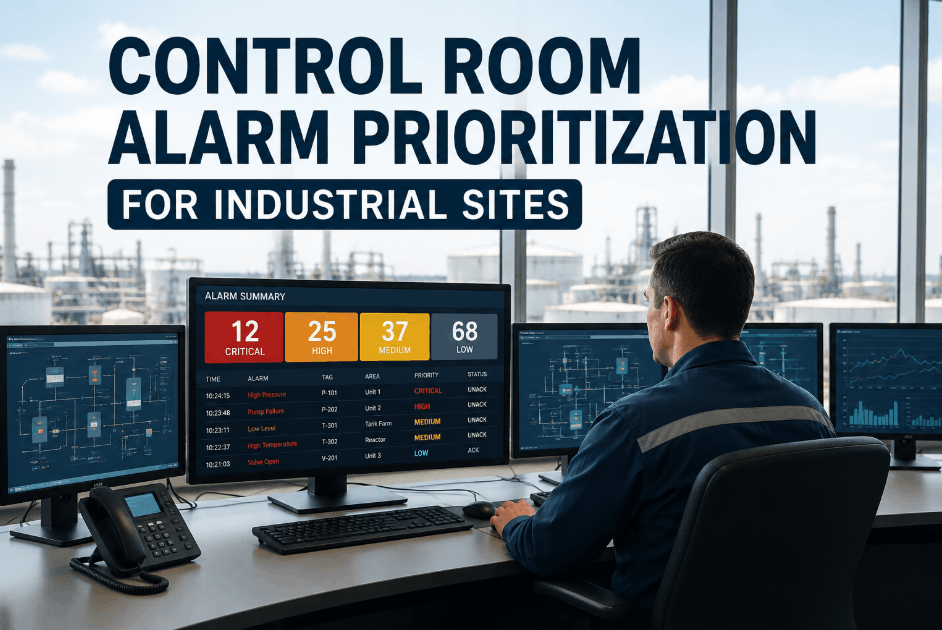
A control room that receives hundreds of alarms a shift cannot treat every signal as equally urgent — yet most alarm systems do exactly that, presenting every trip, deviation, and sensor flag with the same visual weight. Control room alarm prioritization fixes this by ranking alerts on urgency, operational impact, and false-alert history from the same asset, so operators see the handful of alarms that actually require action instead of scrolling through noise. Teams using Sign Up Free on OxMaint can route detected anomalies and sensor alerts into prioritized, auto-assigned work orders, giving control room staff a ranked action list instead of a flat alarm log.
Why Industrial Sites Still Struggle With Alarm Overload
Most control rooms inherited alarm configurations built over years of incremental additions, with little review of which alerts still carry real operational consequence. Without urgency, impact, and false-alert history attached to the same alarm record, operators cannot tell a critical trip from a sensor that nuisance-fires every shift. Book a Demo to see how OxMaint scores and ranks alerts by asset criticality and alert history instead of treating every alarm the same.
Core Inputs for Control Room Alarm Prioritization
Effective alarm prioritization is not a single threshold — it combines several inputs from the same asset and alert history to decide what reaches the top of the queue. Sign Up Free to start structuring these inputs against your monitored assets in OxMaint.
Asset Criticality Weighting
Alerts from assets tied to safety, environmental, or production-critical functions are weighted higher than alerts from low-impact equipment.
False-Alert and Nuisance History
Logging how often a given alarm has previously required no action helps de-prioritize chronic nuisance alerts without disabling them entirely.
Operational Impact Scope
Alarms that affect downstream processes or multiple connected assets are ranked above isolated, single-asset deviations.
Detection Confidence and Source Reliability
AI vision and sensor-based detections logged with a confidence score help operators distinguish a high-certainty alert from a borderline reading.
Time-of-Day and Shift Pattern Correlation
Alert frequency tied to shift handover periods or specific operating windows highlights when prioritization rules may need adjustment.
Linked Work Order and Resolution History
Connecting each alarm to its eventual work order and outcome reveals which alert types reliably precede real failures versus those that close with no finding.
Alarm Prioritization Reference by Industrial Site Type
Alarm volume and consequence severity vary widely by facility type, so prioritization logic needs to reflect the operating context of each site. Book a Demo or Sign Up Free to see how OxMaint adapts alert ranking and escalation by site and asset type.
| Site Type | Primary Alarm Driver | Escalation Speed Needed | Consequence if Mis-Prioritized | OxMaint Lever |
|---|---|---|---|---|
| Process and Chemical Plants | Pressure, temperature, leak detection | Immediate | Very High — safety and environmental exposure | AI Vision detection + auto work order escalation |
| Power Generation Facilities | Equipment trip and protection signals | Immediate | Very High — generation loss and grid impact | Criticality-weighted alert ranking |
| Manufacturing Production Lines | Line stoppage and quality deviations | Fast | High — production loss and rework | Work order auto-assignment by impact scope |
| Water and Utility Treatment Sites | Flow, level, and compliance thresholds | Fast | High — regulatory and service impact | Compliance-linked alert escalation |
| Distribution and Logistics Hubs | Conveyor, HVAC, and material handling faults | Moderate | Medium — throughput delay | Shift logbook handover + alert history tracking |
How Flat Alarm Queues Compound Industrial Risk
When every alarm appears with the same urgency, operators develop their own informal triage habits — and those habits do not scale across shifts or sites. Book a Demo to see how OxMaint replaces informal triage with a consistent, auditable prioritization workflow.
Building a Control Room Alarm Prioritization Workflow with OxMaint
Rolling out structured alarm prioritization is a phased process that builds on the asset and alert data already flowing through your control room. Book a Demo to map these steps onto your current alarm and monitoring setup.
Map Alarm Sources to Asset Criticality Tiers
Register monitored assets in OxMaint with a criticality tier so every alert inherits a baseline urgency weight from its source asset.
Tag Alert Types with Operational Impact Scope
Classify alarms by how far their impact extends — single asset, connected process, or facility-wide — to refine the ranking beyond criticality alone.
Log False-Alert Outcomes for Six to Twelve Weeks
Track which alarms resolve with no finding so OxMaint can build a false-alert history that down-weights chronic nuisance alerts.
Configure Auto Work Order Escalation for High-Priority Alerts
Set OxMaint to automatically generate and assign a work order when a high-urgency alarm fires, removing the dependency on manual escalation.
Review Ranking Accuracy Against Resolution Outcomes
Use OxMaint reporting to compare alert priority against actual resolution outcomes and adjust weighting rules as the alarm fleet evolves.
Frequently Asked Questions: Control Room Alarm Prioritization
What is control room alarm prioritization?
It is a method of ranking alarms by urgency, operational impact, and false-alert history so operators respond to the most consequential alerts first instead of treating every alarm equally.
Why do industrial control rooms experience alarm fatigue?
Alarm systems often accumulate alerts over years without review, so nuisance and repeat alarms outnumber genuinely critical signals, training operators to respond more slowly to everything.
How does OxMaint support alarm prioritization?
OxMaint links alerts to asset criticality, tracks false-alert history, and automatically creates and escalates work orders for high-priority alarms, giving control rooms a structured response workflow.
Can alarm prioritization reduce false alerts entirely?
Prioritization does not eliminate false alerts, but it de-weights chronic nuisance alarms based on resolution history so they no longer compete for attention with genuine threats.
How is alarm prioritization different from general alarm management?
General alarm management configures thresholds and notifications. Prioritization adds a ranking layer on top, using criticality, impact, and history so operators know which alarm to act on first.



-inspection-checklist-for-industrial-facilities.png)