Packaging lines generate alerts constantly — a motor running hot on Line 3, a vibration spike on a case sealer, a pressure dip on a filler. When every alert carries the same visual weight, maintenance response teams triage by whichever notification arrived most recently instead of whichever asset failure would actually stop production. Sign Up Free to start scoring packaging line alerts by urgency, asset impact, and likely cause inside Oxmaint, or Book a Demo to see how AI-prioritized alert triage routes the highest-consequence fault to the right technician first, every time.
Maintenance Operations · Packaging · 2026
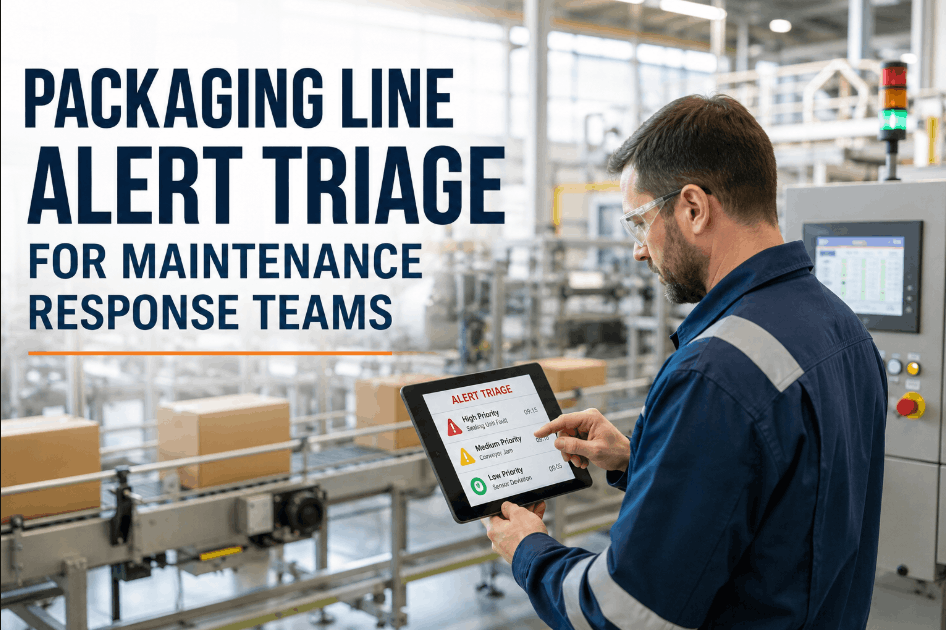
Packaging Line Alert Triage for Maintenance Response Teams
Score every packaging line alert by urgency, asset criticality, and likely cause so response teams fix the right problem first instead of chasing noise.
50%+Faster average response time once AI prioritizes packaging line alerts ahead of manual triage
73%Of routine alerts auto-dispatched to the correct technician with zero supervisor review
84%First-visit completion rate when parts and fault data are pre-checked before dispatch
44%Reduction in rework events when technician certification is matched before assignment
Where Packaging Line Alert Noise Hides the Real Fault
Most packaging plants generate far more alerts than any single response team can meaningfully act on, and the gap between alert volume and triage capacity is exactly where critical line faults go undetected. Sign Up Free to configure asset-criticality and severity scoring for every line in your plant before the next sealer fault gets buried under low-priority notifications.
01
Uniform Severity Tagging
Risk Window: Continuous line operation
High VolumeWhen every alert carries the same priority flag, technicians triage by arrival time rather than production impact — a critical filler fault can sit behind a dozen cosmetic notifications.
02
Single-Sensor False Positives
Risk Window: Startup & ramp-up cycles
Noise SourceA vibration or current spike during startup looks identical to a genuine fault signature unless the alert logic accounts for known transient operating states.
03
No Asset Criticality Weighting
Risk Window: Multi-line plants
Largest VariableThe same anomaly amplitude on a bottleneck filler and a redundant case packer triggers identical alerts, even though one stops the entire line and the other does not.
04
Manual Triage Bottleneck
Risk Window: Peak shift hours
Cognitive LoadA supervisor manually deciding which alert gets a technician next is making a judgment call with incomplete data on workload, skills, and parts availability.
05
Skill-Blind Dispatch
Risk Window: Cross-shift handoff
Rework DriverSending a mechanical technician to an electrical fault, or a junior technician to a complex PLC issue, extends mean time to repair and often requires a second visit.
06
No Feedback on False Positives
Risk Window: Ongoing
Prevention InputWhen a technician's false-positive close-out never reaches the alert model, the same noisy sensor keeps generating the same low-value alert indefinitely.
Alert Triage — Without vs. With Oxmaint
Structured triage changes where response teams spend their time on a packaging line — away from sorting notifications and toward fixing confirmed faults. Book a Demo to walk through your current alert volume and identify where automated triage saves the most response time.
Packaging Line Alert Triage Maturity — Where Does Your Team Score?
Alert triage maturity ranges from fully manual review at shift change to AI-prioritized routing that reaches a technician before a line fault produces a single rejected case. Book a Demo to assess your packaging operation's triage maturity with an Oxmaint solutions engineer.
Packaging Line Alert Triage Maturity
Score 5 = AI-prioritized, certification-aware dispatch · Score 1 = fully manual review
5
AI-Prioritized · Certification-Aware Dispatch
Every alert scored by criticality, fault type, and SLA window in seconds. Technicians matched by certification and proximity. Most routine cases dispatch without supervisor input.
Profile: Response speed and first-visit completion are systematic outcomes, not dependent on whoever is on shift.
4
Structured Scoring · Partial Dispatch Automation
Critical assets carry weighted priority and most dispatch is automated, but certification matching and parts readiness checks are inconsistent across shifts.
Action: Extend automated certification matching to every shift, not just peak hours.
3
Supervisor Review · Verbal Escalation
A supervisor reviews incoming alerts and assigns technicians manually. Severity is judged by experience, not asset criticality data.
Gap: Manual triage under shift pressure is the primary source of delayed response at this level.
2
Reactive Response · Alert Backlog
Alerts queue faster than the team can clear them. Technicians work the backlog in arrival order regardless of production impact.
Risk: Critical faults wait behind cosmetic alerts with no structured way to surface them.
1
No Triage Structure
Alerts are noticed when someone happens to be looking at the screen. Dispatch depends entirely on individual awareness.
Risk: Line downtime is driven by who is paying attention, not by asset criticality.
Stop Triaging Alerts by Recency. Start Triaging by Impact.
Oxmaint scores every packaging line alert by urgency, asset criticality, and likely cause — then routes it to the right technician automatically.
How Oxmaint Structures Packaging Line Alert Triage
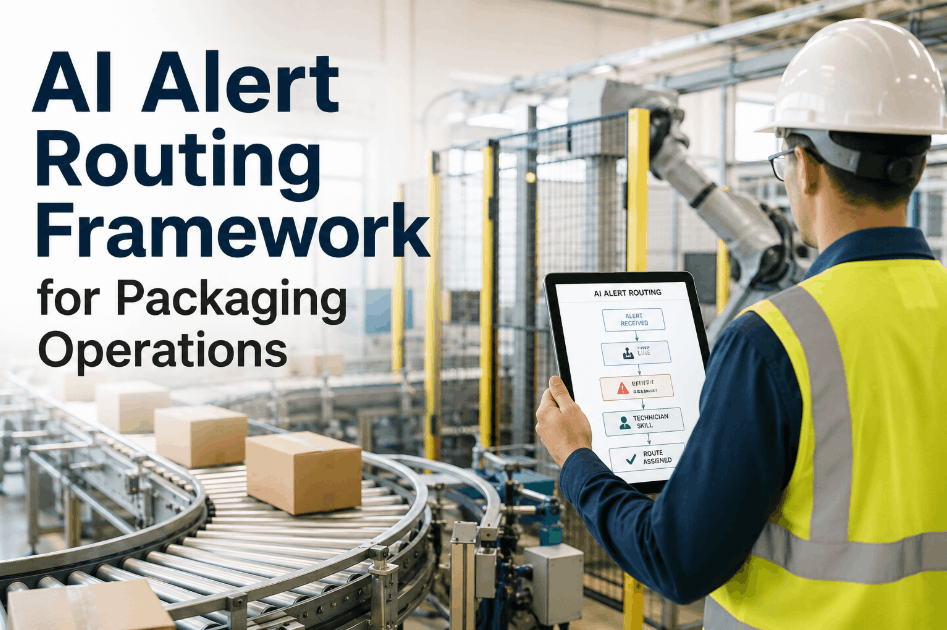
Oxmaint converts raw packaging line alerts into prioritized, assigned work orders without a manual triage step in between. Sign Up Free to configure severity scoring for your line's asset register. Book a Demo to see certification-aware dispatch running against your current technician roster.
Multi-Sensor Correlation
Cross-Signal Confirmation
Requires evidence across data streams before firing an alert
When vibration, temperature, and current draw shift together in a correlated pattern, the probability of a real fault rises — filtering out single-sensor noise before it reaches a technician.
Criticality-Weighted Scoring
Score in <2 seconds
Priority set from asset criticality, fault type, and SLA window
The same anomaly amplitude on a bottleneck filler and a redundant unit produces different priority scores automatically, so the line that actually stops production is acted on first.
Certification-Aware Dispatch
Skill + Proximity + Load
Routine alerts matched to the right technician automatically
Oxmaint checks certification scope, current workload, and proximity before assigning a work order — eliminating the rework cost of dispatching the wrong technician to a job.
False-Positive Feedback Loop
Improves Over 60–90 Days
Technician close-out notes retrain the alert model
When a technician marks an alert as a non-event, that outcome feeds back into the model for that asset, progressively reducing repeat false positives on the same sensor.
"
Our team was triaging close to 200 alerts a week across six packaging lines, mostly by gut feel. A bearing fault on our primary filler sat unactioned for two shifts because three cosmetic sensor alerts arrived after it. Once we set up criticality-weighted scoring in Oxmaint, the same fault would have reached a certified technician within minutes instead of two shifts later.
Maintenance Manager — Consumer Packaged Goods Plant, 6 Packaging Lines, Ohio
Frequently Asked Questions
What causes alert fatigue on packaging lines?
Alert fatigue happens when every notification carries the same priority and single-sensor noise is treated the same as confirmed faults. Technicians stop trusting alerts and triage by recency instead of impact.
How does Oxmaint decide which alert gets a technician first?
Oxmaint scores each alert against asset criticality, fault severity, and active SLA commitments in under two seconds, so the highest-consequence fault is routed ahead of lower-impact notifications automatically.
Can Oxmaint reduce false positive alerts over time?
Yes. Multi-sensor correlation filters out single-signal noise, and technician close-out feedback retrains the model for each asset, reducing repeat false positives as more outcomes are logged.
Does alert routing account for technician certification?
Yes. Oxmaint matches each work order to technicians whose certification scope covers the fault type, alongside their current workload and proximity to the asset.
Does Oxmaint integrate with existing line sensors and IoT systems?
Oxmaint connects to existing IoT sensors, vision systems, and PLC data feeds without requiring hardware replacement, converting confirmed anomalies directly into prioritized work orders.
Turn Every Packaging Line Alert Into the Right Action — Not Background Noise.
Oxmaint scores alerts by urgency and asset impact, routes them to the right technician, and learns from every close-out to cut noise over time.