-inspection-checklist-for-industrial-facilities.png)
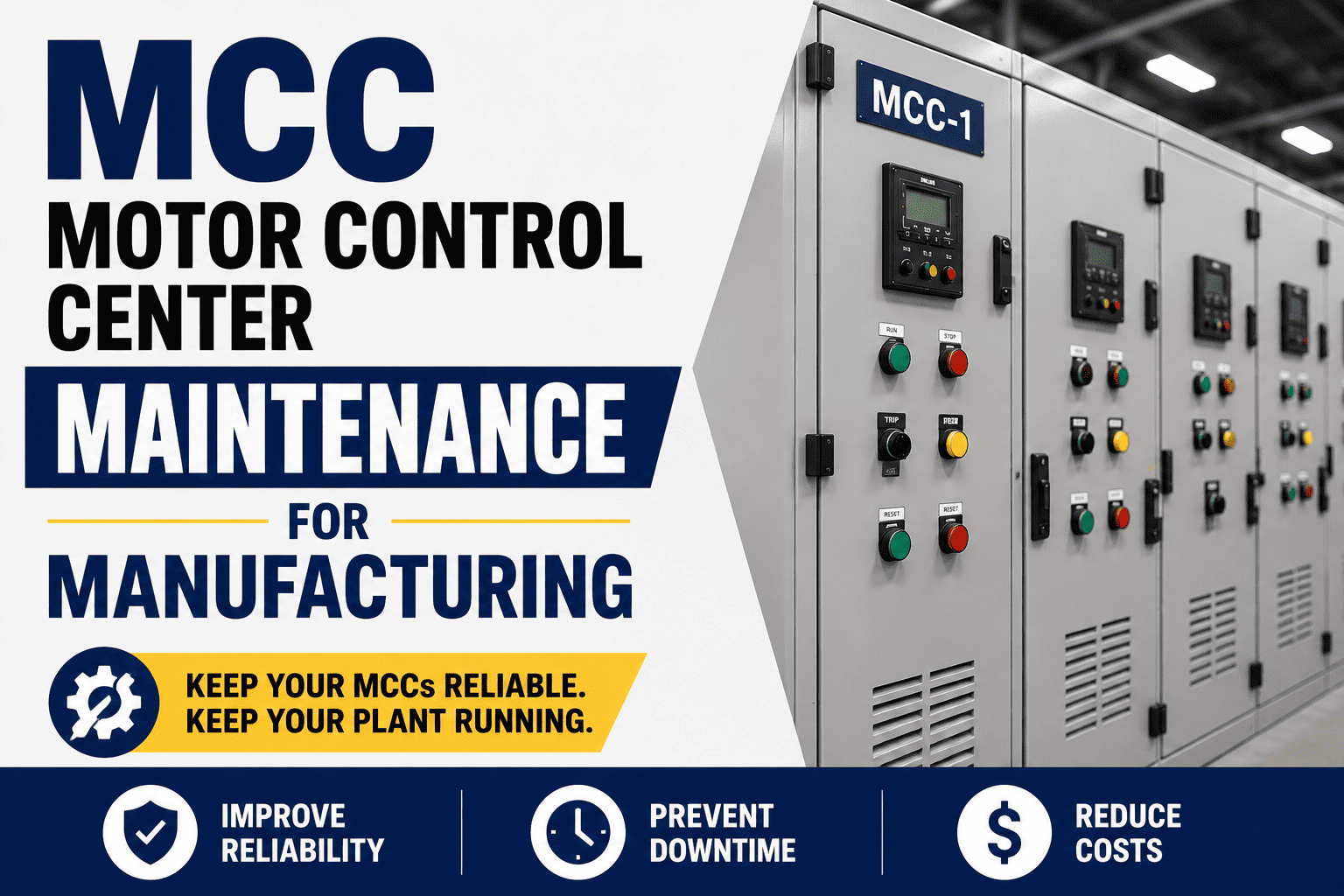
A Motor Control Center inspection checklist is the structured foundation for safe, compliant electrical maintenance on industrial and manufacturing facilities — an undetected loose bus connection, degraded contactor, or failed overload relay in an MCC can trigger arc flash events, motor failures, and OSHA-citable electrical hazards that stop production and expose facilities to serious liability. Industrial facilities operating multi-section MCCs, variable frequency drives, and motor branch circuit protection across production lines face inspection complexity that paper-based electrical PM forms cannot track at the compartment or bucket level. This MCC inspection checklist covers bus bar connections and torque verification, circuit breaker and fuse condition, contactor and overload relay inspection, grounding system continuity, thermographic hot spot detection, and enclosure integrity — organized by MCC section so qualified electricians execute inspections in sequence without missing a safety-critical component. Sign Up Free to digitize your MCC inspection work orders in Oxmaint, auto-assign electrical PM tasks by panel section and equipment zone, and maintain a timestamped compliance audit trail across every MCC in your facility.
Your Facility MCCs Have Dozens of Compartments. Is Every Bucket Being Inspected on Schedule?
Oxmaint auto-schedules MCC inspection work orders by panel section and bucket position, routes tasks to qualified electricians, and generates timestamped compliance records that satisfy NFPA 70B audit requirements and OEM warranty documentation — from a single CMMS platform.
MCC Bus Bar and Main Power Connection Inspection Checklist
Main bus bar connections are the highest-consequence failure point in any Motor Control Center — a loose or oxidized bus joint generates resistive heat that cascades to adjacent compartments, destroys insulation, and can initiate arc flash events that disable entire production lines. Book a Demo to see how Oxmaint PM work orders capture bus torque readings, thermographic inspection results, and connection condition records linked to each MCC section and bucket position.
MCC Circuit Breaker and Branch Circuit Fuse Inspection Checklist
Circuit breaker and fuse condition in MCC branch circuit compartments directly determines whether motor branch circuits receive adequate short-circuit and overload protection — a breaker with a worn trip mechanism or a fuse with heat damage may fail to interrupt a fault, turning a motor failure into a facility-wide electrical incident. Sign Up Free to schedule MCC breaker inspection work orders, capture trip test results and torque readings by bucket position, and build a replacement history record for every circuit protection device in your facility MCCs.
Contactor and Overload Relay Condition Inspection Checklist
Contactor contact wear and overload relay calibration drift are the most common causes of unexpected motor starters failing mid-production — a contactor with severely worn contacts operates normally under light load but fails under full motor starting current, stopping the machine at the highest-demand moment. Book a Demo to see how Oxmaint tracks contactor replacement intervals, contact wear measurements, and overload relay test results by MCC bucket and motor asset in a single maintenance record.
MCC Thermographic and Infrared Hot Spot Inspection Checklist
Thermographic inspection of energized MCC sections is the single most effective predictive technique for identifying bus connections, breaker terminals, and contactor assemblies developing resistive heat before they progress to arc flash or motor trip events — NFPA 70B recommends annual infrared inspection of all energized electrical distribution equipment. Sign Up Free to embed MCC thermographic inspection routes into Oxmaint work orders, attach thermal image reports to each bucket and section asset record, and track corrective action completion on every identified hot spot across your facility.
MCC Grounding System and Enclosure Safety Inspection Checklist
MCC grounding integrity and enclosure condition are the final barriers protecting personnel from electrical shock in the event of an insulation failure or arc flash event — an MCC with a broken equipment ground conductor or a missing enclosure cover panel creates an OSHA-citable electrical hazard that cannot be addressed after an incident. Book a Demo to see how Oxmaint captures grounding continuity test results, enclosure condition records, and LOTO verification data in timestamped MCC inspection work orders that satisfy NFPA 70B and OSHA audit requirements.
MCC Inspection Frequency and Governing Standard Reference
| MCC Component / System | Inspection Task | Frequency | Governing Standard |
|---|---|---|---|
| Main Bus Bar Connections | Visual inspection, torque verification, megohmmeter test | Annual | NFPA 70B / NETA MTS |
| Circuit Breakers (MCCB) | Trip test, terminal torque, physical inspection | Annual | NFPA 70B / NETA MTS / UL 489 |
| Branch Circuit Fuses | Holder inspection, rating verification, continuity | Annual | NFPA 70B / NEC 240 |
| Contactors | Contact wear, coil test, auxiliary contact check | Annual / Per OEM | IEC 60947-4 / NEMA ICS 2 |
| Overload Relays | Setting verification, thermal class check | Annual | IEC 60947-4 / OEM |
| Thermographic Inspection | Infrared scan, hot spot classification, anomaly logging | Annual (energized) | NFPA 70B / NETA / ISO 18434 |
| Grounding System | Continuity resistance, lug torque, conductor sizing | Annual | NEC 250 / OSHA 1910.303 |
| Arc Flash Labels | Label currency, PPE category, incident energy values | Annual / After system changes | NFPA 70E / OSHA 1910.132 |
| LOTO Procedures | Procedure posting, hardware availability, isolation labeling | Annual / Each PM | OSHA 1910.147 |
| CMMS Inspection Records | Findings documentation, corrective actions, deferred items | Each Inspection | OSHA / NFPA 70B / Insurance |
Stop Managing MCC Inspection Records on Paper Forms and Spreadsheets.
Oxmaint builds NFPA 70B and OSHA-aligned MCC inspection checklists into your CMMS, enforces required data capture at every compartment and section, and generates timestamped records that satisfy auditors and insurance loss control reviewers — from a single platform your electrical maintenance team uses on mobile in the field.
Frequently Asked Questions — Motor Control Center Inspection Checklist
Every MCC Section. Every Bucket. Every Inspection Record — Documented and Audit-Ready in Oxmaint.
Oxmaint makes MCC electrical maintenance the most defensible part of your facility PM program — not the documentation gap that surfaces when an OSHA inspector, insurance loss control reviewer, or NFPA 70B auditor asks for evidence of your inspection execution record.
![transformer-maintenance-checklist-for-industrial-facilities-[annual---quarterly]](./manage-post-2k26/uploads/transformer-maintenance-checklist-for-industrial-facilities-[annual---quarterly].png)