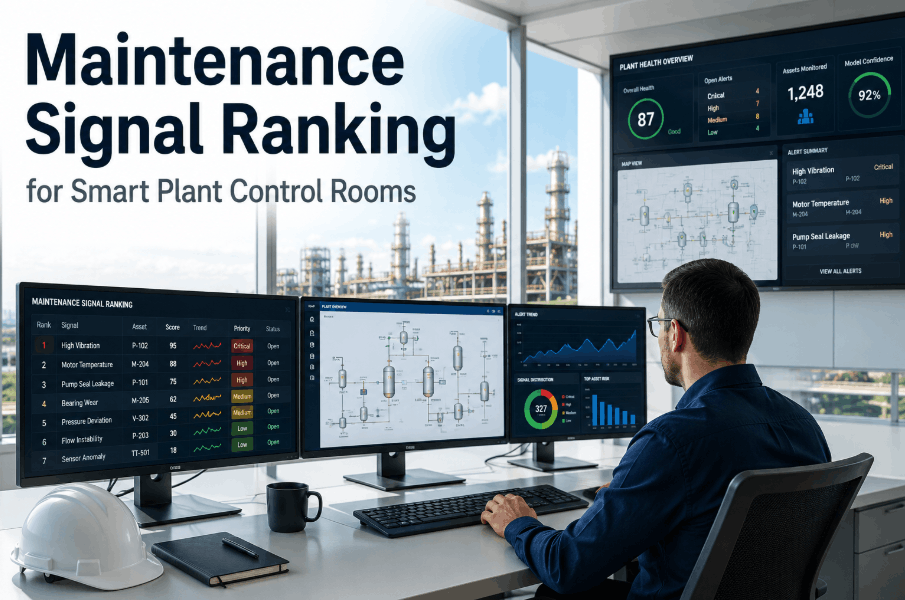
Smart plant control rooms generate hundreds of maintenance signals per shift—but the volume of alerts has outpaced the capacity of operators and reliability teams to evaluate them meaningfully. Without a structured signal ranking system, high-priority equipment faults compete for attention alongside low-value nuisance alarms, slowing response to the signals that actually matter. Sign Up Free with Oxmaint to centralize maintenance signal data, apply ranked alert routing, and give your control room teams clarity on which signals require immediate action versus scheduled review. This guide provides plant directors, control room managers, and reliability engineers with the framework to build a maintenance signal ranking system that reduces noise, accelerates response, and protects production performance.
Why Alert Fatigue Is the Biggest Threat to Smart Plant Maintenance Signal Management
Modern process plants operating with DCS, SCADA, and CMMS-connected sensor networks can generate thousands of maintenance-relevant signals daily. The problem is not a lack of data—it's the absence of ranking logic that separates signals requiring immediate control room action from those that belong in a planned maintenance queue or can be safely suppressed. Book a Demo to see how Oxmaint structures maintenance alert routing to deliver ranked signals directly to the right teams. When every alert looks equally urgent, operators develop alert fatigue—a well-documented phenomenon where critical signals are missed, delayed, or dismissed at the same rate as irrelevant ones because the cognitive load of continuous triage overwhelms reliable discrimination. Maintenance signal ranking solves this by applying equipment criticality, historical failure context, and process impact weighting before any signal reaches the control room display.
Maintenance Signal Ranking Criteria: What Determines Signal Priority
Effective maintenance signal ranking weights each signal against multiple criteria simultaneously—not just current severity, but equipment criticality, historical failure context, and process consequence. Sign Up Free to build equipment criticality profiles in Oxmaint that drive automated signal ranking based on your plant's specific production priorities.
Signals from production-critical assets—those with no redundancy or direct impact on throughput—receive higher rank regardless of signal severity. Criticality classifications built into CMMS asset records automatically elevate alerts from these assets to control room priority queues.
Signals matching known failure mode signatures for a specific asset—based on maintenance history, RCA findings, and condition trends—receive elevated rank because context confirms they are more likely to precede actual equipment failure than similar signals on healthy assets.
How rapidly a signal is changing relative to its baseline determines urgency more accurately than absolute value alone. A temperature reading of 85°C stable for three weeks ranks lower than one that has risen 15°C in the past 48 hours, even if both remain below alarm thresholds.
Signals on equipment whose failure would trigger safety system activation, production loss above defined cost thresholds, or regulatory compliance breaches receive automatic escalation in rank independent of other scoring factors.
Maintenance Signal Ranking Tiers: Routing Logic for Smart Plant Control Rooms
A practical signal ranking framework organizes maintenance signals into distinct tiers that drive different routing destinations and response time expectations. Plant teams that implement tiered routing eliminate the binary alarm / no-alarm model that forces operators to evaluate every signal manually. Book a Demo to see how Oxmaint's maintenance alert platform supports multi-tier signal routing with equipment context attached to every notification.
| Signal Tier | Ranking Criteria | Routing Destination | Response Expectation | Example Signal |
|---|---|---|---|---|
| Tier 1: Immediate Action | Critical asset + rapid progression + high failure probability | Control room display + shift supervisor + on-call engineer | Acknowledge within 5 minutes | Compressor bearing temp rising 8°C/hr on critical service |
| Tier 2: Urgent Maintenance | Critical or important asset + confirmed degradation trend | Maintenance planner + reliability engineer work queue | Work order within 24 hours | Pump vibration trending above baseline for 5 days |
| Tier 3: Planned Review | Non-critical asset + slow degradation + no immediate failure risk | Maintenance planning weekly review queue | Schedule within next PM cycle | Heat exchanger efficiency declining 3% over 30 days |
| Tier 4: Monitored / Informational | Low criticality + stable condition + no failure mode match | CMMS trend log + reliability dashboard only | Review at monthly reliability meeting | Utility motor current 5% above nameplate on non-critical service |
| Tier 5: Suppressed | Known nuisance source + zero process consequence + no degradation trend | Suppression log with documented rationale | Periodic suppression list review quarterly | Recurrent low-level vibration on isolated test equipment |
Implementing Maintenance Signal Ranking Using CMMS and Asset Criticality Data
Signal ranking is only sustainable when criticality data, failure history, and alert routing rules are maintained in a connected CMMS rather than managed manually per shift. Manual ranking degrades under operational pressure—CMMS-driven automation ensures ranking logic is applied consistently regardless of shift, staffing level, or production pace. Sign Up Free to configure asset criticality ratings and maintenance alert routing tiers inside Oxmaint for your control room signal management program.
- Rate every asset in Oxmaint by criticality: production impact, redundancy availability, safety consequence
- Document failure modes and historical patterns per asset to enable context-aware signal ranking
- Link criticality ratings to asset records so alert routing automatically reflects equipment priority
- Define tier thresholds combining criticality, progression rate, and failure mode match factors
- Map each signal tier to specific routing destinations: control room, planner queue, suppression log
- Review and adjust tier boundaries quarterly based on false positive and missed signal rates
- Attach signal history, trend charts, and criticality rating to every auto-generated maintenance work order
- Include historical failure context so technicians arrive with full diagnostic background, not just an alarm code
- Track signal-to-work-order conversion rate as a measure of alert routing effectiveness
- Track Tier 1 signal acknowledgment times to confirm response speed targets are being met
- Review suppressed signals quarterly to ensure no genuine degradation is being hidden
- Measure alert fatigue indicators: alarm acceptance rate, operator override frequency, missed signal incidents
Common Signal Ranking Failures in Smart Plant Control Rooms
Maintenance Signal Ranking KPIs for Smart Plant Control Room Performance
Quantifying signal ranking program effectiveness requires tracking metrics that connect alert management to production protection outcomes, not just alarm volume statistics. Book a Demo to explore Oxmaint's maintenance performance dashboards built for smart plant operations teams managing high signal volume environments.
Average time from Tier 1 signal generation to operator acknowledgment. Measures whether the highest-priority ranked alerts are actually reaching the right people with sufficient urgency.
Percentage of Tier 1–2 signals acknowledged and actioned versus overridden or ignored. Low acceptance rate is a leading indicator of alert fatigue and ranking calibration failure.
Percentage of Tier 1 and Tier 2 signals that result in a maintenance work order. Low conversion indicates signals are being acknowledged but not actioned, leaving equipment at risk.
Percentage of Tier 1 dispatches that found no genuine maintenance finding on inspection. High false positive rates erode operator confidence and accelerate alert fatigue re-emergence.
Overall alarm frequency per operating shift. Industry benchmarks suggest above 150 alarms per shift indicates signal management issues requiring ranking and suppression program review.
Unplanned stoppages or quality events attributable to critical maintenance signals that were not acknowledged or actioned within tier response time. The ultimate measure of signal ranking program value.