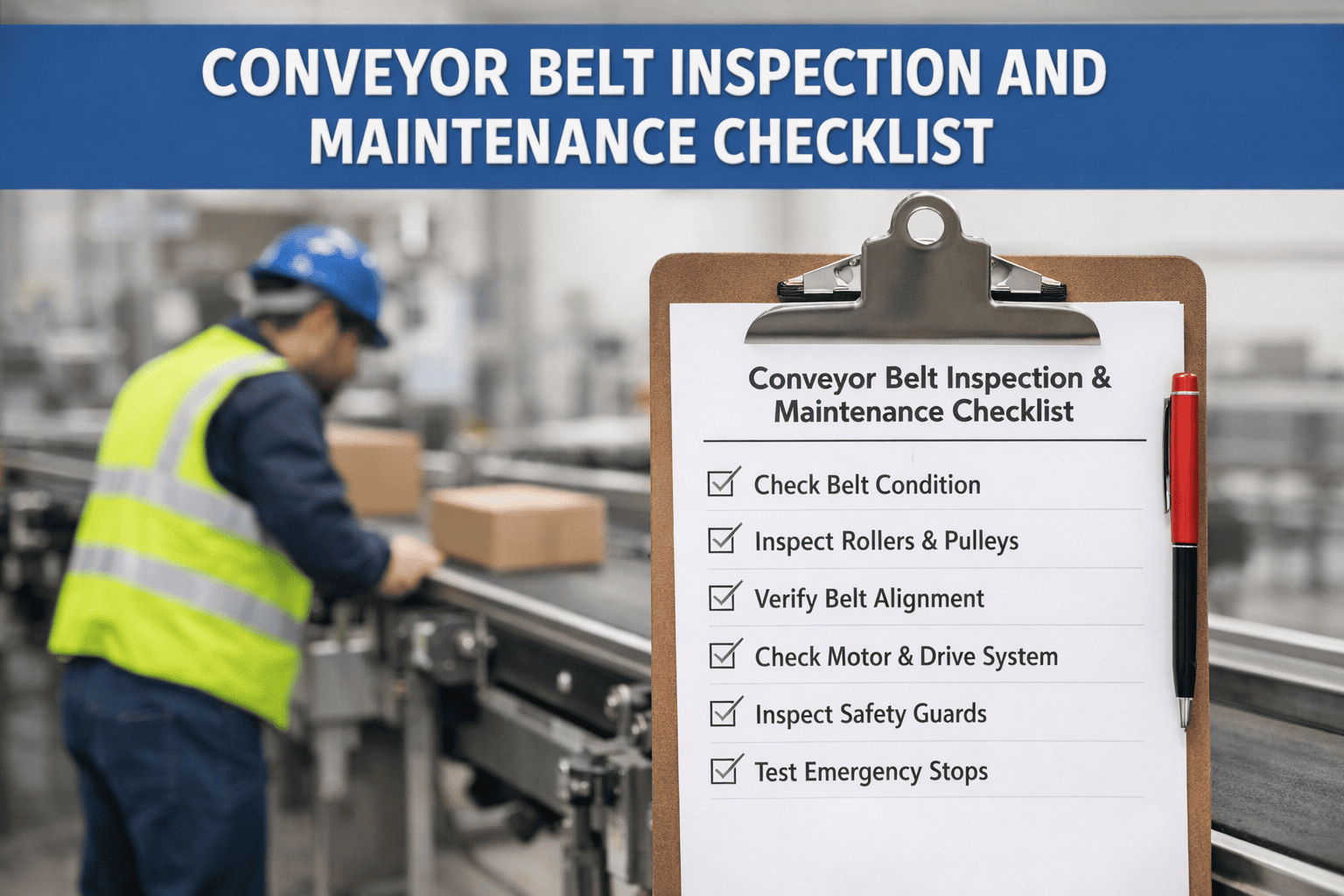
Conveyor belt failures rarely strike out of nowhere — they begin with a slightly skewed idler, a fastener loosened by a quarter turn, or a bearing running a few degrees warmer than last shift. Manufacturing plants that catch these early signals through a structured checklist run their belts longer, ship orders on time, and avoid the panicked overtime calls that define plants stuck in reactive mode. The difference between a 30-minute fix and a six-hour line shutdown almost always comes down to whether someone walked the line yesterday with a checklist in hand. Use this six-component inspection guide to inspect your conveyor systems the way reliability engineers do — organized by component rather than by calendar — and turn every routine round into documented reliability data with OxMaint's CMMS built for manufacturing plants.
Manufacturing · Preventive Maintenance · Inspection Checklist
Conveyor Belt Maintenance Checklist for Manufacturing Plants
Six components. Thirty inspection points. A frequency matrix that maps every check to daily, weekly, monthly, and quarterly rounds — built for plant maintenance leads, reliability engineers, and shift supervisors who refuse to let small issues turn into shutdowns.
~50%
Of operators report productivity loss linked to unexpected belt damage
5
Highest-priority items: tracking, splice, E-stop, bearings, tension
2 to 3%
CEMA-recommended max belt sag between idlers under load
B20.1
ANSI/ASME standard referenced under OSHA 1926.555
The Cost Curve
What an Unplanned Belt Stop Actually Costs Your Plant
A single belt-related stoppage cascades through your plant in predictable stages. The earlier you intervene with a checklist round, the cheaper the recovery and the smaller the ripple.
Stage 01
First 30 minutes
Line stops without warning. Operators stand idle. Work-in-progress cools or spoils depending on process. The clock starts on missed daily output targets.
Stage 02
Hours 1 to 4
Maintenance diagnoses the fault, sources spare parts, and may need rush shipping at premium rates. Overtime begins. Adjacent processes start backing up.
Stage 03
Day 1
Production rescheduling kicks in. Customer commitment risk surfaces. The plant manager reports up the chain. Root cause is unclear without inspection records.
Stage 04
Week 1 onward
Backlog clearance, late-fee penalties, and the reliability post-mortem. The team commits to inspecting more rigorously — and the same loop repeats next quarter.
The Six Components
Inspect by Component, Not by Calendar
The most reliable maintenance teams structure their conveyor checklists around what is being inspected, not when. This makes routes faster, training simpler, and findings easier to trend over time. Six component groups cover every critical wear path on a belt conveyor.
01 · Belt Surface & Splice
02 · Idlers, Rollers & Bearings
03 · Drive System
04 · Tension & Tracking
05 · Safety Devices
06 · Cleaning & Lubrication
01
Belt Surface & Splice Integrity
The belt is the most visible asset and the most expensive single component to replace. Surface and splice issues progress quickly under load — a small edge fray can become a structural tear within a single shift on a high-throughput line.
Visual scan of top and bottom belt surfaces
Inspect the entire length for cuts, tears, cracks, frayed edges, and signs of belt cupping or curling. Photograph any anomaly for trend tracking.
Belt thickness uniformity along the length
Measure with a thickness gauge at fixed reference points. Uneven thinning signals localised abrasion from a fixed source — usually a stuck idler or skirt rubber.
Splice condition — fasteners, plates, and seam alignment
Verify mechanical fasteners are seated, splice plates are not lifting, and vulcanised seams show no separation, ply lifting, or rubber cover damage.
Edge wear pattern across belt width
Heavier wear on one edge points to mistracking. Symmetric edge wear points to over-troughing or undersized belt for the load.
Material buildup, foreign objects, and embedded debris
Remove anything caught between the belt and structural components. Embedded fasteners or sharp debris cause progressive cover damage that ends in belt failure.
02
Idlers, Rollers & Bearings
A seized idler under a moving belt acts like sandpaper — it can burn flat spots into a new belt cover overnight. Idlers, rollers, and their bearings are the highest-volume wear components on any conveyor and the easiest to overlook because there are so many of them.
Spin test on every accessible idler and roller
With the belt locked out, hand-rotate each roller. Free spin is good; stiffness, grinding, or zero rotation is a flag for immediate replacement.
Listen for bearing noise during operation
Walk the line with the belt running. Grinding, squeal, or rhythmic clicking indicates bearing failure in progress — locate and tag the unit before continuing.
Bearing temperature spot-check with IR thermometer
Compare each bearing temperature against the line average. A unit running 15 degrees hotter than peers is a leading indicator of seizure within days.
Idler frame alignment and bracket condition
Verify each idler frame sits square to the belt path. Bent or skewed brackets push belt edges into structure and accelerate edge wear and mistracking.
Roller surface condition — flat spots, coating loss, debris wrap
A roller with a flat spot was seized recently and needs replacement even if it spins now. Material wrapped around shaft ends signals scraper or skirt failure upstream.
Stop transcribing paper checklists at the end of every shift. Capture findings, photos, and corrective actions on a phone — and let OxMaint create the work order automatically.
03
Drive System — Motor, Pulleys, Gearbox
The drive system delivers all the power the belt ever sees. A small drift in motor amp draw, gearbox oil colour, or pulley lagging condition often shows up days before the failure that takes the line down.
Drive motor amp draw within nameplate range
Read amps under typical load and compare to baseline. A rising trend signals increasing system friction — failed bearings, mistracking, or material buildup somewhere on the line.
Motor mounting bolts and base condition
Torque-check mounting bolts each month. A motor that has walked even a few millimetres misaligns the drive coupling and chews through bearings on both sides.
Gearbox oil level, colour, and visible contamination
Clear amber is healthy. Dark, milky, or shavings-laden oil signals internal wear. Sample for analysis at the manufacturer-recommended interval.
Drive and tail pulley lagging condition
Inspect for lagging chunks missing, glazed surfaces, or grooving. Worn lagging causes belt slip — which the operator usually fixes by over-tensioning, accelerating splice failure.
V-belts, chains, and couplings on auxiliary drives
Check for wear, glazing, missing teeth, and proper tension. Coupling alignment should be verified annually with dial indicators or laser tools.
04
Belt Tension & Tracking
Tension and tracking are inseparable. Get one wrong and the other compensates badly — usually with the belt rubbing structure, fasteners failing, and material spilling into places it should never reach.
Belt sag between carrying idlers
CEMA recommends 2 to 3 percent sag at the idler spacing under full load. Excessive sag drops material; insufficient sag overstresses the belt and splice.
Belt tracks centred on head, tail, and snub pulleys
Sight along the belt from each end pulley. Drift to one side under load is normal in small amounts; persistent drift is a tracking issue, not a belt issue.
Take-up unit position and remaining travel
Counterweight or screw take-ups should retain travel headroom for belt stretch. A take-up at the end of its travel is a belt replacement waiting to happen.
Take-up moves freely without binding
A bound take-up cannot compensate for thermal expansion or stretch — and the belt absorbs every variation as cyclic stress at the splice.
Belt edge contact with frame, chutes, or skirts
Any rubbing damages cover and cuts useful belt life. Investigate the upstream cause — usually loading skew, idler condition, or pulley lagging — rather than just trimming the obstruction.
05
Safety Devices & Emergency Controls
Conveyor safety devices that fail at the moment they are needed have the same risk profile as no safeguards at all. Pull-cord stops, drift switches, and nip-point guards must be tested on every weekly round under OSHA 1910.147, 1910.219, and ANSI/ASME B20.1 references in 1926.555.
Pull-cord emergency stops at access points
Verify a continuous pull cord with no slack, a working tensioner, and visible station signage. Test activation at each station — the conveyor must not restart until the switch is reset.
Belt drift and ripped-belt detection switches
Trip-test each switch monthly. A drift switch that has been bypassed during commissioning or after a false trip is a recurring finding in incident reviews.
Nip-point guards at head, tail, and take-up pulleys
Guards must be in place, secured, and substantial enough to prevent reach-under, reach-over, or reach-through exposure per 29 CFR 1910.219.
Lockout / tagout points clearly labelled
Every isolation point — electrical, pneumatic, gravity, stored mechanical — must be identifiable, accessible, and supported by a written, machine-specific procedure.
Audible start-up warning before conveyor energises
Required by 29 CFR 1926.555 for conveyors where the operator station is remote. Confirm the warning sounds and is loud enough to be heard at the furthest access point.
06
Cleaning, Lubrication & Material Buildup
Carryback under the return run is the silent killer of conveyors. It coats return idlers, builds up on pulleys, throws tracking off, and pools as a slip hazard underneath the line. Scrapers and skirt seals exist to prevent this — and they need their own checklist.
Primary and secondary belt scraper contact
Scraper blades must sit flush against the belt across full width. Worn or chattering blades let material past — the start of every carryback problem.
Carryback removal under the return run
Material under the return belt builds up against return idlers, throws tracking off, and creates slip hazards. Sweep weekly and investigate the source if it returns quickly.
Bearing lubrication intervals on schedule
Follow the OEM grease schedule — type, quantity, frequency. Document each application; this protects against both under-greasing failures and over-greasing seal damage.
No over-greasing — purges past seals contaminate the belt
More grease is not better. Excess grease forces past seals, mixes with dust, and ends up on the belt where it attracts more contamination.
Skirt rubber gap and condition at loading zone
Worn or loose skirt rubber spills material outside the chute. Adjust skirt clamps weekly and replace rubber when it no longer seats flat against the belt.
Frequency Matrix
What to Inspect — Daily, Weekly, Monthly, Quarterly
Every component has its own rhythm of attention. Use this matrix to assign inspections by role and frequency rather than relying on shift handovers or memory. Scroll horizontally on mobile to see all four cadence columns.
| Component |
Daily |
Weekly |
Monthly |
Quarterly |
| Belt Surface & Splice |
Visual scan during operation |
Detailed wear inspection at scheduled stop |
Splice gauge measurement and photo log |
Belt thickness profile against replacement threshold |
| Idlers, Rollers & Bearings |
Listen for unusual noise |
Spin test on every accessible roller |
Bearing temperature scan with IR tool |
Lubricate per OEM, replace failed units |
| Drive System |
Motor amp draw observation |
Visual leak inspection on gearbox |
Vibration analysis on drive train |
Gearbox oil sample for lab analysis |
| Tension & Tracking |
Tracking observation each shift |
Belt sag measurement at idler span |
Take-up unit travel review |
Re-tension and re-track full system |
| Safety Devices |
E-stop walk and visual check |
Pull-cord activation test at each station |
Drift switch trip test, guard audit |
LOTO procedure review and recalibration |
| Cleaning & Lubrication |
Scraper contact check, debris sweep |
Carryback removal under return run |
Skirt rubber gap measurement |
Full deep clean during scheduled outage |
Top Failure Modes
The Three Failures That Cost Manufacturing Plants the Most
Most belt failures trace back to a small number of root causes. Knowing them changes how a checklist round feels — from a paperwork exercise to a targeted hazard hunt.
01
Belt Mistracking
Cause
Skewed idlers, uneven loading, worn or coated pulley lagging
Symptom
Edge wear on one side, belt rubbing structure, accelerated splice fatigue
Prevention
Weekly tracking observation, monthly idler alignment audit, address loading skew at source
02
Splice Failure
Cause
Over-tensioning, fastener corrosion, fatigue cycles from mistracking
Symptom
Lifted splice plates, ply separation, sudden mid-shift belt parting
Prevention
Monthly splice inspection with photo log, correct take-up tension, replace at wear threshold
03
Idler Seizure
Cause
Bearing failure, contamination ingress past worn seals, missed lubrication
Symptom
Hot bearing, grinding noise, flat spots burned into belt cover
Prevention
Weekly spin test, monthly IR temperature scan, replace failed units immediately
Reliability KPIs
Five Numbers Every Plant Should Track
A checklist program without metrics drifts back into paperwork within a quarter. These five numbers, reviewed monthly, keep the program honest and tied to plant outcomes.
MTBF per Conveyor Line
Mean operating hours between unplanned stops
Target: rising trend month-on-month
Belt Life Achieved vs OEM
Hours run divided by manufacturer expected life
Target: above 90 percent
Inspection Completion Rate
Completed rounds divided by scheduled rounds
Target: 100 percent
Open Finding Closure Rate
Findings closed within seven days of being raised
Target: above 90 percent
Unplanned Downtime Hours
Hours per 1,000 operating hours per conveyor
Target: declining trend quarter-on-quarter
FAQs
Frequently Asked Questions
How often should we inspect conveyor belts in a manufacturing plant?
Run daily visual checks during operation, weekly hands-on checks during scheduled stops, monthly comprehensive inspections, and quarterly major assessments. High-throughput or critical lines may need more frequent rounds.
Book a demo to see how OxMaint schedules each cadence automatically.
What does OSHA require for conveyor belt safety in a manufacturing plant?
OSHA 29 CFR 1910.22 covers general housekeeping, 1910.147 covers lockout/tagout during maintenance, 1910.219 covers guarding at nip points, and 1926.555 references ANSI/ASME B20.1 for conveyor design and operation.
Get started with OxMaint to track each standard's frequency and evidence in one place.
What is the most common cause of conveyor belt failure?
Belt mistracking is the most frequently cited root cause — it accelerates edge wear, damages structural components, and stresses splice seams. Most mistracking traces back to idler condition, uneven loading, or worn pulley lagging rather than the belt itself.
Book a demo to see how OxMaint trends mistracking findings over time.
Can a CMMS help manage conveyor belt maintenance checklists?
Yes. A CMMS like OxMaint converts paper checklists into mobile-completed digital rounds, auto-generates work orders from findings, tracks reliability KPIs across every conveyor line, and stores photo evidence and trend data for audit and reliability decisions.
Start free and run your next round digitally.
What belt sag percentage is acceptable between idlers?
CEMA recommends a maximum sag of 2 to 3 percent of the idler spacing under full load, depending on material lump size and troughing angle. Excessive sag causes load shifting and material spillage; insufficient sag overstresses the belt and splice.
Book a demo to see how OxMaint logs sag readings against spec.
Run Every Conveyor Round Through OxMaint
Mobile checklists, photo evidence, automatic work orders, and trend data — built for manufacturing plants that refuse to let small issues become production-line shutdowns. Start free or book a 30-minute walkthrough with our team.