A textile plant maintenance supervisor receives three urgent calls within an hour: Ring spinning frame #4 showing excessive vibration, dyeing machine temperature controller malfunctioning mid-batch ($48,000 product at risk), and air jet loom repeatedly breaking warp threads. Each requires immediate troubleshooting, but the supervisor faces a critical problem—no systematic troubleshooting process exists. Technicians rely on tribal knowledge, maintenance history scattered across paper logbooks and spreadsheets, and troubleshooting procedures exist only in experienced workers' heads. Result: 3.5-hour average troubleshooting time, 40% first-time fix rate, and recurring problems that different shifts solve differently (or not at all).
This troubleshooting chaos costs textile manufacturers millions annually through extended downtime, repeated failures, and knowledge loss when experienced technicians retire. Digital work orders with integrated troubleshooting frameworks transform reactive firefighting into systematic problem-solving—capturing equipment-specific diagnostic procedures, linking condition monitoring data to work orders, documenting successful repairs building organizational knowledge, and enabling mobile-guided troubleshooting reducing mean-time-to-repair 45-60%. Textile manufacturers implementing digital troubleshooting systems achieve 35-50% downtime reduction, improve first-time fix rates to 75-85%, and reduce dependency on key personnel through documented expertise. Organizations ready to transform troubleshooting can explore how Oxmaint CMMS enables digital work order troubleshooting.
What if your maintenance team could troubleshoot spinning frame vibration in 15 minutes instead of 2 hours—using mobile-guided diagnostics with step-by-step procedures and real-time condition data?
Digital work orders eliminate troubleshooting guesswork through systematic diagnostics, equipment-specific procedures, and captured tribal knowledge. Join 150+ textile facilities using Oxmaint for intelligent troubleshooting.
Common Textile Equipment Problems & Digital Solutions
Textile manufacturing involves complex machinery requiring specialized troubleshooting knowledge. Digital work orders provide systematic diagnostic frameworks for recurring problems.
Five Critical Textile Equipment Issues
Problem: Spinning Frame Excessive Vibration
Traditional Approach: Technician inspects frame, checks multiple potential causes (bearing wear, spindle imbalance, belt tension, foundation issues), trial-and-error diagnosis taking 2-3 hours.
Digital Work Order Solution: Mobile app displays equipment-specific troubleshooting tree: (1) Scan frame QR code loading diagnostic procedure, (2) Check vibration sensor data showing which spindle positions exceed thresholds, (3) Follow guided inspection with photo requirements, (4) System suggests probable causes ranked by historical frequency.
Problem: Dyeing Machine Color Inconsistency
Traditional Approach: Operator reports color issue, technician reviews recipe, checks temperature control, dye pump operation, pH levels—no systematic diagnostic procedure, relying on experience.
Digital Work Order Solution: Work order auto-generated when temperature variance exceeds ±2°C setpoint. Mobile checklist: (1) Verify temperature sensor calibration date, (2) Check circulation pump flow rate vs. specification, (3) Confirm dye injection timing, (4) Link to batch records showing temperature profile. System displays last 5 similar failures with solutions.
Problem: Air Jet Loom Warp Thread Breakage
Traditional Approach: Operator clears break, restarts loom. Pattern repeats 6-8 times per shift. No root cause investigation—just reactive clearing.
Digital Work Order Solution: After third break within 2 hours, system auto-generates diagnostic work order. Mobile checklist guides inspection: (1) Measure warp tension consistency, (2) Check yarn path for snags/rough surfaces, (3) Verify air jet pressure, (4) Inspect reed for damage. Historical data shows 80% of breaks correlate with specific yarn batch—system flags correlation.
Problem: Knitting Machine Needle Breakage
Traditional Approach: Replace broken needle, restart. Recurring breaks frustrate operators but no investigation into why needles fail.
Digital Work Order Solution: After 3 needle breaks within 24 hours, system generates troubleshooting work order with guided inspection: (1) Check needle bed alignment, (2) Verify yarn tension settings, (3) Inspect sinkers for wear, (4) Review maintenance history showing last needle bed cleaning. Mobile app links to OEM troubleshooting manual section.
Problem: Dryer Temperature Fluctuation
Traditional Approach: Technician manually checks gas burner, blower operation, damper positions, controls—no structured diagnostic approach.
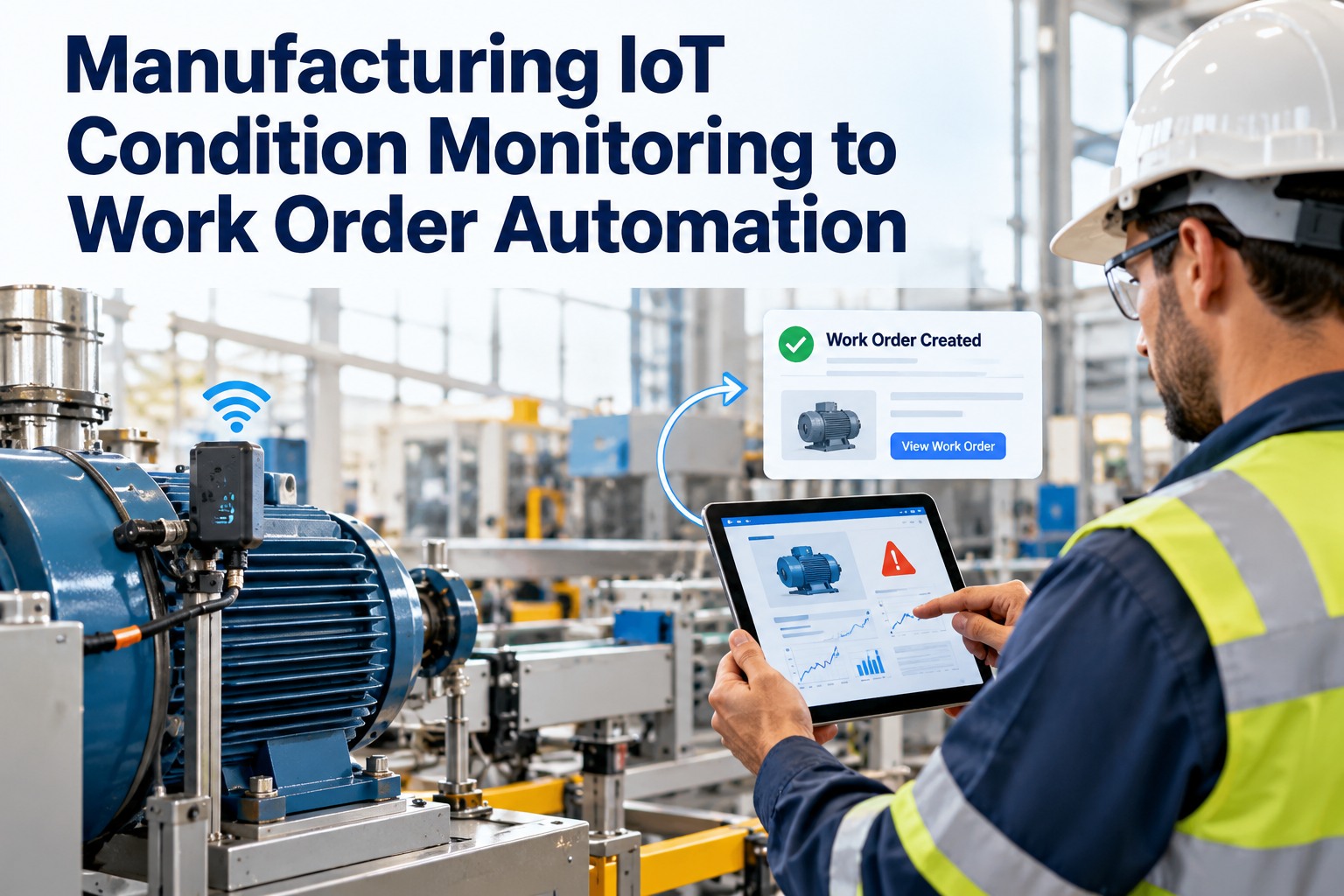
Digital Work Order Solution: IoT temperature sensors detect 8°C fluctuation triggering automatic work order. Mobile diagnostic: (1) Review temperature trend chart (past 24 hours), (2) Check combustion air pressure, (3) Verify gas valve operation, (4) Inspect flame sensor condition. System compares current symptoms to 12 previous similar issues with documented solutions.
Boost Manufacturing & Plants Uptime with Connected Sensors
IoT sensors provide real-time equipment condition data enabling proactive troubleshooting before failures cause downtime.
Four-Layer Sensor Integration Framework
Critical Asset Monitoring
Deploy sensors on high-impact textile machinery:
- Spinning Equipment: Vibration sensors on ring frames, roving frames, draw frames detecting bearing wear, imbalance, mechanical issues
- Weaving/Knitting: Thread tension monitors, warp break counters, loom vibration sensors identifying setup issues and mechanical problems
- Dyeing/Finishing: Temperature sensors (±0.5°C accuracy), pH monitors, flow meters on dye machines ensuring process consistency
- Utilities: Compressed air pressure/leak detection, steam pressure/flow, chiller performance, motor current monitoring
Anomaly Detection & Alerts
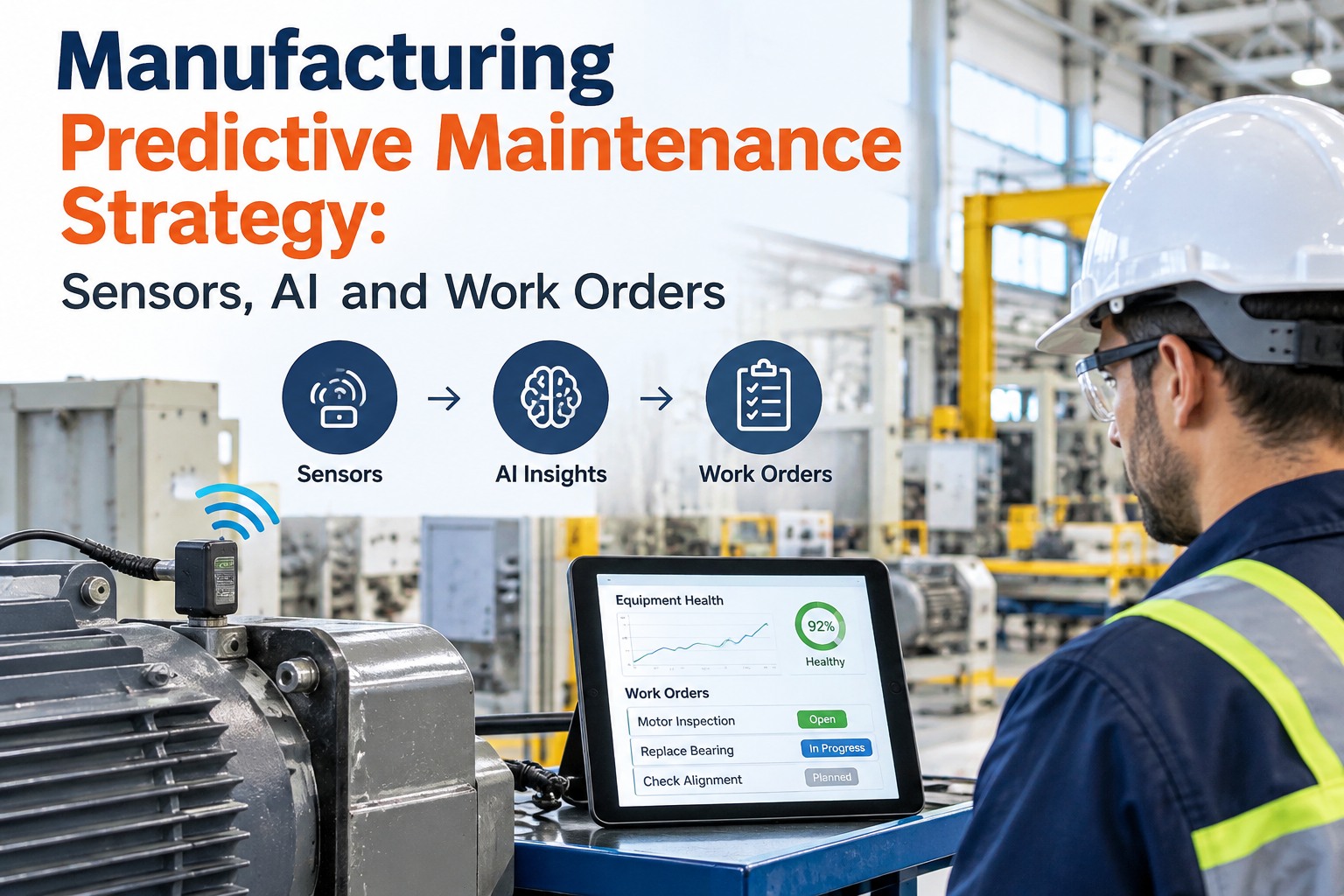
AI analyzes sensor data identifying abnormal conditions triggering proactive work orders:
- Baseline Learning: System establishes normal operating ranges during healthy operation (spinning frame vibration 0.8-1.2 mm/s, dyeing machine ±1.5°C setpoint)
- Threshold Alerts: Automatic work order generation when readings exceed normal (vibration >1.5 mm/s, temperature variance >3°C)
- Trend Analysis: Gradual degradation detection (vibration increasing 15% over 2 weeks suggests bearing wear—schedule maintenance before failure)
- Pattern Recognition: AI identifies correlations invisible to humans (thread breaks correlate with 5% humidity decrease + 3°C temperature drop)
Automated Work Order Generation
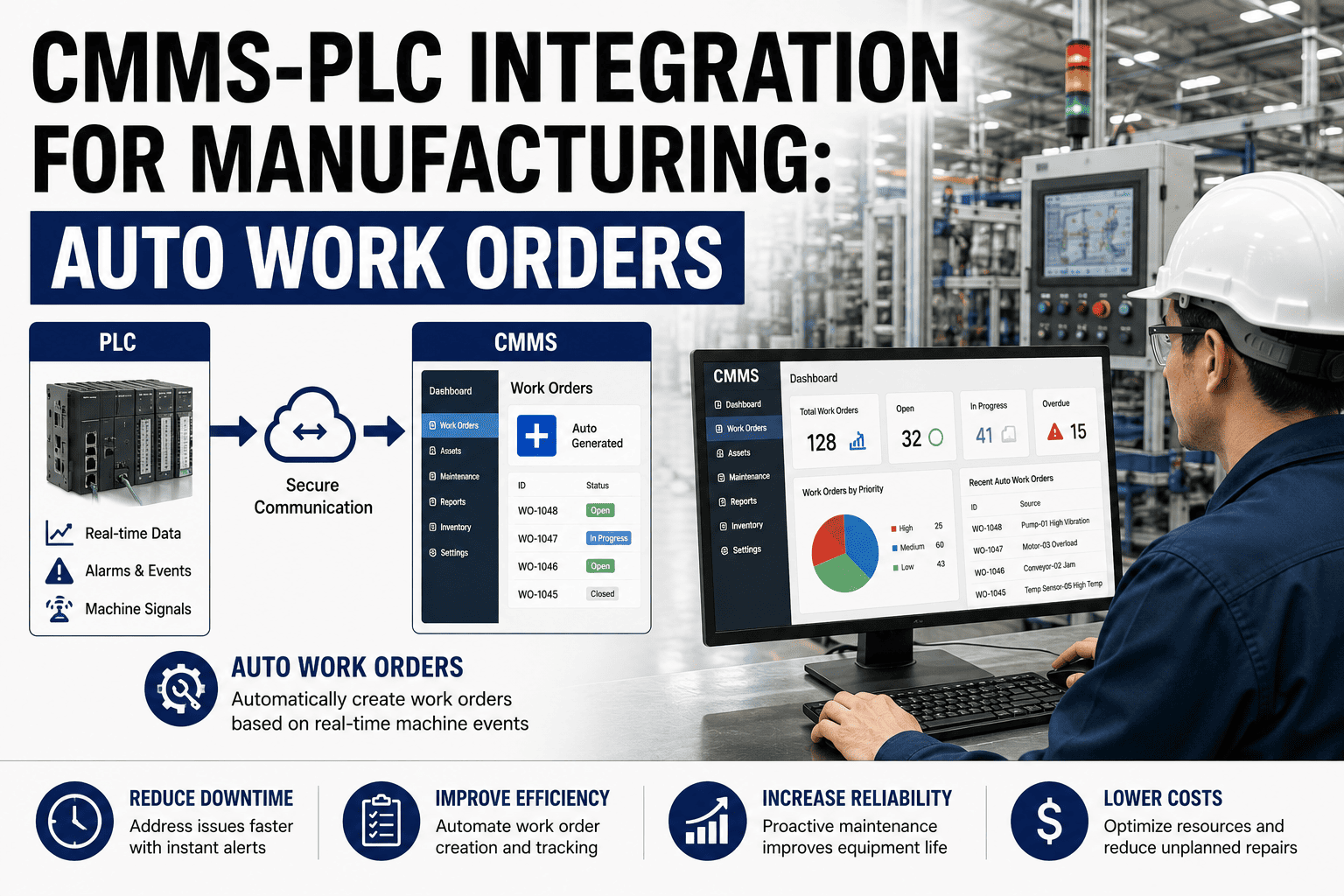
System creates maintenance tasks automatically when sensors detect issues:
- Equipment Context: Work order includes asset details, sensor readings, historical performance, maintenance history, linked OEM manuals
- Priority Scoring: (Severity × Production Impact × Safety Risk) ÷ Response Time = Priority ranking
- Diagnostic Guidance: Troubleshooting procedures loaded automatically based on sensor readings and failure symptoms
- Parts Identification: System suggests likely parts needed based on symptom analysis and historical repairs
Continuous Improvement Loop
Every troubleshooting outcome improves system intelligence:
- Failure Pattern Library: Successful repairs documented with symptoms, diagnostics, solutions building organizational knowledge
- AI Learning: Machine learning improves prediction accuracy from 65-70% initial to 85-90% after 12-18 months
- Procedure Refinement: Troubleshooting steps optimized based on actual effectiveness—eliminate non-value steps, add missing diagnostics
- Knowledge Capture: Retiring technician expertise preserved in digital procedures, photos, diagnostic notes accessible to entire team
Turning Alerts into Actions — A Manufacturing & Plants Framework with Analytics
Sensor alerts only create value when converted to executed maintenance actions. This framework ensures systematic response.
Five-Stage Alert-to-Action Workflow
Intelligent Alert Generation
Process: Sensor detects abnormal condition → AI analyzes severity and context → System determines if alert warranted or false positive → Generates work order only for actionable issues
Textile Example: Spinning frame vibration sensor reads 1.8 mm/s (normal: 0.8-1.2 mm/s). AI checks: Is machine running? (Yes) Recent maintenance? (No) Historical pattern? (Similar to 8 previous bearing failures) → Generates high-priority work order with 85% confidence bearing replacement needed within 7 days.
Automatic Work Order Creation & Assignment
Process: Work order generated with complete context → Priority scoring → Skills matching → Automatic assignment to qualified technician → Mobile notification with one-click acceptance
Assignment Logic: High-priority spinning frame vibration → Requires Level 2 mechanical certification → Check technician availability and location → Assign to nearest qualified tech → Include diagnostic procedure, parts list, expected duration (2.5 hours)
Mobile-Guided Troubleshooting Execution
Process: Technician opens mobile app → Scans equipment QR code → Loads troubleshooting procedure → Follows step-by-step diagnostics with photo requirements → Records findings → Completes repair → Documents solution
Mobile Features: Equipment history accessible instantly, sensor data charts showing trend, OEM manual sections linked, parts cross-reference, video tutorials for complex procedures, digital signature + timestamp
Outcome Verification & SLA Tracking
Process: Work order closed → System monitors equipment performance → Validates issue resolved (sensor readings return to normal) → Tracks response time, repair time, downtime duration → Updates SLA metrics
SLA Metrics: Critical alerts (dyeing machine failures): <30 minute response, 85% resolved within 2 hours. High-priority (spinning frame vibration): <2 hour response, 90% resolved within shift. Medium-priority: <8 hour response.
Analytics & Continuous Improvement
Process: System analyzes completed work orders identifying patterns → Most frequent failures → Longest troubleshooting times → Recurring problems indicating incomplete repairs → Equipment reliability trends → Technician performance metrics
Improvement Actions: Update troubleshooting procedures based on successful techniques, add sensors to equipment showing recurring issues, schedule proactive maintenance for equipment with degrading performance, refine alert thresholds reducing false positives
Mobile Inspections Manufacturing & Plants for Textile Machinery
Mobile inspections complement condition monitoring by capturing observations impossible for sensors—visual defects, unusual sounds, operator feedback, wear patterns.
Three Mobile Inspection Strategies
Equipment-Specific Inspection Routes
Digital checklists tailored to textile machinery types:
- Spinning Department: Ring frames (spindle condition, traveler wear, top roller status), roving frames (creel tension, flyer operation), draw frames (roller alignment, sliver quality)
- Weaving Department: Looms (reed condition, shuttle/rapier wear, harness alignment, warp tension), warping machines (beam alignment, tension consistency)
- Knitting Department: Circular knits (needle bed condition, cam wear, yarn tension), flat knits (carriage operation, needle condition)
- Finishing Department: Dryers (burner condition, air flow, exhaust system), stenters (pin chain condition, temperature uniformity)
Operator-Led Problem Reporting
Empower operators to report issues using mobile apps:
- Simple Interface: Operators scan machine QR code, select problem type (quality issue, mechanical problem, unusual sound, safety concern), take photo, describe briefly
- Automatic Routing: Report converts to work order, routed to appropriate technician based on problem type and urgency
- Feedback Loop: Operators notified when issue resolved, can confirm problem fixed or report recurrence
- Knowledge Capture: Operator observations linked to work orders providing valuable context for troubleshooting
Barcode/QR-Driven Maintenance Verification
Ensure maintenance tasks completed on correct equipment with proper verification:
- Task Assignment: "Lubricate spinning frame #12 bearings" → Technician must scan frame #12 QR code before closing task
- Photo Requirements: Mandatory before/after photos for visual verification (belt tension adjustment, cleaning completion, parts replacement)
- Location Verification: GPS confirms technician physically present at equipment location
- Audit Trail: Complete timestamp record with technician ID, equipment scanned, photos attached, digital signature
Audit Trail & Manufacturing & Plants Compliance Requirements
Textile manufacturing faces regulatory, customer, and certification audits requiring comprehensive maintenance documentation. Digital work orders create automatic audit trails.
Four Compliance Documentation Requirements
ISO 9001 Quality Management
Requirement: Demonstrate systematic equipment maintenance preventing quality defects, documented calibration for measuring equipment, corrective action tracking.
Digital Solution: Complete maintenance history accessible instantly showing: scheduled PM completion rates (98%), calibration due dates with alerts, quality-related work orders linking equipment issues to product defects, corrective actions with effectiveness verification.
Customer Quality Audits
Requirement: Major customers (apparel brands, automotive textiles) audit manufacturing controls ensuring consistent product quality. Equipment maintenance proof required.
Digital Solution: Customer-ready reports showing equipment reliability metrics, preventive maintenance completion, condition monitoring data, corrective action effectiveness. Photo evidence of equipment condition, cleanliness, proper lubrication.
OSHA Safety Compliance
Requirement: Document lockout/tagout procedures, guard inspections, safety-critical equipment maintenance (emergency stops, fire suppression, ventilation).
Digital Solution: Mandatory safety checklists enforced through mobile app (cannot close work order without completing safety verification), photo documentation of lockout procedures, digital signatures confirming safety training, incident tracking linking equipment failures to safety events.
Real-World Textile Troubleshooting Examples
Ring Spinning Frame Bearing Failure Prevention
Problem: Bearing failures causing 8-12 hour emergency repairs ($18K parts + $96K lost production = $114K per failure). Occurring 6-8 times annually across 50 frames.
Digital Solution: Vibration sensors on each frame + AI pattern recognition. System detects 15% vibration increase over 3 weeks → Auto-generates work order "Schedule bearing replacement during weekend maintenance." Mobile app guides technician through proper procedure with torque specifications and photos.
Dyeing Machine Temperature Control
Problem: Temperature inconsistency causing 12-15 batch rejections annually (avg $42K per batch = $504K-$630K annual waste). Troubleshooting relied entirely on one senior technician's expertise.
Digital Solution: Temperature sensors (±0.5°C accuracy) monitoring all 8 dyeing machines. When variance exceeds ±2°C, system auto-generates troubleshooting work order with guided diagnostics: Check sensor calibration → Verify circulation pump → Inspect heating element → Review batch profile. Senior technician's knowledge captured in digital procedures accessible to all.
Air Jet Loom Warp Break Reduction
Problem: Chronic warp breaks (15-20 per shift on specific looms) reducing efficiency and frustrating operators. No systematic root cause investigation—just reactive clearing.
Digital Solution: Operators report breaks via mobile app (scan loom QR, tap "warp break," take photo). After 5 breaks within shift, system generates troubleshooting work order. Digital checklist guides inspection of warp tension, yarn path, air jet pressure, reed condition. AI analyzes break patterns revealing 75% correlate with specific yarn supplier batch + humidity <45%.
90-Day Implementation Roadmap
System Setup & Asset Registration
Activities: Deploy Oxmaint CMMS platform, create asset hierarchy (spinning dept, weaving dept, finishing dept), register critical equipment with photos and specifications, generate QR codes for all assets, upload OEM manuals, define maintenance team roles and permissions.
Quick Win: Mobile work order system operational replacing paper forms—immediate improvement in work order tracking and completion documentation.
Sensors & Troubleshooting Procedures
Activities: Install IoT sensors on 10-15 highest-impact assets (spinning frames, dyeing machines, critical looms), configure alert thresholds, develop equipment-specific troubleshooting procedures for top 10 recurring failures, capture senior technician knowledge in digital workflows, train team on mobile troubleshooting.
Quick Win: First sensor-triggered work order preventing failure—demonstrate predictive capability building momentum.
Analytics & Continuous Improvement
Activities: Review first 60 days performance metrics, refine alert thresholds based on false positive rate, expand sensor coverage to additional equipment, document successful troubleshooting cases building knowledge base, implement operator reporting system, configure SLA tracking and compliance reports.
Quick Win: Calculate pilot ROI showing prevented failures and reduced troubleshooting time—justify broader deployment.
Key Performance Indicators
Troubleshooting Efficiency Metrics
Equipment Reliability Metrics
Expert Insight
I've seen condition monitoring projects fail repeatedly—not because technology didn't work, but because organizations ignored change management. People don't resist technology; they resist change imposed on them. Successful implementations engage teams early, address concerns genuinely, celebrate quick wins, and maintain patience. Technology delivers 40% of value; people embracing it deliver remaining 60%.
Frequently Asked Questions
Excel in Maintenance & Troubleshooting
Digital work orders + guided diagnostics — reduce downtime and speed first-time fixes.