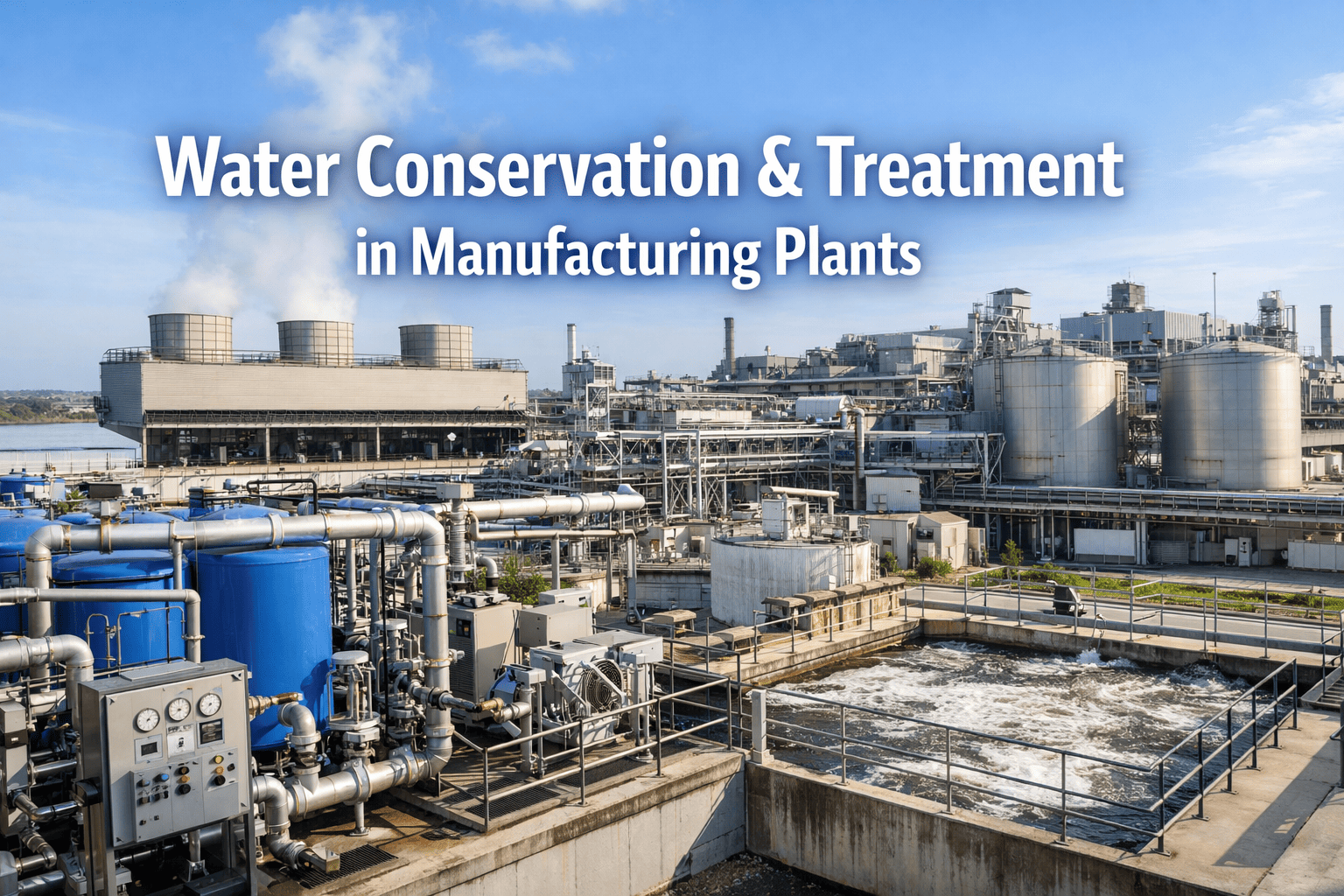
A single manufacturing plant can consume 500,000 to 2 million gallons of water per day — and up to 40% of that volume leaks, evaporates through uncontrolled cooling towers, or gets discharged as treatable wastewater that never returns to process. Oxmaint's CMMS platform helps manufacturers track water assets, schedule treatment maintenance, and monitor consumption patterns across every production line, cooling system, and wastewater unit in the plant — turning water from an invisible utility cost into a measurable, controllable operational input.
Where Manufacturing Plants Actually Lose Water
Before conservation strategies can work, teams need visibility into where water is actually consumed and lost. Most plants assume production lines are the biggest water users — the reality is far more distributed, with cooling systems and auxiliary processes often surpassing direct production consumption.
Water Loss Distribution in Typical Manufacturing Plant
Cooling Tower Evaporation & Blowdown
Largest single water loss category
Production Process Water
Direct use in product lines
Cleaning & Sanitation (CIP)
Clean-in-place cycles
Boiler Feedwater & Steam Loss
Blowdown and condensate loss
Undetected Leaks & Line Losses
Hidden cost — fully recoverable
Utility & Facility Use
Restrooms, landscaping, misc.
The Four Pillars of Industrial Water Management
Pillar 01
Measure
Install flow meters at every major consumption point — production lines, cooling towers, boilers, cleaning stations. Without sub-metering, plant-level water bills tell you nothing about where savings are possible.
Typical ROI: 3–6 months on meter installation
Pillar 02
Reduce
Fix leaks within 48 hours of detection. Adjust cooling tower cycles of concentration. Optimize CIP water volumes to the minimum validated by food safety standards. Install spray nozzle upgrades and low-flow fixtures where applicable.
Savings potential: 15–25% of baseline
Pillar 03
Recycle
Treat and reuse rinse water, condensate, and blowdown within the plant. Cascade water from cleaner processes to dirtier ones before final discharge. Reverse osmosis reject streams often have further process value.
Savings potential: 20–40% of freshwater intake
Pillar 04
Treat
Maintain wastewater treatment equipment on rigorous preventive schedules. Clarifiers, DAF units, biological reactors, and filtration systems fail silently and cause permit violations that cost far more than the maintenance itself.
Risk avoided: $10K–$250K per violation event
Water Conservation Technologies — What Actually Works in Plants
Proven Water Reduction Technologies by Application
Scroll to view full comparison
Water is a Managed Asset — Not a Background Cost
Start Tracking Every Gallon with a Purpose-Built CMMS
Oxmaint gives plant teams asset-level visibility into cooling towers, wastewater systems, RO trains, and every flow meter in the facility — so conservation isn't a one-time project, it's a daily operational discipline.
The Water-Maintenance Connection — Why CMMS Matters
Most water losses in manufacturing are actually maintenance failures in disguise. A leaking valve, a scaled heat exchanger forcing higher cooling tower blowdown, a failed clarifier skimmer, a stuck float valve in a reservoir — each of these is a maintenance problem that shows up as a water problem on the utility bill. When maintenance and water conservation are managed in separate systems, the connection is invisible.
01
Cooling Tower Efficiency
Scaled heat exchanger surfaces force higher approach temperatures, which force higher cooling flow, which increases evaporation and blowdown. A clean system uses 10–15% less makeup water than a neglected one.
02
Steam Trap Integrity
Failed steam traps discharge condensate that should return to the boiler. A single failed trap can waste 50,000+ gallons of pre-treated, pre-heated water per year — recoverable with a quarterly inspection program.
03
CIP System Calibration
Clean-in-place cycles validated once and never re-audited tend to drift toward longer, wetter cycles "to be safe." Scheduled calibration work orders reclaim 10–20% of CIP water without compromising validation.
04
Wastewater Plant Uptime
When on-site treatment fails, plants either halt production or discharge non-compliant effluent. Preventive maintenance on aerators, blowers, and clarifier drives keeps the reuse loop closed and permits intact.
05
Leak Response Time
A 1/8-inch pipe leak at 60 psi wastes 29,000 gallons per month. CMMS-driven leak work orders with priority routing cut response from days to hours — the single highest-ROI water conservation discipline.
06
Meter Calibration Discipline
Uncalibrated flow meters drift 5–15% per year, silently corrupting every water report and conservation goal. Annual calibration work orders preserve the data integrity behind every reduction claim.
Building a Water Conservation Program — 90-Day Roadmap
Days 1–15
Audit & Baseline
Walk the plant. Inventory every water-using asset. Identify every meter, every discharge point, every treatment unit. Pull 12 months of utility bills. Establish baseline gallons-per-unit-of-production.
Days 16–35
Quick Wins
Fix every visible leak. Repair failed steam traps. Tighten cooling tower cycles with chemistry validation. Most plants capture 8–12% savings in this phase without capital spend.
Days 36–60
Instrument & Monitor
Install sub-meters on the top five consumption points. Set up dashboards that track daily water use per production line. Schedule preventive maintenance on every treatment asset in the CMMS.
Days 61–90
Capital Planning
With data in hand, build the business case for reuse projects — RO recovery, CIP recycling, cascade reuse. Rank by payback period. Present to leadership with firm numbers, not estimates.
Financial Impact — What Conservation Actually Returns
Real Savings from Systematic Water Management
$0.03–$0.12
Cost per gallon when true wastewater treatment and discharge fees are included
18–28%
Average freshwater intake reduction achieved within 24 months of structured program launch
$180K–$600K
Annual savings typical for a mid-size plant with 1M gallon/day consumption baseline
3.2 yrs
Median payback on integrated water management capital investments in US manufacturing
Frequently Asked Questions
Water Management for Manufacturing Operations
Every Drop Tracked. Every Treatment Asset Maintained. Every Savings Verified.
Oxmaint turns water conservation from an annual sustainability report item into a daily operational practice — with asset histories, preventive schedules, and consumption dashboards that keep your program on track quarter after quarter.